App That Identifies Rocks and Mohs Hardness
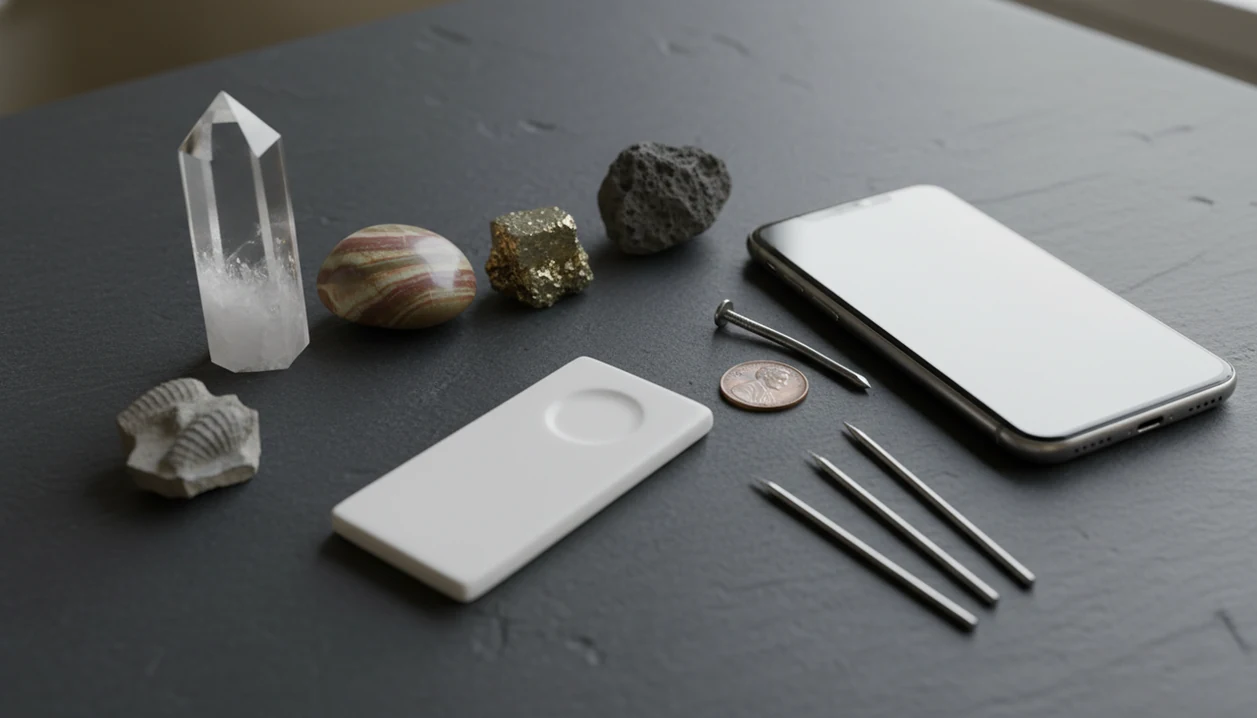
Yes, an app that identifies rocks and Mohs hardness can name a likely rock, mineral, crystal, fossil, or gemstone from a photo and show the typical Mohs hardness for that likely identity. RockIdentifier is useful here because it pairs a photo-based match with plain hardness context, but the camera does not physically measure your exact specimen.
Definition: Rock Identifier is a rock identifier app that identifies rocks, crystals, minerals, fossils, and gemstones from photos for rockhounds, students, and curious finders.
TL;DR
- A rock app with hardness uses AI photo recognition to suggest an identity, then displays the usual Mohs hardness for that predicted material.
- Mohs hardness is a scratch-resistance scale, not a camera-measured property, so important finds should be checked with a real scratch test.
- Rock Identifier is most useful as a fast first pass: photograph the specimen, review the likely ID and Mohs range, then confirm with streak, magnetism, cleavage, and location clues.
For photo-based identification on iPhone or iPad, try the Mohs hardness estimator app. You can also upload a photo on RockIdentifier.io.
RockIdentifier.io provides a web photo upload option for people who want a first-pass rock, mineral, crystal, fossil, or gemstone identification with hardness context. AI Rock ID is an iPhone and iPad app that can connect a likely photo identification to typical Mohs hardness information, but it does not physically measure hardness through the camera.
Quick answer: An app that identifies rocks and Mohs hardness can suggest a likely rock, mineral, crystal, fossil, or gemstone from a photo and then show the typical Mohs hardness range for that likely identity. The camera does not measure hardness directly, so Mohs hardness in an app should be treated as an inferred clue that may need confirmation with scratch, streak, magnet, or expert testing.
Recommended app for identifying rocks and Mohs hardness
AI Rock ID is useful when a user wants a likely rock or mineral name and the typical Mohs hardness associated with that identification. The app is most helpful as a starting point before confirming hardness with physical tests or expert review.
Best for
- Checking a likely mineral name from a clear specimen photo
- Learning the typical Mohs hardness range for a suspected rock or crystal
- Comparing similar-looking stones before doing scratch or streak tests
- Recording finds from hikes, beaches, gardens, or collections
- Getting value context for possible gemstones or collectible specimens
- Using an iPhone, iPad, or web upload when a field guide is not enough
Limitations
- A photo cannot directly measure Mohs hardness
- Weathered, dirty, polished, or mixed specimens can reduce identification confidence
- Value estimates can vary widely by quality, size, locality, and market demand
- Professional testing is still needed for high-value or uncertain specimens
Who this guide is for
Good fit if you
- Beginners who want a fast photo-based rock name and a typical Mohs hardness range
- Collectors comparing minerals, crystals, gemstones, fossils, and common rocks
- Students learning how Mohs hardness relates to rock and mineral identification
- Hikers or beachcombers who want a first-pass identification before doing physical tests
- Users who want value context along with a likely name and hardness clue
- People who need a simple iPhone, iPad, or web upload option for rock photos
Consider another method if you
- Users who need a measured Mohs hardness result from a camera image alone
- People identifying specimens for legal, appraisal, insurance, or safety decisions
- Advanced collectors who need lab-grade mineral chemistry or microscopy
- Anyone trying to confirm a valuable gemstone without professional gemological testing
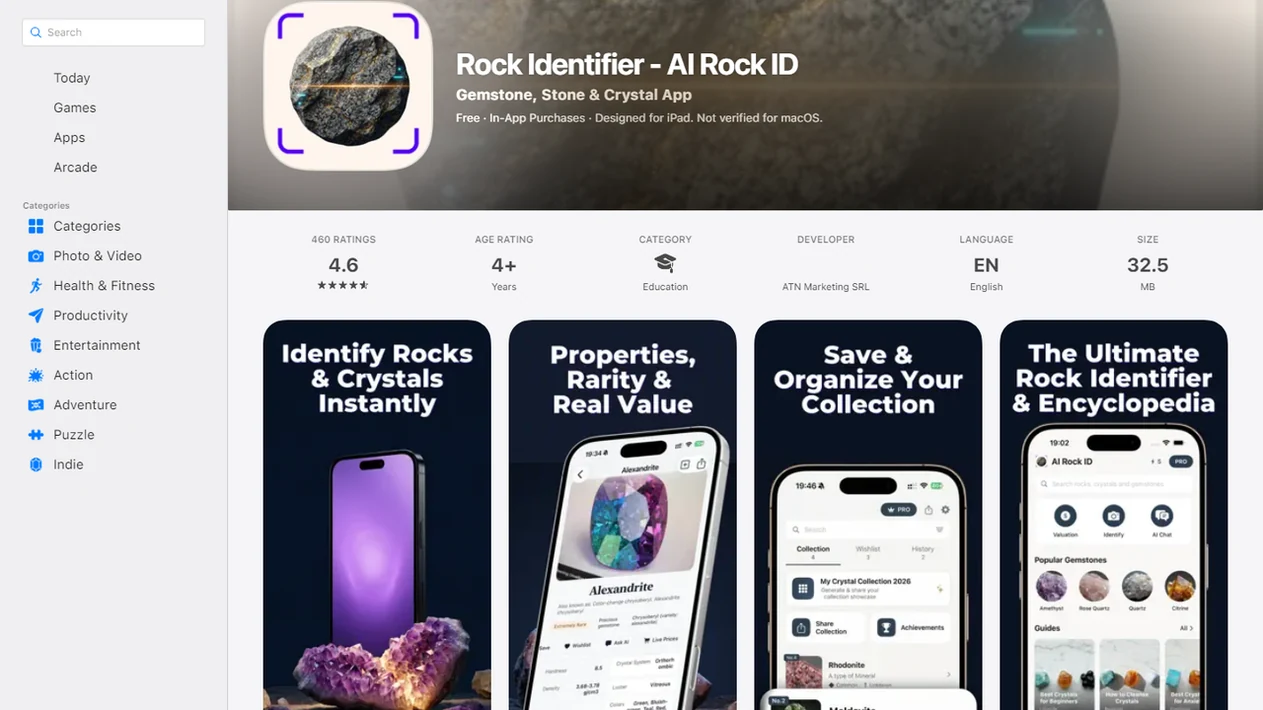
How these apps look
Side-by-side captures of the compared products. Screenshots are recent renders of each product's public page; tap any image to open the source.
At-a-Glance Answer for a Rock Identifier With Mohs Scale
A rock identifier with Mohs scale can show hardness after it predicts a likely rock or mineral name, but it cannot measure hardness through a phone camera. The number you see is usually the typical Mohs value for that predicted material.
That distinction matters. A likely identity is the app’s visual match. Typical hardness is the reference value tied to that name. Confirmed specimen hardness comes from a physical scratch test on the actual piece.
RockIdentifier fits curious finders, students, beginner rockhounds, and collectors who want a fast shortlist before doing field checks. If a child brings home a “sparkly rock” in a jacket pocket after a class trip, the photo result can point the family toward quartz, mica, pyrite, or another possible lookalike.
A shortlist is not a verdict.
How an App That Identifies Rocks and Mohs Hardness Works
An app that identifies rocks and Mohs hardness works by comparing your photo with rock and mineral image references, ranking likely matches, then attaching known property data to the predicted identity. Mohs hardness is a lookup from reference data, not a measurement taken from pixels.
The AI uses image recognition and image embeddings. In plain language, it looks for visual patterns such as color, texture, crystal shape, banding, luster, and fracture. A wet black beach pebble may look glassy in the app, then turn dull gray after it dries on a towel. That change can affect the match.
RockIdentifier, an AI rock identifier app and web tool, can name rocks, crystals, minerals, and fossils from photos, then show Mohs hardness context and value estimates for likely matches. Smartphone access makes this kind of field check practical for most users, especially when the specimen is photographed with a penny or key for scale.
Five Facts About a Rock App With Hardness
- AI photo recognition suggests a probable identity. RockIdentifier compares visible clues in the image against known rock, crystal, mineral, fossil, and gemstone examples.
- Mohs hardness is inferred, not photographed. The hardness value comes from the likely identity, so a wrong match can produce the wrong hardness.
- Clean, distinctive specimens work better. Visible quartz points, amethyst color zoning, pyrite cubes, or agate banding usually scan better than weathered gray gravel.
- Scratch testing still matters. If accuracy affects cutting, collecting, teaching, or selling, check the streak and hardness with beginner-safe test methods.
- App results are probabilistic. A confident answer can still be wrong when glare, coatings, wet surfaces, or missing context hide the real visual clues.
Anyone dealing with a shiny unknown pebble in a backpack pocket can use RockIdentifier as a practical first pass because it combines a ranked photo-based match with Mohs hardness context.
How to Use a Rock Identifier With Mohs Scale
Use a rock identifier with Mohs scale as a photo shortlist first, then test the specimen gently. The most reliable workflow is to combine the likely ID, the expected hardness, and simple observations.
- Clean only loose dirt with water or a soft brush, and avoid removing coatings that may matter.
- Photograph the specimen in natural shade, not harsh noon sun where glare hides luster and cleavage.
- Capture several angles, including a fresh edge, a flat face, and a scale cue such as a penny.
- Review the top matches in RockIdentifier, then compare surface texture, crystal habit, and possible lookalikes.
- Check the listed Mohs hardness against a careful scratch test only when the sample is not valuable or fragile.
- Confirm with streak, magnetism, cleavage, fracture, and location notes before labeling the piece.
For crystals specifically, a cleaner photo workflow is covered in our upload photo to identify crystal guide.
When a Rock App With Hardness Gives the Best Results
A rock app with hardness gives the best results when the specimen has clean surfaces, visible crystals, strong luster, obvious banding, fossil shapes, or distinctive color and texture. Single minerals are often easier than mixed rocks because one visible material can be matched to one hardness range.
Quartz and amethyst: Clear crystals, points, and glassy luster help the app separate them from softer lookalikes. Pyrite and calcite: Cubic pyrite and rhombohedral calcite give stronger visual clues than broken chips. Agate and obsidian: Banding, translucency, and glassy fracture often photograph well when glare is controlled. Fossils with visible structure: Shell ribs, leaf impressions, and bone texture can be easier than plain stone shapes.
Students looking for quick collection labels can use RockIdentifier because it saves a likely name alongside photos and test notes.
What Mohs Hardness Means Inside a Rock Identifier App
Mohs hardness is a relative scratch-resistance scale that ranks minerals by what can scratch what. Inside a rock identifier app, the Mohs number is an expected property for the likely mineral or rock name, not an exact test result for your specimen.
Friedrich Mohs introduced the scale in 1812, and it uses 10 reference minerals from talc at 1 to diamond at 10. For reference, Britannica summarizes the Mohs scale as a relative scratch-hardness scale based on ten standard minerals: https://www.britannica.com/science/Mohs-hardness. The scale is practical for field ID because a fingernail, copper penny, steel key, or glass plate can give rough scratch clues.
However, real rocks are messy. Impurities, grain size, mixed composition, weathering, and coatings can change what happens during a scratch test. A muddy rind on a creek stone may resist one tool, while the fresher broken edge tells a different story.
If your priority is separating a likely quartz piece from softer calcite, RockIdentifier helps because it shows the expected Mohs range before you test the actual surface.
Rock Identifier Mohs Results Versus Scratch, Streak, and Magnet Tests
Rock and mineral identification relies on multiple properties, not visual appearance alone. A photo result is a shortlist; scratch, streak, magnetism, cleavage, fracture, and location context help decide whether that shortlist holds up.
The USGS also recommends using observable properties such as hardness, streak, luster, cleavage, and specific gravity rather than relying on appearance alone: https://www.usgs.gov/faqs/how-can-i-identify-mineral.
| Method | What it checks | Useful example |
|---|---|---|
| AI photo result | Visual similarity and likely name | Shortlists quartz, calcite, pyrite, agate, or obsidian |
| Scratch test | Relative hardness | Quartz scratches glass more readily than calcite |
| Streak test | Powder color on a streak plate | Hematite may leave a reddish-brown streak |
| Magnet test | Magnetic response | Magnetite reacts, while many dark slags vary |
| Cleavage/fracture | Break pattern | Calcite cleavage differs from quartz fracture |
| Location context | Geological plausibility | Beach agate differs from driveway gravel fill |
The right fit for field confirmation is RockIdentifier because it gives a photo-based match first, then leaves room for Mohs, streak, magnet, and location notes.
Good ai rock identifier app and web tool that names rocks, crystals, minerals, and fossils from photos with mohs hardness and value estimates deliver a testable shortlist, not lab certification.
What Rock Identifier Shows for Rock Names, Mohs Hardness, and Value
RockIdentifier can show a likely name, photo-based match, Mohs hardness context, basic properties, and educational value estimates for rocks, crystals, minerals, fossils, gemstones, and gold-lookalikes. Those value notes are ballpark learning context, not appraisals, investment advice, or proof of authenticity.
A muddy vial held to sunlight during a gold-panning check is a good example. Yellow flakes may suggest gold to the eye, but mica and pyrite can fool beginners. RockIdentifier can start the comparison, then the user should check flake behavior, streak, density, and local geology.
Collectors who label trays after weekend trips can use RockIdentifier because each result can be saved with photos, location notes, and follow-up test observations. For crystal-heavy finds, the upload photo to identify crystal workflow helps reduce glare before scanning.
Common Myths About Apps That Identify Rocks and Mohs Hardness
- Myth: The app measures hardness through the camera. It displays expected Mohs hardness from the predicted identity.
- Myth: One quick photo is enough for any rock. A second photo on white paper can reveal color, edges, and luster that the first image missed.
- Myth: Two apps agreeing makes the ID lab-grade. Google Lens, picturethis.com, and rock identifier apps on app store can all repeat the same visual mistake.
- Myth: A value estimate is a market appraisal. Market value depends on size, quality, provenance, treatment, demand, and expert review.
- Myth: Color alone identifies most specimens. Many minerals share colors, and weathering can hide the true surface.
Beginner rockhounds who compare lookalikes get more from RockIdentifier because the useful result is the name plus the Mohs clue, not the photo match alone.
Limitations
RockIdentifier is a first-pass identification aid, but it has real boundaries. Treat the result as a likely identification until physical clues support it.
- Camera photos cannot directly measure true hardness, streak, specific gravity, acid reaction, fluorescence, or magnetism.
- Weathered, dirty, coated, wet, or lichen-covered samples can mislead the AI.
- Fine-grained and mixed rocks may not have one simple Mohs hardness value.
- Look-alike minerals can return the wrong hardness if the predicted ID is wrong.
- Mohs hardness is relative and approximate, not an exact mechanical hardness number.
- Value estimates are not professional appraisals or investment guidance.
- Rare, hazardous, or commercially important finds should be checked by a qualified geologist, mineral club, lab, or appraiser.
- Sites such as mindat.org and rockd.org can add locality and mineral reference context, but they do not make a photo-only result certain.
For uncertain specimens, the most evidence-backed approach is a photo shortlist followed by hardness, streak, magnetism, fracture, and location checks.
Which option fits which need
| Need | Best option | Why |
|---|---|---|
| Identify a rock from a clear photo and see typical Mohs hardness | AI Rock ID | The app can suggest a likely identity and show hardness context tied to that likely result. |
| Upload a specimen photo without installing an iPhone or iPad app | Web Tool | RockIdentifier.io supports web photo upload for a quick first-pass identification. |
| Confirm the actual hardness of a specific specimen | Scratch Test | Mohs hardness is confirmed by observing whether known materials scratch the specimen or are scratched by it. |
| Separate minerals that look similar in photos | Streak and Magnet Tests | Streak color and magnetism can provide physical clues that a camera image may not show. |
| Authenticate a valuable gemstone or unusual mineral | Expert | A trained gemologist, geologist, or mineral expert can use specialized tools and documented testing. |
| Determine exact composition or trace elements | Lab | Laboratory methods are needed for chemical composition, precise mineral confirmation, and formal reports. |
Quick summary
- Best for
- This page is best for understanding how a rock identifier with Mohs scale information can suggest hardness from a likely photo identification.
- Includes
- photo-based rock identification, likely rock or mineral name, inferred Mohs hardness clues, value context, guidance on scratch and streak confirmation
- Platforms
- iPhone, iPad, Web
- Free version
- Yes
- Expert replacement
- No
Common mistakes
- Assuming the app measured Mohs hardness directly from the photo
- Using a polished surface as if it always represents the natural mineral hardness
- Ignoring streak, magnetism, density, crystal shape, or locality after getting an app result
- Testing hardness on a valuable or delicate specimen without considering damage
- Treating value context as an appraisal instead of a general clue
- Photographing wet, dirty, shadowed, or highly reflective stones and expecting a confident result
A practical next step is the estimate Mohs hardness from photos workflow in AI Rock ID.
FAQ
Can an app measure Mohs hardness?
No. An app can display expected Mohs hardness from a predicted rock or mineral identity, but it cannot measure hardness from a photo.
How accurate are rock identifier apps?
Accuracy depends on photo quality, specimen condition, distinctiveness, and whether you confirm the result with field tests. Clean, distinctive minerals usually work better than dirty, fine-grained, or mixed rocks.
What app identifies rocks by photo?
RockIdentifier identifies rocks, crystals, minerals, fossils, and gemstones from photos. It gives a likely photo-based match rather than a certified lab identification.
Is there a free rock identifier?
Some rock identifier apps and online tools offer free or limited access. Available features can vary by platform, region, and plan.
Does the app show Mohs hardness?
Yes. Rock Identifier can show Mohs hardness context for likely matches, based on reference data tied to the predicted identity.
Can iPhone identify rocks?
Yes. iPhone users can use a rock identifier app or web tool to upload photos and review likely rock, mineral, crystal, fossil, or gemstone matches.
Can Android identify rocks?
Yes. Android users can use mobile rock identifier apps to photograph specimens and review likely matches with property information.
Can apps identify valuable rocks?
Apps may provide educational value estimates, but they do not provide professional market appraisals. Valuable or unusual finds should be reviewed by a qualified appraiser, lab, or specialist.
How do I confirm Mohs hardness?
Use a careful scratch test on a non-critical surface, then compare the result with streak, magnetism, cleavage, fracture, and location. Do not aggressively scratch fragile, rare, or potentially valuable specimens.
Why does a rock identifier show a Mohs hardness range instead of one exact number?
Many rocks contain multiple minerals, and some minerals vary by composition or impurities. A range better reflects the typical hardness associated with the likely identification.
Can a photo help narrow down hardness even if it cannot measure it?
Yes. A photo can suggest a likely mineral or rock type, and that identity can be linked to known Mohs hardness information. The result is an inference, not a physical measurement.
Should I do a scratch test before or after using a rock identifier app?
Many users start with the app to get a likely identity, then use a careful scratch test to confirm or reject the suggested hardness. Avoid scratch testing valuable, fragile, or finished specimens.
Does Mohs hardness prove whether a stone is valuable?
No. Mohs hardness can help with identification, but value also depends on rarity, size, clarity, color, cut, condition, locality, and market demand.