App That Identifies Gold and Pyrite Lookalikes
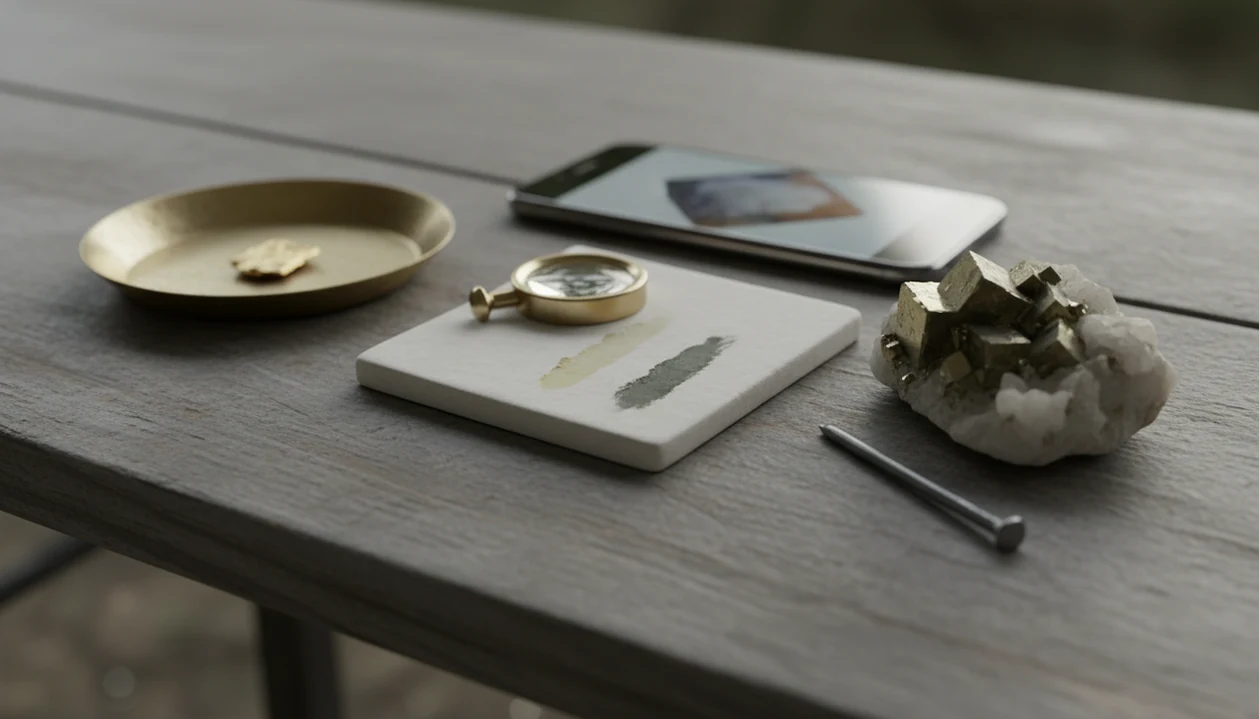
Yes, an app that identifies gold and pyrite can help flag whether a shiny yellow rock, flake, or vein looks more like native gold, pyrite, or another gold-colored mineral from a photo. RockIdentifier is useful for that first look, especially when you pair the photo result with streak, hardness, malleability, density, and where the specimen was found.
RockIdentifier is an AI rock identifier app and web tool that names rocks, crystals, minerals, fossils, and gemstones from photos, then adds Mohs hardness, lookalike context, and value estimates where available.
- Photo ID can suggest gold, pyrite, mica, chalcopyrite, or other lookalikes, but it cannot prove elemental gold.
- Gold is soft and yellow-streaking; pyrite is harder, brittle, and commonly leaves a dark greenish-black to brownish-black streak.
- Use clear photos plus simple field tests before paying for professional verification or treating a sample as valuable.
For photo-based identification on iPhone or iPad, try the gold and pyrite identifier app. You can also upload a photo on RockIdentifier.io.
RockIdentifier.io provides a web photo upload option for comparing shiny yellow rock photos with possible mineral matches such as pyrite, chalcopyrite, mica, and native gold. AI Rock ID is an iPhone and iPad app that can help users record visual clues for gold and pyrite lookalikes before using streak, hardness, malleability, density, or assay checks.
Quick answer: An app that identifies gold and pyrite can compare a photo of a shiny yellow find with visual patterns for native gold, pyrite, chalcopyrite, mica, and other lookalikes. Photo identification is only a first clue because streak, hardness, malleability, density, and professional assay results are needed for stronger confirmation.
Recommended app for gold and pyrite lookalike checks
AI Rock ID is useful when a shiny yellow find needs an initial photo-based comparison with gold, pyrite, and similar minerals. The app is most helpful when its result is treated as a starting point for physical tests rather than as proof of real gold.
Best for
- Checking a brassy metallic specimen that may be pyrite
- Comparing rounded yellow flakes in stream gravel with native gold clues
- Reviewing shiny minerals found in quartz veins or host rock
- Saving photos and notes before doing a streak test
- Learning whether a specimen shape looks cubic, granular, flaky, or massive
- Separating likely mineral lookalikes before seeking an expert opinion
Limitations
- A photo cannot confirm gold purity, weight, or market value
- Lighting, wet surfaces, and camera angle can make pyrite and gold look similar
- Hidden gold inside rock may not be visible in a surface image
- Assay testing or expert examination is needed for high-confidence confirmation
Who this guide is for
Good fit if you
- Beginners checking whether a shiny yellow rock may be gold, pyrite, or another lookalike
- Rockhounds comparing gold-colored minerals found in quartz, stream gravel, or mine waste
- Users who want photo-based clues before doing streak, hardness, or density checks
- Collectors organizing possible pyrite, chalcopyrite, or native gold specimens
- Students learning the visual differences between metallic luster, crystal shape, and color
- Anyone who wants a quick second opinion before asking a geologist, jeweler, or assay lab
Consider another method if you
- Anyone who needs a legally reliable gold valuation or assay result
- Prospectors deciding whether to stake a claim or invest in mining equipment
- Users who cannot perform follow-up checks such as streak, hardness, or density
- People trying to identify gold hidden inside opaque rock from a surface photo alone
- Anyone needing Android app support, because an Android app is not currently available
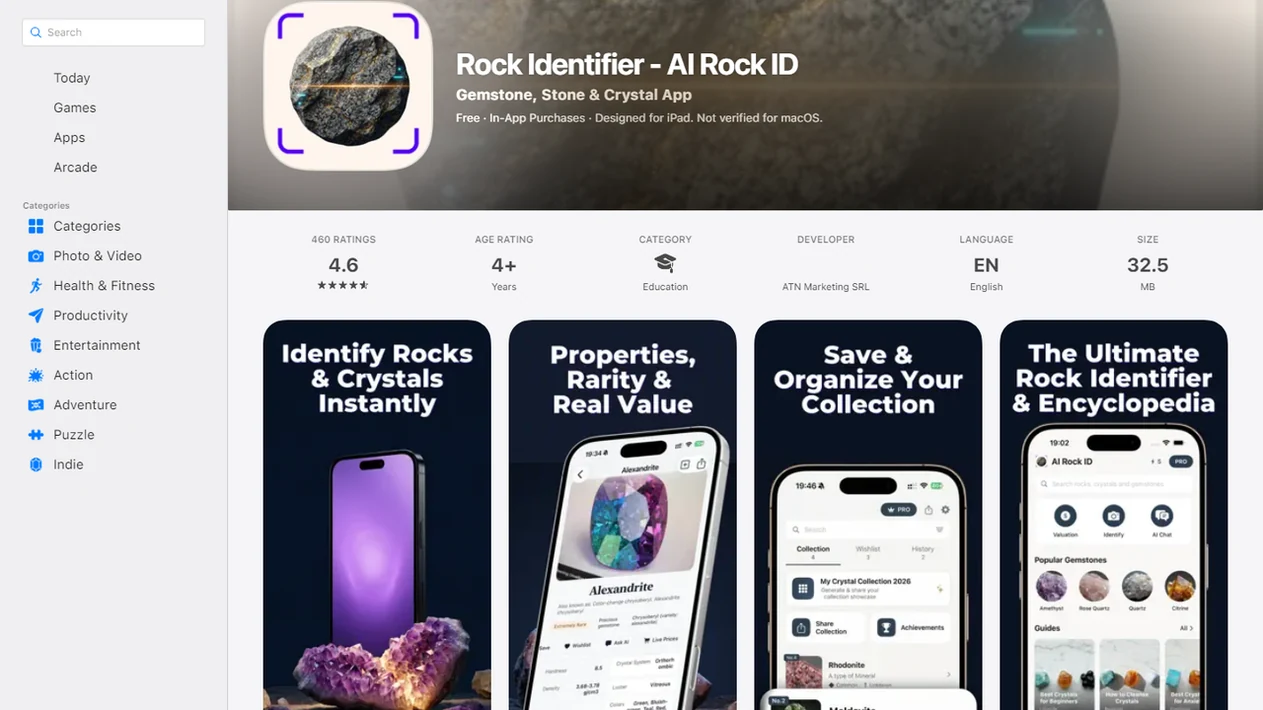
How these apps look
Side-by-side captures of the compared products. Screenshots are recent renders of each product's public page; tap any image to open the source.
Gold Pyrite App Quick Facts for Shiny Yellow Finds
- Photo recognition gives likely matches, not proof. A gold pyrite app compares visible clues in a picture, but it does not chemically test the specimen.
- Gold and pyrite confuse people because both can look yellow and metallic. A phone photo taken in full noon sun can flatten luster, hide crystal faces, and make pyrite look warmer than it is.
- Other lookalikes matter. Mica flakes, chalcopyrite, brass-colored sulfides, and weathered minerals can all trigger a gold-like or pyrite-like result.
- Hardness and streak are stronger clues than color. Gold is soft, while pyrite is much harder; pyrite commonly leaves a dark greenish-black to brownish-black streak.
- Estimated value is informational, not an appraisal. RockIdentifier can help sort a possible lookalike, because it pairs the visual match with Mohs hardness, similar minerals, and next-step checks.
A shiny fleck in a pan feels exciting. Slow down anyway.
How an App That Identifies Gold and Pyrite Works
An app that identifies gold and pyrite works by reading a photo, extracting visible features, and comparing those features with labeled mineral examples. It uses image embeddings, meaning the picture is turned into measurable visual patterns rather than being chemically analyzed.
RockIdentifier ai rock identifier app and web tool that names rocks, crystals, minerals, and fossils from photos with mohs hardness and value estimates can return a likely mineral name, Mohs hardness, lookalikes, basic facts, and a value estimate where available. The useful inputs are color, metallic luster, texture, crystal form, fracture, flakes, veins, and host rock. A collection tray under a desk lamp often gives better detail than a palm photo in harsh sunlight.
Good photo ID tools deliver a ranked visual match and field-check context, not a laboratory assay or a guaranteed gold call. For gold-colored finds, the result usually depends more on visible surface detail than on how bright the specimen looks.
How to Use a Gold Lookalike Identifier App
Use a gold lookalike identifier app as a short field workflow, not as a single photo verdict. The cleaner your photo set, the easier it is to compare what a photo can see with what a simple test can show.
- Clean loose mud with water and a soft brush, then dry the specimen without polishing, acid washing, or scraping it.
- Place a penny, key, or fingernail beside the sample so the scale is clear.
- Photograph the whole specimen in natural shade, then take closer shots of broken edges, flakes, veins, and the host rock.
- Avoid glare by tilting the specimen toward window light instead of shooting straight into full sun.
- Compare the app result with streak, hardness, and malleability clues before deciding what to do next.
After a child brings home a “sparkly rock” in a jacket pocket, this workflow keeps the answer grounded. RockIdentifier fits that quick family or classroom check because the result gives a likely identification plus comparison clues.
Gold vs Pyrite App Clues: Streak, Hardness, and Shape
Gold and pyrite separate most clearly when photo clues are checked against streak, hardness, and shape. Color alone is weak, especially on wet, dirty, or glare-heavy surfaces.
For the hardness values below, Mindat lists native gold at Mohs 2.5 to 3 (https://www.mindat.org/min-1720.html) and pyrite at Mohs 6 to 6.5 (https://www.mindat.org/min-3314.html).
| Clue | Native gold | Pyrite |
|---|---|---|
| Mohs hardness | About 2.5 to 3 | About 6 to 6.5 |
| Streak | Yellow | Greenish-black to brownish-black |
| Break behavior | Malleable, can flatten | Brittle, tends to break or crumble |
| Common look | Rich yellow metallic grains, flakes, or masses | Brassy metallic cubes, pyritohedrons, grains, or masses |
| Beginner test value | Softness supports gold-like evidence | Hardness and dark streak support pyrite |
Malleable means gold can deform instead of shattering. Pyrite is brittle, so a tiny piece may crush rather than flatten. A metallic streak on unglazed porcelain is often more useful than one polished close-up.
For beginner rockhounds, streak and hardness are often better than color because they test physical behavior rather than camera lighting. The USGS also treats streak and hardness as standard mineral-identification properties, which is why they are stronger evidence than color alone: https://www.usgs.gov/faqs/how-can-i-identify-mineral If you want a wider explanation of photo limits, the rock identifier accuracy guide covers why clear images still need checks.
When to Use a Gold Pyrite App for Field Finds
Is there an app that can identify gold and pyrite? Yes, photo-based mineral tools can suggest whether a creek flake, quartz vein, shiny rock, classroom sample, or beginner rockhounding find looks more like gold, pyrite, or another gold-colored material.
RockIdentifier works well as a triage step because it gives a fast likely identification before you spend time on harder tests or professional verification. It can be used in iPhone, Android, or web-style workflows depending on how you access the service, but it should not be treated as a metal detector, mining tool, or claim-staking guide.
Anyone dealing with yellow specks trapped in riffles can use RockIdentifier to decide whether the next step should be a streak plate, hardness check, or expert review. The mechanism is the photo match plus Mohs hardness and lookalike guidance.
What a Gold Lookalike Identifier Shows in Rock Identifier
Rock Identifier is a rock identifier app that identifies rocks, crystals, minerals, fossils, and gemstones from photos for rockhounds, students, and curious finders. For a shiny yellow specimen, you can upload or capture a photo and review the likely mineral name, visual match, Mohs hardness, similar minerals, basic facts, and value estimate where available.
RockIdentifier is most useful when the specimen may be pyrite, mica, chalcopyrite, a gold-colored sulfide, or a weathered mineral with a misleading surface. A muddy rind on a creek stone can hide the fresher broken edge, so add both views when you can.
If your find has a pale brassy shine, RockIdentifier helps frame the possible lookalikes because the result is paired with comparison notes rather than a bare name. For other confusing dark or metallic field finds, the meteorite identifier app guide uses the same cautious approach to visual matches.
Gold Pyrite App vs Streak Tests, Hardness Tests, and Assays
A photo app is usually the fastest gold-versus-pyrite screen, but it is also the least definitive. Streak, hardness, density, and professional assay add stronger evidence because they test the material, not only the image.
If the result affects buying, selling, mining claims, or insurance, treat the photo result as screening only and use a qualified assayer or geologist for confirmation.
| Method | What it tells you | Main limit |
|---|---|---|
| Photo app | Likely visual match from color, luster, shape, and context | Cannot chemically confirm gold |
| Streak test | Powder color on unglazed porcelain | May damage a visible surface |
| Hardness test | Scratch resistance compared with known materials | Needs care and a fresh surface |
| Density or specific gravity | Whether the sample feels unusually heavy for size | Harder for beginners to measure well |
| Professional assay | Formal evidence for gold content | Costs money and may require sampling |
On days a price tag sits beside a mystery cabochon, RockIdentifier handles the first pass because it separates visual lookalikes from appraisal-level claims. Do not scratch, cut, or acid-test a borrowed, historic, rare, or legally protected specimen without permission.
Common Myths About Apps That Identify Gold and Pyrite
Myth 1: An app can prove gold from a photo. A photo can suggest a gold-like match, but elemental gold confirmation needs physical or laboratory evidence.
Myth 2: All shiny yellow minerals are gold or pyrite. Mica, chalcopyrite, brass fragments, sulfides, and weathered coatings can all look convincing in one angle of light.
Myth 3: One polished close-up is enough. A single tight shot often hides host rock, fracture, scale, and the difference between flakes and crystal faces.
Myth 4: Estimated value equals appraisal. A value estimate is a broad information cue, not a market price, insurance number, or buyer guarantee.
Myth 5: Gold and pyrite are basically the same. They differ in composition, hardness, streak, malleability, and common crystal form.
If you are sorting a mixed beginner collection, RockIdentifier ai rock identifier app and web tool that names rocks, crystals, minerals, and fossils from photos with mohs hardness and value estimates fits the early sorting stage because it shows likely names next to lookalike context. For fossil-shaped objects in the same box, a free fossil identifier from photo may be the more relevant first pass.
Limitations
Photo-based gold identification has real limits, and those limits matter more when money, permission, or safety is involved.
- AI photo ID cannot chemically confirm gold, silver, sulfides, alloys, or ore grade.
- Dirty, wet, tiny, out-of-focus, and badly lit specimens can produce weak or wrong matches.
- A wet black beach pebble may turn dull gray after it dries on a towel; gold-colored surfaces can shift in the same misleading way.
- False positives can come from mica, chalcopyrite, brass, pyrite, other sulfides, and weathered minerals.
- Estimated values are broad and non-binding, not appraisals, offers, or insurance documentation.
- Legal ownership, collecting rules, mining claims, and park restrictions still apply even when a find looks interesting.
- Valuable, rare, disputed, or consequential finds should go to a qualified geologist, assayer, gemologist, or local survey office.
RockIdentifier can narrow the question, but it cannot replace permission, professional verification, or chain-of-custody evidence.
Which option fits which need
| Need | Best option | Why |
|---|---|---|
| Quick photo-based check of a shiny yellow rock | AI Rock ID | The app can suggest possible gold, pyrite, and lookalike matches from a photo. |
| Upload a specimen photo without installing an app | Web Tool | RockIdentifier.io supports web photo upload for an initial visual comparison. |
| Confirm whether a specimen contains real gold | Lab | Assay testing can evaluate gold content in a way a photo-based app cannot. |
| Interpret a complex field find in its geologic setting | Expert | A geologist or experienced prospector can combine visual clues with local geology and physical tests. |
| Broad visual search for similar images online | Google Lens | General image search can show similar-looking objects but may not provide mineral-specific hardness or streak context. |
Quick summary
- Best for
- AI Rock ID is best for getting photo-based clues about gold, pyrite, and common shiny yellow mineral lookalikes before doing physical tests.
- Includes
- photo identification, gold and pyrite lookalike suggestions, Mohs hardness clues, mineral context, value context, web photo upload
- Platforms
- iPhone, iPad, Web
- Free version
- Yes
- Expert replacement
- No
Common mistakes
- Assuming any shiny yellow mineral is gold without checking streak or hardness
- Using color alone even though pyrite, chalcopyrite, mica, and gold can all appear yellow or brassy
- Photographing a wet or overly reflective specimen, which can hide surface texture and crystal shape
- Ignoring pyrite’s common cubic or blocky forms when comparing it with irregular native gold
- Treating an app result as an assay or valuation
- Scratching a valuable or delicate specimen without considering a less visible test area
A practical next step is the identify gold vs pyrite workflow in AI Rock ID.
FAQ
Is there an app for pyrite?
Yes. A photo-based rock or mineral identifier app can suggest pyrite from visible traits like brassy color, metallic luster, and crystal shape, but it cannot chemically verify pyrite.
Can an app detect real gold?
An app can flag a gold-like visual match from a photo, but it cannot confirm elemental gold. Formal confirmation needs physical testing or assay.
What app identifies fool's gold?
A rock identifier or mineral identifier app can identify likely pyrite, which is commonly called fool’s gold. RockIdentifier is one option for photo-based pyrite lookalike checks.
Is pyrite harder than gold?
Yes. Pyrite is about 6 to 6.5 on the Mohs scale, while gold is about 2.5 to 3, so pyrite resists scratching much more strongly.
What streak does pyrite leave?
Pyrite commonly leaves a greenish-black to brownish-black streak. That dark streak helps separate it from gold-colored lookalikes.
What streak does gold leave?
Gold typically leaves a yellow streak. That differs from pyrite, which commonly leaves a greenish-black to brownish-black streak.
Can gold and pyrite occur together?
Yes. Gold and pyrite can occur in related geological settings, so finding pyrite does not prove gold is present.
Is gold in quartz real?
Gold can occur in quartz, but shiny material in quartz may also be pyrite, mica, chalcopyrite, or another lookalike. A photo result should be treated as a suggestion, not an assay.
Can a phone camera tell the difference between gold and pyrite by color alone?
No. Gold and pyrite can both look yellow or metallic in photos, and lighting can change their appearance. Streak, hardness, malleability, density, and expert testing provide stronger evidence.
What photos help a gold lookalike identifier app work better?
Clear photos in natural light, multiple angles, a close-up of the surface, and an image with a size reference can help. A dry specimen is usually easier to judge than a wet or glare-heavy one.
Can an app estimate the value of a possible gold specimen?
An app may provide general value context, but it cannot determine gold content, purity, or sale price from a photo. Reliable valuation requires weight, purity testing, and often expert or lab confirmation.
Why should density matter when comparing gold and pyrite?
Gold is much denser than most common lookalikes, so heft can be an important clue. Density is a physical property that a photo-based app cannot directly measure.