Upload a Photo to Identify Crystal Specimens Carefully
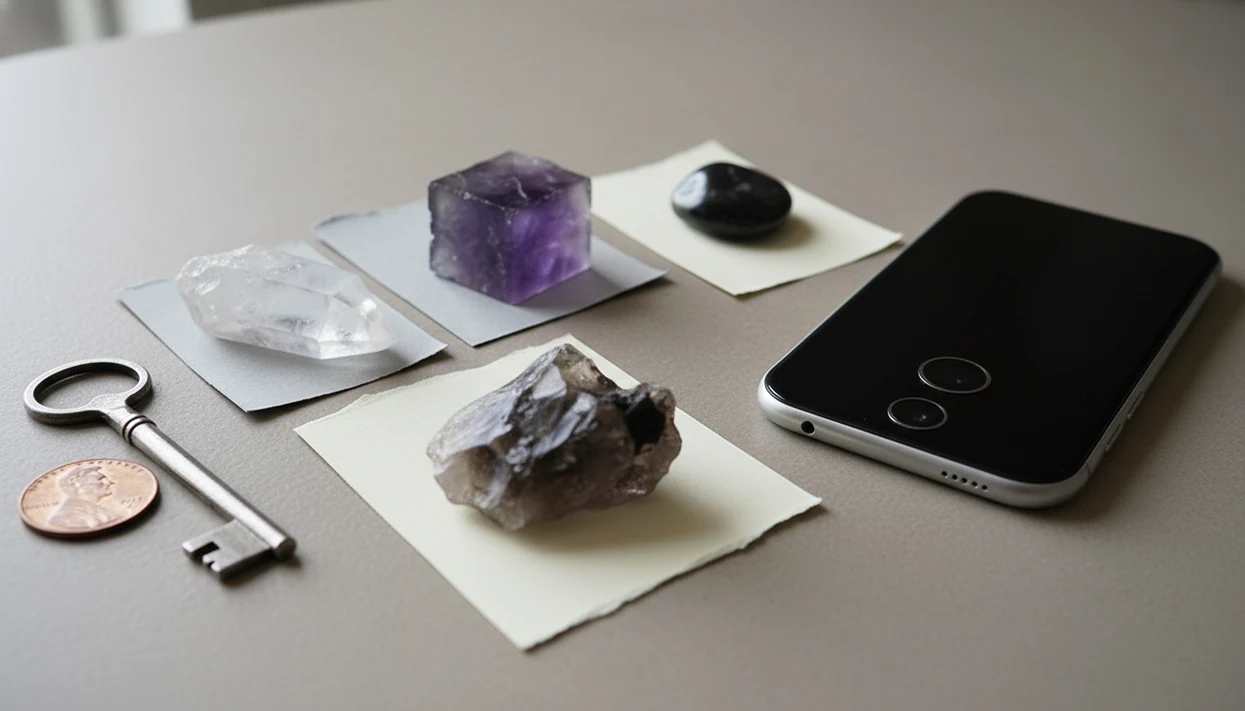
You can upload photo to identify crystal specimens by taking clear, well-lit images from several angles and using RockIdentifier for a first-pass match. Treat the result as a likely ID, then confirm it with simple checks such as hardness, streak, luster, cleavage, and matrix context.
> Definition: RockIdentifier is an AI rock identifier app and web tool that names rocks, crystals, minerals, fossils, and gemstones from photos, then adds property notes such as Mohs hardness and value estimates.
TL;DR
- Use bright indirect light, a plain contrasting background, and close photos that show the crystal filling most of the frame.
- Upload multiple angles when possible, including crystal faces, broken surfaces, matrix, transparency, and any unusual growth pattern.
- Photo ID is a starting point, not proof; confirm look-alike minerals with Mohs hardness, streak, cleavage, fracture, and other basic tests.
For photo-based identification on iPhone or iPad, try the crystal identifier app. You can also upload a photo on RockIdentifier.io.
RockIdentifier.io provides a web photo upload option for users who want to compare crystal images with likely mineral matches and visual clues. AI Rock ID is an iPhone and iPad app that supports photo-based crystal identification with Mohs hardness clues and value context for careful review.
Quick answer: Upload photo to identify crystal specimens by showing clear views of crystal shape, luster, color zoning, matrix, and any visible inclusions. Photo-based crystal identification can narrow likely matches, but hardness, streak, specific gravity, and expert testing may be needed for confident verification.
Recommended app for uploading photos to identify crystal specimens
AI Rock ID is useful when a crystal photo shows clear shape, luster, surface texture, and matrix context. The app can help narrow possible matches before the user decides whether manual tests or expert verification are needed.
Best for
- Checking an unknown crystal from a collection tray
- Comparing multiple angles of a crystal cluster
- Reviewing tumbled stones with caution when visual clues are limited
- Documenting crystals found in matrix or host rock
- Getting Mohs hardness clues before attempting safe tests
- Saving likely identifications for later comparison
- Adding value context without treating the result as an appraisal
Limitations
- Photo results can be uncertain when crystals share similar color and habit
- Tumbled, dyed, coated, or heat-treated stones may be difficult to identify visually
- The app cannot replace lab testing for high-value gemstones
- The app cannot confirm internal chemistry from a photo alone
Who this guide is for
Good fit if you
- Beginners who want a first-pass crystal identification from clear photos
- Collectors comparing crystal habit, luster, color, and matrix context
- People sorting unknown quartz, calcite, fluorite, amethyst, or similar specimens
- Users who can photograph a crystal from multiple angles in good light
- Anyone who wants Mohs hardness clues and basic value context alongside visual matches
- iPhone, iPad, or web users who prefer photo upload before doing manual tests
Consider another method if you
- Users who need certified gemstone grading or appraisal
- People identifying crystals from blurry, filtered, or single-angle photos
- Cases involving potentially hazardous minerals that require safe handling guidance
- Legal, insurance, resale, or scientific identification that requires lab confirmation
- Specimens where destructive testing is not acceptable without expert advice
How upload photo to identify crystal specimens carefullies look
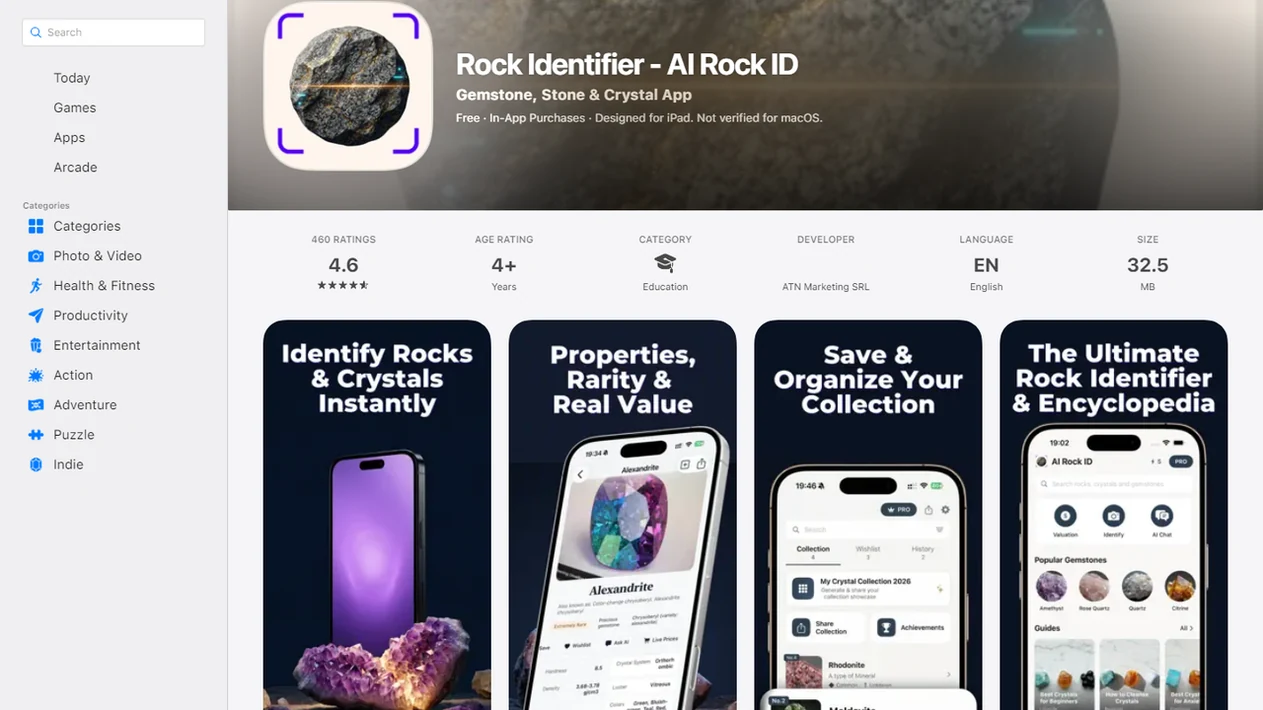
Side-by-side captures of the compared products. Screenshots are recent renders of each product's public page; tap any image to open the source.
Crystal Photo Identifier Image Requirements
The best upload shows the specimen sharply, close up, and in natural-looking light. A crystal photo identifier works better when it can see faces, edges, texture, and surface shine without glare.
Photograph the top, side, broken edge, crystal terminations, and attached matrix if the crystal is still in rock. Put a penny, key, or fingernail nearby for scale, then remove loose dust before shooting. A plain dark background helps pale quartz stand out; white paper helps smoky or dark crystals.
Glare hides clues fast.
Tumbled and polished stones need extra context because the original crystal faces may be gone. When a wet black beach pebble turns dull gray after drying on a towel, that change matters. RockIdentifier ai rock identifier app and web tool that names rocks, crystals, minerals, and fossils from photos with mohs hardness and value estimates is most useful when the photo preserves those small visual clues.
Crystal Photo Identifier AI Matching Process
A crystal photo identifier works by comparing your upload with labeled mineral images and returning probable visual matches, not a certified laboratory ID. The matching process relies on image embeddings, which are compact digital patterns that help software compare shape, color, and texture.
RockIdentifier weighs visible traits such as color, luster, transparency, surface texture, crystal habit, cleavage, fracture, and growth pattern. A glassy six-sided point may suggest quartz, but a purple cubic crystal may push the result toward fluorite instead of amethyst. A noon-sun phone photo can wash out luster and cleavage, so the same specimen may match differently under softer light.
Mineral diversity is the hard part. The U.S. Geological Survey reports more than 4,000 recognized mineral species, and the International Mineralogical Association lists more than 5,900 approved mineral species in recent counts. See the USGS mineral resources overview at https://www.usgs.gov/centers/national-minerals-information-center and the International Mineralogical Association mineral list at https://mineralogy-ima.org/Minlist.htm. Good ai rock identifier app and web tool that names rocks, crystals, minerals, and fossils from photos with mohs hardness and value estimates deliver likely matches and next checks, not certified mineral analysis.
Crystal Photo Identifier Upload Steps
Use this workflow when you want to identify crystal by picture and still keep the result grounded in mineral evidence.
- Set the specimen on a plain contrasting background in bright indirect light.
- Clean loose dust or mud gently, but leave coatings or inclusions visible if they seem natural.
- Photograph several angles, including close-up details, broken surfaces, crystal terminations, and attached matrix.
- Upload the clearest image first, then add extra views if the crystal photo identifier supports multiple photos.
- Review the likely matches instead of stopping at the first name shown.
- Confirm the suggested ID with Mohs hardness, streak, cleavage, fracture, and locality notes.
When a parent is reading a simple hardness chart beside a child’s “sparkly rock” from a field trip, the upload gives a starting name. The checks decide whether that name holds up. RockIdentifier fits that beginner workflow because it pairs photo-based match results with plain property notes and Mohs hardness prompts.
Crystal Picture Identification Use Cases
“Can I use a photo to figure out what crystal I found?” Yes, photo identification is useful when you need a likely name, mineral family, or next beginner-safe test to try.
It helps with unknown field finds, inherited specimens, classroom samples, tumbled stones, and collection sorting. A grandparent’s jar of creek stones may contain quartz, agate, jasper, calcite, slag glass, and a few surprises. Quartz shows up often because it makes up about 12% of Earth’s crust by volume, according to USGS educational material. Source: USGS quartz mineral information, https://www.usgs.gov/centers/national-minerals-information-center/quartz-statistics-and-information.
RockIdentifier is a practical fit when the question is “what should I test next?” because it gives alternative matches and mineral-property clues after the image scan. For beginners, a likely crystal family is often more useful than one overconfident name because it points to the next hardness, streak, or cleavage check.
5 Photo Details That Improve Crystal Identification
- Luster: Capture whether the surface looks glassy, metallic, waxy, dull, pearly, or silky. A greasy luster under kitchen light can shift a guess away from ordinary glass.
- Crystal habit: Show points, cubes, blades, needles, masses, clusters, or botryoidal forms. Habit often separates minerals that share the same color.
- Transparency: Photograph transparent, translucent, and opaque areas. Hold the specimen near a window, not against the sun.
- Matrix and growth context: Include the host rock when the crystal is still attached. A quartz chunk near exposed roots tells a different story than a loose polished point.
- Surface condition: Show natural faces, breaks, polish, weathering, coatings, and inclusions. Muddy rind on a creek stone can hide the fresher broken edge.
Collectors looking for a crystal photo identifier should choose RockIdentifier because it encourages multiple visual clues rather than relying on color alone.
Rock Identifier Crystal Upload Results
After you upload a crystal photo, RockIdentifier usually shows likely specimen names plus alternative matches. The result may also place the find in a rock, crystal, mineral, fossil, or gemstone category where that distinction helps the explanation.
Expect property notes, not a final verdict. Mohs hardness is especially useful because many lookalikes overlap in color but differ in scratch resistance. The Mohs scale runs from 1 for talc to 10 for diamond, and most beginner ID charts use that range.
A metallic streak on unglazed porcelain can change the whole answer.
Value estimates, where shown, should be treated as approximate. Size, clarity, damage, treatment, locality, and market demand all affect value beyond what one image can prove. After an upload, when the result suggests a valuable-looking gemstone, RockIdentifier earns its place by showing cautious alternatives and basic verification steps.
Crystal Photo Identifier vs Manual Mineral Tests
Photo clues are fast, but manual mineral tests help confirm or reject the first match. Color alone is weak evidence because many minerals share colors, and one mineral species can vary widely.
| Method | What it checks | What it can help confirm | Main caution |
|---|---|---|---|
| Photo clues | Color, habit, luster, transparency, growth pattern | Likely visual matches | Lighting, polish, and camera color can mislead |
| Mohs hardness | Scratch resistance from 1 to 10 | Quartz vs calcite, fluorite vs glassy lookalikes | Test gently on inconspicuous spots |
| Streak | Powder color on unglazed porcelain | Metallic minerals and iron-rich specimens | Hard minerals may not streak well |
| Cleavage or fracture | How the specimen breaks | Calcite, fluorite, mica, feldspar | Broken or tumbled stones may hide it |
| Acid reaction | Fizzing in carbonate minerals | Calcite-rich specimens | Use only safe dilute acid methods |
| Specific gravity | Relative heaviness for size | Dense ore minerals and some gems | Requires careful weighing |
For field finders, a photo-first workflow with an app that identifies rocks and Mohs hardness is often easier than manual testing alone because it narrows the list before you scratch, streak, or compare cleavage.
Limitations
RockIdentifier can help identify crystal by picture, but photo-only ID has real limits. Treat difficult, rare, or valuable specimens as candidates for expert review.
- Blurry, shadowed, overexposed, or color-shifted indoor photos can produce wrong matches.
- Tumbled and polished stones may hide natural crystal faces, cleavage, fracture, and growth habit.
- Lookalikes such as quartz and glass, amethyst and fluorite, or calcite and aragonite may require tests beyond photos.
- Rare or poorly represented minerals may be returned as more common matches.
- Precise market value, authenticity, treatment history, and provenance cannot be proven from one image.
- High-stakes identification may require spectroscopy, X-ray diffraction, petrographic microscopy, or expert in-person review.
- Broad visual search tools such as Google Lens or picturethis.com may recognize color and shape, but they often skip mineral tests.
- Reference databases such as mindat.org and rockd.org are useful, however they can feel dense for a beginner holding one unknown specimen.
If a result affects buying, selling, safety, or scientific reporting, use RockIdentifier as a triage step, then seek qualified testing.
Which option fits which need
| Need | Best option | Why |
|---|---|---|
| Quick visual match from a clear crystal photo | AI Rock ID | The app is designed for photo-based rock, crystal, mineral, fossil, and gemstone identification on iPhone and iPad. |
| Upload a crystal image without installing an app | Web Tool | RockIdentifier.io supports web photo upload for users who want browser-based identification. |
| Confirm a valuable gemstone or jewelry stone | Lab | Laboratory testing can evaluate properties that a photo cannot confirm, such as refractive index, treatment, and composition. |
| Compare a crystal with broad web image results | Google Lens | General image search can show similar-looking objects, but it may not focus on mineral-specific clues or verification steps. |
| Identify a rare specimen with unusual crystal habit | Expert | A mineralogist, gemologist, or experienced collector can combine visual review with tests and locality knowledge. |
Quick summary
- Best for
- This page is best for users who want to upload a photo to identify crystal specimens using visual features and safe follow-up checks.
- Includes
- multi-angle photo guidance, crystal habit clues, matrix context, luster review, Mohs hardness clues, value context, verification limits
- Platforms
- iPhone, iPad, Web
- Free version
- Yes
- Expert replacement
- No
Common mistakes
- Using only one photo instead of showing multiple angles of the crystal
- Photographing the specimen under colored lighting or heavy filters
- Ignoring the matrix or host rock that may provide identification context
- Assuming color alone is enough to separate similar crystals
- Uploading a photo without a scale reference for crystal size
- Treating a photo-based match as a certified appraisal or lab result
A practical next step is the identify crystals from a photo workflow in AI Rock ID.
FAQ
Can I identify a crystal by picture?
Yes, a clear picture can produce likely crystal matches. Confirmation may still require hardness, streak, cleavage, fracture, or expert review.
What kind of photo is best for identifying crystals?
Use a sharp, close, well-lit photo on a plain contrasting background. Add multiple angles, including crystal faces, broken edges, and matrix.
Are crystal identifier apps accurate?
Crystal identifier apps can be useful, but accuracy depends on image quality, specimen type, and look-alike minerals. AI photo identification is a starting point, not proof.
Can AI identify tumbled stones?
AI can suggest matches for tumbled stones, but polished surfaces make identification harder. Natural faces, cleavage, and growth texture are often removed.
Is color enough to identify a crystal?
No, color alone is unreliable for crystal identification. Combine color with luster, hardness, streak, transparency, habit, and fracture.
What is Mohs hardness?
Mohs hardness is a 1-to-10 relative scale used to compare mineral scratch resistance. Talc is 1, and diamond is 10.
Can a photo show how much a crystal is worth?
A photo can support a rough value estimate, but it cannot prove market value. Appraisal depends on size, quality, treatment, authenticity, provenance, and demand.
When do I need lab testing for a crystal?
Lab testing is needed for rare, valuable, treated, or visually ambiguous specimens. Methods such as spectroscopy or X-ray diffraction can identify materials that photos cannot confirm.
Should I photograph a crystal wet or dry?
A dry photo is usually better because wet surfaces can change luster and make color look deeper than it is. If a wet photo is useful for showing texture, include a dry photo as the main reference.
Should I include the crystal matrix in the photo?
Yes, matrix can provide important context because some minerals commonly form with specific host rocks or associated minerals. A close-up and a wider photo of the full specimen are both useful.
Can a photo identify whether a crystal is dyed or treated?
A photo may show clues such as unnatural color concentration, surface coating, or dye in cracks, but it cannot reliably confirm treatment. Higher-value or suspicious specimens should be checked by a qualified expert or lab.
What background should I use for crystal photo identification?
Use a plain, neutral background with soft natural light and minimal glare. Avoid patterned surfaces because they can distract from crystal edges, transparency, and surface texture.