Can a Phone Measure Mohs Hardness From a Photo?
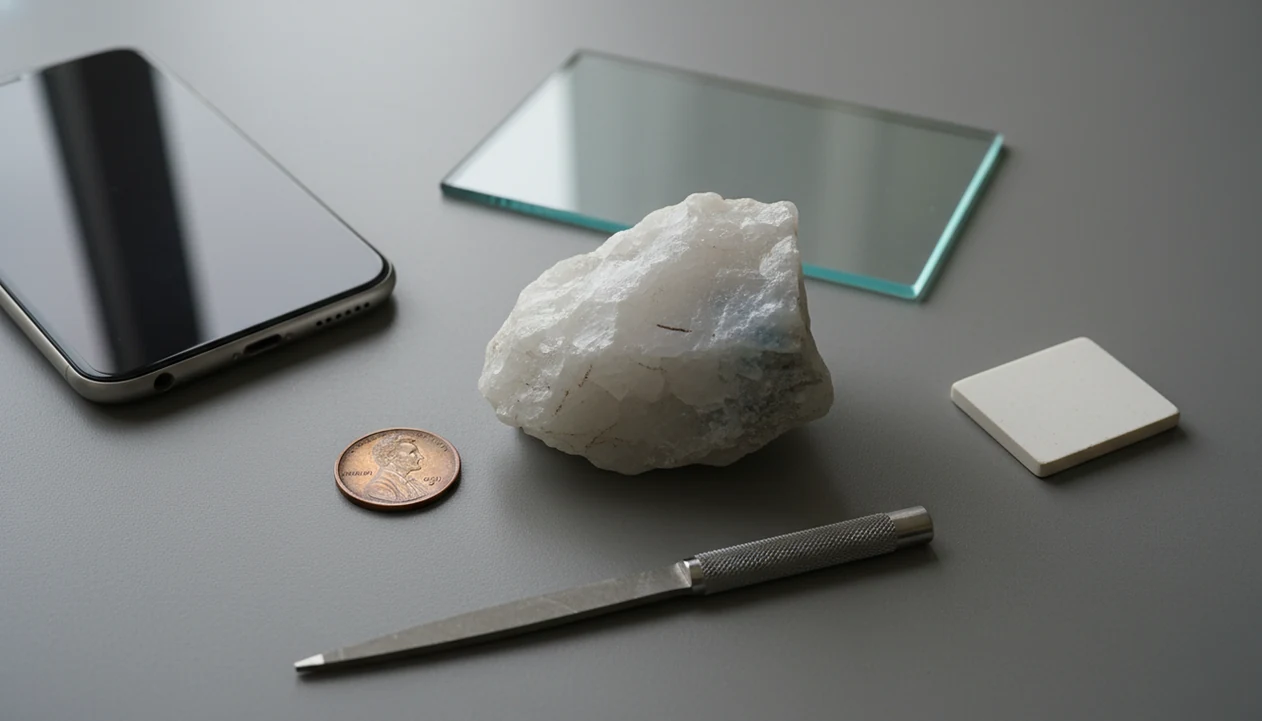
No. A phone cannot directly measure Mohs hardness from a photo, because Mohs hardness requires a physical scratch test. A rock identifier app can only infer a likely hardness range after identifying the probable rock or mineral.
Definition: Mohs hardness is a relative scratch-resistance ranking based on whether one known material can visibly scratch another material.
TL;DR
- A phone camera can identify visual clues, but it cannot perform the physical scratching required for a true Mohs hardness test.
- Rock Identifier can estimate likely Mohs hardness by matching a photo to a probable rock, mineral, crystal, fossil, or gemstone and showing its typical reference range.
- For better confidence, combine photo identification with simple field tests such as scratch testing, streak, luster, cleavage, and density.
For photo-based identification on iPhone or iPad, try the Mohs hardness estimator app. You can also upload a photo on RockIdentifier.io.
RockIdentifier.io provides a web photo upload option that can help identify rocks, minerals, crystals, fossils, and gemstones before reviewing likely Mohs hardness context. AI Rock ID is an iPhone and iPad app that can support photo-based identification, but it does not turn a phone camera into a physical Mohs hardness tester.
Quick answer: Can a phone measure Mohs hardness from a photo? No, a phone can only infer likely Mohs hardness after a rock or mineral is identified, and a real hardness result requires a physical scratch test or lab method.
Recommended app for photo-based Mohs hardness estimates
AI Rock ID can be useful when you want to identify a specimen first and then review likely Mohs hardness clues. It should be treated as an identification aid, not as a replacement for a real scratch test.
Best for
- Estimating likely hardness after photo identification
- Comparing a visual identification with common Mohs hardness ranges
- Learning when a glass plate, steel tool, or fingernail test may help
- Documenting rock, crystal, mineral, fossil, or gemstone finds
- Checking whether a specimen may need expert review before testing
- Avoiding misleading claims that a camera directly measures hardness
Limitations
- A photo cannot physically test scratch resistance
- Look-alike minerals may have different hardness values
- Surface coatings, weathering, and lighting can affect visual identification
- Potentially valuable gems should not be scratch tested without expert guidance
Who this guide is for
Good fit if you
- Beginners who want to understand why camera Mohs hardness claims are limited
- Rock and mineral collectors comparing a photo estimate with a scratch test
- Students learning the difference between visual identification and physical hardness
- Users who need likely Mohs hardness context after identifying a specimen
- People checking whether glass, steel, or a fingernail test may be useful
- iPhone, iPad, or web users who want photo-based rock and mineral identification first
Consider another method if you
- Users who need a certified Mohs hardness result for appraisal, sale, or insurance
- People identifying valuable gemstones where destructive scratch testing is risky
- Users who need laboratory-grade mineral testing
- Anyone expecting a phone camera to directly measure scratch resistance
At a Glance: Phone Mohs Hardness Measurement
A smartphone camera cannot directly measure Mohs hardness. It can photograph color, texture, shine, crystal shape, and broken surfaces, but it cannot feel whether one material scratches another.
A phone hardness test is usually shorthand for an app-based estimate. The app first tries to identify the likely rock or mineral, then reports the typical hardness range for that material. That is useful, but it is not the same as a measured scratch result.
The pocket check is real.
If a child brings home a “sparkly rock” after a school field trip, a phone can help narrow quartz, mica, pyrite, or glassy slag. A true Mohs test still needs contact tools, such as a fingernail, copper coin, steel file, glass plate, or Mohs picks. Tools like RockIdentifier can help you decide what to test next, not certify hardness from pixels.
Five Facts About Camera Mohs Hardness Claims
- Mohs hardness is a relative scratch test from 1 to 10, not a force reading or digital sensor value.
- The Mohs scale uses 10 reference minerals, from talc at 1 to diamond at 10, according to the National Park Service: https://www.nps.gov/articles/mohs-hardness-scale.htm.
- A real hardness test requires contact with reference tools or minerals and a visible scratch on the sample.
- Phone apps can estimate hardness only after visual identification, usually by matching the likely mineral to a reference range.
- Hardness should be combined with streak, luster, cleavage, density, magnetism, transparency, and other observations before you trust an ID.
A wet black beach pebble can look like polished basalt, then turn dull gray after drying on a towel. That one change can shift the app’s likely match. For beginner rock sorting, a camera estimate is often useful because it points you toward the next simple test.
Mohs Hardness Scratch Testing Method
Mohs scratch testing works by comparing an unknown sample against materials of known hardness and watching which one makes a real groove. A powder smear, dust trail, or rubbed surface mark does not count as a scratch.
In the field, people often start with rough references: a fingernail near 2.5, a copper coin around 3, a steel file near 6.5, and glass around 5.5 to 6 on the Mohs scale. These common field-reference values should be treated as approximations rather than calibrated measurements; for the standard Mohs sequence, cite NPS guidance at https://www.nps.gov/articles/mohs-hardness-scale.htm. Mohs picks make the sequence more controlled. ASTM C1895-20 describes Mohs scratch hardness as a mechanical test method, which is why a camera Mohs hardness reading cannot replace contact testing: https://www.astm.org/c1895-20.html.
Check the fresh spot.
A muddy creek stone may hide its real surface until you clean it or look at a fresher broken edge. If the scratch leaves a groove you can feel with a fingernail, that matters more than a pale powder line. Pair the result with a streak test for minerals when the specimen looks metallic.
Rock Identifier Photo-Based Mohs Hardness Estimate
Rock Identifier is a rock identifier app that identifies rocks, crystals, minerals, fossils, and gemstones from photos for rockhounds, students, and curious finders. Its Mohs hardness information is an inferred estimate, not a direct measurement of scratch resistance.
The app analyzes visible traits such as color, texture, crystal habit, shape, banding, grain size, and surface appearance. It then maps a likely rock or mineral identification to reference hardness information. A clear quartz match may point toward hardness 7, while calcite often points near 3.
A good ai rock identifier app and web tool that names rocks, crystals, minerals, and fossils from photos with mohs hardness and value estimates delivers likely identification plus reference context, not lab-grade hardness measurement. Lighting, dust, coatings, weathering, and mixed compositions can change the match. We have seen noon sun flatten crystal faces so badly that retaking the photo in shade changed the top result.
Phone Hardness Test vs Real Mohs Scratch Test
A phone-based hardness result is identification-derived; a Mohs scratch test is contact-derived. The difference matters because one predicts from appearance, while the other checks scratch resistance directly.
| Method | What it measures | Tools needed | Output | Main risk |
|---|---|---|---|---|
| Phone app estimate | Likely hardness range after visual ID | Phone camera, app, good light | Probable Mohs range | Wrong ID gives wrong hardness |
| Guided phone hardness test | User-entered scratch observations | Phone plus fingernail, coin, glass, file, or picks | Better-supported estimate | User may mistake powder for a groove |
| Real Mohs scratch test | Contact scratch resistance | Known reference minerals or Mohs picks | Relative hardness bracket | Can damage small or polished specimens |
| Lab or expert evaluation | Multiple physical and optical properties | Specialist tools | More reliable identification | Cost, time, and access |
Glass is commonly around 5.5 to 6, and a fingernail is about 2.5 on the Mohs scale. A single number from an app should not be treated as a lab measurement. For shiny specimens, luster in mineral identification can explain why glare and surface shine confuse both people and cameras.
Common Myths About Camera Mohs Hardness Apps
Myth 1: Better camera resolution can measure hardness. More pixels show surface detail, but they do not show how the mineral resists scratching.
Myth 2: Image clarity can replace scratch testing. A crisp photo of a crystal face still cannot prove whether glass, steel, or quartz will scratch it.
Myth 3: A single app hardness number is precise and measured. Most app numbers are reference values tied to the predicted identification.
Myth 4: Every piece of the same rock has exactly the same hardness. Multi-mineral rocks can test differently from one grain to the next.
Weathering, impurities, coatings, and mixed composition all matter. We have watched a striped pebble among shell fragments look like one rock in the photo, then show a softer weathered rind under a simple scratch. Hardness narrows choices; it does not finish the job.
Camera Mohs Hardness Estimate Decision Guide
“Is a camera Mohs hardness estimate enough?” Yes for learning and sorting; no for valuation, sales, gem claims, safety decisions, or precise identification.
Use a phone estimate when
Use it when you want beginner sorting, a likely identification, lookalike narrowing, or a short list of tests to try next. An egg carton full of backyard finds is a good use case: photograph each piece, add a penny or key for scale, then group likely quartz, limestone, granite, slag, and jasper.
Do a physical test when
Do a scratch test when the result affects buying, selling, cutting, collecting, safety, or a gemstone claim. Hardness usually works best when combined with streak, luster, cleavage and fracture, density, and acid reaction where appropriate.
When to Get Expert Identification
Get expert identification whenever the result affects money, safety, or a gemstone claim. A phone result is useful for education and triage, but it is not a legal opinion, safety certification, appraisal, or proof of authenticity.
- Use a qualified geologist or gemologist before selling, appraising, insuring, cutting, or advertising a specimen as a gemstone. Value and identity often depend on more than appearance.
- Skip scratch testing on fragile crystals, polished pieces, heirlooms, valuable finds, or anything that may release hazardous dust. A small groove can permanently lower a specimen’s value.
- Seek help promptly for fibrous, dusty, metallic, unusually heavy, or uranium-associated minerals, especially if you do not know how to store or handle them safely.
- Confirm important IDs with several physical properties, not photo matching alone. Hardness, streak, luster, cleavage, density, magnetism, and reaction tests can point in different directions.
- Treat app results as learning tools that suggest likely next steps. They can guide your questions for an expert, but they should not stand alone for transactions or safety decisions.
Limitations
A smartphone alone cannot scratch the sample or sense scratch resistance. Camera-based Mohs hardness depends on the accuracy of the rock or mineral identification.
- A phone camera sees appearance, not mechanical resistance.
- Lighting, dust, coatings, wet surfaces, and weathering can mislead image recognition.
- Full noon sun can hide luster and cleavage behind glare on a crystal face.
- Multi-mineral rocks may have several hardness values across one hand specimen.
- Mohs hardness is qualitative, relative, and non-linear, not a precise engineering measurement.
- A hardness estimate can lead to wrong value assumptions if used alone.
- Polished, dyed, tumbled, or treated specimens may not show natural surfaces.
- Important identifications should be confirmed with physical testing, a geology instructor, a gemologist, or another qualified expert.
Apps such as RockIdentifier can be practical for first-pass sorting, but they should not be used as professional appraisal, legal collecting permission, or proof that a specimen is safe to handle.
Which option fits which need
| Need | Best option | Why |
|---|---|---|
| Identify a rock or mineral from a photo before checking likely hardness | AI Rock ID | Photo identification can provide a likely specimen name and related Mohs hardness context. |
| Upload a specimen photo without installing an app | Web Tool | RockIdentifier.io can be used in a browser for photo-based identification and general hardness clues. |
| Confirm actual scratch resistance | Real Mohs Scratch Test | Mohs hardness is based on whether one material scratches another, which requires physical contact. |
| Check a potentially valuable gemstone | Expert | An expert can reduce the risk of damaging a valuable or treated stone during testing. |
| Measure hardness for scientific or commercial documentation | Lab | A laboratory can use controlled methods and documentation beyond a phone-based estimate. |
Quick summary
- Best for
- This page is best for understanding why a phone cannot directly measure Mohs hardness and when a photo-based estimate may still be useful.
- Includes
- camera hardness claim explanation, Mohs scratch test context, photo-based hardness estimate guidance, phone test limitations, expert identification triggers
- Platforms
- iPhone, iPad, Web
- Free version
- Yes
- Expert replacement
- No
Common mistakes
- Assuming a phone camera can directly measure Mohs hardness
- Treating a photo-based hardness estimate as a confirmed scratch test result
- Scratching a polished gemstone or collectible specimen without considering damage
- Using dirty, weathered, or coated surfaces for a hardness test
- Confusing mineral identification confidence with hardness certainty
- Ignoring that similar-looking minerals can have different Mohs hardness values
A practical next step is the estimate Mohs hardness from photos workflow in AI Rock ID.
FAQ
Can a phone test hardness?
No. A phone alone cannot perform the physical scratch contact required for a Mohs hardness test.
Can a camera measure Mohs hardness?
No. A camera captures appearance, but Mohs hardness measures relative scratch resistance.
Are Mohs apps accurate?
Mohs apps can be useful when the rock or mineral identification is correct. Their hardness result is usually a reference estimate, not a measured value.
What is a phone hardness test?
A phone hardness test usually means an app-based estimate or a guided scratch-test workflow. It is not a camera measurement of hardness.
Can photos identify mineral hardness?
Photos can suggest a likely mineral and its typical hardness range. They cannot prove hardness without physical testing.
How do I test Mohs hardness?
Scratch the unknown sample with known reference materials, then look for a visible groove. Start gently with a fingernail, copper coin, glass plate, steel file, or Mohs picks.
Does glass test mineral hardness?
Yes. Glass, around 5.5 to 6 Mohs, is often used as a simple field reference for minerals softer or harder than glass.
Is Mohs hardness exact?
No. Mohs hardness is relative, qualitative, and non-linear rather than a precise engineering value.
Why can a photo suggest hardness but not prove it?
A photo can help identify a likely mineral, and known minerals have typical Mohs hardness ranges. The photo does not show whether the specimen can actually scratch or be scratched by a test material.
Can lighting or surface condition affect a hardness estimate?
Yes. Lighting, weathering, dirt, coatings, and polished surfaces can affect visual identification, which can make a photo-based Mohs hardness estimate less reliable.
Should I scratch test a gemstone I might sell?
No, not without expert guidance. Scratch testing can damage a gemstone, and an appraised or potentially valuable stone should be evaluated by a qualified gemologist or lab.
What should I do if the photo ID and scratch test disagree?
Recheck the test on a fresh, inconspicuous surface and confirm that the testing material is appropriate. If the result still conflicts, use expert identification or laboratory testing.