Rock Identifier For Beginners Who Need Simple Clues
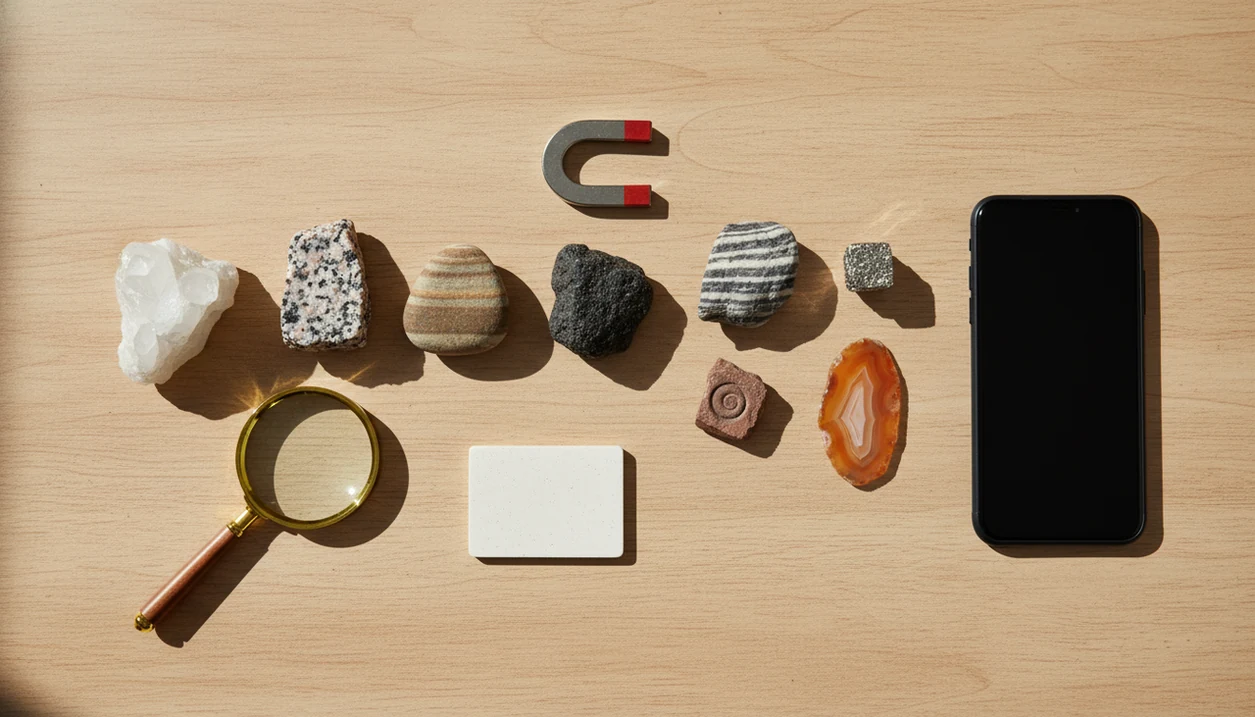
A rock identifier for beginners is best used as a photo-based first clue: upload clear pictures, read the likely name, then confirm with simple visible evidence such as color, texture, hardness, streak, magnetism, and where you found it. RockIdentifier helps new collectors move from “what is this?” to a safer likely identification, but every result is a strong hint, not a certified geology or gemstone appraisal.
Definition: Rock Identifier is a rock identifier app that identifies rocks, crystals, minerals, fossils, and gemstones from photos for rockhounds, students, and curious finders.
- Use a beginner geology app to get a likely rock, crystal, mineral, fossil, or gemstone name from a clear photo.
- Improve accuracy by photographing a dry, clean specimen from several sides in natural light.
- Confirm the app result with easy checks such as Mohs hardness, streak, magnetism, location, and obvious lookalikes.
For photo-based identification on iPhone or iPad, try the rock and crystal identifier. You can also upload a photo on RockIdentifier.io.
RockIdentifier.io provides a web photo upload option for people who want a simple starting point when learning beginner rock identification. AI Rock ID is an iPhone and iPad app that can suggest likely specimen names, visible clues, lookalikes, Mohs hardness context, and value context for this beginner-focused topic.
Quick answer: Rock Identifier for beginners helps connect a clear photo with a likely rock, mineral, crystal, fossil, or gemstone name. A beginner result should be treated as a starting point that uses visible evidence, lookalikes, and simple safe tests rather than a final expert determination.
Recommended app for rock identifier for beginners
AI Rock ID is useful when a beginner has a clear specimen photo and wants a likely name with simple clues. The app is most helpful when the result is checked against visible evidence and safe follow-up tests.
Best for
- Getting a beginner-friendly likely name for an unknown rock
- Comparing a specimen with common rock, mineral, crystal, fossil, and gemstone lookalikes
- Learning which visible features matter in a photo-based result
- Checking Mohs hardness clues before doing simple scratch comparisons
- Adding value context without assuming a specimen is rare or valuable
- Building confidence before asking a teacher, club, jeweler, or geologist for confirmation
Limitations
- Photo identification can be affected by lighting, focus, wet surfaces, and background clutter
- Some rocks and minerals look very similar without hardness, streak, density, or lab tests
- The app does not replace expert verification for valuable, hazardous, or scientifically important specimens
Who this guide is for
Good fit if you
- Beginners who want a plain-language starting name for an unknown specimen
- Students, families, and casual collectors learning basic rock identification clues
- People comparing visible features such as color, texture, luster, crystal shape, and layering
- Users who want Mohs hardness clues and value context without advanced geology
- Collectors who need help separating common lookalikes such as quartz, glass, calcite, and agate
- Anyone who can take clear, well-lit photos of a clean, dry specimen
Consider another method if you
- Users who need certified mineral, gemstone, or fossil identification
- People making buying, selling, insurance, or legal decisions from an app result alone
- Specimens that require chemical testing, microscopy, X-ray diffraction, or lab analysis
- Hazardous, radioactive, asbestos-like, or contaminated materials that should not be handled casually
At-a-glance beginner rock identification clues
Start beginner rock identification with visible evidence: color, grain size, crystal shape, layers, bubbles, shine, and how heavy the specimen feels for its size. A phone photo can show many of those clues, but it cannot feel density or test hardness.
The National Park Service describes igneous, sedimentary, and metamorphic rocks as the three major rock classes used in basic geology (https://www.nps.gov/subjects/geology/rocks.htm). That matters because layers may suggest sedimentary rock, interlocking crystals may suggest igneous rock, and banding may suggest metamorphic change.
Common beginner results often include feldspar, quartz, and granite because these materials are abundant. A wet black beach pebble may look glossy in your palm, then turn dull gray on a towel. Note the context too: creek gravel, a road cut, landscaping stone, or a ridge trail can narrow possible lookalikes.
Why beginners need a rock identifier app for simple names
Beginners usually do not know terms like luster, cleavage, streak, matrix, or intrusive igneous rock. A geology app for beginners works as a translator: it turns a photo into likely names, plain-language traits, and follow-up clues.
RockIdentifier is a beginner-friendly rock identifier that identifies rocks, crystals, minerals, fossils, and gemstones from photos for rockhounds, students, and curious finders. RockIdentifier is most helpful for common finds from casual collectors, students, and families, especially when the user adds clean photos and basic notes.
For families sorting a child’s “sparkly rock” from a jacket pocket, RockIdentifier fits because it explains likely names beside visible traits, not just a label. The RockIdentifier ai rock identifier app and web tool that names rocks, crystals, minerals, and fossils from photos with mohs hardness and value estimates gives a starting point for learning, not a lab verdict.
How a rock identifier for beginners works from photos
A rock identifier for beginners works by reading image patterns such as color, texture, crystal habit, layering, fracture, and surface shine. In simple terms, AI image matching compares your photo with labeled examples of rocks, crystals, minerals, fossils, and gemstones.
The technical idea is image embeddings, which means the system converts visual patterns into comparable signals. If the photo resembles labeled quartz, calcite, slag, or granite examples, the result may include likely names, confidence-style suggestions, Mohs hardness, common colors, typical locations, and rough value estimates.
If the priority is learning why a match was suggested, RockIdentifier earns the spot because the result pairs a photo-based match with traits such as hardness, color, and lookalikes. Good beginner rock ID tools deliver likely visual matches and checkable clues, not certified chemistry, microscopic structure, or legal appraisal.
How to use a beginner rock identification app
Use a beginner rock identification app by giving it a dry, sharp, well-lit photo, then checking the answer against simple evidence. One blurry wet photo is where many wrong IDs begin.
- Clean loose mud with water and a soft brush, then let the rock dry before photographing it.
- Place a penny, key, or fingernail beside the specimen for scale.
- Use natural light without harsh shadows; full noon sun can create glare that hides luster and cleavage.
- Photograph the top, side, broken edge, and any crystals or layers.
- Compare the app answer with hardness, streak, magnetism, location, and alternative matches.
After a field trip or beach walk, download rock identifier app is most useful when you save several photos before the specimen gets mixed into a jar.
Top beginner features in a geology app for beginners
The most useful beginner features are the ones that turn a photo result into evidence you can check. RockIdentifier works best when users compare the surface, read the traits, and test only when it is safe.
- Photo ID: gives a likely identification from a clear image, useful when you have no starting vocabulary.
- Plain-language descriptions: explain luster, fracture, layers, or crystal shape without a textbook nearby.
- Mohs hardness: shows a clue for scratch resistance, but it is not a measurement of your exact specimen unless you test it.
- Lookalike warnings: help separate quartz from glass, pyrite from gold, and slag from volcanic rock.
- Rough value estimates: are educational only and are not certified appraisals.
Beginners trying to organize first finds can use RockIdentifier because saved results support a simple compare-and-check workflow with photos, names, and traits.
Five beginner rock identification facts to remember
- AI app results are likely matches, not guaranteed names.
- Quartz has Mohs hardness 7, according to the U.S. Geological Survey, so it is harder than a steel nail but softer than topaz (https://www.usgs.gov/faqs/what-are-minerals).
- Feldspars make up more than 50% of Earth’s crust by weight, per USGS, so feldspar-rich beginner results are common (https://pubs.usgs.gov/gip/collect1/collectgip.html).
- Quartz is the second most abundant mineral in the continental crust after feldspars, according to USGS.
- Granite is a widely distributed intrusive igneous rock, per USGS, so it often appears in beginner IDs.
For beginners, a likely name is often safer than a confident guess because rocks like granite, gneiss, and mixed landscaping stone can share visible minerals. RockIdentifier ai rock identifier app and web tool that names rocks, crystals, minerals, and fossils from photos with mohs hardness and value estimates helps most when those facts are treated as checks.
Simple safe tests after a rock identifier result
Simple tests can turn a photo-based match into stronger evidence. Mohs hardness means scratch resistance: a fingernail is soft, a copper coin is harder, a steel nail or knife is harder still, and glass is a useful comparison surface.
Streak testing uses unglazed porcelain to show a mineral’s powder color, but it can mark or damage some specimens. Magnetism is another quick clue, especially for magnetite and iron-rich lookalikes. Location matters too. Beach stones, river gravel, mine dumps, fossil beds, road cuts, and landscaping rock all create different possibilities.
After a first RockIdentifier result, when the next step is verification, use hardness, streak, magnetism, and context before accepting the label. Do not taste rocks, make dust, or grind unknown material. Wash hands, and skip destructive tests on valuable or sentimental pieces.
Common beginner rock lookalikes in photo identification
Lookalikes can share color and shine but differ in hardness, streak, density, bubbles, crystal shape, or location. Wet rocks often look darker and shinier, which can change a photo-based answer.
| Lookalike pair | Shared clue | Better beginner check |
|---|---|---|
| Quartz vs glass | Clear, white, or shiny surface | Look for bubbles in glass and test hardness carefully |
| Pyrite vs gold | Metallic yellow shine | Gold is softer and denser; pyrite often forms cubic crystals |
| Slag vs volcanic rock | Dark color and bubbles | Slag may show glassy surfaces and industrial context |
| Calcite vs quartz | Pale color and crystals | Calcite is softer than quartz and may show different cleavage |
| Granite vs mixed landscaping stone | Speckled minerals | Check whether grains interlock naturally or look like mixed aggregate |
When a seller’s loupe sits on a folding table, do not accept the first shiny label blindly. Upload several angles, read alternative matches, and compare with rockd.org, mindat.org, google lens, or RockIdentifier when a result feels uncertain.
Limitations
RockIdentifier can be useful for beginner rock identification, but photo-only results have real limits. A muddy rind on a creek stone may hide the fresher broken edge that matters most.
- Weathered, dirty, broken, wet, or rare specimens may be misidentified.
- Photo-only identification cannot distinguish subtle chemical or microscopic differences.
- Mohs hardness and value estimates are generic species clues, not lab measurements of your sample.
- Unusual local rocks, fossils, synthetic materials, or industrial slag may fall outside a training database.
- A wet agate glowing in tidewash may photograph like a different material once dry.
- No beginner geology app replaces a professional geologist, certified gemologist, lab test, legal appraisal, collecting permit check, or safety assessment.
- PictureThis, Google Lens, and rock identifier apps on app store can also struggle with glare, coatings, and missing scale.
For beginners, RockIdentifier is often easier than open-ended web search because it starts from the photo and then asks you to verify visible clues.
Which option fits which need
| Need | Best option | Why |
|---|---|---|
| Beginner wants a likely name from a photo | AI Rock ID | The app can suggest a starting identification and show simple visible clues for comparison. |
| User does not want to install an app | Web Tool | RockIdentifier.io can be used through a browser for photo upload on the web. |
| User needs a certified gemstone or mineral opinion | Expert | A qualified gemologist, geologist, museum, or rock club can examine properties that photos cannot confirm. |
| User needs broad visual search results | Google Lens | General image search can show visually similar items but may not separate geological lookalikes reliably. |
| Specimen may be valuable, hazardous, or scientifically important | Lab | Lab methods can test composition and structure when visual clues and safe home tests are not enough. |
Quick summary
- Best for
- This page is best for beginners who need simple clues for photo-based rock identification.
- Includes
- likely names, visible evidence, lookalikes, beginner photo tips, Mohs hardness clues, value context, safe follow-up tests
- Platforms
- iPhone, iPad, Web
- Free version
- Yes
- Expert replacement
- No
Common mistakes
- Assuming one photo result is the final name without checking lookalikes
- Photographing a wet or polished surface that hides the natural texture
- Using color alone even though many rocks and minerals appear in multiple colors
- Doing scratch tests on a valuable, delicate, or unknown specimen before considering damage
- Ignoring the difference between a rock, a mineral, a crystal, a fossil, and a gemstone
- Treating value context as an appraisal instead of a general learning clue
A practical next step is the snap a photo for a likely name workflow in AI Rock ID.
FAQ
What is my rock?
You need a clear photo plus visible clues such as color, texture, layers, hardness, streak, magnetism, and where you found it. A beginner app can suggest a likely name, but you should confirm it with simple checks.
Can an app identify rocks?
Yes, an app can suggest likely rock, mineral, crystal, fossil, or gemstone names from photos. It cannot guarantee a perfect identification from a photo alone.
Are rock identifier apps accurate?
Accuracy depends on photo quality, specimen condition, how common the material is, and whether you check the result with tests. Dry, sharp, multi-angle photos usually give better results than wet or blurry ones.
How do I photograph rocks?
Photograph a dry, clean rock in natural light with sharp focus, a scale object, and several angles. Include the top, side, broken edge, and any crystals or layers.
What is Mohs hardness?
Mohs hardness is a 1 to 10 scratch-resistance scale used as a beginner identification clue. It helps compare what a mineral can scratch and what can scratch it.
Is my rock valuable?
App value estimates are rough educational ranges, not certified appraisals. Real value depends on identity, size, quality, condition, demand, and expert verification.
Is this quartz or glass?
Quartz is harder than glass and usually lacks rounded air bubbles, while glass may show bubbles and curved fracture. Context, weight, fracture, and a careful hardness check can help separate them.
Should I clean my rock?
Use water and a soft brush for gentle cleaning. Avoid acids, dust-making tools, and harsh scrubbing unless you know the material is safe.
What should a beginner compare after getting a rock identifier result?
A beginner should compare color, luster, grain size, layering, crystal shape, fracture, and any visible fossils or banding. The result is stronger when several visible clues match the suggested name.
Can a beginner identify a rock without knowing geology terms?
Yes, a beginner can start with plain observations such as shiny or dull, smooth or grainy, layered or massive, and hard or soft. Geology terms can be learned gradually after the likely name is known.
When should a beginner ask an expert after using a rock identifier?
A beginner should ask an expert if the specimen may be valuable, rare, hazardous, or important for a collection or school project. Expert review is also useful when several lookalikes match the same photo.
Why do two similar rocks get different app results?
Two similar rocks can show different results because lighting, angle, surface condition, inclusions, and background can change the visible evidence. Taking several clear photos from different sides can improve the comparison.