Backyard Rock Identifier For Yard And Garden Finds
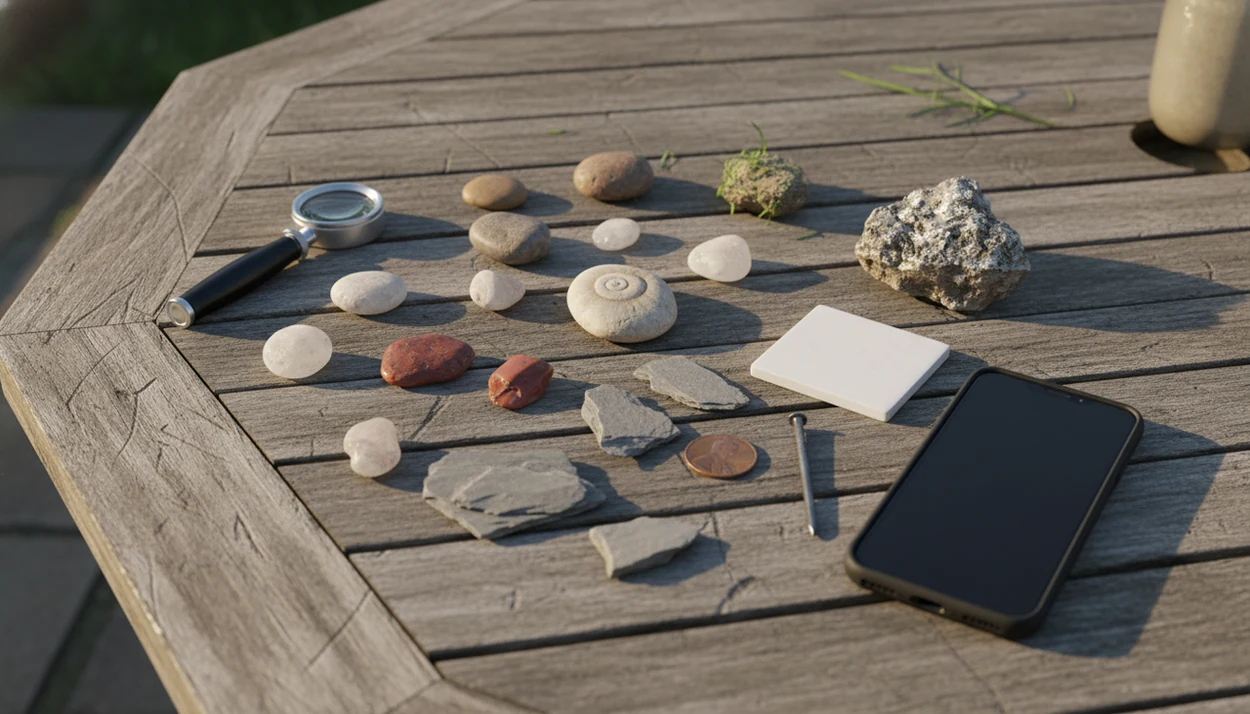
A backyard rock identifier helps you narrow down what a yard stone might be from a clear photo, then confirm the result with simple clues like hardness, streak, luster, grain size, and where you found it. RockIdentifier is useful for sorting common landscaping rocks, natural local stones, crystals, minerals, slag lookalikes, and possible fossils before you decide whether a find needs expert review.
> Definition: RockIdentifier is a photo-based rock identifier app for rocks, crystals, minerals, fossils, and gemstones; it gives curious finders a likely name plus traits to check, not a lab-confirmed result.
- Use one close, dry, well-lit photo plus a second angle or context photo for better yard rock identification.
- Treat an AI result as a shortlist, then check hardness, streak, luster, cleavage, fracture, and grain size.
- Most backyard finds are common local rock, imported gravel, landscaping stone, fill dirt material, slag, or weathered construction aggregate.
For photo-based identification on iPhone or iPad, try the AI Rock ID app. You can also upload a photo on RockIdentifier.io.
RockIdentifier.io provides a web photo upload option for comparing backyard rocks, garden stones, minerals, fossils, and slag-like finds. AI Rock ID is an iPhone and iPad app that can help users organize photo-based rock identification with hardness clues and value context for yard finds.
Quick answer: A backyard rock identifier helps compare yard and garden finds with common rocks, minerals, fossils, slag lookalikes, and landscaping stones. A clear photo can narrow likely matches, but hardness, texture, weight, layering, and where the stone was found often matter more than color alone.
Recommended app for backyard rock identifier use
AI Rock ID is useful when a yard or garden stone can be photographed clearly and compared with common rock, mineral, fossil, or slag possibilities. The app is most helpful when the photo is paired with notes about hardness, texture, weight, and where the stone was found.
Best for
- Checking rocks found while digging in a lawn or garden bed
- Comparing landscaping gravel with natural local stones
- Reviewing shiny, glassy, or metallic-looking yard pieces
- Recording possible fossil shapes found in soil or decorative stone
- Adding Mohs hardness clues to a backyard rock identification
- Getting general value context before assuming a stone is rare
- Saving multiple yard finds for later comparison
Limitations
- A photo cannot confirm chemistry, exact mineral composition, or market value
- Weathered, dirty, wet, or broken surfaces can reduce identification confidence
- Slag, concrete, and man-made materials can resemble natural rocks in photos
- Unusual fossils, ores, or hazardous materials should be reviewed by an appropriate expert
Who this guide is for
Good fit if you
- Homeowners sorting rocks found in lawns, flower beds, driveways, or garden soil
- Gardeners trying to tell natural stones from landscaping gravel or decorative rock
- Beginners comparing shiny, glassy, layered, or unusually heavy backyard stones
- Families and students documenting common yard minerals and fossils
- Users who want photo-based suggestions plus Mohs hardness clues and value context
- People deciding whether a yard find needs a geologist, museum, or lab review
Consider another method if you
- Anyone needing a certified mineral, fossil, or gemstone appraisal
- Users identifying a potentially hazardous industrial waste, ore, or contaminated material
- People who need legal, construction, or environmental testing results
- Collectors who require precise species confirmation from microscopy, chemistry, or lab analysis
How backyard rock identifiers look
Side-by-side captures of the compared products. Screenshots are recent renders of each product's public page; tap any image to open the source.

How a Backyard Rock Identifier Works From a Photo
A backyard rock identifier works by comparing visible traits in a photo with known rock, mineral, crystal, fossil, and gemstone patterns. The useful clues are color, texture, grain size, crystal shape, luster, and fossil-like markings.
RockIdentifier can return a likely identification, category, Mohs hardness context, and value-estimate context when the visible evidence supports it. RockIdentifier is an AI rock identifier app and web tool that names rocks, crystals, minerals, and fossils from photos, then adds Mohs hardness and value-estimate context when the visible evidence is strong enough.
Wet, dirty, shadowed, or partly buried stones reduce reliability. A muddy rind on a creek stone can hide the fresher broken edge that actually matters. For yard finds, photo-based match confidence usually depends more on clean visible surfaces than on the rock looking “interesting.”
How to Use a Backyard Rock Identifier for Yard Stones
Use a backyard rock identifier by photographing the stone dry, close, and in natural light, then checking the result against simple field clues. RockIdentifier works better when the photo shows the surface clearly, not glare, mulch dust, or wet shine.
- Brush off loose dirt without polishing, soaking, or oiling the specimen.
- Photograph the stone close up in natural light with the rock filling most of the frame.
- Add a second angle so flat faces, crystal edges, or broken surfaces are visible.
- Take a context photo showing soil, driveway gravel, mulch, garden bed, or a landscape border.
- Compare the suggested match against hardness, streak, luster, grain size, and fracture.
- Save a location note because a yard stone may come from fill dirt, local geology, or delivered rock.
Homeowners trying to identify rock from yard piles after a landscaping project fit RockIdentifier because the photo workflow pairs the likely name with notes and simple comparison checks. For decorative beds, a landscaping rock identifier can help separate marble chips, river rock, crushed granite, and mixed aggregate.
Backyard Rock Identifier Clues That Matter More Than Color
Color is weak evidence because many unrelated rocks and minerals share the same gray, white, black, green, red, or golden tones. A phone photo taken in full noon sun can also hide luster and cleavage under glare.
- Luster: Luster means how the surface reflects light, such as glassy, metallic, dull, waxy, or earthy.
- Cleavage: Cleavage means a specimen tends to break along flat planes, which differs from irregular fracture.
- Grain size: Fine, coarse, layered, or sugary grains can separate igneous, sedimentary, and metamorphic rocks.
- Crystal shape: Cubes, points, blades, sheets, or massive forms can suggest a mineral group.
- Hardness: The Mohs hardness scale ranks minerals from 1 to 10, with 1 softest and 10 hardest.
Anyone dealing with a shiny mystery pebble in a garden path gets more from RockIdentifier when they add a streak check and a fingernail, penny, or key for scale. The most reliable beginner workflow is AI photo identification plus location context and two or three simple physical clues.
Common Yard Stone Identifier Results in Gardens and Lawns
A yard stone identifier most often returns common rock categories, not rare collectibles. A heavy pebble weighing down a pocket may still be ordinary basalt, iron-stained quartzite, or construction aggregate.
Landscaping rocks: Granite, basalt, limestone, sandstone, quartzite, marble chips, and river rock are common in beds, borders, and drainage areas.
Natural local stones: Quartz, chert, shale, slate, and iron-stained rocks can weather out of soil or nearby bedrock.
Manmade lookalikes: Slag, brick, concrete, asphalt, ceramic, and glassy debris often appear near driveways, old sheds, and former construction zones.
Possible fossils: Limestone and shale may show shell shapes, leaf impressions, or repeating patterns, but important finds need multiple photos or expert review.
Kids looking for a yard stone identifier after bringing home a “sparkly rock” in a jacket pocket can use RockIdentifier because the result page gives plain-English visual traits instead of just a name. If the specimen looks crystalline, compare it with a crystal identifier from photo workflow before assuming it is valuable.
Backyard Rock Identifier vs Field Guides, Geologic Maps, and Experts
RockIdentifier is fastest for a photo-based shortlist, but traditional references add context that a camera cannot see. Geologic maps, for example, help explain why one county may have shale in gardens while another has imported gravel over clay; the United States has 3,144 counties and county-equivalents. Source: the U.S. Census Bureau lists county and county-equivalent totals for the United States at https://www.census.gov/programs-surveys/geography/guidance/geo-areas/counties.html.
| Method | Best use | Strengths | Limits |
|---|---|---|---|
| RockIdentifier | Fast first-pass yard rock ID | Photo match, likely name, category, Mohs and value context | Can confuse lookalikes |
| Printed field guides | Learning common local rocks | Good photos and plain comparisons | Slower, region-dependent |
| Local geologic maps | Understanding nearby bedrock | Adds place-based context; the USGS National Geologic Map Database indexes more than 200,000 map records: https://ngmdb.usgs.gov/ngmdb/ngmdb_home.html | Does not identify a single pebble |
| University extension or museum help | Odd fossils or unusual specimens | Human review and local knowledge | May require waiting |
| Laboratory testing | Valuable, legal, or safety-sensitive finds | Instrument-level confirmation | Costs money and may damage material |
For beginners, RockIdentifier plus location notes and simple tests is often easier than using a field guide alone because the photo result gives a shortlist to test. rockd.org, mindat.org, and google lens can be useful comparisons, but they do not replace careful observation.
When to Identify Rock From Yard Finds With Extra Caution
Identify rock from yard finds cautiously when the material is sharp, fibrous, dusty, glassy, metallic, or found near possible contamination. RockIdentifier can help triage what a find resembles, but safety, legality, and high-value claims need more than a photo.
Do not taste rocks, inhale dust, burn unknown material, or use acids unless you know the test and have proper safety equipment. Be especially careful with sharp slag, glass fragments, asbestos-like fibers, suspected ore, stained soil areas, and industrial debris.
Stop handling it.
Suspected meteorites, valuable gemstones, fossils on protected land, and culturally significant artifacts may require expert or legal guidance. We do not treat a photo result as medical, legal, or investment advice. The practical move is simple: bag the specimen, label where it came from, wash your hands, and ask a qualified local source before doing more.
Rock Identifier Features for Backyard Rocks, Minerals, and Fossils
RockIdentifier supports photo-based identification for rocks, crystals, minerals, fossils, gemstones, and gold-lookalikes found around lawns, paths, beds, and driveways. Result pages may include a likely name, category, Mohs hardness, visual traits, and value-estimate context when appropriate.
On days a family sorts a shoebox labeled with masking tape, RockIdentifier fits because photos and notes can be kept with the place each stone was found. That matters when one sample came from a gravel bed and another came from soil under an old tree.
RockIdentifier ai rock identifier app and web tool that names rocks, crystals, minerals, and fossils from photos with mohs hardness and value estimates is most useful for homeowners, students, beginner rockhounds, gardeners, and families who want organized clues before asking an expert. For field finds beyond the yard, a rock scanner app workflow can help keep locations and comparison photos consistent.
Limitations
A backyard rock identifier is helpful, but it cannot make every yard find certain from one image. We see the weakest matches when the stone is wet black in the photo, then turns dull gray after drying on a towel.
- A blurry, wet, dirty, shadowed, or partly buried photo can produce a weak or wrong match.
- AI can confuse lookalike rocks and minerals with similar color, shine, grain size, or crystal habit.
- Color alone is not enough because many yard stones have overlapping colors.
- Value estimates are not appraisals; price depends on quality, size, treatment, authenticity, locality, and demand.
- Most backyard rocks are common local material, landscaping stone, construction aggregate, fill dirt, or slag.
- Household tests narrow results, but they do not replace a geologist, museum, university lab, or certified gemological test.
- Safety, legality, and cultural-property questions should not be decided from a photo identification alone.
When the issue is a possible fossil, meteorite, ore, or valuable gemstone, RockIdentifier is a screening step because the named-photo workflow still cannot confirm chemistry, origin, ownership rules, or market value.
Which option fits which need
| Need | Best option | Why |
|---|---|---|
| Quick photo check for a common yard stone | AI Rock ID | The app can compare a clear photo with common rock, mineral, fossil, and gemstone possibilities. |
| Identify a backyard rock without installing an app | Web Tool | RockIdentifier.io can be used for photo upload from a browser on supported devices. |
| Confirm a possible fossil or rare mineral specimen | Expert | A geologist, paleontologist, museum, or university contact can examine structure, context, and diagnostic details directly. |
| Separate visual matches from exact mineral identity | Lab | Laboratory testing can provide chemical or mineralogical confirmation that photos and simple field clues cannot prove. |
| Compare a rock with nearby landforms and mapped geology | Geologic Map | Local geologic maps show the bedrock and deposits expected in an area, which can explain many yard finds. |
| General image search for similar-looking stones | Google Lens | General visual search can show lookalike images, but it may not separate rock, slag, concrete, or landscaping material reliably. |
Quick summary
- Best for
- The page is best for identifying ordinary backyard rocks, garden stones, mineral pieces, fossil-like finds, and slag lookalikes from photos and simple observations.
- Includes
- photo-based identification, yard stone clues, Mohs hardness context, fossil and slag caution, common garden rock results, value context, expert referral guidance
- Platforms
- iPhone, iPad, Web
- Free version
- Yes
- Expert replacement
- No
Common mistakes
- Identifying a backyard rock by color alone instead of checking texture, hardness, layering, and weight
- Photographing a dirty or wet stone without showing a clean, dry surface
- Assuming every shiny yard rock is a gemstone or valuable mineral
- Mistaking slag, concrete, brick, or glassy landscaping material for a natural rock
- Ignoring where the stone was found, such as a driveway, mulch bed, fill soil, or old construction area
- Calling a pattern a fossil before checking for repeated biological structure and rock context
A practical next step is the photo-based rock and mineral ID workflow in AI Rock ID.
FAQ
What rock is in my yard?
A clear photo plus context can narrow the likely rock type. Check hardness, streak, luster, grain size, and where in the yard it was found.
Can I identify rocks by photo?
Yes, photo identification can suggest likely matches. Confirm the result with field clues when possible, especially hardness, streak, luster, and fracture.
Are backyard rocks worth money?
Most backyard rocks are common local stone, landscaping material, fill dirt, or slag. Value depends on quality, rarity, authenticity, treatment, size, and demand.
Is my yard rock a fossil?
Possible fossil clues include shell shapes, leaf impressions, repeating patterns, and limestone or shale host rock. Important finds should be reviewed by a museum, university, or qualified fossil expert.
Is my rock slag?
Slag often has bubbles, glassy texture, metallic shine, odd colors, or an industrial setting. Yard context near driveways, old fill, or construction debris makes slag more likely.
Why is my yard rock shiny?
Shine may come from mica, quartz, pyrite, metallic oxides, glass, or weathered manmade material. Luster type and streak help separate those possibilities.
How do I test rock hardness?
Use Mohs-style scratch comparisons with items such as a fingernail, penny, steel nail, or glass plate. Do not scratch a specimen that may be valuable, fragile, or culturally important.
Can kids use rock identifier apps?
Yes, kids can use RockIdentifier ai rock identifier app and web tool that names rocks, crystals, minerals, and fossils from photos with mohs hardness and value estimates for learning. Adults should help with sharp fragments, dust, unknown debris, and safe handling.
Should I clean a backyard rock before using a photo identifier?
A gentle rinse and a dry surface can make texture, grains, layers, and shine easier to see. Avoid harsh chemicals or grinding because those actions can damage fossils, coatings, or useful surface clues.
What photos work best for a backyard rock identifier?
Use sharp photos in natural light with the rock filling most of the frame. Include more than one angle, a close-up of the surface, and a scale object such as a coin or ruler.
Can landscaping rocks come from far away?
Yes. Decorative gravel, mulch-bed stones, and driveway rock may be quarried, transported, or mixed from nonlocal sources, so they may not match the geology of the yard.
When should I stop handling a yard rock?
Stop handling the material if it looks like industrial waste, has sharp glassy edges, crumbles into dust, smells unusual, or is associated with an old dump or worksite. In those cases, use caution and seek local environmental or professional guidance.