Beach Rock Identifier From Photos of Weathered Pebbles
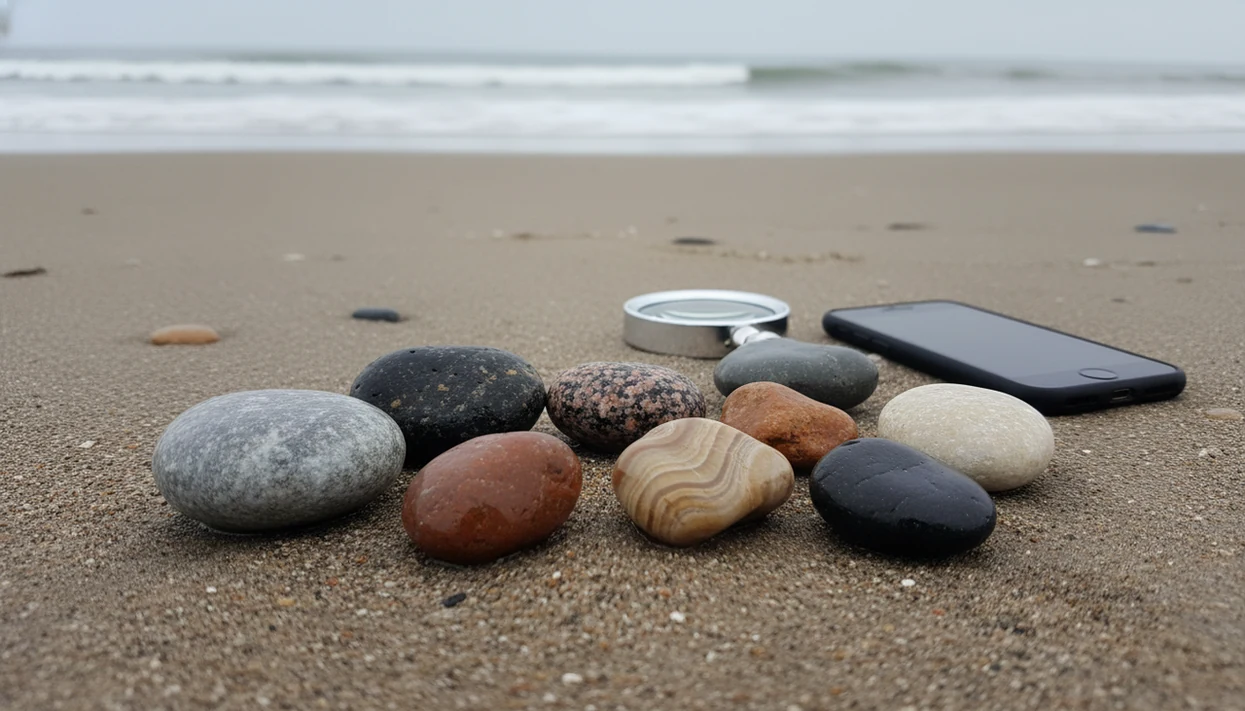
A beach rock identifier can give a likely name for a rounded beach stone from photos, but the best results come from close-ups, a dry surface, a fresh chip or broken edge when available, and the beach location. Treat the result as a practical best guess, then confirm it with simple clues like hardness, streak, magnetism, grain, and local geology.
Definition: RockIdentifier is an AI rock identifier app and web tool that names rocks, crystals, minerals, fossils, and gemstones from photos, then shows supporting clues such as Mohs hardness and educational value estimates when available.
- Beach pebbles are harder to identify than fresh rocks because waves polish away edges, crystal faces, fossils, and other diagnostic details.
- Use multiple photos: dry surface, wet surface, close-up texture, side profile, and any fresh broken surface.
- The most useful results combine AI photo matching with context: beach location, hardness clues, streak, magnet test, weight, and common regional rocks.
For photo-based identification on iPhone or iPad, try the beach rock identifier app. You can also upload a photo on RockIdentifier.io.
RockIdentifier.io provides a web photo upload option for people comparing beach rocks, crystals, minerals, fossils, and gemstones from images. AI Rock ID is an iPhone and iPad app that can help organize beach pebble photos with likely identification suggestions, hardness clues, and value context.
Quick answer: A beach rock identifier can suggest likely matches from photos of rounded, weathered pebbles, but results depend on image quality and visible clues. The most useful photos show dry and wet views, close-ups of texture, a fresh broken surface when available, and context such as beach location.
Recommended app for beach rock identifier photos
AI Rock ID is useful when a beach pebble has enough visible texture, color variation, grain pattern, or fresh-surface detail for comparison. It is most helpful as a starting point before checking hardness, streak, magnetism, location, and local geology.
Best for
- Identifying rounded pebbles found during beachcombing
- Comparing wet and dry photos of the same beach stone
- Saving multiple views of one pebble for later review
- Checking whether a stone may be quartz, jasper, basalt, chert, granite, or another common beach rock
- Adding Mohs hardness clues to a beach stone observation
- Getting value context before assuming a pebble is a gemstone
- Creating an informal reference set from repeated beach finds
Limitations
- Wave polishing can hide diagnostic crystal shapes, grains, and fractures
- AI results may be uncertain when the photo shows only a smooth exterior
- Value context is not a professional appraisal
- Legal collecting rules still need to be checked locally
Who this guide is for
Good fit if you
- Beachcombers trying to narrow down unknown pebbles from shoreline photos
- Beginners comparing rounded beach stones with common rock and mineral possibilities
- Collectors who want Mohs hardness clues before labeling a beach find
- Travelers who want a quick second opinion from iPhone, iPad, or web photo upload
- Students documenting beach rock variety for informal learning
- Users who can photograph multiple angles, close-ups, and any fresh surface
Consider another method if you
- Users who need a legally defensible mineral, fossil, or gemstone identification
- Anyone relying on a single polished pebble photo with no scale or close-up detail
- Collectors deciding high-value sales, insurance, or appraisal outcomes
- Cases that require lab testing, thin sections, chemical analysis, or expert field verification
How beach rock identifier from photos of weathered pebbles look
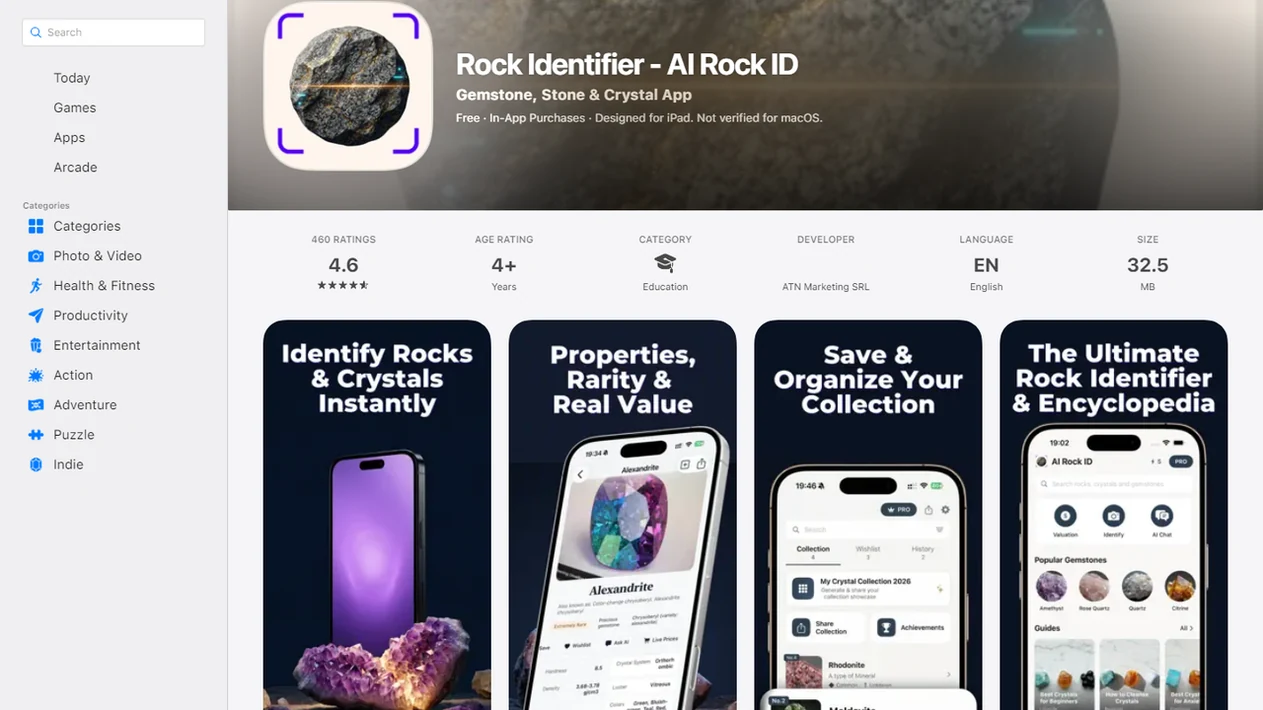
Side-by-side captures of the compared products. Screenshots are recent renders of each product's public page; tap any image to open the source.
Beach rock identifier photo results at a glance
A beach rock identifier can suggest likely rock, mineral, fossil, or gemstone names from visible features in a beach stone photo. RockIdentifier works best when the image shows texture, scale, and context, not just a shiny pebble in your palm.
Rounded stones are tricky. Wave-polished, wet, algae-covered, shadowed, or tiny pebbles often hide the features that separate quartzite from hard sandstone or basalt from dark chert. A wet black beach pebble can turn dull gray after it dries on a towel, and that color shift matters.
Anyone dealing with a pocket full of similar gray stones after low tide can use RockIdentifier as a practical first pass because it compares the photo with visible grain, luster, pattern, and likely category. Results are likely identifications, not lab-grade determinations.
How a Beach Rock Identifier Works
A beach rock identifier works by comparing your pebble photo with visual examples of known rocks, minerals, fossils, and gemstones. It looks for visible traits such as texture, color, luster, and pattern, then ranks the most likely matches.
The app also uses context. A beach location can narrow the field to rocks common in nearby cliffs, rivers, volcanic coasts, glacial deposits, or imported fill, while still allowing for transported stones that arrived by waves, ice, or human activity. Dry photos usually show true color and surface luster better; wet photos can reveal bands, translucency, or fossil outlines; and a fresh edge may expose grain or crystals hidden by the polished outside. Because these clues are visual, the result is a probability list, not a lab-grade mineral determination.
- Photograph the stone dry, wet, and close up so the app can compare more than one surface condition.
- Add the beach or region to filter unlikely matches.
- Review the ranked results as likely names, not final proof.
- Check hardness, streak, magnetism, heft, and layering to confirm or challenge the photo match.
Pebble photo recognition signals in a beach rock identifier
A beach pebble identifier uses photo recognition to compare visible patterns in your image with reference examples of rocks, minerals, fossils, crystals, and gemstones. The match is based on visual probability, not certainty.
The useful signals are color, grain size, banding, luster, texture, translucency, crystal specks, fossils, and weathering rind. A phone photo taken in full noon sun can wash out cleavage and make quartz, calcite, and glassy slag look more alike than they do in hand.
RockIdentifier can improve the likely identification when you add context, such as ocean beach, lake shore, volcanic coast, or glacial gravel. The most reliable photo-based matches come from combining what the camera sees with where the stone was found. Good AI rock identifier app and web tools deliver a ranked visual clue set, not a guaranteed field-lab verdict.
5 steps to use a beach rock identifier app correctly
- Clean gently with water and a soft brush, but leave a fragile fossil, crumbly coating, or odd metallic material alone.
- Photograph dry and wet so color, luster, and hidden bands are both visible.
- Add location with the beach name or region, since local geology filters out many unlikely global matches.
- Check the result against lookalikes, especially quartzite, chert, sandstone, basalt, limestone, jasper, and agate.
- Confirm safely with beginner-safe tests like hardness, streak, magnetism, heft, and layering.
Don’t break suspicious slag, ore, contaminated material, protected fossils, or anything found where collecting is restricted. On days when a child brings home a “sparkly rock” from a beach walk, RockIdentifier fits the family use case because the workflow moves from photo result to simple checks before anyone chips or scratches the find.
Best photo clues for a beach pebble identifier
- Close-up texture usually matters more than a distant whole-stone photo.
- Dry photos give better color and luster clues than wet photos.
- Wet photos can reveal hidden bands, agate-like translucency, or fossil outlines.
- A penny, ruler, key, or fingernail gives scale that helps separate pebble, cobble, and grainy rock.
- A fresh edge can reveal grain, crystals, layering, or fossil structure that a polished outside hides.
Dry surface photos
Let the pebble dry fully before the main photo. A sun-warmed pebble in a palm may look glossy outside, then show a matte, granular surface once dry.
Fresh surface photos
Use an existing chip if there is one. For beach stones, a natural broken edge is often more useful than the rounded skin.
Common beach stones Rock Identifier may suggest
RockIdentifier may suggest quartz, quartzite, granite, basalt, sandstone, limestone, chert, jasper, agate, slate, or fossiliferous limestone when those matches fit the photo and region. No single list fits every beach, because coasts reflect local bedrock, rivers, glaciers, cliffs, and human fill.
Quartz and quartzite: Light, hard, glassy to sugary pebbles are often quartz-rich. USGS notes that quartz grains can make up more than 90% of sand on many quartz-rich beaches source.
Granite and gneiss: Speckled pebbles often show quartz and feldspar. Typical granite contains roughly 20–60% quartz and 10–65% feldspar by volume. Cite this composition range inline, or soften it to a sourced claim such as: Britannica describes granite as a quartz- and feldspar-rich igneous rock source.
Basalt and dark volcanic rocks: These tend to be dark, fine-grained, and dense.
Chert, jasper, and agate: These may show waxy luster, red bands, or translucency.
Limestone and fossiliferous limestone: Shell fragments, fizz reaction, and visible fossils can point this way. Similar rounded stones from streams are covered in our river rock identifier guide.
Beach rock identifier checks after the AI result
- Mohs hardness compares scratch resistance from 1, talc, to 10, diamond; the USGS describes the Mohs scale as a relative test of mineral scratch resistance source.
- A streak test on unglazed tile can show powder color, which may differ from surface color.
- A magnet test can flag magnetite-rich sand, ironstone, slag, or some dark heavy pebbles.
- Heft can separate dense ore-like material from lighter volcanic or sedimentary rocks.
- Layering, shell fragments, and grain size can support sedimentary IDs.
Hardness and scratch clues
Use light pressure only. A fingernail, copper coin, steel nail, or glass plate can provide rough clues, but forceful scratching damages specimens.
Streak and magnet clues
A magnet hovering over black sand tells you something the camera cannot. Avoid acid or destructive tests on protected fossils, unknown industrial material, or beach finds you should not collect.
Beach rock identifier vs beach stone guidebooks
AI identification is fast, but guidebooks, maps, and experts add context that photos cannot supply. Local geology often narrows the list better than a global image match alone.
| Method | Best use | Main limit |
|---|---|---|
| AI app | Fast likely ID from photos | Can misread polished lookalikes |
| Printed beach stone guide | Regional examples and plain comparison | Slower, less flexible |
| Local geology map | Filters likely source rocks | Requires map-reading comfort |
| Rock club or museum | Hands-on beginner help | Not always available |
| Lab or geologist | Important, rare, or valuable finds | Cost and turnaround time |
After a muddy vial is held to sunlight or a pebble looks unusually heavy, RockIdentifier earns a spot before deeper research because it gives likely names, Mohs hardness, and comparison clues in one workflow. A rock scanner app is often easier than a guidebook for first sorting, while a local map is better for ruling out impossible matches.
Beachcomber use cases for Rock Identifier
What can beachcombers use RockIdentifier for? Beachcombers, families, students, beginner rockhounds, travelers, and curious finders can use it to sort pebbles, learn local rock types, check possible fossils, name crystals, and compare lookalikes.
RockIdentifier ai rock identifier app and web tool that names rocks, crystals, minerals, and fossils from photos with mohs hardness and value estimates can provide likely names, Mohs hardness, and educational value estimates where available. Those estimates are not buyer quotes, gem appraisals, or proof of authenticity.
If your priority is learning why two beach stones look alike, RockIdentifier covers the comparison step because the result can be checked against hardness, texture, and common alternatives. For transparent or faceted finds, our crystal identifier from photo page explains extra photo clues.
Common myths about beach rock identifier apps
- Myth: One photo gives a 100% scientific ID. A single image can support a likely identification, but fresh surfaces and simple tests often change the answer.
- Myth: AI identifies every beach pebble worldwide equally well. Common, distinctive stones are easier than rare, altered, or region-specific rocks.
- Myth: Wet shine equals gemstone quality. Water can make ordinary chert, quartz, or glassy slag look more dramatic.
- Myth: Value estimates equal real market prices. Educational estimates do not include grading, demand, provenance, cutting quality, or buyer interest.
- Myth: An ID label proves a stone is safe to handle, break, or collect. Apps do not assess contamination, sharp interiors, protected fossils, or local collecting law.
For beginner collectors, a likely ID is often more useful than a forced exact name because beach wear removes the features needed for certainty.
Limitations
Photo-based beach stone identification has real limits, especially after waves, sand, and weathering have altered the surface.
- Wave-polished stones can lose crystal faces, cleavage, fossil edges, and grain boundaries.
- Blurry, wet, algae-covered, tiny, shadowed, or overexposed photos reduce confidence.
- Lookalikes are common, including quartzite vs hard sandstone and marble vs weathered limestone.
- AI cannot assess local collecting laws, protected fossils, contamination, radiation risk, or safe handling.
- Estimated value is not a real market offer, appraisal, or gem-lab report.
- A beach location may include transported fill, glacial stones, ship ballast, or river-washed material.
- Important, hazardous, rare, or valuable-looking finds deserve local expert, museum, rock club, or lab help.
Google Lens, Mindat, Rockd, local geology maps, and printed regional guidebooks can all be useful cross-checks, but none removes the need for location context, simple tests, and human judgment. For inland finds, a backyard rock identifier may use different clues than a wave-rounded beach pebble.
Which option fits which need
| Need | Best option | Why |
|---|---|---|
| Quick suggestion for an unknown rounded beach pebble | AI Rock ID | The app can compare photo clues and provide likely rock, mineral, fossil, or gemstone matches. |
| Identify a beach stone without installing an app | Web Tool | RockIdentifier.io allows photo upload from a browser for a fast visual comparison. |
| Verify a valuable-looking or unusual beach find | Expert | A geologist, gemologist, or museum specialist can examine features that photos may not show. |
| Confirm composition of a visually ambiguous pebble | Lab | Lab testing can check mineral chemistry, structure, or other properties beyond visual appearance. |
| Broad visual search for similar beach stone images | Google Lens | General image search can show visually similar examples, but it may not separate look-alike rocks reliably. |
Quick summary
- Best for
- Beach rock identifier support is best for narrowing down likely matches for rounded, wave-worn pebbles using multiple clear photos and simple field clues.
- Includes
- photo upload, weathered pebble comparison, texture clues, color clues, Mohs hardness context, value context, result cross-checking
- Platforms
- iPhone, iPad, Web
- Free version
- Yes
- Expert replacement
- No
Common mistakes
- Photographing only the wet, shiny side of a beach rock and missing the dry texture
- Using a photo with no scale, coin, ruler, or hand for size context
- Assuming a rounded pebble is a gemstone because it is colorful or translucent
- Ignoring the beach location and nearby geology when reviewing AI suggestions
- Not checking hardness, streak, magnetism, or fresh-surface clues after the photo result
- Trying to identify a heavily polished stone from one distant image
A practical next step is the identify beach rocks from photos workflow in AI Rock ID.
FAQ
What app identifies beach rocks?
Rock Identifier and similar photo-based tools can suggest likely names from beach stone photos. Results should be checked with photo quality, context, and simple tests.
Can AI identify beach pebbles?
AI can identify many common beach pebbles when texture, color, and scale are visible. It struggles with heavily weathered, tiny, wet, or lookalike stones.
Why are beach rocks hard to identify?
Beach rocks are hard to identify because waves round, polish, and chemically weather their surfaces. Those changes can remove crystal faces, fossils, layering, and fresh grain clues.
Should beach rocks be photographed wet?
Wet photos can reveal hidden bands, translucency, or patterns. Dry photos are still needed for accurate color, luster, and surface texture.
What are common beach stones?
Common beach stones include quartz, quartzite, granite, basalt, sandstone, limestone, chert, jasper, agate, and slate. The actual mix depends on local geology and transported material.
How do I test beach rock hardness?
Test hardness by comparing whether the stone can be lightly scratched by a fingernail, coin, nail, or glass. Do not use unsafe force or damage fossils, protected finds, or suspicious material.
Are beach rock value estimates accurate?
Beach rock value estimates are general educational signals. They are not appraisals, buyer offers, or proof that a stone is gem quality.
Can I collect beach stones legally?
Check local beach, park, fossil, and protected-area rules before removing stones. Some places limit collection or ban removal entirely.
What photos help a beach rock identifier most?
The most helpful set includes a dry photo, a wet photo, a close-up of the surface, and a size reference. A fresh broken surface can improve results when it is already available and safe to photograph.
Can a beach rock identifier tell if a pebble is sea glass or stone?
Photo clues can help separate glassy man-made material from natural stone, especially when edges, bubbles, fracture patterns, and surface texture are visible. Very frosted glass and polished quartz can still look similar in photos.
Does beach location matter for identifying pebbles?
Yes, beach location can make some rock types more likely because local cliffs, rivers, glacial deposits, and human fill affect what washes up. Location should be used as supporting context, not as the only identification clue.
Can one beach pebble have more than one possible identification?
Yes, many rounded beach stones share similar colors and textures after wave polishing. A beach rock identifier result should be treated as a shortlist that needs follow-up checks.