Turquoise vs Dyed Howlite Identification From Photos
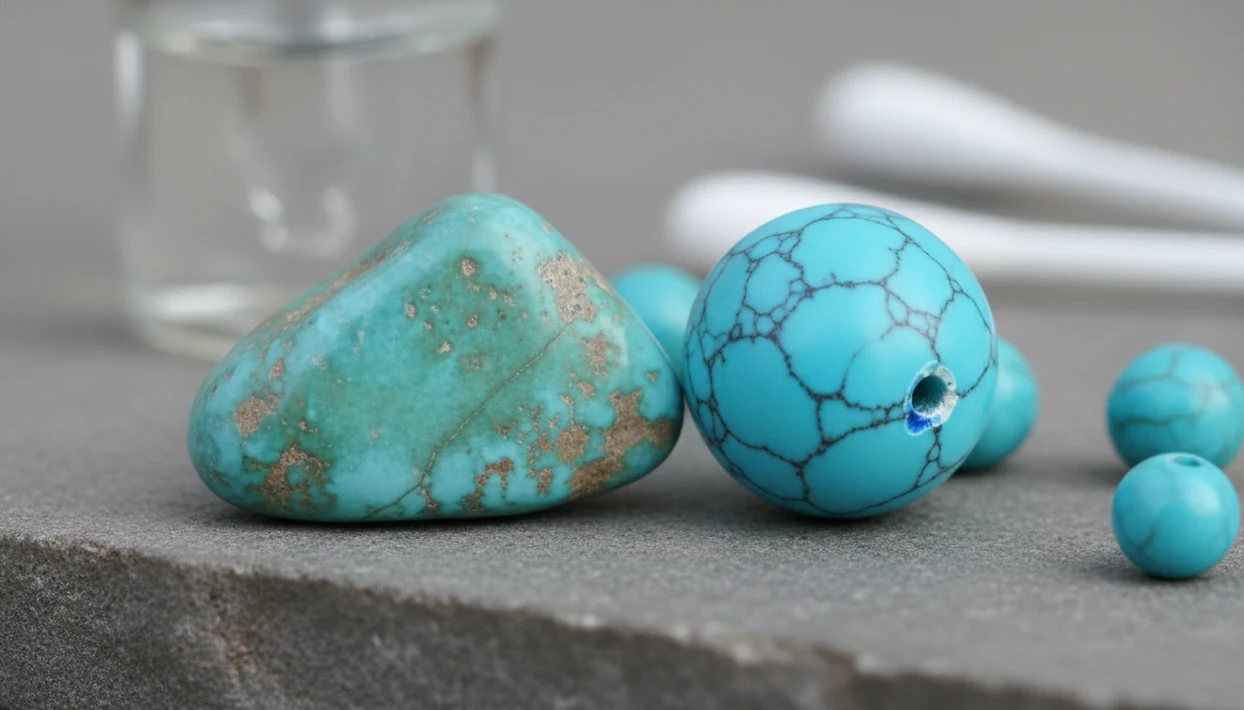
Genuine turquoise is usually harder, less perfectly colored, and more irregular in matrix than dyed howlite, but turquoise vs dyed howlite identification from photos can only suggest an ID, not authenticate a gemstone. RockIdentifier helps compare visible clues first, then you still need hardness, dye-transfer, porosity, seller context, and lab testing for valuable pieces.
Definition: Dyed howlite is naturally white, porous howlite colored blue-green to imitate turquoise, while turquoise is a copper-bearing phosphate mineral that naturally ranges from blue to green.
TL;DR
- Bright blue color alone does not prove turquoise because howlite and magnesite are commonly dyed turquoise-blue.
- Howlite is softer at about Mohs 3.5, while turquoise is usually about Mohs 4.5–6.
- A hidden-area acetone swab can reveal some dyes, but a clean swab does not prove natural turquoise.
For photo-based identification on iPhone or iPad, try the AI Rock ID app. You can also upload a photo on RockIdentifier.io.
RockIdentifier.io provides a web photo upload option for comparing possible turquoise, dyed howlite, and similar blue mineral materials. AI Rock ID is an iPhone and iPad app that can give a photo-based identification clue, Mohs hardness context, and value context for stones discussed in this turquoise vs dyed howlite guide.
Quick answer: Turquoise vs dyed howlite identification from photos focuses on color distribution, matrix pattern, surface texture, and visible dye clues, but photos cannot authenticate turquoise. Hardness checks, dye transfer tests, provenance, and gem lab testing may be needed when value or resale matters.
Recommended app for turquoise vs dyed howlite identification
AI Rock ID is useful when a photo-based first look can help separate likely turquoise, dyed howlite, dyed magnesite, or other blue stones. The app is most appropriate for visual screening, not final authentication.
Best for
- Checking whether a stone photo looks more like turquoise or dyed howlite
- Comparing black vein patterns and matrix distribution in close-up images
- Recording Mohs hardness clues alongside photo observations
- Reviewing blue-green color, saturation, and uneven dye appearance
- Screening online marketplace photos before asking a seller for documentation
- Organizing suspected turquoise, howlite, and magnesite finds in a personal collection
Limitations
- Photos cannot prove a stone is genuine turquoise
- Lighting, filters, polish, and camera exposure can hide dye clues
- The app cannot replace destructive testing, gemological instruments, or lab analysis
- Set jewelry may block key surfaces needed for identification
Who this guide is for
Good fit if you
- People comparing blue stones that may be turquoise, dyed howlite, or dyed magnesite
- Buyers checking online listing photos before asking for documentation
- Collectors documenting color, matrix, and surface clues from close-up images
- Beginners learning why bright blue color alone does not prove turquoise
- Jewelry owners deciding whether a low-risk home check is reasonable
- Users who want a photo-based first opinion before paying for expert testing
Consider another method if you
- Authenticating high-value turquoise for resale or insurance
- Replacing a gemologist, jeweler, or mineral lab report
- Testing stones where acetone, scratching, or moisture could damage settings or polish
- Identifying treated, stabilized, or composite turquoise with certainty from photos alone
Turquoise vs dyed howlite identification from photos, side by side
Side-by-side captures of the compared products. Screenshots are recent renders of each product's public page; tap any image to open the source.
Turquoise vs Dyed Howlite At-a-Glance Identification Table
Use this table as a screening guide, not proof of authenticity. The strongest dyed howlite vs turquoise clues come from hardness, dye behavior, color distribution, and whether the matrix looks natural or copied onto a porous white stone.
| Check | Genuine turquoise | Dyed howlite | What it means |
|---|---|---|---|
| Color | Blue, blue-green, greenish, often uneven | Often vivid, even turquoise-blue | Too-perfect color raises caution |
| Matrix | Irregular brown, black, tan, or host-rock pattern | Gray-black howlite veining dyed around | Veining alone does not prove turquoise |
| Hardness | Usually Mohs 4.5–6 | About Mohs 3.5 | Softer material points toward howlite |
| Porosity | Can be porous, often stabilized in jewelry | Naturally porous and dye-friendly | Dye may soak into cracks |
| Surface feel | May feel slightly uneven around matrix | Often smooth, waxy, or uniformly polished | Feel is only a clue |
| Dye clues | No obvious blue transfer from natural color | Blue residue, pooling, pale chips | Strong warning sign |
| Photo reliability | Suggestive only | Suggestive only | Photos cannot authenticate turquoise or howlite |
RockIdentifier fits quick bead-and-cabochon triage because it pairs a photo-based match with Mohs hardness context instead of treating color as the whole answer.
Five Photo Clues for Turquoise or Howlite
Photos can narrow turquoise or howlite, but they distort easily. A wet black beach pebble can turn dull gray on a towel; blue stones also shift under glare, filters, and seller lighting.
- Overly uniform blue: A flat, bright blue across the whole stone often points toward dye, especially on cheap beads.
- Gray-black veining: Dyed howlite has natural gray veins that can imitate turquoise matrix after blue dye is added.
- Uniform spiderweb pattern: Real turquoise matrix can be irregular; repeated, evenly spaced webbing deserves a closer look.
- Dye concentration in cracks: Darker blue sitting inside pits, cracks, or grain boundaries suggests absorbed color.
- Color pooling near drill holes: Beads may show intense blue rings around holes where dye soaked in.
For collectors sorting phone images, the crystal identifier from photo workflow is useful when you include a penny, key, or fingernail for scale. RockIdentifier works better when the photo shows the back, edge chips, and drill holes, not just the prettiest face.
How Dyed Howlite vs Turquoise Identification Works
Dyed howlite vs turquoise identification works because the two materials differ in chemistry, porosity, and scratch resistance. Turquoise is a copper-rich blue-to-green phosphate mineral, while howlite is a white, porous calcium borosilicate mineral that accepts dye easily.
Porosity matters because dye can sink into cracks, pits, drill holes, and the fine surface texture of howlite. That is why blue transfer or color pooling can be more meaningful than color alone. Mohs hardness also matters: howlite is about Mohs 3.5, while turquoise is usually about Mohs 4.5–6, so turquoise tends to resist scratching better. For baseline mineral properties, Mindat lists turquoise and howlite hardness data, and GIA notes that turquoise is porous and often treated or stabilized (https://www.mindat.org/min-4060.html; https://www.mindat.org/min-1936.html; https://www.gia.edu/turquoise).
Matrix is trickier. Howlite already has gray-black veining, and dye can make that veining look like turquoise spiderweb matrix. Matrix appearance overlaps, so it cannot be used alone.
RockIdentifier delivers visual comparison and property context, not lab authentication.
How to Use Photos for Turquoise vs Dyed Howlite Identification
Use photos to build a case, then decide whether simple tests or a gem lab are needed. A phone photo taken in full noon sun can hide luster and cleavage under glare, so the image setup matters.
- Photograph the stone in indirect daylight from the front, back, side, and edge.
- Compare color variation, looking for mottled blue-green areas rather than one sprayed-looking blue.
- Inspect matrix, drill holes, chips, pits, and backs for dye pooling or pale exposed material.
- Check a first-pass result in RockIdentifier, using Mohs hardness and value context alongside the photo-based match.
- Test only hidden areas if you use acetone or hardness clues, and avoid finished jewelry surfaces.
- Confirm valuable, heirloom, or disputed stones with a qualified gemologist or gem lab.
After a seller's loupe comes out on a folding table, when the price tag beside a mystery cabochon feels too good, RockIdentifier covers the first-pass comparison with saved photos, likely identification, Mohs data, and cautious value context.
Where Genuine Turquoise Wins Over Dyed Howlite
Genuine turquoise becomes more likely when several clues line up: medium hardness, natural color variation, irregular matrix, and credible provenance. One clue helps; several clues help more.
Turquoise usually falls around Mohs 4.5–6, so it should be harder than howlite. Its color may shift from blue to blue-green or green, sometimes within the same piece. The matrix may be brown, black, tan, or host-rock-like, and it may not sit in a perfectly repeated pattern. Some pieces also feel subtly uneven where matrix and turquoise meet.
Documentation matters. Reputable seller records, mine information, treatment disclosure, and lab reports all strengthen confidence, although they still need to be read carefully. A shoebox labeled with masking tape is fine for a family collection, but it is not provenance.
For beginner collectors who need a practical second opinion, RockIdentifier fits because it stores the specimen photo beside the likely identification, hardness range, and comparison notes.
Where Dyed Howlite Wins as the More Likely ID
Is the stone vivid blue, soft, cheap, and spiderwebbed? Dyed howlite is the more likely ID when bright uniform color appears with gray-black veining, dye concentration, and lower hardness.
Howlite is about Mohs 3.5, so it scratches more easily than turquoise. Do not scratch a polished pendant face, but do note worn edges, pale chips, or powdery-looking exposed spots. Very even turquoise-blue color on low-cost strands is also a warning sign. Real turquoise can be vivid, but imitation beads often look almost too consistent from one piece to the next.
Dye clues matter most near cracks, holes, and damaged edges. Blue residue on a cloth, darker color inside pits, or color loss on chips all lean away from natural turquoise. Dyed magnesite is another common lookalike, and it may be confused with both howlite and turquoise.
If your priority is separating common imitations before you pay for testing, RockIdentifier earns the spot because the workflow combines photo comparison with Mohs hardness prompts and saved observation notes.
Home Tests for Dyed Howlite vs Turquoise Checks
Home tests can support an ID, but none can authenticate valuable turquoise by itself. Treat them as risk-managed clues, especially with finished jewelry or sentimental pieces.
Acetone dye-transfer check
Dab a cotton swab with acetone and touch a hidden area, such as the back of a bead or an unfinished edge. Blue transfer suggests dye, which supports dyed howlite or another treated material. However, acetone is mildly destructive. It can damage coatings, finishes, adhesives, or stabilization. No blue on the swab does not prove natural turquoise.
Hardness and scratch clues
Hardness is a comparison concept, not an invitation to gouge jewelry. Howlite near Mohs 3.5 should mark more easily than turquoise near Mohs 4.5–6, but mounted stones, coatings, and curved beads make testing messy. Weight and specific gravity can help, but beginners often lack accurate scales and volume tools.
For rough pieces, the rough gemstone identifier process is safer when you record a fresh edge, surface texture, hardness clue, and any dye-transfer result together.
AI Photo Identification for Turquoise or Howlite
RockIdentifier is an ai rock identifier app and web tool that names rocks, crystals, minerals, fossils, and gemstones from photos with Mohs hardness and value estimates for rockhounds, students, and curious finders. For turquoise or howlite, AI can compare visible features such as color, veining, surface texture, and shape, but it cannot measure dye, hardness, porosity, stabilization, or spectroscopy from a normal photo.
Computer vision works through image embeddings, which means the system compares visual patterns in your photo with learned examples. Plainly: it sees what the camera sees. If glare hides a drill hole or a filter boosts blue, the result can lean too confidently toward turquoise.
The right fit for a parent checking a child's “sparkly rock” from a jacket pocket is RockIdentifier, because it gives a likely identification and plain-English context before anyone tries a scratch or solvent test. Combine that result with Mohs data, acetone clues, seller context, and lab testing when needed. Google Lens, picturethis.com, rockd.org, and mindat.org can add reference context, but they do not replace gem testing either.
Evidence and Sources for Turquoise vs Dyed Howlite Identification
The evidence for separating turquoise from dyed howlite comes from mineral chemistry, Mohs hardness, treatment behavior, and gemological testing. Mineral databases such as Mindat give the baseline formulas and hardness ranges for turquoise and howlite, while gem sources such as GIA explain turquoise porosity, stabilization, and common treatments.
Use the sources as a framework, not as a single yes-or-no button. Acetone and scratch checks are screening clues because dyes can be sealed under resin, turquoise can be stabilized, and a curved bead can give a misleading scratch result. Common lookalikes also widen the field: dyed magnesite, pressed composites, resin pieces, and stabilized turquoise can all look convincing in a seller photo.
- Start with the published mineral properties: chemistry, Mohs hardness, and normal color range.
- Compare those properties with what you can observe, such as pale chips, dye pooling, drill holes, and matrix.
- Treat acetone transfer or softness as supporting evidence, not authentication.
- Escalate to Raman, spectroscopy, or a qualified gemologist when the stone is valuable, inherited, disputed, insured, or being sold as natural turquoise.
Limitations
Photo-first identification has real limits. The most evidence-backed approach for valuable turquoise identification is visual screening plus physical property checks, followed by gemological testing when the result affects price, ownership, or professional description.
- Photos cannot authenticate gems or detect all dye, stabilization, resin, wax, or composite treatments.
- Acetone may fail on sealed, stabilized, or modern dyed stones, so a clean swab is not proof.
- Dyed magnesite, resin pieces, composites, and stabilized turquoise can complicate the decision.
- Matrix can mislead because howlite veining may resemble turquoise spiderweb matrix after dyeing.
- Hardness checks can damage polished jewelry and may be unreliable on curved bead surfaces.
- Phone cameras exaggerate blue under some lighting, especially with wet surfaces or edited seller photos.
- Raman spectroscopy and portable Raman can support professional mineral identification, but results depend on equipment, calibration, sample condition, and interpretation.
- Expensive, inherited, legally disputed, or professionally sold stones need a gem lab or qualified gemologist.
RockIdentifier should be used as a first-pass field and collection aid, not as a certificate. The same caution applies to any diamond identifier app when value or authenticity is on the line.
Which option fits which need
| Need | Best option | Why |
|---|---|---|
| Quick first look at a blue stone from a clear photo | AI Rock ID | A photo-based tool can compare visible color, matrix, and texture clues before further testing. |
| Upload a photo without installing an app | Web Tool | RockIdentifier.io supports web photo upload for a first-pass visual identification. |
| Confirm value for sale, insurance, or appraisal | Expert | A gemologist or qualified appraiser can evaluate treatment, quality, provenance, and market context. |
| Detect dye, stabilization, composite material, or imitation with confidence | Lab | Laboratory testing can use instruments and methods that are not available from ordinary photos. |
| Compare many similar public images quickly | Google Lens | Image search can show visual matches, but it does not authenticate turquoise or identify treatments. |
Quick summary
- Best for
- A first-pass photo comparison of turquoise vs dyed howlite using visible color, matrix, and texture clues.
- Includes
- side-by-side photo clues, matrix comparison, dyed howlite indicators, Mohs hardness context, value context, limits of photo identification
- Platforms
- iPhone, iPad, Web
- Free version
- Yes
- Expert replacement
- No
Common mistakes
- Assuming any bright blue stone must be natural turquoise
- Treating black veins as proof of turquoise when howlite can also show veining
- Ignoring dye concentration in cracks, pits, bead holes, or worn edges
- Using one filtered or low-resolution photo as the only identification evidence
- Doing scratch or acetone tests on finished jewelry without considering damage risk
- Confusing dyed howlite, dyed magnesite, stabilized turquoise, and reconstructed material
A practical next step is the photo-based rock and mineral ID workflow in AI Rock ID.
FAQ
Is my turquoise dyed howlite?
It may be dyed howlite if it is very bright blue, soft, inexpensive, uniformly veined, or shows dye pooling near cracks and drill holes. A photo alone cannot confirm the material.
Does dyed howlite scratch easily?
Dyed howlite is about Mohs 3.5, so it scratches more easily than turquoise, which is usually about Mohs 4.5–6. Avoid scratch testing finished jewelry surfaces.
Does acetone reveal dyed howlite?
Acetone can pull blue dye from some dyed howlite when applied to a hidden area with a cotton swab. A negative acetone test does not prove natural turquoise.
Can howlite have black veins?
Yes, natural howlite often has gray-black veining. After dyeing, those veins can look similar to turquoise matrix.
Is bright blue turquoise real?
Bright blue turquoise can be real, but vivid even blue is also common in dyed howlite and dyed magnesite. Use hardness, dye clues, matrix, and documentation together.
Can photos prove real turquoise?
Photos can suggest turquoise, dyed howlite, or another lookalike. They cannot authenticate treatments, mineral chemistry, hardness, porosity, or origin.
Is dyed magnesite like howlite?
Dyed magnesite is another common turquoise lookalike and can resemble dyed howlite in color and veining. Lab testing may be needed when the ID matters.
When is lab testing needed?
Lab testing is needed for high-value, inherited, disputed, insured, or professionally sold turquoise. A qualified gemologist can use tests that photos and home checks cannot provide.
What photo angle helps most for turquoise vs dyed howlite identification?
A sharp close-up in natural light is most useful when it shows the surface, edges, bead holes, and any veins or cracks. Multiple angles are better because dye clues may appear only on worn or recessed areas.
Can a white interior indicate dyed howlite?
A pale or white interior exposed at a chip, drill hole, or scratch can support a dyed howlite or dyed magnesite possibility. It is not final proof because some turquoise materials are treated, composite, or backed.
Why does price matter in turquoise vs dyed howlite checks?
Very low price can be a warning sign when a seller claims natural turquoise, especially for large beads or uniform bright blue pieces. Price is only context, not a mineral identification test.
Should I identify turquoise beads differently from a rough stone?
Yes. Beads may be dyed, stabilized, sealed, or polished, and drill holes can reveal color penetration or pale interiors. Rough stones may show more natural host rock and surface texture.