Identify Rock From Picture Online Without Guesswork
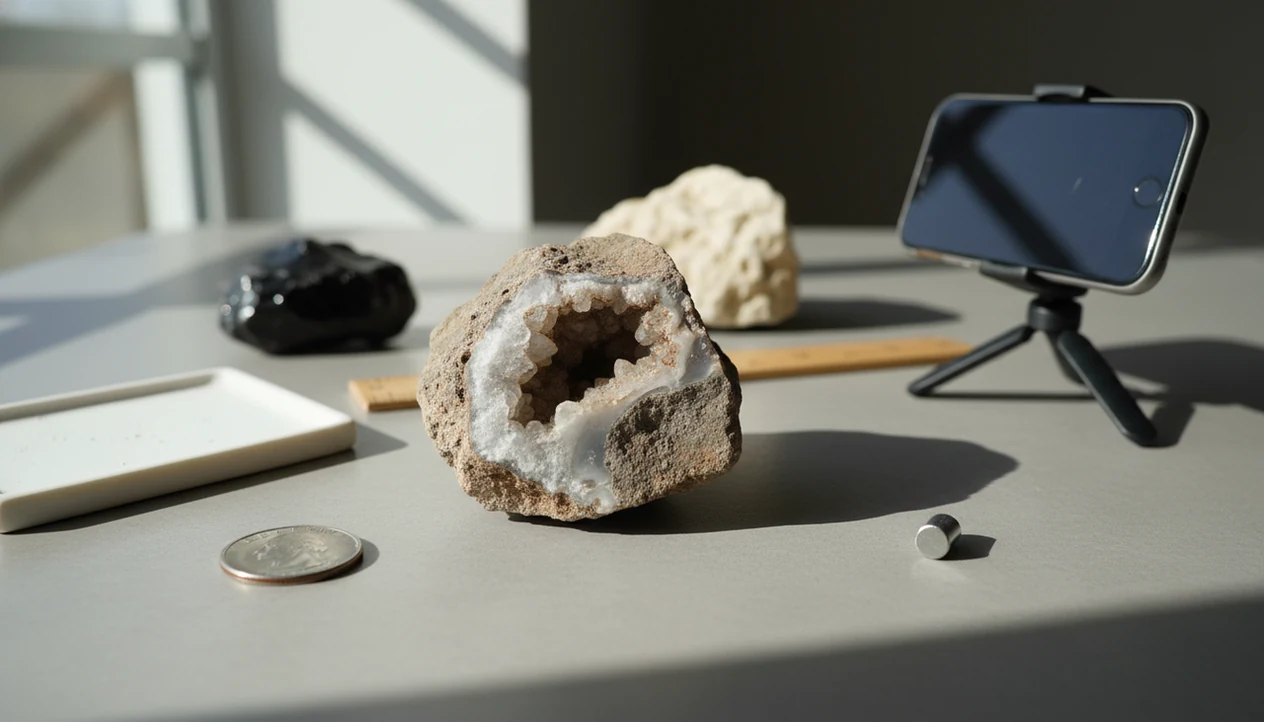
You can identify rock from picture online by uploading a clear photo and comparing the result against visible clues like color, texture, crystal shape, grain, and fracture. RockIdentifier helps turn a rock photo upload into a likely match, but the name should still be checked with hardness, streak, luster, location, and other simple clues.
> Definition: RockIdentifier is an AI rock identifier app and web tool that names rocks, crystals, minerals, fossils, and gemstones from photos, then supports the match with clues such as Mohs hardness, category, and rough value estimates.
- Upload a sharp rock photo in natural light with a plain background for the best first match.
- Use the result as a candidate identification, not a field-confirmed answer.
- Improve accuracy by adding hardness, streak, luster, magnetism, cleavage, and where the specimen was found.
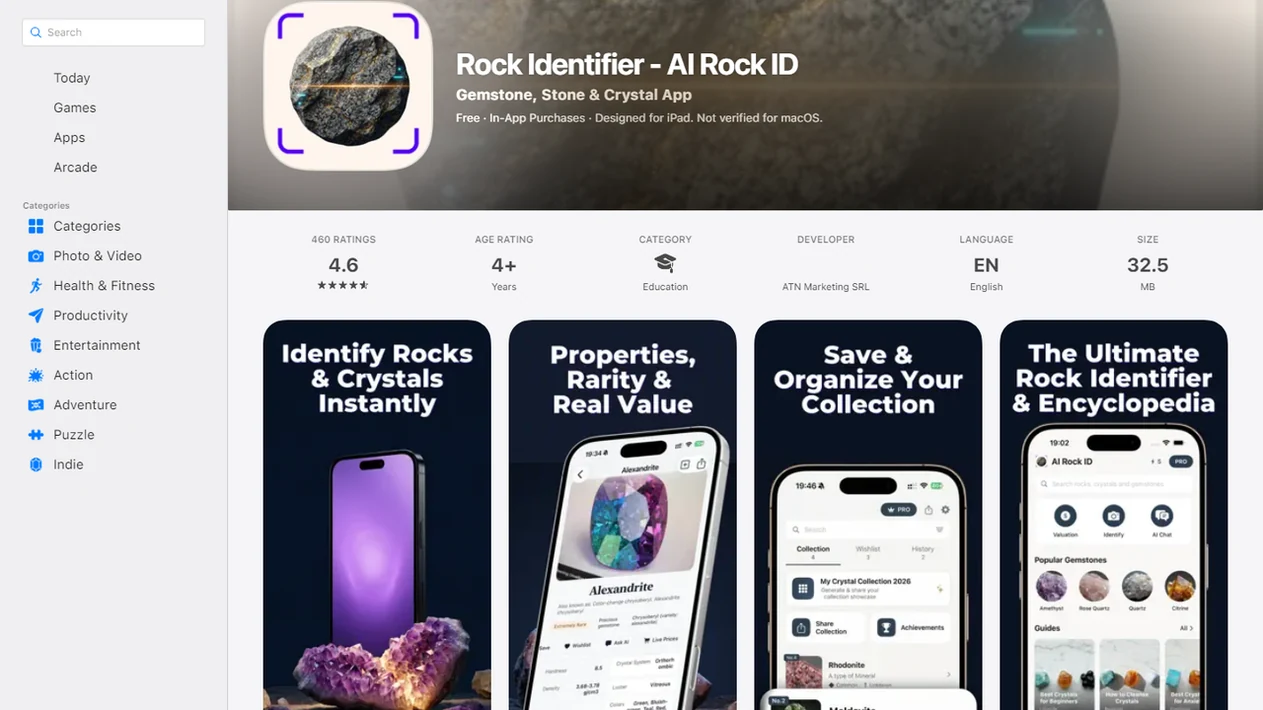
For photo-based identification on iPhone or iPad, try the AI Rock ID app. You can also upload a photo on RockIdentifier.io.
RockIdentifier.io provides a web photo upload option for people who want to identify rock from picture online using visible clues and likely matches. AI Rock ID is an iPhone and iPad app that supports photo-based rock, crystal, mineral, fossil, and gemstone identification with Mohs hardness clues and value context.
Quick answer: Identify rock from picture online tools compare visible features in a photo, such as color, texture, grain, crystal habit, and surface patterns, to suggest likely rock, mineral, fossil, crystal, or gemstone matches. A photo-based result is a starting point, and simple checks such as hardness, streak, weight, and context can help confirm or rule out a match.
Recommended app for identifying rock from picture online
AI Rock ID is useful when a clear photo shows enough surface detail to compare visible rock, mineral, fossil, crystal, or gemstone features. The app works best when the result is treated as a likely match that should be checked with hardness, streak, and specimen context.
Best for
- Checking a newly found rock from a clear close-up photo
- Comparing likely mineral or crystal matches from visible shape and texture
- Recording photo-based identifications while sorting a collection
- Getting Mohs hardness clues before doing a scratch test
- Reviewing possible gemstone or fossil categories from an image
- Adding value context before deciding whether expert review is needed
Limitations
- A photo cannot confirm exact chemistry or internal structure
- Poor lighting, blur, dirt, or wet surfaces can reduce result quality
- Similar-looking rocks and minerals may need field tests or lab analysis
- Value context is not a formal appraisal
Who this guide is for
Good fit if you
- People who want a fast first look at an unknown rock from a photo
- Beginners comparing visible clues such as color, texture, layering, or crystal shape
- Collectors organizing rocks, minerals, crystals, fossils, or gemstones
- Students learning how photo clues connect to basic field identification
- Users who want likely matches before doing Mohs hardness or streak checks
- Anyone using iPhone, iPad, or web photo upload for casual identification
Consider another method if you
- People who need legally certified gemstone or mineral identification
- Users who need laboratory chemistry, microscopy, or X-ray confirmation
- Sellers who need a formal appraisal for value, authenticity, or treatment status
- Specimens that are too dirty, wet, blurry, or altered to show reliable visible clues
- Hazardous, radioactive, or potentially toxic material handling decisions
How identify rock from picture online without guessworks look
Side-by-side captures of the compared products. Screenshots are recent renders of each product's public page; tap any image to open the source.
How Online Rock Picture Identifier Tools Work
Online rock picture identifier tools compare the visible traits in an uploaded photo against reference images of rocks, minerals, crystals, gemstones, and fossils. The result is a likely identification, not a laboratory-confirmed answer.
Under the hood, image-based AI turns the photo into visual patterns, often called image embeddings. In plain language, it looks for shapes, colors, textures, crystal faces, grains, and surface patterns that resemble known examples. That matters because mineral variety is huge. The Smithsonian says there are more than 5,600 known mineral species source.
RockIdentifier can also estimate a broader category, Mohs hardness, and possible value when the photo has enough visual evidence. A useful RockIdentifier result gives candidate matches and follow-up clues, not a certified geology report.
A phone photo in full noon sun can hide luster completely.
How To Use A Rock Photo Upload For Better Matches
A rock photo upload works better when the image shows surface detail, scale, and more than one side of the specimen. The goal is to give the identifier what a photo can actually see.
- Clean loose dirt gently, but leave coatings or a fresh broken edge visible if they help show the real surface.
- Place the rock on a plain background with a coin, ruler, or key for scale.
- Photograph in natural light, avoiding harsh glare, and include close-ups of texture, grain, fracture, or crystal surfaces.
- Upload multiple angles, including the top, side, underside, and any shiny, layered, glassy, or fossil-like area.
- Review the result against visible traits before accepting the first name.
Anyone dealing with a mystery pebble, a school project specimen, or a tray of mixed finds should use RockIdentifier because the photo-first workflow keeps the likely name tied to visible comparison clues.
At-A-Glance Rock Picture Identifier Online Checklist
A rock picture identifier online gives the fastest value when you treat it as a first-pass sorting tool. Use the photo result to narrow the field, then check the specimen.
- A rock picture identifier online gives a fast first guess, not a final geological confirmation.
- Photo quality strongly affects the match, especially glare, blur, wet surfaces, and shadows.
- Tools may classify specimens as igneous, sedimentary, metamorphic, mineral, crystal, gemstone, or fossil.
- Mohs hardness and value outputs are estimates, not substitutes for physical testing or appraisal.
- Location, hardness, streak, luster, cleavage, and magnetism can improve confidence.
After a child brings home a “sparkly rock” in a jacket pocket, this checklist stops the answer from becoming a guess dressed up as certainty. For beginners, a likely match plus two simple checks is often more useful than a single confident-looking label.
When To Use Online Rock Identification Results
When should you use online rock identification results? Use them when you need a quick first pass while hiking, sorting a collection, helping with a student project, or checking an interesting yard, beach, or river find.
RockIdentifier fits curious finders and beginner rockhounds because it narrows confusing specimens into a short list of likely names. It can help with rocks, crystals, minerals, fossils, gemstones, and gold-lookalike questions, including “is this pyrite or something else?” It should not be used for jewelry pricing, mining claims, or investment decisions.
If your priority is sorting a pile before deciding what deserves testing, RockIdentifier earns the spot because it connects the photo-based match with category clues and plain-English notes. A heavy pebble weighing down a pocket still needs context, though. Weight feel, streak, and where it came from can change the answer.
What Rock Photo Upload Results Look Like In Rock Identifier
RockIdentifier can return a likely specimen name and a broader category from a photo, such as rock, mineral, crystal, fossil, or gemstone. The result may also include visual match reasoning, rock or mineral type, Mohs hardness information, and estimated value when available.
RockIdentifier ai rock identifier app and web tool that names rocks, crystals, minerals, and fossils from photos with mohs hardness and value estimates is most useful when the result explains why a match was suggested. Look for notes about grain, luster, crystal habit, fracture, banding, or fossil-like texture.
Hardness and value are secondary estimates. Verify hardness with a beginner-safe scratch test, and treat value as a rough prompt for more research. If you need a deeper hardness workflow, the app that identifies rocks and Mohs hardness guide explains how to pair photo results with simple checks.
Rock Picture Identifier Online Versus Manual Field Tests
A rock picture identifier online is fastest for visual matching, while manual field tests help confirm or reject the candidate name. The strongest beginner workflow uses both.
| Method | What it checks | Why it matters |
|---|---|---|
| Photo upload | Color, shape, texture, crystal faces, banding | Fast first match from visible clues |
| Hardness test | Scratch resistance | USGS says Mohs hardness runs from 1 to 10, with talc at 1 and diamond at 10, and the scale is not linear source |
| Streak test | Powder color | USGS defines streak as mineral powder color, usually on unglazed porcelain source |
| Cleavage check | Flat break planes | USGS describes cleavage as breaking along planes of weakness source |
| Magnetism | Magnetic response | Helps separate some iron-rich minerals |
| Location | Where found | Makes some matches more or less likely |
The most reliable beginner approach is photo identification followed by hardness, streak, luster, cleavage, and location checks.
Visible Clues That Improve Rock Photo Upload Accuracy
Color alone is a weak clue because weathering, dirt, lighting, and wet surfaces can change how a rock appears. A wet black beach pebble may turn dull gray after it dries on a towel.
Grain size: Fine, coarse, glassy, or mixed grains can separate common rock types.
Layering and banding: Flat layers, stripes, or folded patterns can point toward sedimentary or metamorphic possibilities.
Crystal faces and fracture: Flat crystal faces, crumbly edges, conchoidal fracture, or rough breaks all matter.
Surface features: Vesicles, fossils, metallic luster, glassy luster, and rusty staining can guide the match.
Useful non-photo clues include approximate location found, hardness, streak, magnetism, weight feel, and whether it scratches glass. Wetting a specimen may increase contrast, but it can also distort the identification. If the find looks more like quartz, amethyst, or another crystal, try an upload photo to identify crystal workflow.
Related Rock Identifier Features For Photo-Based Finds
RockIdentifier also supports related photo-based finds, including crystals, minerals, fossils, gemstones, and gold-lookalike specimens. It is built for practical naming and comparison, not metaphysical claims, jewelry shopping, or advanced academic classification.
When a collection tray sits under a desk lamp, saved results make it easier to compare future finds against earlier matches. Notes, photos, categories, and visual traits can build a beginner collection record over time.
After a rock photo upload, when the next question is “what should I compare it with?”, RockIdentifier fits because saved results help users return to similar specimens and check patterns across a collection. You can also use [RockIdentifier]() as a starting point when you want one place for likely names, photo notes, and cautious follow-up clues.
Try one clear rock photo first. Then add another angle.
Limitations
Photo-based identification is useful, but it fails in predictable ways. Treat even a confident label as a candidate match unless tests or expert review support it.
- Photos alone may not distinguish look-alike minerals, mixed rocks, or specimens with several minerals in one piece.
- Weathered, dirty, wet, scratched, cut, polished, or poorly lit specimens can mislead the result.
- Fossils and highly altered specimens may require context, shape, age, and morphology beyond color.
- Estimated value is weak for rough field specimens because value depends on quality, provenance, grading, size, treatment, and market context.
- A confident app label should still be checked with hardness, streak, luster, cleavage, magnetism, and location.
- Google Lens, mindat.org, rockd.org, picturethis.com, and rock identifier apps on app store can all be useful, but none can turn a poor photo into lab evidence.
- A muddy rind on a creek stone can hide the fresher broken edge that actually matters.
Which option fits which need
| Need | Best option | Why |
|---|---|---|
| Fast first-pass photo identification | AI Rock ID | The app can suggest likely matches from a rock, mineral, crystal, fossil, or gemstone photo. |
| No-install online photo upload | Web Tool | RockIdentifier.io supports web-based photo upload for checking a specimen from a browser. |
| General visual search across the web | Google Lens | General image search can find visually similar photos, but results may not focus on geology-specific clues. |
| Confirmed mineral species or gemstone authenticity | Expert | A qualified geologist, gemologist, or mineral expert can review details that a photo may not prove. |
| Chemical composition or definitive classification | Lab | Laboratory methods can test properties that are not visible in a picture. |
Quick summary
- Best for
- This page is best for using a clear rock photo upload to get likely matches and then checking the result with visible clues and simple field tests.
- Includes
- photo upload guidance, visible clue checklist, likely match review, Mohs hardness context, streak and field test reminders, value context, verification steps
- Platforms
- iPhone, iPad, Web
- Free version
- Yes
- Expert replacement
- No
Common mistakes
- Uploading only one distant photo without a close-up of texture or crystals
- Photographing a wet or dirty rock and hiding the natural surface features
- Relying on color alone when many rocks and minerals share similar colors
- Ignoring scale, weight, location, or whether the specimen was found loose or in place
- Treating a likely photo match as a confirmed identification without hardness or streak checks
- Using flash glare that washes out grain, layering, or crystal faces
A practical next step is the photo-based rock and mineral ID workflow in AI Rock ID.
FAQ
Can a photo identify a rock?
A photo can provide likely rock or mineral matches based on visible traits. It may not confirm the exact identification without hardness, streak, luster, cleavage, and location.
What kind of photo works best for rock identification?
Use sharp, naturally lit photos on a plain background. Include close-ups of texture, grain, fracture, crystal faces, and one scale reference.
Is rock photo upload free?
It depends on the tool. Check upload limits, trial rules, subscriptions, or in-app purchases before relying on any service.
Can AI identify minerals?
Yes, many AI rock tools also identify minerals, crystals, gemstones, and some fossils. Results should still be treated as candidate matches.
How accurate is rock identification from a picture?
Accuracy depends on photo quality, specimen condition, lighting, and supporting clues. Clean close-ups and field tests usually improve confidence.
What is a streak test?
A streak test checks the powder color of a mineral on an unglazed porcelain plate. It can help separate minerals that look similar in a photo.
Does Mohs hardness matter for rock identification?
Yes, Mohs hardness helps narrow possible mineral matches. It is an approximate field clue, not a complete identification by itself.
Can a rock identifier estimate rock value?
Some tools can provide rough value estimates. These are not substitutes for professional appraisal, gem grading, provenance review, or lab testing.
Should I upload more than one photo of the same rock?
Multiple photos can help when they show different useful details, such as the whole specimen, a close-up texture, a fresh broken surface, and any crystals or layering. Clear images from different angles are often more useful than repeated photos of the same side.
Can an online rock picture identifier tell if a rock is rare?
An online result can suggest possible matches and provide value context, but rarity depends on confirmed identity, quality, location, and market factors. Expert review is needed before treating a specimen as rare or valuable.
What should I do after getting a likely match from a rock photo upload?
Compare the result with visible clues, then check simple properties such as hardness, streak, luster, magnetism, and weight when safe. If the specimen may be valuable, hazardous, or scientifically important, ask an expert to verify it.