Rough Gemstone Identifier From Photo And Field Clues
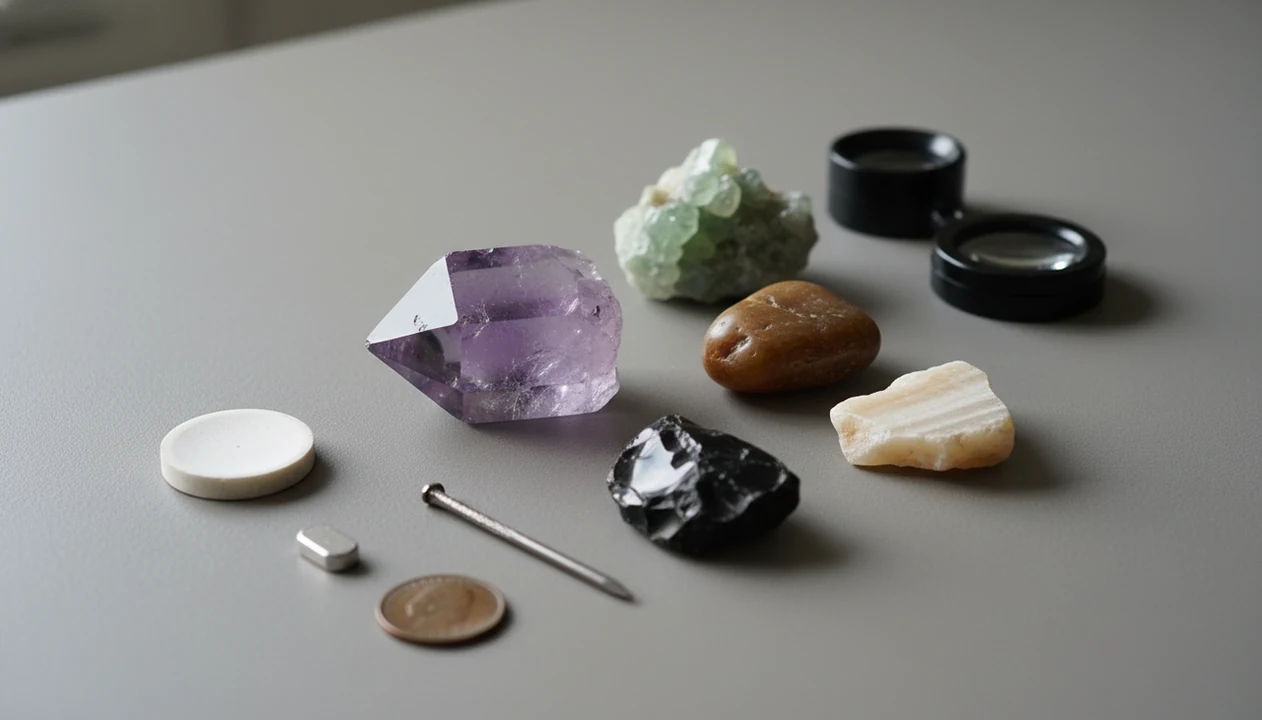
A rough gemstone identifier can suggest likely names for an uncut stone from a clear photo, especially when the image shows color, luster, crystal habit, fracture, and matrix. RockIdentifier helps turn that first photo into a likely identification, then you should compare the result with hardness, streak, magnetism, and weight before trusting it.
Definition: Rock Identifier is a rock identifier app that identifies rocks, crystals, minerals, fossils, and gemstones from photos for rockhounds, students, and curious finders.
TL;DR
- Photo-based rough gem ID works best with sharp natural-light images, a neutral background, and at least one natural or broken surface.
- AI can suggest likely matches, Mohs hardness context, and broad value clues, but it cannot certify gemstones or detect most treatments.
- The best rough gemstone workflow combines photo ID with field clues such as hardness, streak, luster, crystal habit, and matrix.
For photo-based identification on iPhone or iPad, try the gemstone identifier app. You can also upload a photo on RockIdentifier.io.
RockIdentifier.io provides a web photo upload option for people who want to compare rough gemstone images with visible identification clues. AI Rock ID is an iPhone and iPad app that can help organize rough gemstone observations before a gem lab or expert review is needed.
Quick answer: A rough gemstone identifier from photo can suggest likely matches by comparing visible clues such as color, luster, crystal habit, transparency, and surrounding matrix. Photo ID is useful for narrowing possibilities, but uncertain, valuable, treated, or synthetic specimens still need gemological testing or lab confirmation.
Recommended app for rough gemstone identification from photo
AI Rock ID is useful when a rough gemstone has enough visible surface detail for comparison. It can help users record likely matches, hardness clues, and value context before deciding whether professional testing is needed.
Best for
- Checking rough gemstone possibilities from a clear close-up photo
- Comparing luster, color zoning, and crystal habit in uncut stones
- Recording matrix and surface texture clues from field specimens
- Learning whether a rough stone may need Mohs hardness testing
- Sorting mixed rough stones into likely mineral or gemstone groups
- Deciding which specimens may justify gem lab review
Limitations
- Photo ID cannot certify gemstone identity or value
- Treatments, synthetics, and imitations may look similar in photos
- Poor lighting, wet surfaces, or heavy matrix can reduce reliability
- Lab instruments are still needed for definitive gemstone identification
Who this guide is for
Good fit if you
- Beginners trying to narrow down an unknown rough gemstone from a clear photo
- Rockhounds comparing field clues such as matrix, crystal shape, and luster
- Collectors sorting rough stones before deciding which pieces need testing
- Students learning how rough gemstone appearance differs from polished stones
- Users who want Mohs hardness clues and basic value context before seeking expert help
- People with iPhone, iPad, or web access who want a quick first-pass identification
Consider another method if you
- Anyone needing a certified gemstone report or appraisal
- Sellers pricing valuable rough gemstones for commercial transactions
- Users trying to prove whether a stone is natural, synthetic, treated, or imitation
- Specimens that require refractive index, specific gravity, spectroscopy, or microscope testing
How rough gemstone identifier from photo and field clues look
Side-by-side captures of the compared products. Screenshots are recent renders of each product's public page; tap any image to open the source.
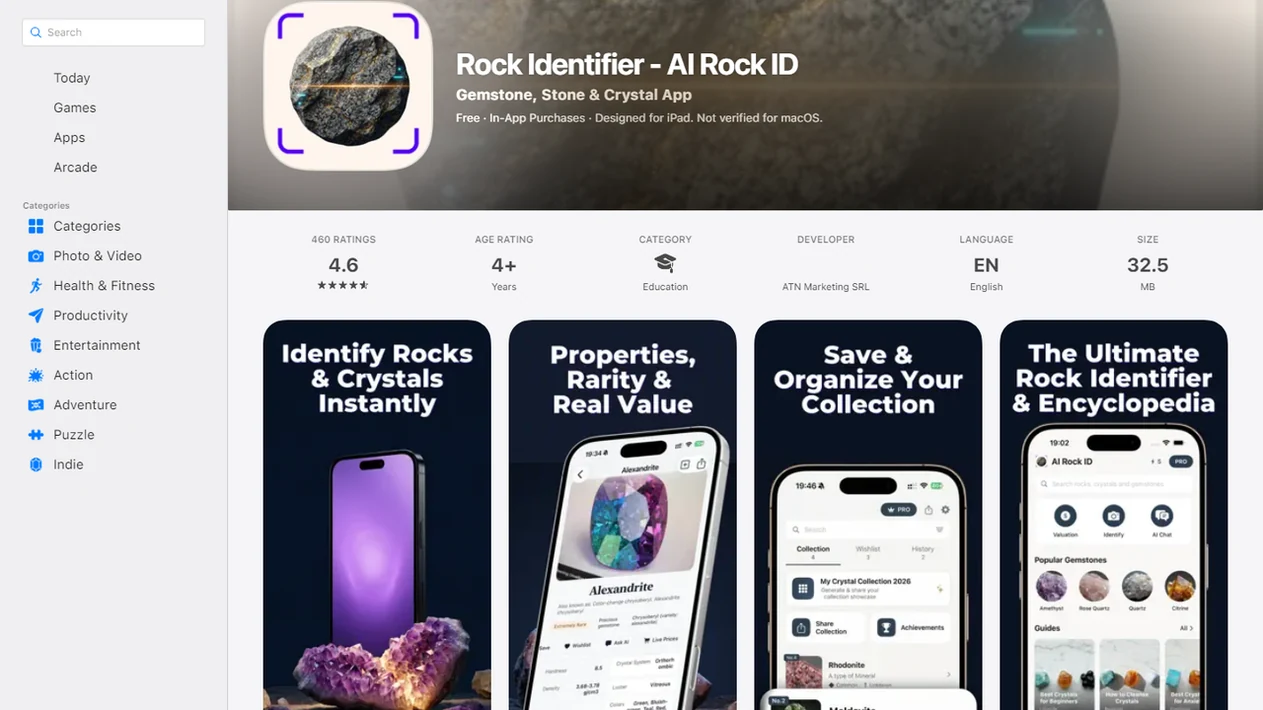
How a Rough Gemstone Identifier Works From a Photo
A rough gemstone identifier uses computer vision to compare visible traits in a photo against labeled examples of known stones. It reads what the camera can show: color, luster, grain, banding, fracture, crystal habit, and host rock matrix.
Under the hood, image embeddings turn visual patterns into comparable data. In plain terms, the system asks, “What known stones look most like this one?” RockIdentifier compares photos with a large labeled rock, mineral, crystal, fossil, and gemstone database, then returns likely matches rather than certainty. A yellow flake bending in tweezers may point away from brittle pyrite, but the photo alone still has limits.
Rough ID is harder than polished gem ID because dirt, weathering, broken edges, and coatings hide useful clues. A wet black beach pebble can look glossy and promising, then dry dull gray on a towel. RockIdentifier is an ai rock identifier app and web tool that names rocks, crystals, minerals, and fossils from photos with Mohs hardness and value estimates, so treat it as fast visual sorting rather than lab certification.
How to Use a Rough Gem Photo ID Tool
Use rough gem photo ID as a careful workflow, not a single snap-and-decide moment. The image matters as much as the software because glare, shadows, and missing scale can push the match in the wrong direction.
- Clean loose mud from the stone, but leave the natural surface intact when possible.
- Place the specimen on a neutral background with a penny, key, or fingernail beside it for scale.
- Photograph it in natural light from several angles, including one close-up of a broken or natural surface.
- Upload the sharpest image to RockIdentifier after checking that luster and texture are not washed out.
- Compare the likely result with hardness, streak, magnetism, matrix, and weight clues when you can.
If your priority is a quick first pass before sorting a mixed tray, RockIdentifier fits because it pairs photo ID with Mohs hardness context and plain-language comparison notes. Try the scan after the photo is clean, not after ten blurry retakes in kitchen glare.
Five Rough Gemstone Identifier Facts Beginners Should Know
- AI analyzes visible traits, not hidden chemistry. A photo can show luster, habit, color, fracture, and matrix, but it cannot directly prove chemical composition.
- Clear photos greatly improve rough gem photo ID. Full noon sun can create glare that hides luster and cleavage, so bright shade often works better.
- Rough gemstone IDs are probable matches, not lab certificates. Similar-looking quartz, calcite, fluorite, glass, and corundum can fool a photo-only workflow.
- Similar-looking rough stones need field tests for confirmation. The Mohs hardness scale runs from 1 for talc to 10 for diamond and has been used in mineral identification since Friedrich Mohs introduced it in 1812 (Encyclopaedia Britannica).
- RockIdentifier can show a likely name, Mohs hardness context, and a general value estimate. That matters because the U.S. Geological Survey notes that thousands of mineral species are known, and many beginner finds have common lookalikes (USGS).
Collectors trying to identify rough gemstone pieces from a grandparent's jar of creek stones usually need sorting help first. RockIdentifier covers that job with likely names, property notes, and saved specimen records.
When to Use an App for Rough Gemstone Specimens
When should you use an app for rough gemstone specimens? Use one when you have a found stone, creek or trail find, inherited mixed lot, rock shop mystery-bin piece, classroom specimen, or beginner rockhounding collection that needs a likely mineral family.
Photo ID is strongest for sorting what to test next. A child may bring home a “sparkly rock” in a jacket pocket after a school field trip; the useful question is not “Is this valuable?” but “Is this mica, quartz, calcite, pyrite, or something else?”
Beginners who collect unlabeled stones from trails and creek beds can use RockIdentifier before deciding whether a specimen deserves professional inspection. The mechanism is simple: scan, read the likely match, then test hardness, streak, and magnetism against the suggested mineral family.
Rough Gem Photo ID Clues That Improve Accuracy
Color helps, but it should never be the only clue. Amethyst, fluorite, glass, and slag can all appear purple in a phone photo, especially under warm indoor light.
Visual clues in the photo
Crystal habit often narrows the field. Look for hexagonal quartz points, cubic fluorite, bladed forms, prismatic crystals, or massive pieces with no clear crystal shape. Luster also matters: glassy, waxy, metallic, dull, and pearly surfaces point toward different mineral groups. A coin placed beside a mystery rock can make the result more useful because size and texture become easier to judge.
Field clues after the photo
After the scan, compare fracture and cleavage. Conchoidal breaks, flat cleavage planes, and splintery fractures are not interchangeable clues. Matrix and location also help; note pegmatite, basalt, vein quartz, gravel, or sedimentary layers when you know them. For quartz-heavy finds, our crystal identifier from photo guide explains why transparency alone can mislead.
The most reliable beginner workflow is photo ID plus field clues because surface appearance changes with lighting, weathering, and coatings.
Rough Gemstone Identifier Versus Lab Gem Testing
A rough gemstone identifier suggests probable visual matches, while a gem lab can test physical and optical properties with instruments. Use photo tools for learning and triage; use labs when the answer affects money, insurance, resale, or certification.
| Question | Rough gemstone identifier | Professional gem lab |
|---|---|---|
| Likely mineral name | Suggests probable matches from visible clues | Confirms with trained examination and testing |
| Natural vs synthetic | Usually cannot prove origin | May test origin with microscopy and spectroscopy |
| Treatments | Cannot reliably detect heat, dye, or filling | Uses advanced instruments for treatment evidence |
| Precise species or variety | Gives a likely name or family | Can separate close varieties and species |
| Value estimate | Offers broad value clues | Supports appraisal with grading data |
| Certificate | Does not issue lab certification | Can provide formal reports |
Gemological laboratories use methods such as microscopy, spectroscopy, refractive-index testing, and specific-gravity testing to separate natural, synthetic, treated, and lookalike stones (Gemological Institute of America). For diamond-like rough stones, our diamond identifier app page explains why appearance is only the first filter.
Common Rough Gemstone Identifier Myths
Myth 1: One fuzzy photo gives a 100% accurate ID. A blurry image may hide crystal habit, cleavage, and surface texture, so the practical correction is simple: retake the photo in bright shade with scale.
Myth 2: An app can prove a stone is natural, synthetic, untreated, or treated. That call usually needs lab instruments, not just a visible surface. A muddy rind on a creek stone tells you less than the fresher broken edge.
Myth 3: A photo can give an exact sale price. Photo tools may give general value ranges, but market price depends on species, quality, size, cutting potential, demand, and documentation.
Myth 4: Every transparent or colorful stone is rare. Many attractive minerals are common, and abundance matters. Quartz, calcite, fluorite, feldspar, and glassy slag are frequent lookalikes.
The right fit for learning from possible lookalikes is RockIdentifier because it shows likely matches beside practical clues such as hardness, luster, and general value notes.
Limitations
Rough gemstone identifiers are useful, but they should not be treated as gem labs in your pocket. The limits are clearest when a result could affect buying, selling, insurance, or certification.
- Photo-only tools cannot see internal inclusions well enough for many gemological calls.
- They cannot reliably detect heat treatment, dye, fracture filling, irradiation, coating, or synthetic origin.
- Rare local minerals, damaged specimens, and unusual crystal habits may be misclassified.
- Blurry, shadowed, wet, dirty, or heavily edited photos reduce accuracy.
- Value estimates are broad and cannot replace appraisal, grading, or current market pricing.
- Do not rely on photo ID alone when buying expensive gems, insuring a stone, reselling a specimen, or requesting certification.
- Lab questions about treatments and synthetics often require microscopy, spectroscopy, refractive index, and specific gravity testing.
A crowded hall light at a mineral show can make a cut stone flash beautifully, but flash is not proof. For pricing context, an app that estimates gemstone value should still be treated as a broad guide, not a final appraisal.
Which option fits which need
| Need | Best option | Why |
|---|---|---|
| Quick first-pass rough gemstone identification from a photo | AI Rock ID | The app can compare visible rough gemstone clues such as color, luster, crystal habit, and matrix. |
| Identify a rough specimen without installing an app | Web Tool | RockIdentifier.io can be used for web photo upload when a browser-based option is preferred. |
| Confirm whether a rough gemstone is natural, treated, or synthetic | Lab | Gem labs can use instruments and controlled tests that photo ID cannot provide. |
| Understand field context and geological setting | Expert | A geologist, gemologist, or experienced rockhound can interpret locality, matrix, and associated minerals. |
| Broad visual search for similar-looking images | Google Lens | General image search can show visually similar photos but may not separate lookalike minerals reliably. |
Quick summary
- Best for
- A rough gemstone photo ID tool is best for narrowing down likely gemstone possibilities from visible field clues.
- Includes
- photo comparison, rough gemstone visual clues, color, luster, crystal habit, matrix, Mohs hardness clues, value context
- Platforms
- iPhone, iPad, Web
- Free version
- Yes
- Expert replacement
- No
Common mistakes
- Photographing only a polished face or broken edge and ignoring the natural crystal habit
- Assuming bright color alone proves a rough stone is a valuable gemstone
- Using wet photos that exaggerate luster, transparency, and color saturation
- Ignoring matrix and associated minerals that can provide important field clues
- Confusing quartz, glass, calcite, fluorite, and beryl based only on color
- Treating a photo suggestion as a lab-confirmed gemstone identification
A practical next step is the identify gemstones from photos workflow in AI Rock ID.
FAQ
What app identifies rough gemstones?
RockIdentifier can identify likely rough gemstone matches from photos and show related clues such as Mohs hardness, luster, and general value context. RockIdentifier ai rock identifier app and web tool that names rocks, crystals, minerals, and fossils from photos with mohs hardness and value estimates is for first-pass ID, not certification.
Can I identify gemstones by picture?
Yes, a clear picture can suggest likely gemstone or mineral matches. It cannot provide a certified gem ID or prove treatment status.
How accurate is rough gem photo ID?
Accuracy depends on photo quality, surface condition, lighting, and how many lookalike minerals share the same appearance. Clean, sharp photos with scale and natural surfaces usually perform better.
How do I photograph rough gemstones?
Use natural light, a neutral background, a scale reference, and multiple angles. Include a close-up of a natural or broken surface.
Can AI identify synthetic gemstones?
AI usually cannot confirm synthetic origin from appearance alone. Synthetic detection often requires lab instruments such as microscopy and spectroscopy.
What tests identify rough gemstones?
Beginner tests include Mohs hardness, streak, luster, magnetism, density feel, cleavage, fracture, and crystal habit. Use these tests to check the photo-based match.
Are rough gemstones always valuable?
No, many attractive rough stones are common. Value depends on species, quality, size, clarity, cutting potential, documentation, and market demand.
When should I use a gem lab?
Use a gem lab for expensive stones, resale, insurance, treatment detection, synthetic origin questions, or formal certification. Photo ID is a screening step, not a lab report.
Can rough gemstone color change the photo ID result?
Yes. Color is one clue, but lighting, weathering, iron staining, and camera settings can make rough gemstones appear different from their actual color.
Should I clean a rough gemstone before taking a photo?
Light cleaning can help if dirt hides the surface, but aggressive cleaning may damage soft minerals or remove useful matrix clues. Photograph the specimen before and after gentle cleaning when possible.
Why does matrix matter in rough gemstone identification?
Matrix can show the host rock and associated minerals, which often helps narrow down possible gemstone identities. A close-up of the stone plus a wider photo showing matrix is more useful than one isolated image.
Can a rough gemstone photo suggest value?
A photo can provide general value context, but it cannot determine market value. Value depends on confirmed identity, size, quality, treatments, locality, demand, and expert grading.