Rock Identifier Accuracy and Limits for Photo-Based ID
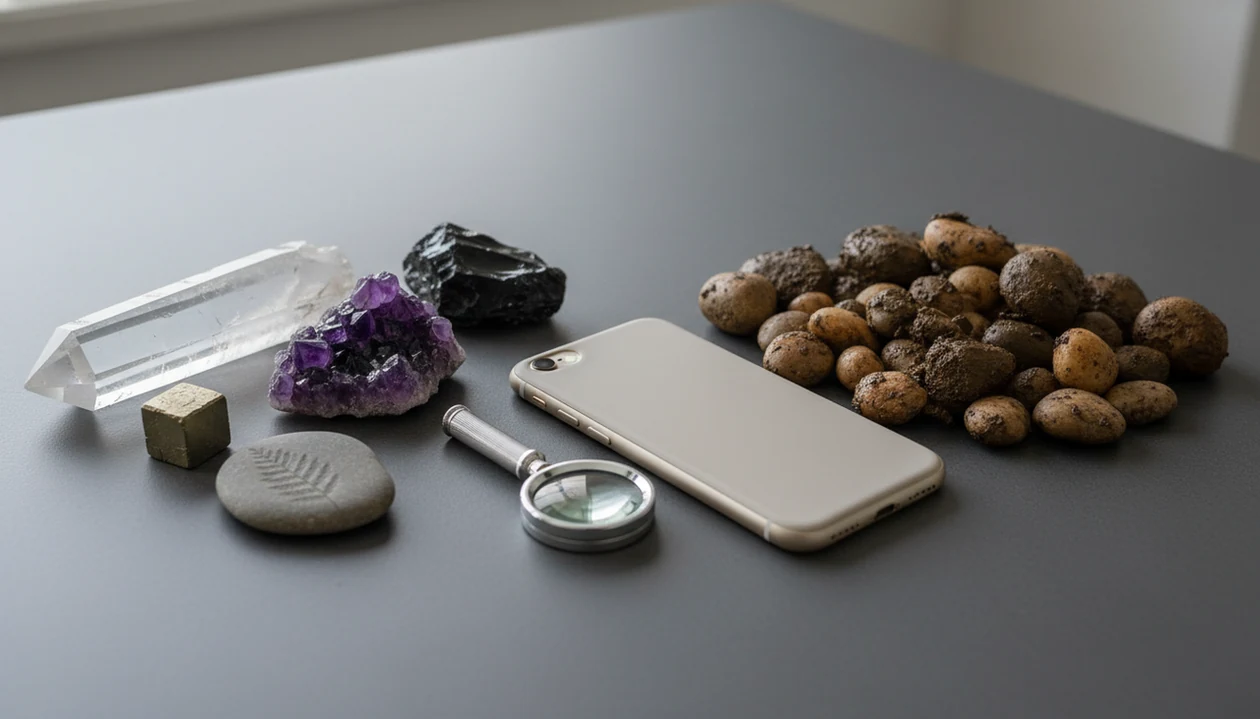
Rock identifier accuracy is strongest for common, visually distinctive rocks, crystals, minerals, and fossils, but it drops when a specimen is weathered, mixed, rare, poorly photographed, or visually similar to another species. Treat photo-based results as informed suggestions, then confirm important IDs with hardness, streak, magnetism, density, location context, or expert review.
Definition: A rock identifier app uses photos to suggest likely rocks, crystals, minerals, fossils, or gemstones, but the result should be verified with physical tests or expert review when accuracy matters.
TL;DR
- Photo-based rock ID is best for common, distinctive specimens such as quartz, granite, obsidian, pyrite, amethyst, and many recognizable fossils.
- Accuracy depends heavily on photo quality, visible surfaces, specimen condition, database coverage, and whether the result is checked with physical tests.
- Rock ID apps cannot replace lab analysis, geologists, or gemologists for rare minerals, look-alikes, treated gemstones, exact value, or high-stakes decisions.
For photo-based identification on iPhone or iPad, try the rock and crystal identifier. You can also upload a photo on RockIdentifier.io.
RockIdentifier.io provides a web photo upload option for people who want a first-pass identification of rocks, crystals, minerals, fossils, or gemstones. AI Rock ID is an iPhone and iPad app that can support photo-based identification, but this article explains why results should be checked against specimen features and follow-up tests.
Quick answer: Rock identifier accuracy depends on photo quality, visible features, specimen type, and whether the result is checked with physical tests. Photo-based identification can provide useful starting points, but similar-looking rocks, minerals, fossils, crystals, and gemstones may require hardness, streak, density, locality, or expert review.
Recommended app for rock identifier accuracy checks
AI Rock ID can be useful when a clear specimen photo and basic context are available. It is most appropriate as a starting point for narrowing possibilities, not as a substitute for a geologist, gemologist, or lab.
Best for
- Checking likely names for common rocks and minerals
- Comparing a crystal or gemstone photo with visual matches
- Recording Mohs hardness clues alongside an identification attempt
- Reviewing multiple photos of the same specimen from different angles
- Learning why color alone is not enough for reliable identification
- Deciding whether a specimen needs expert or lab review
Limitations
- Photo results can be less reliable for look-alike minerals and altered specimens
- Rare minerals may not be identified confidently from images alone
- Value context is not a certified appraisal
- Hazardous or high-value specimens should be reviewed by a qualified expert
Who this guide is for
Good fit if you
- Beginners who want to understand what affects rock identifier accuracy
- Collectors comparing multiple possible names for a rock, mineral, crystal, fossil, or gemstone
- Users who can take clear photos from several angles
- People willing to add context such as location, texture, color, and visible crystal shape
- Learners who want to combine photo results with Mohs hardness clues
- Hobbyists who need a first-pass ID before deciding whether to ask an expert
Consider another method if you
- Users who need a certified gemstone appraisal or legal valuation
- People identifying rare minerals from one unclear photo
- Anyone needing safety decisions about asbestos, radioactive minerals, or hazardous materials
- Sellers who need a lab report for high-value stones
- Users who cannot provide photos, context, or basic follow-up observations
Rock Identifier Accuracy at a Glance
Rock identifier accuracy is variable, not absolute. It is usually strongest when the specimen has clear visual clues and weakest when the image hides the traits that separate one mineral from another.
A clean quartz point, purple amethyst cluster, black glassy obsidian chip, or obvious fossil imprint gives the software more to compare. A muddy creek stone, a wet beach pebble, or a polished shop specimen gives less. We’ve seen a wet black beach pebble turn dull gray after drying on a towel, which changes the visual match completely.
Confidence is not proof. For important IDs, compare the surface, note the context, and check hardness, streak, magnetism, or heft before trusting the label.
Five Facts About AI Rock ID Accuracy
- AI rock ID accuracy is highest for common, visually distinctive specimens. Quartz, granite, obsidian, pyrite, amethyst, pumice, and many fossils often have visible traits that match training examples.
- Poor photos reduce accuracy fast. Blur, glare, dirt, reflections, filters, and clutter can hide luster, crystal shape, banding, or fossil pattern. A phone photo taken in full noon sun can wash out cleavage and make a shiny mineral look flat.
- Rare minerals and look-alikes are harder. Mineral databases contain thousands of valid species, and many share color or surface texture.
- App results work best as a shortlist. The top result should be read beside likely alternatives, not treated as final proof.
- Physical checks improve confidence. Mohs hardness, streak, magnetism, density, locality, and trusted references help confirm or correct a photo-based match.
How Photo-Based Rock Identifier Accuracy Works
Photo-based rock identifier accuracy comes from comparing visible traits in an image with learned examples of rocks, minerals, crystals, gemstones, and fossils. The system reads patterns such as color, texture, luster, crystal habit, banding, shape, fracture, and fossil outlines.
In technical terms, the model uses image embeddings. In plain language, it turns the photo into a set of visual clues and compares those clues with known examples. A result may include a confidence score and likely alternatives, especially when several materials look similar.
What the app can see matters. What a photo cannot confirm matters more. A camera cannot directly measure chemistry, crystal structure, refractive index, or exact density, which is why photo identification limits are part of any honest result.
Specimen Types With the Highest Rock App Accuracy
Some specimens give photo tools a fair chance because their visual clues are strong and common.
- Quartz and amethyst: Clear, milky, or purple crystal habits are often recognizable when the faces are clean.
- Obsidian and pumice: Glassy luster or frothy texture can stand out in a plain photo.
- Granite and sandstone: Grain size, color mix, and layering help the model sort broad rock types.
- Pyrite and common fossils: Cubic shine, brassy color, shell shapes, or leaf impressions can create strong matches.
A fresh broken edge often identifies better than a weathered rind. We usually photograph both, because the outside tells the field story and the inside shows cleaner texture. Multiple clear angles improve the top suggestion.
Specimen Types That Lower AI Rock ID Accuracy
Does AI rock ID accuracy drop for certain specimens? Yes. Weathered, stained, dirty, wet, polished, coated, or broken pieces are more likely to be misread because the surface no longer shows the original mineral clearly.
Mixed rocks are another trouble spot. Breccias, conglomerates, altered volcanic material, slag, concrete, glass, and man-made look-alikes can combine clues from several categories. A heavy pebble weighing down a pocket might feel metallic, but the photo may only show a dark lump.
Gold look-alikes need extra caution. Pyrite, chalcopyrite, mica, and brass-colored slag can fool both beginners and software. Value-sensitive gemstones also need more than a photo; our separate note on diamond photo identification limitations explains why lab tests matter.
Photo Quality Factors Behind Rock App Limitations
Photo quality is one of the main rock app limitations because the model can only judge visible evidence. Natural light, sharp focus, a plain background, a scale object, and several angles usually produce better results than one dramatic close-up.
Use a penny, key, or fingernail beside the specimen for scale. Avoid glare, filters, heavy shadows, motion blur, and cluttered workbenches. A collection tray under a desk lamp can help, but tilt the rock until glare stops hiding the surface.
Close-ups are useful, but they can remove context. Include the whole specimen, then add a fresh broken surface and the exterior surface when possible. If location tags are saved with field photos, review your privacy and location choices before sharing.
Physical Tests That Improve Rock Identifier Confidence
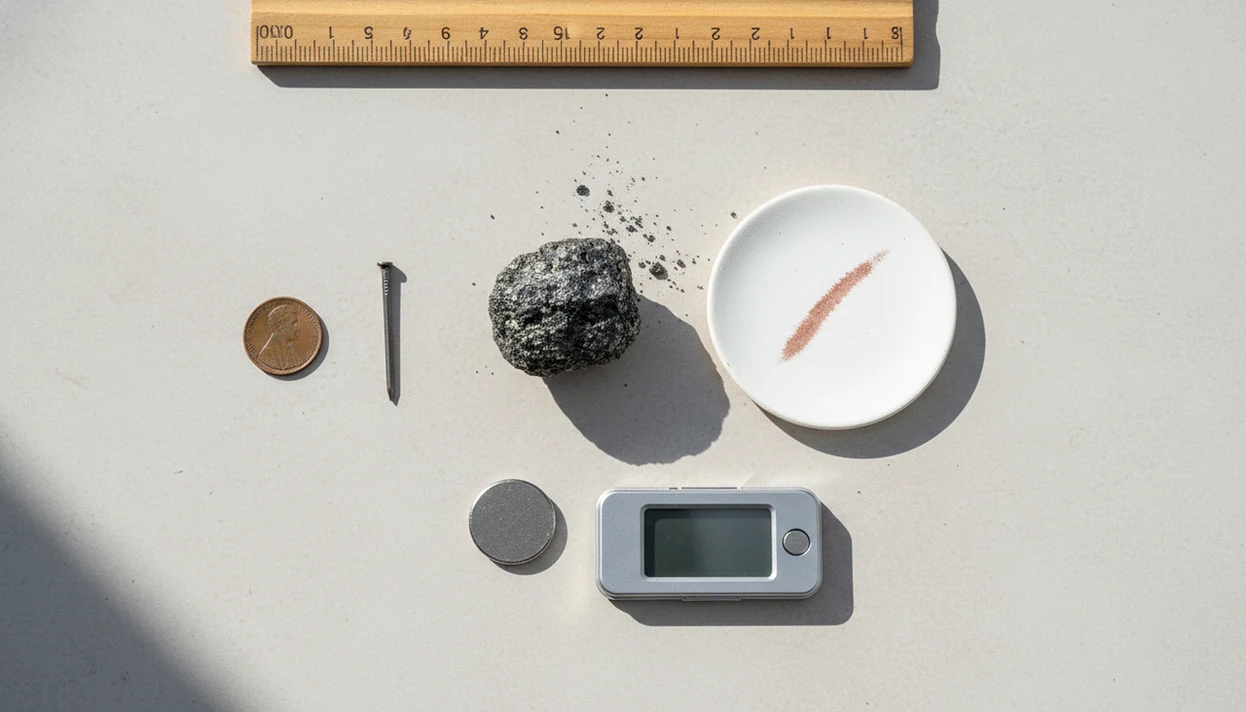
Physical tests improve rock identifier confidence by checking the app’s top result against traits a photo cannot measure well. Use beginner-safe tests gently, and do not scratch valuable, fragile, polished, or collectible specimens.
For reference, the Mohs hardness scale is a relative 1-to-10 scratch-resistance scale used in gem and mineral identification; see GIA’s overview: https://www.gia.edu/gia-news-research/mohs-scale.
| Test | What it checks | How it helps |
|---|---|---|
| Mohs hardness | Scratch resistance from talc at 1 to diamond at 10 | Narrows minerals that look alike in color |
| Streak | Powder color on unglazed porcelain | Separates some metallic minerals from look-alikes |
| Magnetism | Attraction to a magnet | Flags magnetite and some iron-rich material |
| Heft or density | Weight for size | Helps compare quartz, slag, ore, and heavy minerals |
| Dilute acid | Carbonate reaction where appropriate | Supports calcite or limestone possibilities |
| Locality | Where it was found | Removes unlikely species from the shortlist |
For beginners, a hardness test plus streak and location is often more useful than another close-up because it adds evidence the camera never captured. If a label already entered your collection, fix mislabeled rock collection steps can help clean the record.
Common Myths About AI Rock ID Accuracy
- Myth: an app is always 100% accurate. No photo-based system can guarantee every rock, mineral, fossil, or gemstone from one image.
- Myth: the first confident-looking name must be correct. A polished red stone could suggest several minerals until hardness, streak, and transparency are checked.
- Myth: photo ID can reliably give exact market value. Value depends on size, quality, treatment, provenance, demand, and authenticity. For more detail, read rock value estimate limitations.
- Myth: apps replace geologists, gemologists, or lab testing. Professionals still matter for rare, altered, valuable, or disputed material.
- Myth: color alone identifies a rock or mineral. Color is helpful, but luster, hardness, habit, streak, and context often matter more. A good ai rock identifier app and web tool that names rocks, crystals, minerals, and fossils from photos with mohs hardness and value estimates should deliver a likely identification and next checks, not a certified conclusion.
Evidence Sources for Photo-Based Rock ID Limits
Photo-based rock ID limits are based on the gap between visible clues and measurable mineral properties. Authoritative mineral lists and gem references support the same caution: a picture can suggest a name, but it cannot prove every property behind that name.
The International Mineralogical Association recognizes a very large set of approved mineral names, which raises the chance of look-alikes when color, luster, or crystal shape overlap. GIA’s Mohs hardness reference is a reminder that mineral identification often depends on properties a camera does not test, such as scratch resistance, toughness, optical behavior, and other physical clues. A photo also cannot directly confirm chemistry, density, or refractive index; it can only show surfaces, shapes, colors, and textures that may correlate with them.
When an app result matters, use it as the first pass:
- Treat the top match as a shortlist, not a certified label.
- Compare the suggested alternatives for shared color, habit, and luster.
- Add safe checks such as hardness, streak, magnetism, heft, and locality.
- Ask a geologist, gemologist, or lab to confirm valuable, rare, altered, or disputed specimens.
Limitations
Photo-based ID has real limits. That is not a failure; it is the boundary between visual matching and mineral testing.
- A phone camera cannot measure chemical composition, crystal structure, refractive index, or precise density.
- Many mineral species look similar in photos; the International Mineralogical Association maintains an official list of thousands of approved mineral names: https://mineralogy-ima.org/Minlist.htm.
- Internal accuracy claims may not match uncontrolled user photos from trails, beaches, classrooms, or dim garages.
- Training data can bias a model toward common rocks and minerals.
- Weathering, coatings, polishing, wet surfaces, slag, concrete, glass, and altered material can be misread.
- Exact species, variety, treatment status, provenance, and market value may require expert or lab review.
- Do not rely on one photo-based result for buying, selling, safety, mining, legal, or academic decisions.
- Collection rules and field safety still apply; check collection location safety for rockhounds before removing material.
Tools like RockIdentifier can be useful for a first pass, but important claims need stronger evidence.
When to Ask a Geologist, Gemologist, or Lab
Ask a professional whenever the result could affect money, safety, ownership, records, or legal choices. A photo result can guide your next question, but it should not be the only evidence for high-stakes rock, mineral, fossil, or gemstone decisions.
Use the right expert for the problem. Gemstones need gemological testing before serious buying, selling, appraisal, or insurance, especially when treatment, imitation, or origin could change value. Field specimens may need a geologist when the location, layer, formation, or academic record matters. Potentially hazardous, rare, disputed, or legally sensitive material deserves review before it is handled, sold, mined, donated, or labeled as certain.
- Pause before acting on a photo ID if the specimen may be valuable, rare, dangerous, protected, or disputed.
- Document the find with clear photos, size, weight, date, location notes, and any safe test results.
- Choose a gemologist or lab for gemstones, treatments, authenticity, value, and insurance paperwork.
- Ask a geologist for field context, provenance, stratigraphy, or research-grade identification.
- Avoid using photo ID alone for safety, mining, legal, academic, or major financial decisions.
Which option fits which need
| Need | Best option | Why |
|---|---|---|
| First-pass identification from clear photos | AI Rock ID | The app can compare visible features and suggest likely matches for common specimens. |
| Desktop or browser-based photo upload | Web Tool | RockIdentifier.io supports web photo upload when a user is not working from the iPhone or iPad app. |
| Certified gemstone identity or value | Lab | A lab can perform controlled testing and issue documentation when visual identification is not enough. |
| Field context and geological interpretation | Expert | A geologist can evaluate locality, formation, texture, and physical properties together. |
| Broad visual search for similar-looking images | Google Lens | General image search can show visual similarities, but it does not confirm mineral properties. |
Quick summary
- Best for
- This page is best for understanding the accuracy and limits of photo-based rock, mineral, crystal, fossil, and gemstone identification.
- Includes
- photo quality factors, specimen types, AI rock ID limits, Mohs hardness clues, follow-up tests, expert review guidance
- Platforms
- iPhone, iPad, Web
- Free version
- Yes
- Expert replacement
- No
Common mistakes
- Assuming one photo is enough when important surfaces, crystals, or textures are not visible
- Treating color as a confirmed identity instead of one clue among several
- Ignoring Mohs hardness, streak, luster, cleavage, and density clues
- Using a wet, polished, dirty, or shadowed specimen photo without noting the condition
- Expecting a photo-based result to distinguish every rare mineral or gemstone look-alike
- Using an app result as a certified appraisal or lab-grade identification
A practical next step is the snap a photo for a likely name workflow in AI Rock ID.
FAQ
How accurate are rock identifier apps?
Photo-based rock ID accuracy varies by specimen type, photo quality, surface condition, and whether the result is checked with physical tests. Treat the result as a likely identification, not final proof.
Can an app identify rocks?
Yes, an app can identify many common rocks, minerals, crystals, and fossils from photos. The result should be used as a suggestion that needs context and verification.
Why was my rock misidentified?
Common causes include poor lighting, blur, weathering, dirt, wet surfaces, mixed material, or visually similar minerals. One photo may not show the trait that separates the correct match.
Are rock ID apps reliable?
Rock ID apps are more reliable for common, distinctive specimens than for rare, altered, valuable, or mixed material. Verification with hardness, streak, magnetism, density, or expert review is still important.
Can photos identify minerals?
Photos can identify many visible mineral traits, including color, habit, luster, and banding. They cannot directly confirm chemistry or crystal structure.
What improves rock ID accuracy?
Use natural light, sharp focus, a plain background, scale, and multiple angles. Add physical tests such as Mohs hardness, streak, magnetism, and locality when safe.
Can apps identify rare minerals?
Rare minerals are harder to identify because training examples may be limited and visual overlap can be high. Expert review or lab testing may be needed.
Can Rock Identifier value rocks?
RockIdentifier may provide approximate value context, but photos cannot confirm treatment, provenance, authenticity, or current buyer demand. Use appraisal or market verification for serious buying or selling.
Does hardness confirm rock identity?
Mohs hardness helps narrow the possibilities, especially when minerals look similar. It rarely proves identity by itself.
When should I ask a geologist?
Ask a geologist, gemologist, or lab when the specimen is valuable, rare, dangerous, legally sensitive, academically important, or still uncertain after basic tests. RockIdentifier should not be the only evidence in those cases.
Does location improve photo-based rock identification?
Location can improve confidence because many rocks and minerals are more likely in certain geological settings. A photo result is stronger when locality matches the specimen’s likely occurrence.
Should I photograph a rock before or after cleaning it?
A lightly cleaned specimen is usually easier to photograph, but aggressive cleaning can remove useful surface clues. If cleaning changes the appearance, note that when reviewing the identification.
Can lighting change a rock identifier result?
Lighting can affect perceived color, luster, transparency, and texture. Natural, even lighting and multiple angles usually provide better visual evidence than harsh flash or strong shadows.
Why do polished stones reduce identification confidence?
Polishing can hide fracture, grain, cleavage, weathering, and other diagnostic features. A polished stone may still be identifiable, but it often needs hardness, density, or expert review for higher confidence.