Luster In Mineral Identification From Photos And Hand Samples
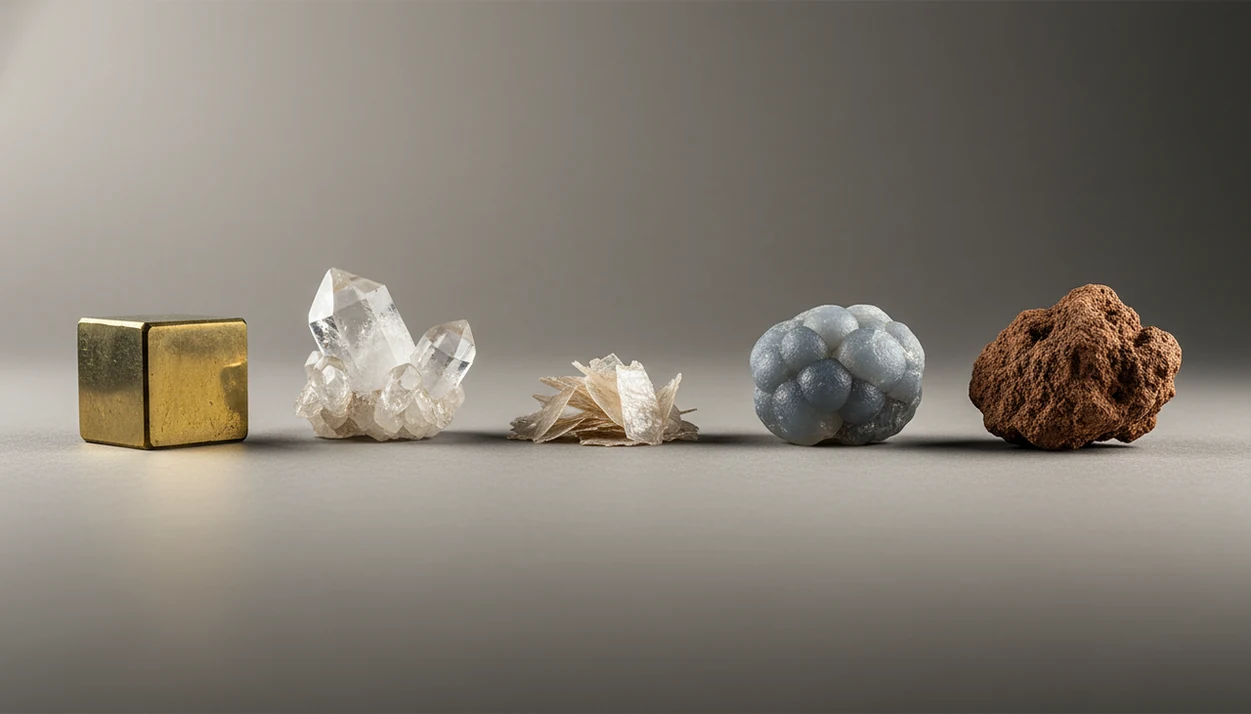
Luster in mineral identification is the way a mineral surface reflects light, such as metallic, glassy, waxy, pearly, dull, or earthy. For quick photo and hand-sample ID, judge luster on a fresh, clean surface and use it with hardness, streak, cleavage, and other clues.
> Definition: Mineral luster is the visible quality of reflected light from a mineral surface, not the mineral’s color.
- Start by deciding whether the surface looks metallic, like a coin or polished metal, or non-metallic, like glass, wax, pearl, silk, resin, grease, or soil.
- Fresh surfaces matter because tarnish, dirt, weathering, and rough breaks can hide the true mineral luster.
- Luster narrows identification but does not name a mineral by itself; pair it with Mohs hardness, streak, cleavage, density, and a clear photo.
For photo-based identification on iPhone or iPad, try the mineral identifier app. You can also upload a photo on RockIdentifier.io.
RockIdentifier.io provides a web photo upload option for comparing visible mineral features such as luster, color, texture, and surface condition. AI Rock ID is an iPhone and iPad app that can help users document luster clues alongside hardness and identification context.
Quick answer: Luster in mineral identification describes how a mineral surface reflects light, such as metallic, glassy, waxy, dull, or earthy. It is most useful when observed on a fresh, clean surface and compared with color, streak, hardness, and crystal form.
Recommended app for luster in mineral identification
AI Rock ID is useful when a mineral photo clearly shows how the surface reflects light. It works best when luster is treated as one clue, not as a final identification by itself.
Best for
- Checking whether a specimen appears metallic or non-metallic
- Comparing glassy, waxy, dull, earthy, or pearly-looking surfaces
- Recording luster observations with Mohs hardness clues
- Reviewing multiple photos taken under different lighting angles
- Separating fresh-surface clues from weathered-surface appearances
- Learning which visual clues support or weaken an identification
Limitations
- Photos can distort luster because of glare, shadows, or poor focus
- Weathered coatings may hide the true mineral luster
- Polished or wet surfaces can make dull minerals look brighter
- App results should not replace expert or laboratory confirmation
Who this guide is for
Good fit if you
- Beginners learning how to describe mineral luster from hand samples
- Rock and mineral collectors comparing metallic and non-metallic luster
- Students using photos to practice visual mineral identification clues
- People checking whether a specimen looks glassy, waxy, dull, or earthy
- Users who want to combine luster observations with Mohs hardness clues
- Anyone preparing better mineral photos for app-based identification
Consider another method if you
- Users who need a confirmed laboratory mineral analysis
- Collectors evaluating valuable gemstones or ore specimens for sale
- Specimens with weathered, dirty, coated, or polished surfaces only
- Cases where luster must be measured with optical instruments rather than described visually
Mineral Luster Definition For Rock Identification
> Mineral luster is the visible quality of reflected light from a mineral surface, not the mineral’s color.
In practical rock identification, luster answers one question first: does the surface reflect light like metal, or does it reflect light in a non-metallic way? Metallic luster looks like a coin, polished ore, or fresh metal. Non-metallic luster includes glassy, pearly, waxy, silky, greasy, resinous, earthy, and dull surfaces.
For a source-backed geology reference, OpenGeology describes luster as a mineral property used with hardness, cleavage, streak, and other observations during identification: https://opengeology.org/textbook/3-minerals/
Color can distract beginners. A black mineral may look metallic, glassy, or earthy depending on its surface. A wet black beach pebble can look glossy in your hand, then turn dull gray after it dries on a towel.
Luster is one physical property, not a final answer. It works better when you compare it with hardness, streak, cleavage, density, and where the sample was found.
Five Facts About Luster In Mineral Identification
- Luster describes reflection, not body color. A yellow mineral can be metallic, resinous, earthy, or glassy, depending on how its surface returns light.
- Begin with metallic versus non-metallic. That first split quickly separates metal-like ore minerals from quartz-like, wax-like, or soil-like surfaces.
- Common non-metallic terms include vitreous, pearly, waxy, silky, greasy, earthy, and dull. Intro geology labs commonly start with metallic versus non-metallic luster, then teach descriptors such as vitreous, pearly, silky, greasy, resinous, earthy, and dull; see Geology.com's luster reference for examples: https://geology.com/minerals/luster.shtml
- Fresh surfaces give the safer reading. Tarnish, mud, oxidation, and weathering can make a reflective mineral look flat or powdery.
- Luster must be combined with other properties. Use it with Mohs hardness, streak, cleavage, and density because mineral species often share the same luster.
A likely identification gets stronger when the visual clues agree. One shiny clue is not enough.
How Mineral Luster Works On A Fresh Surface
Mineral luster works through the interaction of light with a mineral’s surface. Smooth surfaces create stronger specular reflection, meaning light bounces back in a more organized direction. That is the plain reason some samples look glassy, mirror-like, or metallic.
Rough surfaces scatter light. The same mineral may look dull, earthy, or chalky if the surface is pitted, dusty, oxidized, or broken into tiny grains. A creek stone with a muddy rind can hide the fresher broken edge underneath, so the outside may not show what the mineral really does with light.
Photos add another layer. Full noon sun can throw glare across a crystal face and hide luster and cleavage at the same time. For photo-based identification, the useful view is usually a clean surface in bright indirect light, not the shiniest possible flash.
Metallic-Luster Minerals Versus Non-Metallic Mineral Luster
Metallic luster means a mineral surface looks like polished metal, a coin, graphite-dark metal, or fresh ore. Non-metallic mineral luster covers everything else, including glassy, pearly, waxy, silky, greasy, earthy, dull, and resinous appearances. Educational earth science resources commonly teach the two-main-groups convention first, then divide non-metallic luster into subtypes.
Shiny does not automatically mean metallic. Quartz can be very bright, but its typical shine is vitreous, like broken glass, not like a silver coin. A vendor tray of mixed crystals can make this obvious when pyrite flashes like metal beside clear quartz that flashes like glass.
| Luster group | Appearance cue | Photo clue |
|---|---|---|
| Metallic | Looks like a coin, metal tool, or polished ore | Bright highlights may look mirror-like or dark-silver |
| Vitreous non-metallic | Looks like broken glass | Sharp white reflections on clear or translucent faces |
| Pearly or silky | Soft sheen, often on cleavage or fibers | Glow shifts as the sample is rotated |
| Earthy or dull | Powdery, soil-like, low reflection | Little shine even in good light |
Common Mineral Luster Types Seen In Photos
Vitreous or glassy luster: This is the bright reflection seen on many quartz and feldspar surfaces. In photos, it often looks like broken glass with crisp points of light.
Pearly luster: Pearly luster has a soft sheen like pearl or shell. It often appears on cleavage faces, so it may show only on certain flat surfaces.
Waxy luster: Waxy surfaces have a muted shine, like candle wax. The reflection looks soft rather than sharp.
Silky luster: Silky luster comes from fine fibers that reflect light like satin or silk threads. It can make a specimen glow in one direction.
Greasy luster: Greasy luster looks slightly oily, even when the sample is dry. It can be tricky in photos because fingerprints create a similar effect.
Earthy or dull luster: Earthy minerals look powdery, soil-like, or low-reflection. A crumbly edge under gentle pressure is often a clue that the surface is not simply dirty.
How To Use Luster In Mineral Identification
Use luster as an early sorting clue, not as the final name of the mineral. The goal is to observe the cleanest reflection you can, then check whether the rest of the specimen agrees.
- Clean one safe surface with water, a soft brush, or a cloth when the sample is stable and not fragile, powdery, or suspected to be hazardous. Avoid polishing it so hard that you create an artificial shine.
- Rotate the specimen under bright indirect light, such as a shaded window or cloudy outdoor spot, and watch how the reflection changes across fresh faces, cleavage planes, and weathered edges.
- Decide metallic versus non-metallic before reaching for finer terms like vitreous, waxy, pearly, silky, greasy, or dull. That first split prevents “shiny” from becoming a vague label.
- Compare the luster with hardness, streak, cleavage, and heft. A glassy shine plus hard scratch resistance points in a different direction than a heavy, dark, metallic-looking ore.
- Photograph two or three angles before using photo ID tools, especially if one face is dull and another is reflective.
Luster Photo Checks For Rock Identifier App Results
RockIdentifier is an ai rock identifier app and web tool that names rocks, crystals, minerals, and fossils from photos with Mohs hardness and value estimates for rockhounds, students, and curious finders. For luster, the photo matters as much as the sample. Harsh light can exaggerate shine, while deep shade can flatten a glassy face into a dull patch.
Use bright indirect light when possible. A windowsill, shaded porch, or cloudy outdoor spot usually gives better luster detail than flash or full noon sun. If it is safe, photograph a fresh broken or cleaned surface, not only the weathered outside.
Take several angles. Metallic, glassy, and dull areas may appear on different faces of the same hand sample. Tools like RockIdentifier can offer a photo-based match, not lab verification, so your notes still matter. A good ai rock identifier app and web tool that names rocks, crystals, minerals, and fossils from photos with mohs hardness and value estimates should deliver a cautious first-pass ID, not a certified mineral analysis.
Luster Compared With Color, Streak, And Hardness
Luster is reflection quality, color is hue, streak is powder color, and Mohs hardness is scratch resistance. These properties answer different questions, so they should not be blended into one impression.
| Property | What it tells you | Beginner-safe check |
|---|---|---|
| Luster | How the surface reflects light | Rotate a clean surface under steady light |
| Color | The visible hue of the specimen | Compare dry color, not wet color |
| Streak | Powder color on unglazed porcelain | Use a streak test for minerals when safe |
| Hardness | Resistance to scratching | Compare against fingernail, copper, glass, or steel carefully |
| Cleavage | How the mineral breaks along planes | Compare flat breaks with cleavage and fracture |
Several minerals can share the same luster and still be different species. For beginners, luster is often easier than density because you can see it first, but density may separate lookalikes when shine and color match.
When Mineral Luster Helps And When It Misleads
Does luster identify a mineral by itself? No. Luster is most useful as an early sorting clue, especially when you are separating metallic-luster rocks from glassy, waxy, or earthy non-metallic samples.
A good field note should say what you actually saw, such as 'metallic on fresh broken face, dull brown on weathered outside,' instead of forcing the whole sample into one luster label.
Fresh surfaces, clean samples, and consistent light improve accuracy. A metallic mineral that has weathered outdoors may look brown, dull, or earthy. Oxidation can hide the real shine so completely that the sample looks like ordinary soil-coated stone until a fresher edge appears.
Borderline terms also cause trouble. Submetallic luster sits between metal-like and non-metallic. Resinous to greasy surfaces can shift with lighting. Mixed specimens may have one shiny mineral and one dull mineral in the same rock.
Use luster as part of a complete observation set. Add hardness, streak, cleavage, magnetism when relevant, and specific gravity and heft for heavy lookalikes.
Limitations
Luster is useful, but it is not a stand-alone mineral ID. These limits matter whether you are using your eyes, a hand lens, or a rock scanner app.
- Luster is subjective, so two observers may disagree on “glassy,” “greasy,” or “submetallic.”
- Weathering, tarnish, dirt, and oxidation can mask true mineral luster.
- Rough surfaces can make reflective minerals look dull or earthy.
- Poor smartphone lighting can mislead both people and AI tools by adding glare or removing shine.
- Luster alone cannot uniquely identify a mineral because many species share the same reflection type.
- Some minerals show intermediate or mixed lusters that do not fit simple categories.
- Photos may miss scale, heft, streak, hardness, cleavage, and fresh broken surfaces.
If a specimen may be valuable, hazardous, or legally restricted to collect, use safe at home mineral tests and seek expert confirmation.
Which option fits which need
| Need | Best option | Why |
|---|---|---|
| Identify luster from a clear mineral photo | AI Rock ID | The app can compare visible surface shine with other identification clues from the same image. |
| Upload a specimen photo without using an iPhone or iPad app | Web Tool | RockIdentifier.io supports photo-based identification through a web upload option. |
| Confirm an ore mineral with metallic luster | Expert | Metallic-looking minerals may require streak, density, magnetism, or professional review. |
| Measure exact mineral composition | Lab | Luster is visual, while laboratory tests can confirm chemistry and crystal structure. |
| Compare broad visual matches quickly | Google Lens | General image search may show similar-looking specimens but does not test mineral properties. |
Quick summary
- Best for
- This page is best for learning how luster in mineral identification helps narrow down possible minerals from photos and hand samples.
- Includes
- mineral luster definition, metallic luster, non-metallic luster, fresh surface checks, photo tips, comparison with color, streak, and hardness
- Platforms
- iPhone, iPad, Web
- Free version
- Yes
- Expert replacement
- No
Common mistakes
- Judging luster from a dirty or weathered surface instead of a fresh surface
- Confusing mineral color with luster because both are visual clues
- Calling any shiny surface metallic even when it is glassy or pearly
- Using one photo with harsh glare as the only luster evidence
- Ignoring streak and hardness after observing luster
- Assuming polished, wet, or coated specimens show natural luster
A practical next step is the identify minerals from photos workflow in AI Rock ID.
FAQ
What is mineral luster?
Mineral luster is the way a mineral surface reflects light. It describes whether the surface looks metallic, glassy, waxy, pearly, dull, earthy, or similar.
Is luster the same as color?
No. Luster is the quality of reflected light, while color is the hue you see on the mineral surface.
What is metallic luster?
Metallic luster is a metal-like shine similar to a coin, polished metal tool, or fresh metal ore. Pyrite, galena, and many ore minerals can show metallic luster.
Can quartz have metallic luster?
Quartz usually has vitreous, or glassy, luster rather than metallic luster. It may be shiny, but that shine is more like broken glass than polished metal.
What minerals have earthy luster?
Clay minerals, limonite-rich surfaces, some hematite, and weathered powdery minerals may appear earthy. These surfaces often look soil-like, chalky, or low-reflection.
How do you test luster?
Clean the surface if safe, rotate it under steady light, and compare the reflection with known terms like metallic, glassy, waxy, or dull. A fresh surface gives a better reading than a weathered rind.
Can photos show mineral luster?
Photos can show mineral luster when lighting, focus, and surface condition are good. RockIdentifier and similar photo tools work better when you include several angles, a clean surface, and a scale cue like a penny or fingernail.
Why is a fresh surface important when judging mineral luster?
A fresh surface is important because weathering, soil, oxidation, and coatings can change how a mineral reflects light. A broken or clean natural surface usually gives a better luster clue.
Can the same mineral show more than one luster type?
Yes. Some minerals can appear different on crystal faces, broken surfaces, or weathered areas, so luster should be checked on more than one surface when possible.
What lighting is best for photographing mineral luster?
Soft natural light or indirect bright light usually helps show luster without excessive glare. Multiple angles can help separate true surface reflection from camera reflection.
Why should luster be compared with streak and hardness?
Luster can narrow possibilities, but many minerals share similar surface shine. Streak and hardness add independent clues that make the identification more reliable.