Cleavage And Fracture In Minerals For Better Rock ID
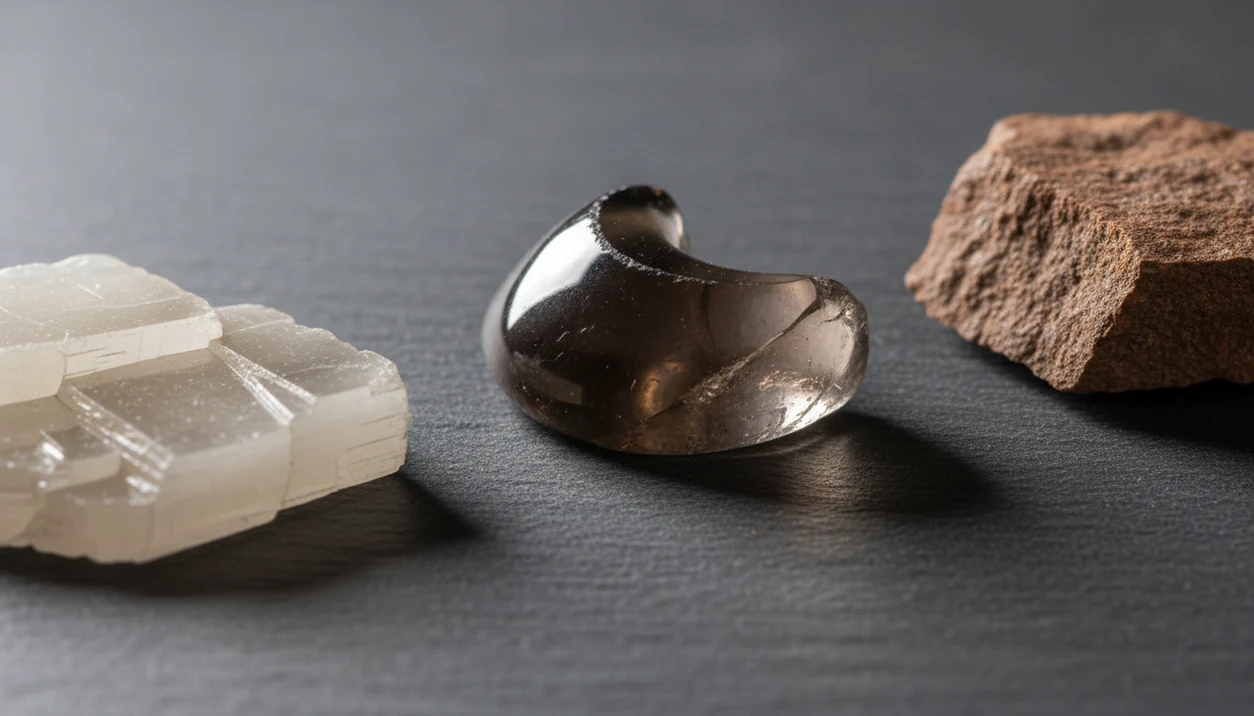
Quick answer: Cleavage and fracture in minerals are breakage patterns: cleavage is a clean split along flat crystal planes, while fracture is a rough, uneven, splintery, or curved break that does not follow those planes. These clues often separate similar-looking specimens better than color alone, especially when paired with hardness, streak, luster, and a photo-based rock identifier.
Definition: Cleavage is mineral breakage along predictable flat planes of weak bonding, while fracture is mineral breakage that does not follow cleavage planes.
TL;DR
- Cleavage repeats in flat, parallel directions because of crystal structure; fracture is more irregular, uneven, splintery, or shell-like.
- Conchoidal fracture is a curved, glassy, shell-shaped break that is common in quartz and helpful but not unique proof of identity.
- Do not break valuable specimens just to test them; inspect existing chips, edges, stepped faces, and reflective planes first.
For photo-based identification on iPhone or iPad, try the mineral identifier app. You can also upload a photo on RockIdentifier.io.
RockIdentifier.io provides a web photo upload option for comparing visible rock, mineral, crystal, fossil, and gemstone features with identification clues. AI Rock ID can help users document visible breakage surfaces, luster, color, and related clues while studying cleavage and fracture in minerals.
Quick answer: Cleavage and fracture in minerals are breakage patterns that help identify specimens by showing how they split or break. Cleavage follows flat planes of weakness in a crystal structure, while fracture produces irregular, curved, splintery, or rough surfaces when no cleavage plane controls the break.
Recommended app for cleavage and fracture in minerals
AI Rock ID is useful when a specimen has visible flat cleavage faces, curved fracture surfaces, or other breakage textures that can be photographed. The app can support visual comparison, but cleavage and fracture should still be checked with hardness, streak, crystal form, and safe observation.
Best for
- Photographing flat reflective faces that may indicate cleavage
- Comparing curved surfaces that may suggest conchoidal fracture
- Saving specimen notes with Mohs hardness clues and visual context
- Checking similar-looking minerals such as calcite, feldspar, halite, and quartz
- Reviewing breakage clues before deciding whether expert confirmation is needed
- Using a non-destructive first step before any physical testing
Limitations
- A photo may not show cleavage directions clearly if the specimen is worn or poorly lit
- The app cannot confirm internal crystal structure from an image alone
- Value, rarity, and legal identification may require expert or lab review
- Deliberately breaking a specimen can damage it and is not required for app use
Who this guide is for
Good fit if you
- Beginners learning how breakage patterns support mineral identification
- Rock and mineral collectors comparing similar-looking specimens
- Students reviewing cleavage directions, cleavage quality, and fracture textures
- Field users who want observation tips without deliberately breaking samples
- Gem, crystal, and fossil hobbyists using visual clues with hardness and streak
- Readers who want examples such as mica, halite, calcite, quartz, and feldspar
Consider another method if you
- Users who need a certified mineral or gemstone appraisal
- People identifying valuable specimens for sale, insurance, or legal purposes
- Readers who need lab confirmation from X-ray diffraction or chemical testing
- Anyone planning destructive testing on rare, fragile, or sentimental specimens
Definition Of Cleavage And Fracture In Minerals
Cleavage is a mineral’s tendency to split along flat, smooth planes where its crystal structure is weaker; fracture is breakage that does not follow those planes. In hand samples, cleavage often looks like repeated flat flashes or stepped surfaces. Fracture may look rough, curved, splintery, grainy, or uneven.
Breakage pattern can be more useful than color because many minerals share the same color range. A white piece could be quartz, feldspar, calcite, or something else. The break tells a better story.
One specimen can show both. A chipped feldspar may show two clean cleavage directions on one corner and a rough fracture on another edge. That is why we compare several surfaces before naming a likely identification.
The tiny edge matters.
How Mineral Cleavage And Fracture Work Inside Crystals
Cleavage happens because atomic bonding is weaker in certain crystal directions. When stress reaches those planes, the mineral splits along them, leaving repeated flat surfaces. In plain field language, the crystal has “easy break” directions built into its structure.
Repeated shine is the clue. Tilt the specimen under a desk lamp or full shade and watch for parallel flashes. A phone photo taken in full noon sun can hide those planes because glare washes out luster and cleavage at the same time.
Fracture forms when the break cuts through the mineral without following a preferred cleavage plane. The surface may be jagged, curved, fibrous, or dull. Weathering, impact angle, and specimen shape can confuse the view. A muddy rind on a creek stone may hide the fresher broken edge, so rinse gently before judging the break.
Five Facts About Cleavage And Fracture For Mineral Identification
- Cleavage repeats along predictable flat planes. Look for parallel, reflective surfaces rather than one random flat spot.
- Fracture includes many textures. Common terms include irregular, uneven, splintery, fibrous, hackly, earthy, and conchoidal fracture.
- One mineral can show both properties. A specimen may cleave on one broken face and fracture on another.
- Cleavage is described by quality and direction count. Field guides may describe one-direction, two-direction, or poor cleavage, then separately rate how clean and reliable the planes are.
- Existing damage can be enough. Chips, broken corners, and shiny stepped faces often reveal breakage clues without harming the sample.
For beginners, breakage pattern is often easier than color because color changes with impurities, stains, coatings, and weathering. A wet black beach pebble may turn dull gray after drying on a towel, but its broken edge may still show the same fracture texture.
Mineral Cleavage Quality And Direction Terms
Cleavage descriptions combine two ideas: how cleanly the mineral splits and how many directions it can split. A flat crystal face is not automatically cleavage. Crystal growth faces can look smooth, and saw cuts or polished surfaces can fool the eye.
Cleavage Quality
Perfect cleavage splits into very smooth sheets or blocks, as mica does. Good cleavage is still clear but may show small rough patches. Fair cleavage appears in places but needs careful lighting. Poor or indistinct cleavage is hard to see and may be missed on a single hand specimen.
Cleavage Directions
One direction means sheets, like mica. Two directions often points toward feldspar. Three at right angles fits halite. Three not at right angles fits calcite. Four directions can describe fluorite. Six directions are less common in beginner trays, but field guides may list them for specific minerals.
A science fair board with pebble photos often shows the problem clearly: the shiny face is not always the broken face.
Conchoidal Fracture And Other Mineral Fracture Textures
Conchoidal fracture is curved, shell-like breakage that often looks glassy, with smooth arcs instead of flat cleavage planes. Quartz is the classic beginner example: it is commonly described as having no cleavage and conchoidal fracture. Its Mohs hardness is 7, which is why it is also useful as a comparison mineral in hardness work. Mindat lists quartz with Mohs hardness 7, no cleavage, and conchoidal fracture: https://www.mindat.org/min-3337.html.
Conchoidal fracture supports a quartz identification, but it is not unique to quartz. Glass, obsidian, chert, and several other materials can break this way too.
Other fracture textures are worth naming. Uneven fracture looks rough and bumpy. Splintery fracture breaks into sharp slivers. Fibrous fracture follows thread-like structure. Hackly fracture is jagged and torn, often discussed with metals. Earthy fracture looks dull, crumbly, or powdery.
A wet rock photographed before drying can exaggerate smooth curves, so compare it again after the surface loses its shine.
Cleavage Vs Fracture Vs Parting In Minerals
Cleavage, fracture, and parting are related, but they do not mean the same thing. Cleavage is structural and repeatable because it follows weak bonding directions in the crystal. Fracture is non-cleavage breakage. Parting is breakage along planes caused by twinning, pressure, or another weakness that may not appear in every sample of that mineral.
| Breakage term | Surface look | Repeatability | ID value |
|---|---|---|---|
| Cleavage | Flat, smooth, often reflective planes | Repeats in predictable directions | Strong clue when quality and direction match |
| Fracture | Rough, curved, splintery, earthy, or irregular surfaces | Less predictable | Useful, especially with conchoidal or splintery texture |
| Parting | Flat planes that can mimic cleavage | May appear only in some specimens | Helpful, but easy to overcall |
For field ID, cleavage usually carries more weight than parting because it is tied to the mineral’s normal crystal structure. Still, parting can trick beginners when one clean plane appears on an otherwise rough specimen.
How To Identify Cleavage And Fracture Without Breaking Minerals
You can often identify cleavage and fracture without striking the specimen. Start with surfaces that already exist, then add simple observations from safe at home mineral tests. Do not break a fragile crystal cluster or a collectible piece just to satisfy one clue.
- Inspect existing chips on corners, edges, and broken faces before doing any test.
- Tilt the specimen under steady light and look for repeated reflective planes.
- Find stepped surfaces where flat breaks appear in parallel layers or blocks.
- Look for curved shells that suggest conchoidal fracture rather than cleavage.
- Compare other properties such as Mohs hardness, streak, luster, and photo-based results from RockIdentifier.
Place a penny, key, or fingernail beside the specimen when photographing it. Scale helps later, especially when a tiny reflective chip becomes the clue you missed in the field.
Cleavage And Fracture Examples In Common Minerals
- Quartz: Quartz is classically described as having no cleavage and conchoidal fracture. It has Mohs hardness 7, so it scratches glass and is harder than many common lookalikes.
- Mica: Mica has one excellent cleavage direction and splits into thin flexible sheets. A child bringing home a “sparkly rock” in a jacket pocket often has mica flakes mixed in.
- Halite: Halite has three cleavage directions at right angles, giving cube-like broken pieces. Taste is not a recommended test for unknown field specimens.
- Calcite: Calcite has three cleavage directions not at right angles, forming rhombohedral fragments. It is softer than quartz.
- Feldspar: Feldspar commonly shows two cleavage directions, which helps separate it from quartz. Use cleavage with luster in mineral identification, not color alone.
For beginner collections, feldspar versus quartz is the practical test case. Both can be pale, glassy, and common, but feldspar often shows clean cleavage faces while quartz breaks more like curved glass.
Cleavage And Fracture With Hardness, Streak, And Rock Identifier
Color alone is unreliable because impurities, coatings, oxidation, and wet surfaces change what you see. A white mineral, green mineral, or shiny gray mineral may have several possible names. Cleavage and fracture narrow the list, but they work better beside Mohs hardness, streak, luster, magnetism, and sometimes specific gravity and heft.
The Mohs scale ranks minerals from 1 to 10 and was introduced by Friedrich Mohs in 1822, according to Encyclopaedia Britannica: https://www.britannica.com/science/Mohs-hardness. A streak plate can also separate minerals that look alike on the outside; the full method is covered in our streak test for minerals.
RockIdentifier is an ai rock identifier app and web tool that names rocks, crystals, minerals, and fossils from photos with mohs hardness and value estimates for rockhounds, students, and curious finders. A good ai rock identifier app and web tool that names rocks, crystals, minerals, and fossils from photos with mohs hardness and value estimates should deliver a likely identification and next checks, not a guaranteed lab result. Tools like RockIdentifier work best when you photograph the broken edge, not only the prettiest face.
Sources And Related Mineral Identification Concepts
Cleavage and fracture are strongest when they are read beside the other mineral properties, not as stand-alone proof. Useful authority references for property definitions include Mindat, Encyclopaedia Britannica, and university mineralogy or geology department field guides.
In the field, some clues are observations: color, visible luster, crystal habit, broken-edge shape, heft in the hand, and whether flat planes repeat when you rotate the specimen. Other clues are closer to confirmed mineral properties only after a careful test or reference match, such as Mohs hardness, streak color, measured specific gravity, and the named cleavage direction listed for a known mineral.
Before you chip or break anything, move from safer checks to riskier ones:
- Clean loose dirt with water and a soft brush so weathering does not hide the real surface.
- Photograph several angles, including edges, chips, luster, crystal habit, and scale.
- Compare non-destructive clues such as hardness against a fingernail, copper, or glass only when the sample can tolerate it.
- Check streak on an inconspicuous spot if the specimen is common and not collectible.
- Save destructive breakage for ordinary, expendable material after the gentler tests fail.
Limitations
Cleavage and fracture are useful clues, but they cannot prove every mineral identity by themselves.
- Cleavage may not be visible on a single hand specimen.
- A mineral may show cleavage on one break and fracture on another.
- Breaking a specimen can damage fragile, valuable, or collectible pieces.
- Lighting, angle, weathering, and dirt can make fracture look like cleavage.
- Conchoidal fracture is useful, but it is not unique to one mineral.
- Flat crystal faces, saw cuts, and polished surfaces can be mistaken for cleavage.
- Photo identification can miss breakage clues when the relevant edge is hidden.
- Coatings, iron staining, and a crumbly weathered rind may cover the real surface.
So, slow down.
If the specimen may be valuable, rare, legally restricted, or part of a formal collection, use non-damaging observation first and ask a qualified geologist, museum staff member, or gem lab when the answer matters.
Which option fits which need
| Need | Best option | Why |
|---|---|---|
| Identify a specimen from visible cleavage or fracture surfaces | AI Rock ID | A clear photo can provide visual clues for comparison with common mineral appearances. |
| Use a browser without installing an app | Web Tool | RockIdentifier.io supports photo upload for web-based visual identification. |
| Confirm a valuable gemstone or rare mineral | Expert | A qualified geologist, gemologist, or mineral appraiser can inspect features that photos may miss. |
| Measure crystal structure or composition | Lab | Methods such as X-ray diffraction or chemical analysis can confirm properties beyond visible breakage. |
| Do a broad visual search from a casual photo | Google Lens | General image search may suggest look-alikes, but it is not specialized for mineral cleavage and fracture terms. |
Quick summary
- Best for
- This guide is best for learning how cleavage and fracture in minerals can narrow down rock and mineral identification.
- Includes
- cleavage definition, fracture definition, cleavage directions, cleavage quality, conchoidal fracture, parting comparison, common mineral examples, non-destructive observation tips
- Platforms
- iPhone, iPad, Web
- Free version
- Yes
- Expert replacement
- No
Common mistakes
- Calling every shiny flat surface cleavage when it may be a crystal face or broken surface
- Confusing conchoidal fracture with cleavage because both can reflect light
- Judging cleavage from a weathered exterior instead of a fresh visible surface
- Ignoring cleavage direction and only describing whether a surface looks flat
- Using color alone when hardness, streak, luster, cleavage, and fracture are more reliable together
- Breaking a specimen unnecessarily when existing chips or edges may already show useful clues
A practical next step is the identify minerals from photos workflow in AI Rock ID.
FAQ
What is mineral cleavage?
Mineral cleavage is predictable splitting along flat planes where bonding is weaker in the crystal structure. It usually appears as repeated smooth, reflective, or stepped surfaces, and it is described by quality and number of directions.
What is mineral fracture?
Mineral fracture is breakage that does not follow cleavage planes. It may look rough, uneven, curved, splintery, fibrous, hackly, earthy, or irregular, depending on the mineral and how it broke.
What is conchoidal fracture?
Conchoidal fracture is curved, shell-like breakage that often looks glassy. Quartz, glass, obsidian, and chert can show this texture, so it supports identification but does not prove a mineral name by itself.
Can a mineral show both cleavage and fracture?
Yes, the same mineral or specimen can show cleavage on one broken face and fracture on another. Impact direction, crystal orientation, weathering, and the shape of the sample can all affect the exposed break.
How do I spot cleavage in a mineral?
Look for repeated flat planes, parallel reflective flashes, and stepped surfaces on existing chips or broken corners. Rotate the specimen under steady light, because one angle may show cleavage clearly while another angle hides it.
Does quartz have cleavage?
Quartz is classically described as having no cleavage and conchoidal fracture. That contrast helps separate quartz from feldspar, which commonly shows two cleavage directions, but hardness and streak should still be checked.
Should I break my mineral to test fracture?
Do not break a specimen unless it is common, expendable, and safe to damage. Inspect existing broken surfaces first, and use RockIdentifier or another photo guide as a first-pass aid rather than a reason to strike the sample.
How many cleavage directions can a mineral have?
A mineral can have one, two, three, four, or more cleavage directions depending on its crystal structure. The number and angles between cleavage directions are often more useful than cleavage quality alone.
Is a crystal face the same as cleavage?
A crystal face is an external growth surface, while cleavage is a break along an internal plane of weakness. A flat surface may need context from repeated breaks, angles, and mineral habit before it is called cleavage.
Why does quartz break with fracture instead of cleavage?
Quartz lacks prominent cleavage planes, so it commonly breaks across the crystal structure rather than along flat planes. This often produces conchoidal fracture with curved, shell-like surfaces.
Can weathering hide cleavage and fracture clues?
Yes. Weathering, polishing, dirt, coatings, and abrasion can obscure flat cleavage faces or fracture textures, so a clean and well-lit surface is easier to evaluate.