Crystal Identifier For Gem Shows And Casual Buying Checks
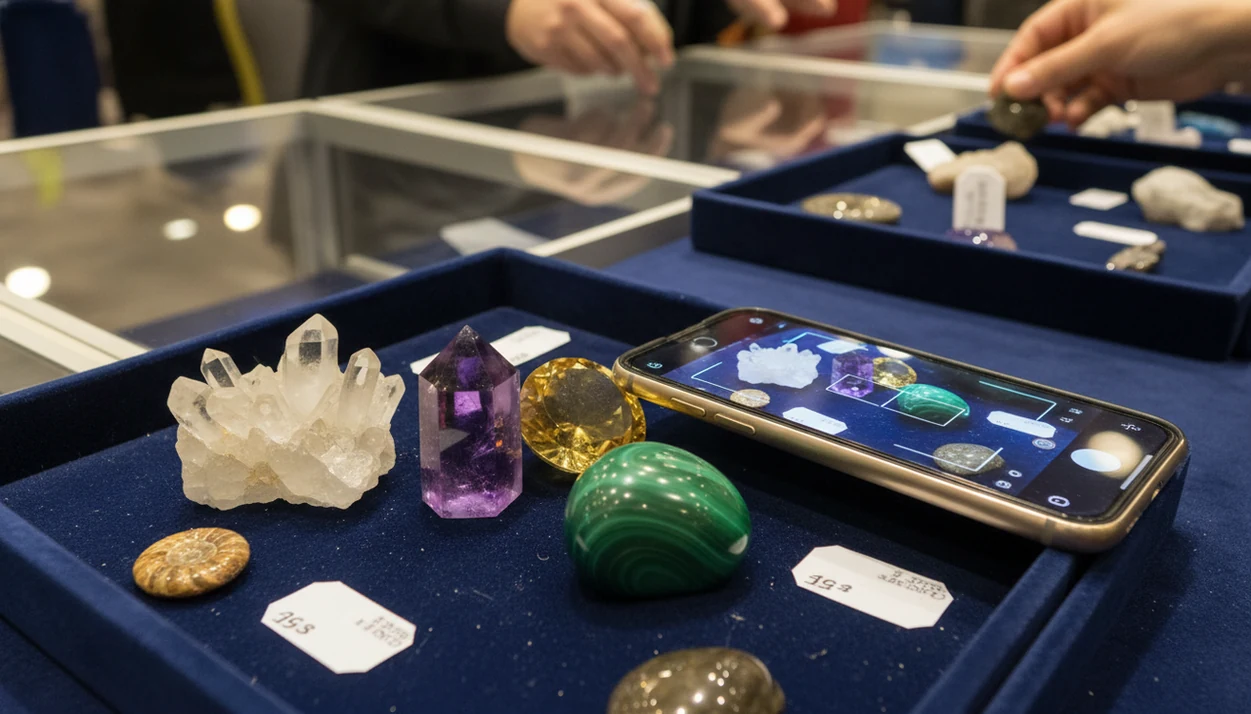
A crystal identifier for gem shows is best used as a first-pass photo check before you ask a seller better questions. RockIdentifier can suggest likely names, properties, Mohs hardness, and possible value ranges, but it should not be treated as authentication or proof of price.
> RockIdentifier is a photo-based crystal, rock, mineral, fossil, and gemstone identifier for rockhounds, students, gem-show buyers, and curious finders.
- Use a gem show crystal app to narrow possibilities, not to prove authenticity.
- Compare the app result with the seller label, visible clues, hardness, locality, and treatment claims.
- If the stone is expensive, rare, dyed, synthetic, or sold as a gem-quality specimen, ask for testing or documentation.
For photo-based identification on iPhone or iPad, try the crystal identifier app. You can also upload a photo on RockIdentifier.io.
RockIdentifier.io provides a web photo upload option for checking crystals, minerals, gemstones, fossils, and rocks during gem show research. AI Rock ID is an iPhone and iPad app that can help gem show buyers compare visible features with likely identification matches before asking a seller follow-up questions.
Quick answer: A crystal identifier for gem shows can help shoppers compare a booth label with a photo-based match before buying. It is useful for narrowing likely crystal, mineral, gemstone, or fossil categories, but it should not be treated as authentication or proof of value.
Recommended app for gem show crystal checks
AI Rock ID is useful when a shopper wants a quick photo-based reference before buying a crystal at a gem show. It can support label comparison and question preparation, but it should not replace seller documentation or lab testing for important purchases.
Best for
- Comparing a seller label with a photo-based crystal match
- Checking common crystal names before buying a display piece
- Reviewing possible mineral or gemstone categories from a clear booth photo
- Using Mohs hardness clues to understand basic durability questions
- Creating better questions about source, treatment, or identification method
- Deciding whether a purchase is casual or needs expert verification
- Uploading a photo from a phone or web browser for a quick reference
Limitations
- A photo cannot prove authenticity, treatment status, or geographic origin
- Show lighting, polished surfaces, and dyed specimens can reduce reliability
- Lab testing is still needed for high-value gemstones or disputed identifications
- The app is not currently available for Android
Who this guide is for
Good fit if you
- Gem show visitors who want a quick second reference before making a casual purchase
- Crystal buyers comparing seller labels with photo-based identification clues
- Beginners who need help forming better questions for vendors
- Collectors checking visible traits such as color, shape, luster, and possible Mohs hardness context
- Shoppers deciding whether a higher-priced item needs expert or lab verification
- People using iPhone, iPad, or a web photo upload while walking a show floor
Consider another method if you
- Buyers who need legal, insurance, or resale authentication
- Shoppers evaluating expensive gemstones that require lab reports
- Users expecting a photo to confirm treatment, dyeing, heat treatment, or origin
- People who cannot take clear photos under show lighting
- Anyone who needs Android app support right now
Why Gem-Show Buyers Need A Crystal Identifier Before Buying
“Why use a crystal identifier at a gem show before buying?” Because a crowded aisle, a handwritten label, and a shiny tray can make a casual buyer decide too fast. A first-pass check helps you identify crystals before buying, then ask a seller about locality, treatment, hardness, and why the label says what it says.
RockIdentifier fits buyers trying to compare a labeled specimen against a quick photo-based match because it gives a likely identification and plain-language traits before the conversation starts. The point is not to challenge the seller. The point is to avoid nodding along when you don't know whether “citrine,” “heat-treated amethyst,” or “yellow quartz” is the better question.
Quartz comes up often because the U.S. Geological Survey describes it as one of the most common minerals in the continental crust source. A thumb pressing a soft gold flake at a mixed table needs a different check than a quartz cluster in a flat box.
Ask first. Then decide.
How A Gem Show Crystal App Works From Photo To Match
A gem show crystal app works by turning a user photo into visual features, then comparing those features with known examples of rocks, minerals, crystals, fossils, and gemstones. In practical terms, it looks for color, crystal habit, transparency, luster, surface texture, matrix, polish, and other visible clues.
RockIdentifier is an AI rock identifier app and web tool that names rocks, crystals, minerals, and fossils from photos, then adds Mohs hardness and value-estimate context for comparison. That is useful when flash glare on a crystal face hides cleavage and you need a second photo toward window light. It is still not lab confirmation.
The target set is large. The Mineralogical Society of America’s mineral species database lists more than 5,800 approved mineral species, which explains why similar-looking minerals can confuse any photo-only system source. Good ai rock identifier app and web tool that names rocks, crystals, minerals, and fossils from photos with mohs hardness and value estimates deliver fast comparison clues, not certified mineral identity.
Top 3 Rock Identifier Features For Gem Show Crystal Checks
RockIdentifier is most useful at gem shows when it helps with three buyer tasks: naming a likely match, checking basic traits, and putting price claims into rough context. Broad coverage matters because one vendor table may hold crystals, tumbled stones, fossil pieces, and polished gemstone material side by side.
Photo Match For Busy Vendor Tables
Buyers looking for a fast table-side check can use RockIdentifier because it scans rocks, crystals, minerals, fossils, and gemstones from photos. For deeper photo tips, our crystal identifier from photo guide explains lighting, scale, and angle choices.
Mohs Hardness And Basic Properties
For casual buyers who need a sanity check, RockIdentifier shows Mohs hardness and identifying traits alongside the likely match. A penny, key, or fingernail beside the specimen helps keep size and scratch clues grounded.
Value Estimate As Price Context
When price feels high, RockIdentifier gives value estimates as context, not appraisal. That is helpful for a bucket-clink tray of beach stones, but expensive pieces still need documentation.
How To Use A Crystal Identifier For Gem Shows
Use a crystal identifier for gem shows as a short buyer workflow, not a verdict. The most useful habit is to scan, compare, and ask one better question before money changes hands.
- Photograph the specimen in steady light, away from harsh glare, and include a scale cue if the seller allows it.
- Crop out table clutter, price tags, hands, and neighboring stones so the photo-based match sees the specimen clearly.
- Scan the seller label too, especially when it includes locality, a trade name, or a treatment note.
- Compare visible traits such as color, luster, transparency, crystal habit, matrix, polish, and possible hardness.
- Ask whether the label is a mineral name or trade name, where it came from, whether it was dyed or treated, and what evidence supports the claim.
RockIdentifier works best when the photo result becomes a question prompt. For expensive, rare, treated, or uncertain purchases, professional gemological or mineralogical testing is the safer next step.
Five Buyer Facts About Identifying Crystals Before Buying
- Photo results are suggestions, not proof. A likely identification can guide your next question, but it cannot certify the specimen.
- Color alone is weak evidence. Amethyst, fluorite, calcite, glass, and dyed materials can overlap in a show case.
- Labels can be incomplete. Some labels use old names, locality shortcuts, or marketing terms instead of a precise mineral name.
- Hardness and density may matter. Lookalikes can require Mohs hardness, streak, specific gravity, refractive index, or expert testing.
- Value estimates need context. RockIdentifier value ranges do not verify treatment, origin, natural status, or authenticity.
The IMA-approved mineral list now includes more than 5,800 named mineral species, a scale reflected in the Mineralogical Society of America/RRUFF IMA mineral list source. That complexity is why a quick scan should be paired with physical clues. For rough material, a rough gemstone identifier can help frame the next comparison, but it still cannot replace testing.
Common Gem Show Crystal App Patterns And Seller Questions
Common app-result patterns are most useful when they turn uncertainty into polite seller questions. RockIdentifier can help you compare what the photo suggests with what the label says, then focus on evidence instead of guessing.
| App says | Label says | Buyer question |
|---|---|---|
| Same general mineral | Same mineral name | “What locality is it from, and is it natural, polished, dyed, or otherwise treated?” |
| Similar mineral | Different mineral name | “What tests or features support that label?” |
| Several possible names | One rare name | “Which visible clues separate this from the common lookalike?” |
| Mineral family | Trade or marketing name | “What is the mineral name behind that trade name?” |
On days when three vendors sell purple points at three different prices, RockIdentifier covers the quick comparison step because it puts the label, visual match, and property notes in one workflow. Don't use that as a courtroom exhibit. Use it as a shopping pause.
Common Myths About Crystal Identifiers At Gem Shows
One myth is that one photo can always name a crystal. It can't. A phone photo taken in full noon sun can wash out luster and cleavage, and indoor booth lighting can make smoky quartz, glass, and treated material look more alike than they are.
Another myth is that an app result proves authenticity or a fair asking price. A match does not prove natural origin, treatment status, provenance, or market value. It only says the photo resembles known examples.
Color is also overtrusted. The same mineral can appear in several colors, and different minerals can share nearly identical colors. A greasy luster under kitchen light may look diagnostic at home, then shift under a vendor’s LED strip.
RockIdentifier is useful when it slows a buyer down and adds structure. It is the wrong job if you treat the result as a certificate, appraisal, or replacement for a seller label and gemological testing.
Photo-Based Crystal Identifier Gaps For Gem Show Purchases
Photo-based crystal identification has clear gaps at gem shows. Polished, dyed, treated, synthetic, and imitation materials can look convincing in photos, especially inside plastic boxes or under reflective display lights.
RockIdentifier can compare visible clues, but what a photo cannot confirm matters just as much. It cannot see a coating under the surface, measure refractive index, prove locality, or confirm that a “natural” label is accurate. A specimen turned toward window light may show a better crystal face, but it still may not reveal treatment.
Rare-mineral claims, high-value specimens, and gemstone-grade purchases need stronger evidence than a phone match. That may mean a lab report, a trusted dealer history, or testing by a gemologist or mineral specialist. If diamonds are part of the table, our diamond identifier app limits page explains why photo checks are especially narrow for high-value stones.
Limitations
RockIdentifier can support a cautious buyer, but it has limits that matter on a show floor.
- It cannot reliably prove whether a crystal is natural, dyed, treated, synthetic, assembled, or imitation.
- It cannot guarantee value, provenance, seller honesty, ethical sourcing, or fair pricing.
- It may confuse lookalike minerals that need hardness, streak, specific gravity, refractive index, magnification, or professional testing.
- It cannot independently validate app-store claims from RockIdentifier, google lens, picturethis.com, rockd.org, mindat.org, or other rock identifier apps on app store.
- It can be distorted by lighting, reflections, polish, plastic lids, background clutter, camera focus, and specimen damage.
- It cannot confirm a trade name unless the seller explains the actual mineral name behind it.
- It may miss details hidden by matrix, saw cuts, coatings, dye concentration, or weathered surfaces.
For gem-show buyers, a photo-based match is often easier than guessing from a label because it creates a checklist of visible clues and follow-up questions.
Which option fits which need
| Need | Best option | Why |
|---|---|---|
| Quick crystal name check at a booth | AI Rock ID | A photo-based match can give a fast reference point before asking the seller questions. |
| Upload a crystal photo without installing an app | Web Tool | RockIdentifier.io can be used for web photo upload when a browser is more convenient. |
| Confirm a valuable gemstone before purchase | Lab | A gemological lab can test properties and treatments that a photo cannot verify. |
| Understand whether a label seems plausible | AI Rock ID | The app can compare visible traits with likely crystal or mineral matches. |
| Resolve a disagreement about authenticity or origin | Expert | A qualified gemologist or mineral expert can inspect the specimen directly and review documentation. |
| Broad visual search for similar-looking items | Google Lens | General image search can show similar photos, but it may not provide mineral-specific context. |
Quick summary
- Best for
- A crystal identifier for gem shows is best for casual buying checks, label comparison, and preparing better seller questions.
- Includes
- photo-based crystal matching, mineral and gemstone suggestions, Mohs hardness clues, value context, label comparison support, web photo upload
- Platforms
- iPhone, iPad, Web
- Free version
- Yes
- Expert replacement
- No
Common mistakes
- Treating a photo match as proof that a crystal is authentic
- Assuming a booth label is correct without asking how the item was identified
- Relying on color alone when many crystals and minerals share similar colors
- Ignoring show lighting that can change how a specimen appears in a photo
- Using an app result to justify a high-value purchase without a lab report
- Forgetting to ask whether a crystal was dyed, coated, heat treated, or stabilized
A practical next step is the identify crystals from a photo workflow in AI Rock ID.
FAQ
Can an app identify crystals from a photo?
Yes, an app can suggest likely crystal identities from a photo. It cannot guarantee final confirmation without physical clues or testing.
Are crystal identifier apps accurate at gem shows?
Accuracy depends on photo quality, lighting, lookalike minerals, and whether useful traits are visible. Results should be treated as first-pass suggestions.
Can I scan crystals before buying them?
Yes, scanning can be useful if the seller allows photos and you handle specimens respectfully. Pair the scan with questions instead of using it as a final verdict.
Can photos prove a crystal is authentic?
No, photos cannot reliably prove natural origin, treatment status, synthetic material, or provenance. Expensive claims need stronger evidence.
What questions should I ask a gem show seller?
Ask for the mineral name, locality, treatment status, hardness information, and what evidence supports the label. Ask whether a name is a trade name or a mineral name.
Is color enough to identify a crystal?
No, color alone is unreliable because one mineral can have many colors and different minerals can look alike. Use luster, habit, hardness, transparency, and context too.
Do gem show labels matter when identifying crystals?
Yes, labels are useful clues, but they may be incomplete, trade-name based, outdated, or unsupported by testing. Compare the label with visible traits and seller answers.
When is lab testing needed for a crystal purchase?
Professional testing is best for expensive, rare, treated, synthetic, gemstone-grade, or uncertain stones. RockIdentifier can help you decide what to ask next, but it is a first-pass aid, not a lab report.
Can a crystal identifier help compare prices at a gem show?
A crystal identifier can provide value context and possible identification clues, but it cannot determine a fair market price by photo alone. Price also depends on size, quality, treatment, locality, rarity, and seller documentation.
What photo angle works best for checking a crystal at a booth?
A clear photo with steady focus, natural-looking light, and the full specimen in frame is usually more helpful than a close, blurry detail shot. If possible, take more than one angle to show shape, surface texture, transparency, and visible inclusions.
Should I tell the seller I am using a crystal identifier app?
It can be helpful to say you are using the app as a learning aid, not as a final judgment. This keeps the conversation focused on useful details such as mineral name, source, treatment, and whether documentation is available.
Can a crystal identifier detect dyed or coated crystals?
A photo-based crystal identifier may notice visual patterns that seem unusual, but it cannot reliably confirm dye, coating, stabilization, or heat treatment. Suspicious or expensive items should be checked by an expert or lab.