
Identify a Crystal From a Photo
Upload crystal photos
Clear, well-lit images help the AI identify it more accurately.

Analyzing your crystal…
Checking texture, color, structure, and lookalikes…
Crystal identifier for raw, tumbled, and cluster crystals. Upload a photo for a fast visual ID, mineral group, Mohs hardness clues, lookalike warnings, and a rough value range.


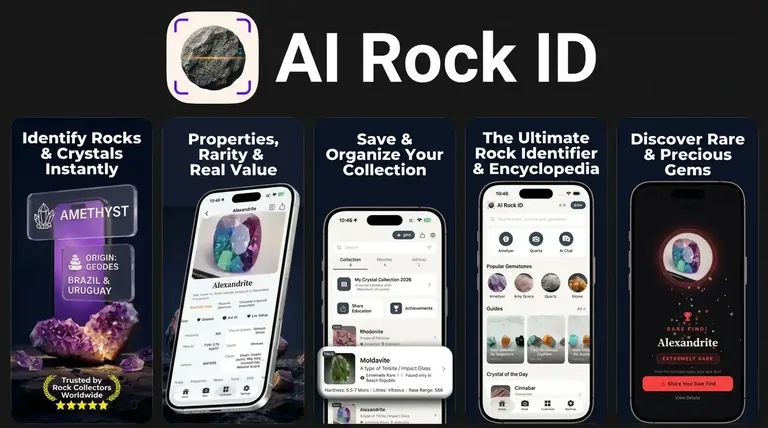
Crystal Identifier helps name raw points, clusters, geodes, tumbled stones, and polished cabochons from a photo. Upload a clear image to receive a likely mineral name, mineral group, Mohs hardness clues, common lookalikes, and a rough value range. The online tool runs in your browser, while AI Rock ID for iPhone and Android adds unlimited scans, saved collections, and additional field tools.
Good fit for
- crystal collectors
- healing crystal shoppers
- raw points, clusters, and geodes
- tumbled stones and cabochons
- jewelry pieces with set stones
Not for
- authenticating expensive gems
- certified gemological lab reports
- insurance grading
- professional appraisal
What Is a Crystal Identifier?
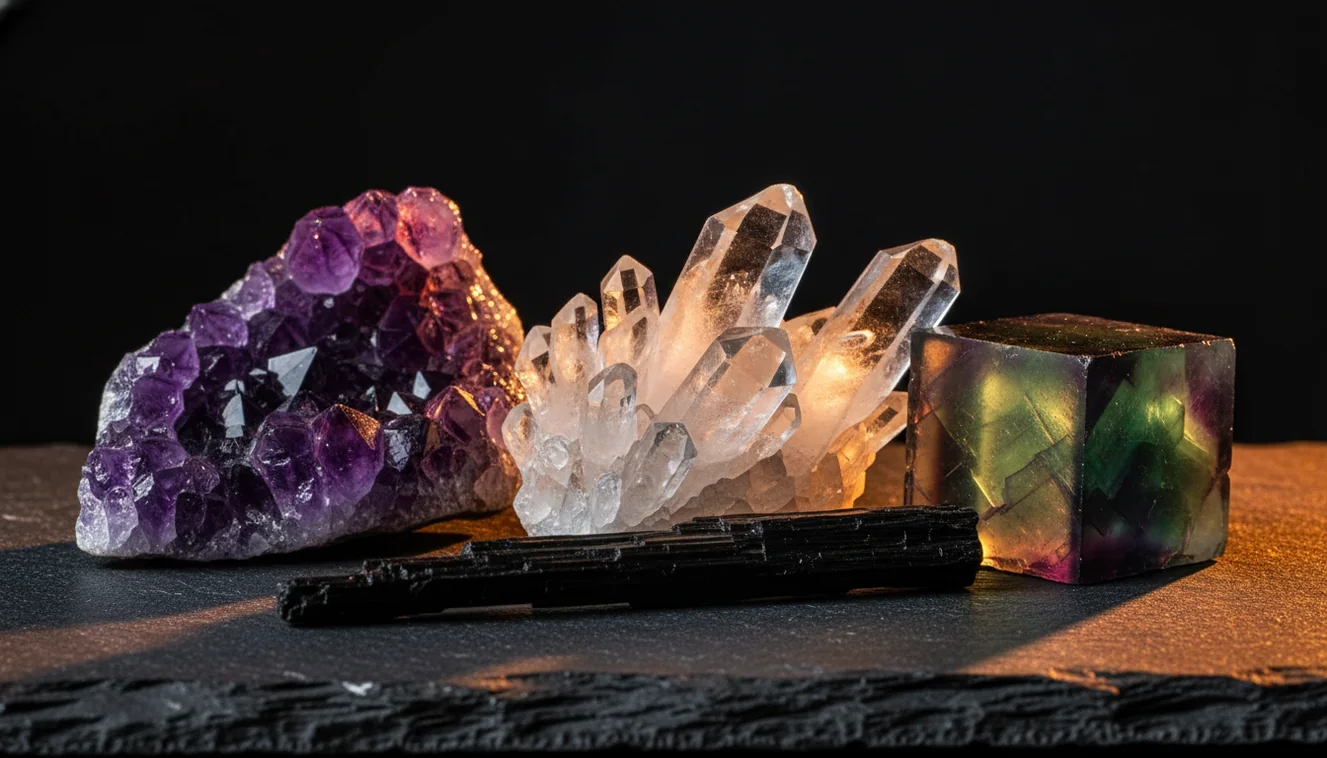
A crystal identifier is a visual lookup tool that names an unknown crystal from a photo. Upload a picture of a quartz point, amethyst cluster, fluorite cube, tumbled stone, or set stone in jewelry, and the AI returns a likely mineral name, mineral group, Mohs hardness clues, and notes on common lookalikes.
It reads what you can already see: color, transparency, luster, crystal habit, termination shape, banding, and any inclusions. Photos are processed in a privacy-friendly workflow and are not posted as public specimens. The same photo check is also available as AI Crystal Identifier on Rock ID, as a Crystal Identifier inside Identify Anything, and as the Crystal Identifier in Lens.
How a Crystal Identifier Works
A photo-based crystal identifier reads visible signals from your image and matches them against learned examples of common crystals. The model weighs color, transparency, luster, crystal habit (single point, cluster, druzy, geode, massive), termination shape, banding, and visible inclusions.
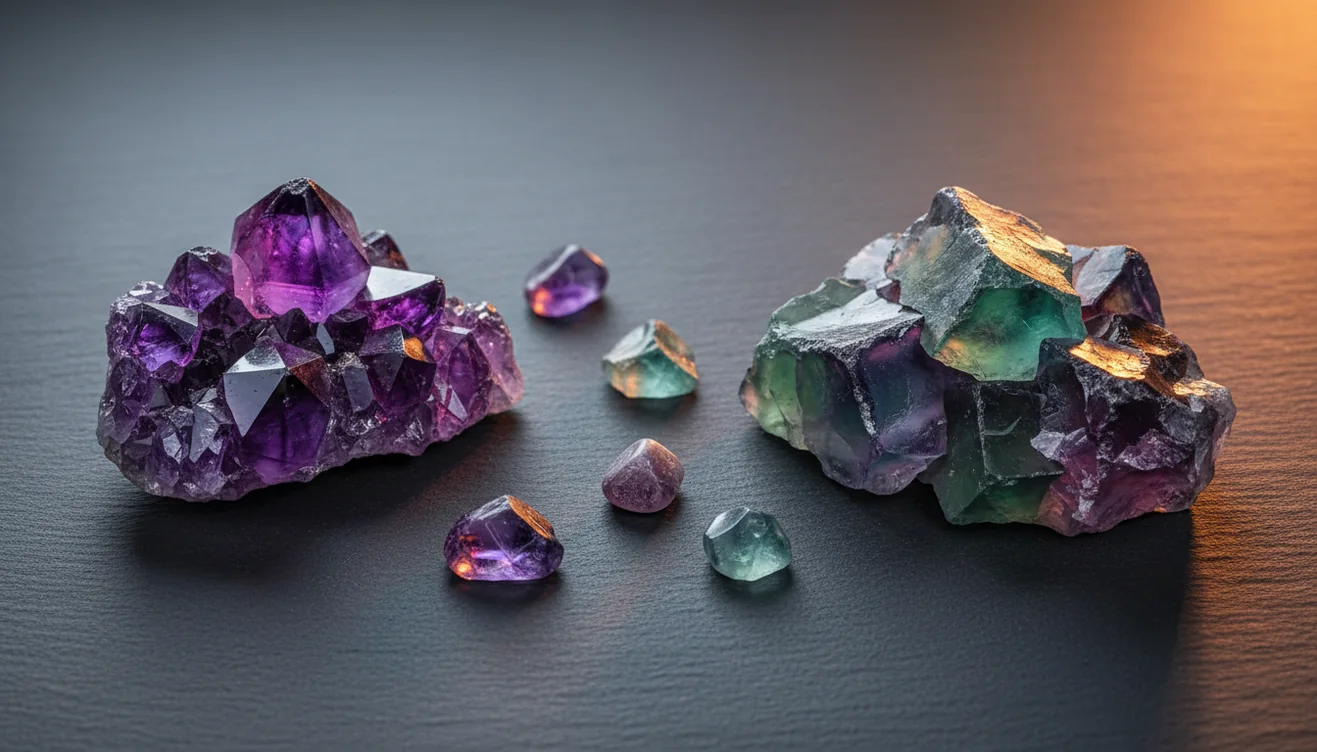
Purple crystal points usually fit amethyst, but the model also considers fluorite cubes, lepidolite books, and charoite. Glassy clear points with conchoidal fracture point toward quartz. Cubic crystals with perfect cleavage suggest fluorite or halite. The result is a ranked list of likely crystals with notes on what to check.
More Identification Tools
If your specimen isn't really a crystal, try a different tool from the Rock Identifier App suite.
Rock Identifier App
The main AI rock identifier for any rock, mineral, crystal, gemstone, or fossil from a photo.
Mineral Identifier
For single minerals where luster, streak, cleavage, and Mohs hardness matter most.
Gemstone Identifier
For loose stones, cut gems, and jewelry stones suspected to be gem-grade material.
Stone Identifier
For river stones, beach pebbles, garden rocks, and landscaping stones.
Fossil Identifier
For shells, bones, plant imprints, and other fossils, with size and matrix clues.
Diamond Identifier
For clear, brilliant stones suspected to be diamond rather than quartz or moissanite.
Gold Identifier
For brassy or yellow specimens suspected to be real gold rather than pyrite or mica.
What App Identifies Crystals From Photos?
AI Rock ID is the iPhone and iPad app most often used to identify crystals from a photo. It returns a likely mineral name, Mohs hardness clues, mineral properties, and a rough value range, with saved collections and unlimited scans for regular collectors.
For a quick one-off check, the upload tool at the top of this page is the fastest option and runs in any browser. For collectors who shop at gem shows or sort large personal collections, the iPhone app is the practical pick.
How to Use a Crystal Identifier
Clean the crystal
Brush off dust and remove fingerprints with a soft cloth. Dust hides luster and crystal faces that the model relies on.
Use natural light
Overcast daylight or open shade gives the truest color. Avoid flash, which creates glare on glassy faces and washes out color.
Show diagnostic angles
Capture the crystal faces, terminations, and any cluster matrix. For transparent crystals, hold against a plain background to show clarity.
Upload the best image
Choose the sharpest photo and run the lookup. If the result is broad, add a second angle showing termination or color zoning.
Check the suggested matches
For ambiguous results, a quick hardness test (does it scratch glass?) usually separates lookalikes such as quartz vs calcite or fluorite vs glass.
Can AI Tell if My Crystal Is Real?
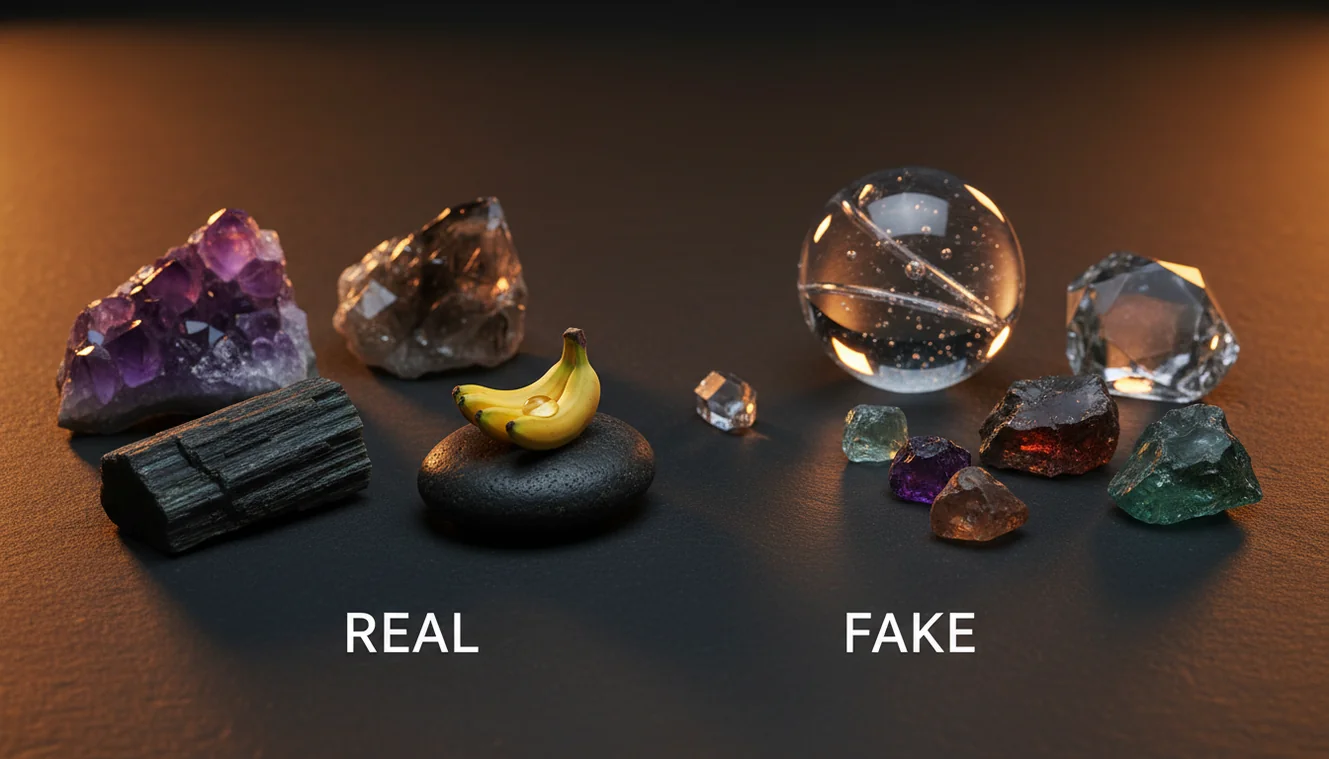
An AI crystal identifier can flag many common fakes from a photo. Glass posing as quartz often shows tiny round bubbles, mold seams, or unnaturally perfect color. Dyed howlite sold as turquoise usually has white veining peeking through chipped surfaces. Aura-treated quartz has an obvious metallic rainbow coat that the model can recognize.
Where photo ID falls short: synthetic quartz grown in labs can look identical to natural quartz, and high-quality heat-treated citrine (originally amethyst) is chemically real quartz, just baked. For high-value purchases, confirm with a gemologist who can measure refractive index, specific gravity, and other lab properties.
For lower-stakes shopping at fairs, markets, or online, the app is a useful first filter before you pay collector prices.
Crystal vs Mineral: What Is the Difference?
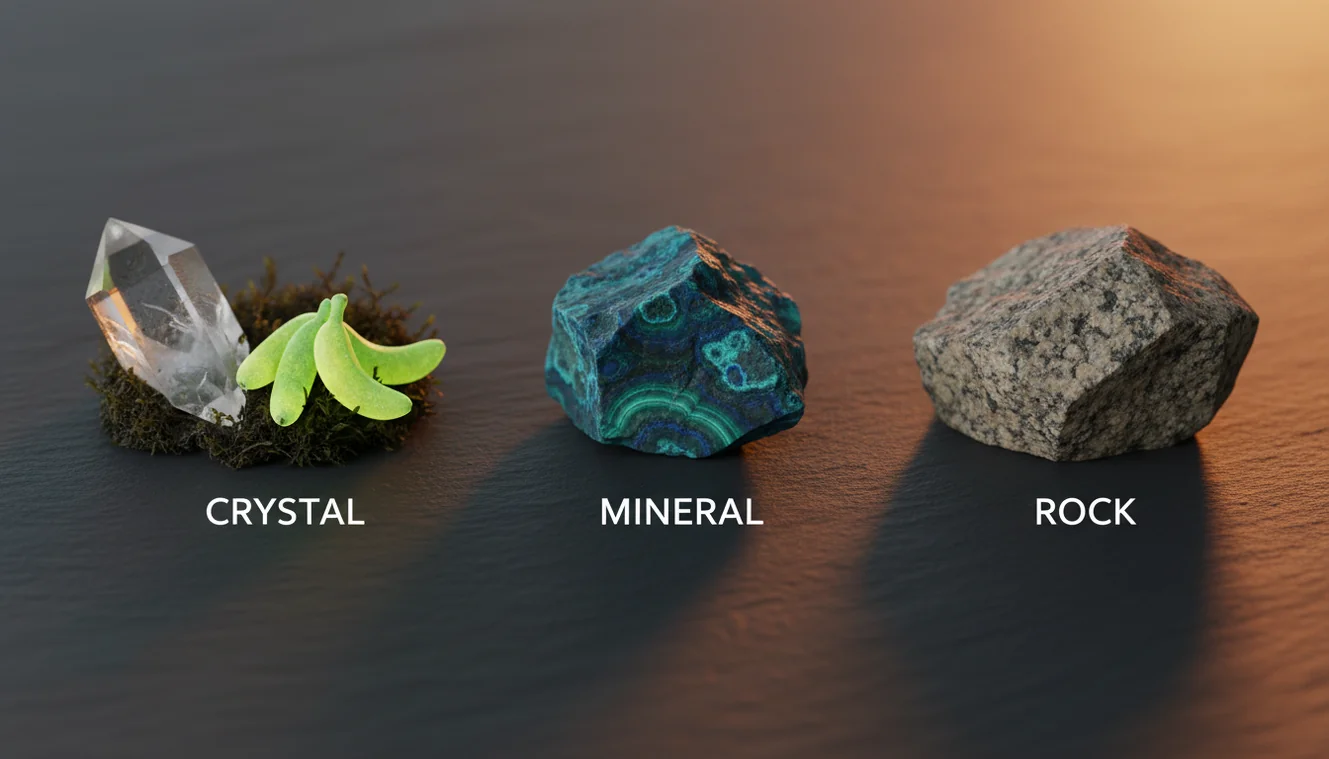
A mineral is a naturally occurring solid with a defined chemical formula and crystal structure. Quartz, calcite, fluorite, and feldspar are all minerals.
A crystal is a single piece of a mineral that grew with visible geometric faces. A quartz point in your hand is a crystal of the mineral quartz. A massive chunk of quartz with no visible faces is still the mineral quartz, but it is not a crystal in the visible sense.
For identification, the workflow is the same: the AI compares visible features against learned examples and returns the likely mineral, whether or not the piece grew as a perfect crystal.
Raw vs Tumbled Crystals
Raw crystals are pieces that grew naturally and were not polished or cut. They show real crystal faces, terminations, and natural fracture surfaces. Raw crystals are usually easier for a photo identifier because shape and habit are part of the signal.
Tumbled crystals are pieces that were rotated with abrasives until smooth and rounded. Tumbling removes natural faces and weathering clues, so the model relies more on color, transparency, and any visible banding or inclusions.
Photo identifiers handle common tumbled stones (rose quartz, amethyst, citrine, sodalite, tiger eye, jasper, obsidian) well. They are less reliable on dyed or coated tumbled stones, where surface color does not match the underlying mineral.
Healing Crystals: A Neutral Note
Many people use crystals for spiritual practice, meditation, decor, or as collectibles. An AI crystal identifier names what the crystal actually is (the mineral and likely variety), shows Mohs hardness, and notes common lookalikes. That is the part the model can confirm.
Metaphysical and healing claims about crystals are personal beliefs, not measurable mineral properties, and the app does not provide medical advice. If you collect for meaning, the identifier still helps by making sure your "amethyst" is amethyst and your "moldavite" is not green glass.
Can Google Lens Identify Crystals?
Google Lens can sometimes match a crystal photo to similar images on the open web. The trouble is that most matches link to shopping pages, Etsy listings, or stock photos rather than mineral identifications. A dedicated crystal identifier returns the likely mineral name, mineral group, hardness, and lookalike notes you actually need.
Can ChatGPT Identify Crystals?
ChatGPT can describe crystals, explain mineral properties, and walk you through identification logic, but it is not a dedicated photo-based crystal identifier. The reliable workflow is: scan the crystal with a tool like RockIdentifier.io or the AI Rock ID iPhone app, then ask ChatGPT to explain the result, compare lookalikes, or interpret the Mohs hardness clue.
Is This Crystal Valuable?
Most common crystals (clear quartz, amethyst, citrine, rose quartz, sodalite, fluorite) have modest value because they are abundant. Value rises with rarity, size, clarity, color saturation, locality, and untreated provenance.
A crystal identifier can give a rough first-pass value range based on the likely mineral and visible quality. For rare or gem-grade specimens, confirm value with a mineral dealer or gemologist.
Where Crystal Photo ID Falls Short
A crystal identifier is best used as a fast first opinion. For valuable purchases or rare specimens, confirm the result with a specialist.
- Dyed, coated, and aura-treated crystals can show surface colors that do not match the underlying mineral.
- Synthetic crystals grown in labs (quartz, ruby, sapphire) can look identical to natural ones in a photo.
- Heat-treated stones (most citrine, much blue topaz) are chemically real but the model cannot detect the treatment.
- Value ranges are rough estimates, so rare or gem-grade pieces deserve a specialist appraisal.
Related Articles
What crystal is this?
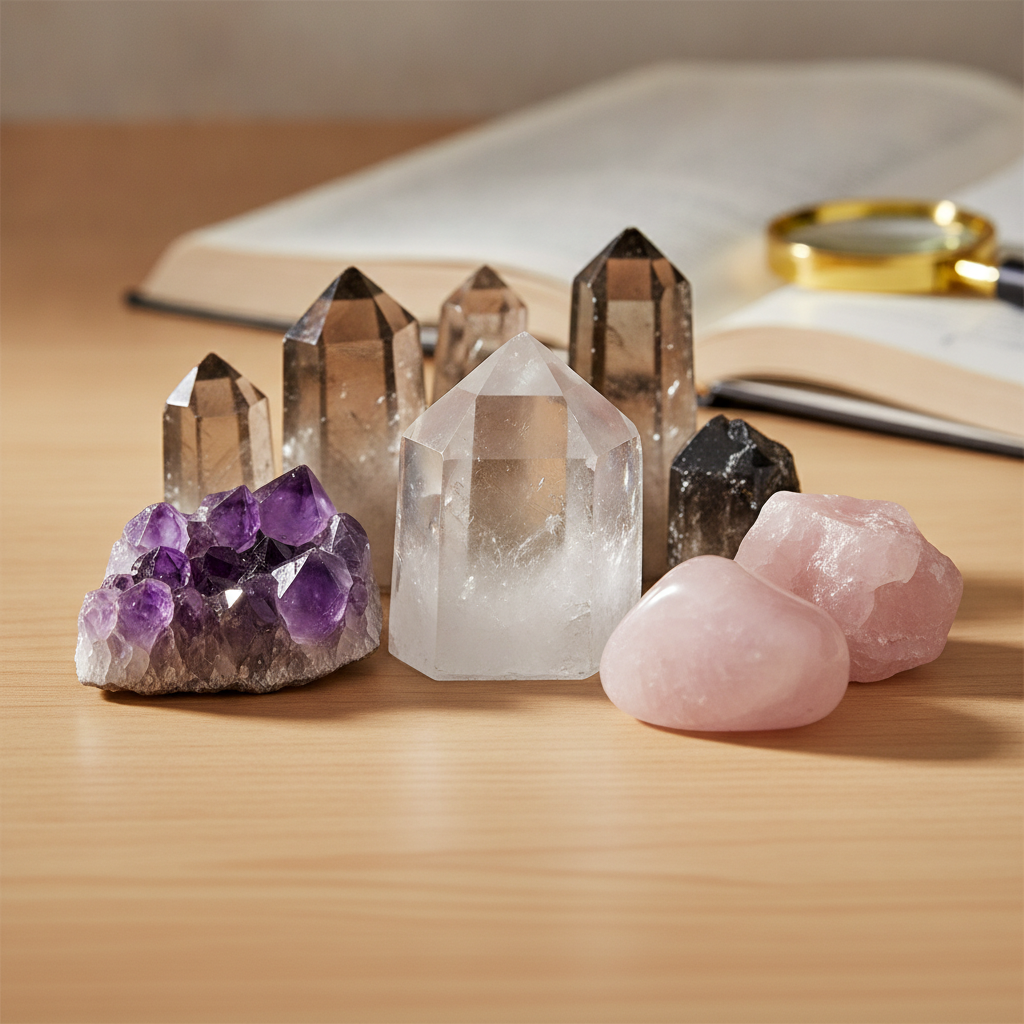
To identify a crystal, examine its crystal habit, cleavage, fracture, luster, transparency, inclusions and color distribution. Take several sharp photos in neutral daylight, including close-ups of terminations, broken surfaces and the host rock when present.
A crystal identifier can suggest visually similar minerals, but a photograph cannot reliably measure hardness, streak, density or optical properties. Confirm important finds with physical tests or a gemologist or mineralogist, especially when value, treatment or authenticity matters.
Frequently Asked Questions
What crystal is this?
Compare its shape, luster, transparency, cleavage and inclusions rather than relying only on color. Quartz, calcite, fluorite and glass can share similar colors but differ in hardness, fracture and crystal form.
How can I identify a crystal from a photo?
Photograph the specimen in indirect daylight against a plain background. Include multiple angles, a close-up, a scale reference and any matrix attached to it. Photo matching provides candidates, which should be checked against physical properties.
Can I identify a crystal from a photo for free?
Free identification websites and limited app features can provide possible matches. Availability and usage limits vary, and no photo tool can confirm every specimen without supporting tests.
How do I tell a real crystal from glass?
Glass commonly shows rounded bubbles, mold seams or curved conchoidal fractures and lacks natural crystal faces or cleavage. These clues are not conclusive because quartz can fracture like glass and some synthetic materials are made without visible bubbles.
Why is crystal color not enough for identification?
Many minerals occur in several colors, while unrelated minerals can look nearly identical. Lighting, surface coatings, irradiation, heat treatment and dye can also alter color, so structure and physical properties are more dependable.
What tests help identify an unknown crystal?
Useful tests include hardness, streak, cleavage, magnetism, specific gravity and response to ultraviolet light. Begin with non-destructive observations, and avoid scratch or acid tests on valuable, polished or delicate specimens.
Can a crystal identifier detect dyed or treated stones?
It may flag suspiciously vivid color, dye concentrated in cracks or patterns associated with treated material, but photographs cannot verify every enhancement. Microscopic or laboratory testing may be needed for a reliable conclusion.