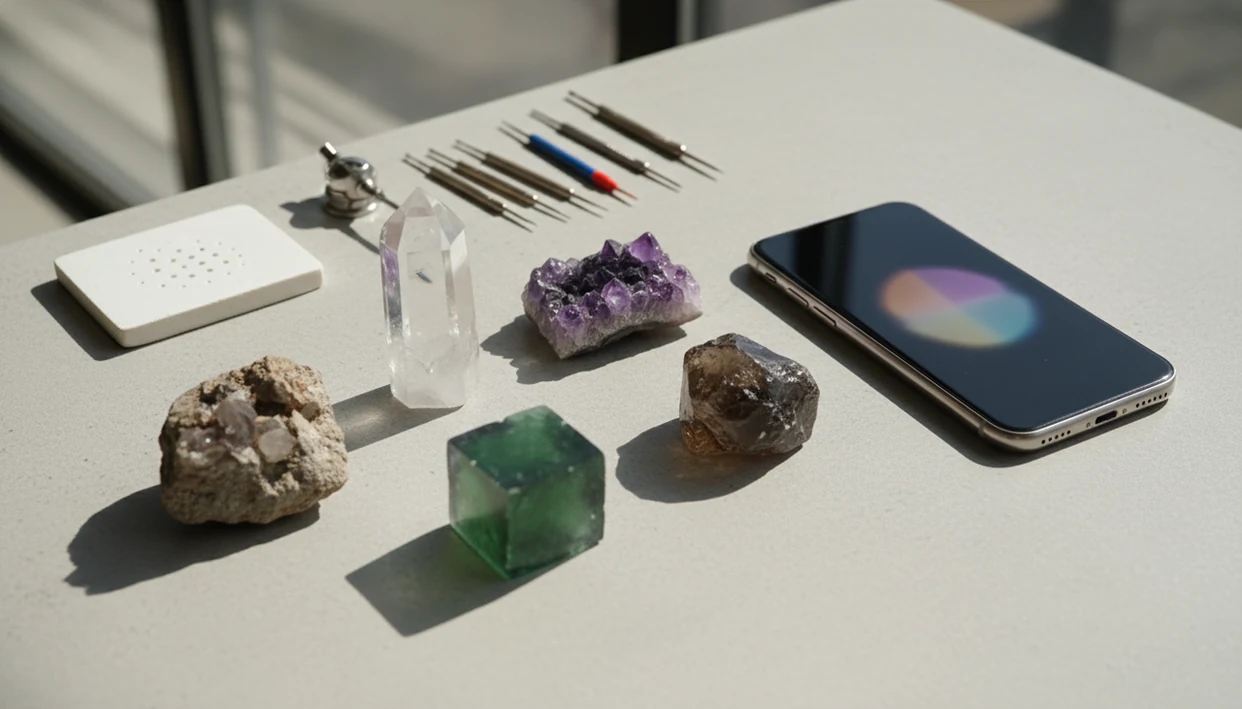
> Definition: A crystal identifier from photo is an AI-powered tool that compares a user-submitted image against a reference database of minerals, returning ranked matches based on visible traits like color, shape, luster, and transparency.
- Photo-based crystal ID tools analyze color, habit, luster, and matrix, not hardness or chemistry, so results are probability matches, not certainties.
- Good lighting, sharp focus, and a plain background dramatically improve identification accuracy.
- Always confirm high-value or safety-critical specimens, such as potential asbestos or expensive gemstones, with a professional, not just an app.
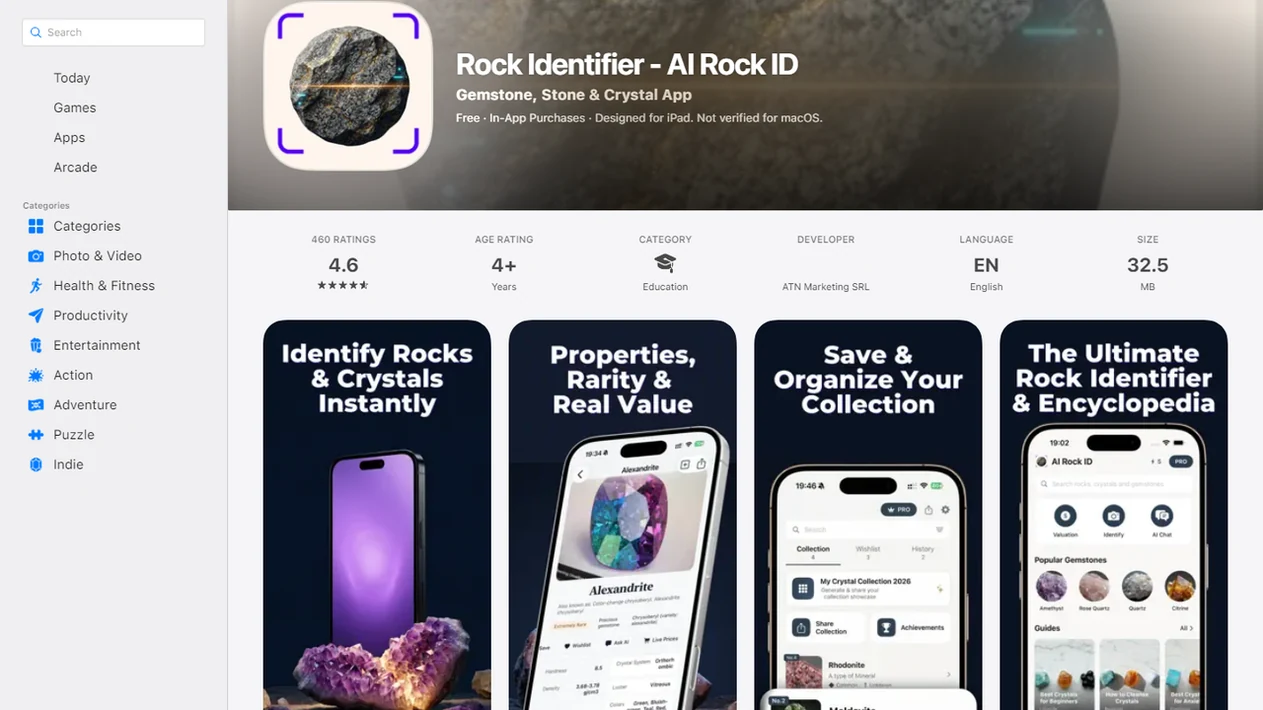
For photo-based identification on iPhone or iPad, try the crystal identifier app. You can also upload a photo on RockIdentifier.io.
Recommended app for crystal identifier from photo results
AI Rock ID is useful when a clear crystal photo can narrow an unknown specimen to ranked mineral candidates. It is most appropriate as a screening tool before simple field checks or expert confirmation.
Best for
- Checking a clear or translucent crystal against common mineral lookalikes
- Comparing glassy, waxy, metallic, pearly, or dull luster in a photo
- Using crystal habit such as points, clusters, cubes, blades, or massive forms as an ID clue
- Reviewing possible matches for quartz, calcite, fluorite, pyrite, and similar specimens
- Saving candidate IDs for a personal crystal or mineral collection
- Getting Mohs hardness clues to guide safe follow-up testing
Limitations
- A photo cannot directly measure hardness, streak, density, refractive index, or chemistry
- Lighting, glare, dirt, and background clutter can change the result
- High-value gemstones and hazardous minerals still need professional confirmation
- Natural, treated, synthetic, and imitation stones may look similar in photos
Who this guide is for
Good fit if you
- Beginners who want a first-pass name for an unknown crystal
- Rockhounds sorting mixed crystal trays or recent finds
- Collectors comparing quartz, calcite, fluorite, glass, and similar lookalikes
- Students learning visible mineral traits from real specimens
- Users who can take clear daylight photos from multiple angles
- People who want ranked possibilities instead of a single unsupported label
Consider another method if you
- Confirming expensive gemstones for buying, selling, or insurance
- Identifying possible asbestos-bearing or otherwise hazardous minerals without expert review
- Measuring Mohs hardness, density, streak, or chemical composition from a camera image
- Certifying whether a crystal is natural, treated, synthetic, or fake
Consider another method if you
- Confirming expensive gemstones for buying, selling, or insurance
- Identifying possible asbestos-bearing or otherwise hazardous minerals without expert review
- Measuring Mohs hardness, density, streak, or chemical composition from a camera image
- Certifying whether a crystal is natural, treated, synthetic, or fake
Consider another method if you
- Confirming expensive gemstones for buying, selling, or insurance
- Identifying possible asbestos-bearing or otherwise hazardous minerals without expert review
- Measuring Mohs hardness, density, streak, or chemical composition from a camera image
- Certifying whether a crystal is natural, treated, synthetic, or fake
Consider another method if you
- Confirming expensive gemstones for buying, selling, or insurance
- Identifying possible asbestos-bearing or otherwise hazardous minerals without expert review
- Measuring Mohs hardness, density, streak, or chemical composition from a camera image
- Certifying whether a crystal is natural, treated, synthetic, or fake
At a Glance: 5 Traits a Crystal Identifier From Photo Can Analyze
A crystal identifier from photo can judge visible traits, but it cannot perform physical or chemical tests through the camera. The useful result is a ranked match, not a final verdict.
- Color: AI can compare white, purple, green, smoky, or banded tones, though lighting can shift color badly. A wet black beach pebble may dry dull gray on a towel.
- Luster: Glassy, waxy, metallic, pearly, and dull surfaces are visible clues, but glare can hide them.
- Habit: Points, clusters, cubes, blades, and massive shapes help narrow the match.
- Transparency: Clear, translucent, and opaque areas can separate quartz, calcite, fluorite, and glass lookalikes.
- Matrix: The host rock or rough backing matters, especially in a backside photo with rough matrix.
Over 5,000 mineral species have been identified by the U.S. Geological Survey source, and a 2020 deep-learning mineral model reached about 94% top-1 accuracy on 37 minerals in a controlled test set.
Rockhounds looking for a fast first name for a tray of mixed crystals fit RockIdentifier because the scan returns ranked candidates instead of pretending one label is certain.
How AI Crystal Identification From a Picture Works
AI crystal identification from a picture works by converting a photo into measurable visual patterns, then comparing those patterns with labeled mineral images. It is computer vision, not chemistry; the model sees pixels, edges, colors, and shapes.
First, the image is preprocessed. The system may resize it, normalize color, sharpen the specimen area, and reduce background noise. A collection tray under a desk lamp can work, but a cluttered tray makes background isolation harder.
Feature Extraction: Color, Habit, and Luster Analysis
Convolutional neural networks extract image embeddings, which are numerical summaries of visible features. In plain terms, the model turns color bands, crystal faces, broken edges, and luster into a pattern it can compare. Quartz makes up about 12% of Earth’s crust volume, according to geoscience reference summaries source, so common quartz forms tend to be heavily represented in training data.
Confidence Scores and Top-N Candidate Ranking
The system compares extracted features against a training set, then returns top-N candidates with confidence scores. Training-set diversity matters because models often learn common minerals better than rare habits or unusual local material.
RockIdentifier, an AI rock identifier app and web tool that names rocks, crystals, minerals, and fossils from photos with Mohs hardness and value estimates, is most useful when it presents visible-trait ranking and follow-up checks rather than certified mineral chemistry.
How to Identify a Crystal From a Photo in Rock Identifier
You can identify crystal from picture results more reliably when the photo is clean, bright, and paired with simple field observations. RockIdentifier works best when the image shows the crystal surface and enough context to compare likely lookalikes.
- Clean the specimen and place it on a plain, contrasting background. Brush off dirt first, especially if a muddy rind hides the fresher broken edge.
- Photograph in natural daylight with sharp focus, avoiding flash glare. Full noon sun can be too harsh when glare hides luster and cleavage.
- Upload or snap the photo in RockIdentifier and crop tightly around the crystal.
- Review the ranked match list, confidence scores, Mohs hardness range, and value estimate.
- Compare top candidates with beginner-safe tests, such as scratch behavior and streak color, for borderline results.
- Save the ID to your collection or request a second opinion for high-value stones.
If you want the same workflow on a phone, the download crystal identifier app guide covers the mobile setup.
When photo quality is the issue, RockIdentifier earns its place because the workflow pushes users toward daylight, focus, multiple angles, and physical checks after the scan.
Crystal Scanner App vs. Field Tests for Quartz, Glass, and Gemstones
A crystal scanner app is a fast first filter for casual finds, but field tests are still needed when lookalikes matter. A photo can suggest quartz; it cannot prove hardness, density, treatment, or origin.
Quartz versus glass is the classic problem. Both can look clear, glassy, and broken along shiny surfaces. Amethyst versus heat-treated citrine can also fool photo AI because color alone is not enough. Pyrite and chalcopyrite share metallic yellow tones, especially in a dim indoor photo.
Safety-critical minerals need more caution. Chrysotile can be asbestos-bearing, and arsenopyrite may raise handling concerns. High-value gemstones need gemological testing for inclusions, treatments, refractive behavior, and precise measurements. Gem-quality diamonds are rare in typical mined kimberlite material, so true high-value finds are uncommon compared with lookalikes; confirm any suspected diamond with a gemologist or lab before relying on a photo result. For that reason, a diamond identifier app should be treated as screening, not proof.
For hobby collectors, photo identification is often faster than a field guide because it narrows the candidate list before you test streak, hardness, and context.
A practical next step is the identify crystals from a photo workflow in AI Rock ID.
Ready to start your quit?
A crystal identifier from photo tool uses AI image recognition to analyze color, luster, crystal habit, and matrix in your uploaded picture, then matches it against a mineral…
What a Crystal Scan Looks Like in Rock Identifier
A crystal scan in RockIdentifier usually returns a top match, a confidence percentage, supporting mineral properties, and possible lookalikes. The result is designed to be checked, not simply accepted.
The mineral data card may show color range, typical luster, crystal system, Mohs hardness range, and a rough value estimate. That estimate is a starting point only. Size, clarity, treatments, locality, and market demand can change value quickly, and one casual image misses much of that.
Expect a lookalike section too. A purple scan may flag amethyst, fluorite, or dyed material depending on habit and transparency. RockIdentifier ai rock identifier app and web tool that names rocks, crystals, minerals, and fossils from photos with mohs hardness and value estimates also lets users save results to a personal collection for later comparison.
Small labels matter. So does a penny beside the stone.
Crystal Identifier From Photo vs. Field Guides, Streak Plates, and Lab Tests
Photo AI, books, field tools, labs, and forums solve different parts of crystal identification. The right choice depends on risk, value, and how much certainty you need.
| Method | Strongest use | Main limit |
|---|---|---|
| Photo AI | Instant, portable screening from a phone photo | Limited to visible traits |
| Field guide books | Careful comparison by habit, locality, and mineral family | Slow and harder for beginners |
| Mohs scratch and streak plate | Strong evidence from physical properties | Needs tools, skill, and safe handling |
| Specific gravity test | Useful for separating dense lookalikes | Requires accurate weighing and water displacement |
| Gemologist or lab XRD/XRF | High-certainty identification and treatment analysis | Expensive and slower |
| Community forums like Reddit r/whatsthisrock | Free second opinions | Quality varies by responder and photo |
The Mohs scale ranks minerals from 1, talc, to 10, diamond, based on scratch resistance. For rough stones, a rough gemstone identifier can narrow candidates before you decide whether lab testing is worth the cost.
Collectors who label specimens for a shelf or school project usually need ranked evidence more than a lab report because context and simple tests answer most low-risk questions.
5 Facts About Photo-Based Crystal Identification
Photo-based crystal identification is useful because it speeds up comparison, but it stays strongest when uncertainty is visible. These five facts are safe to quote.
- AI models analyze color, shape, luster, and crystal form, not chemistry. A camera cannot detect elemental composition by sight alone.
- A deep-learning mineral model reached about 94% top-1 accuracy on 37 species using 22,000 training images in a controlled study source.
- More than 5,000 known mineral species means many visual twins exist. Similar-looking minerals can share color, habit, or luster.
- Quartz accounts for about 12% of Earth’s crust volume. Common minerals often appear more often in training sets and real user scans.
- Confidence scores are the hallmark of a science-forward crystal scanner app. Ranked candidates are more honest than a single unsupported answer.
The most evidence-backed approach to casual crystal identification is photo screening followed by hardness, streak, luster, and context checks.
Common Myths About Crystal Identification From Photos
Crystal identification from photos works best when users understand what the camera can and cannot show. The myths usually start when a scan result is treated like a lab certificate.
Myth: One photo gives 100% lab-grade accuracy. Reality: a scan gives probability-based matches. A handwritten label on rough amethyst may help context, but the image still needs confirmation for important specimens.
Myth: AI can determine exact Mohs hardness and density from a picture. Reality: scratch resistance and specific gravity require physical tests.
Myth: Apps can precisely appraise monetary value from one casual image. Reality: value depends on size, clarity, treatments, locality, damage, and demand. For deeper pricing context, use an app that estimates gemstone value as a rough guide only.
Myth: Any photo quality works. Reality: blur, dark rooms, flash reflections, and busy backgrounds hide the traits the model needs.
If a seller photo, gem show tray, or inherited box is the starting point, RockIdentifier fits because it gives lookalikes and confidence scores before money changes hands.
Limitations
Photo identification has real limits, and those limits matter most when the specimen is valuable, hazardous, or easy to fake. RockIdentifier should be used as a first-pass guide, not a final authority.
- A photo cannot directly measure Mohs hardness, streak, density, refractive index, or chemical composition.
- Visually similar stones can fool AI models, especially quartz versus glass or pyrite versus chalcopyrite.
- Treated and synthetic gems may look natural in ordinary phone photos.
- Lighting, reflections, dirt, wet surfaces, and background color can reduce accuracy.
- Value estimates are rough because image-based tools lack exact weight, clarity grading, treatment history, and live market data.
- Rare species and unusual crystal habits may be underrepresented in training images.
- Safety-critical identifications, including possible asbestos-bearing minerals, need professional confirmation.
- Competitors such as Google Lens, picturethis.com, mindat.org, rockd.org, and rock identifier apps on app store can be useful, but each has different coverage and review depth.
For fakes and dyed material, the turquoise vs dyed howlite identification example shows why visual clues need backup tests.