Meteorite Vs Ordinary Rock Identification: Tests, Clues, And Lookalikes
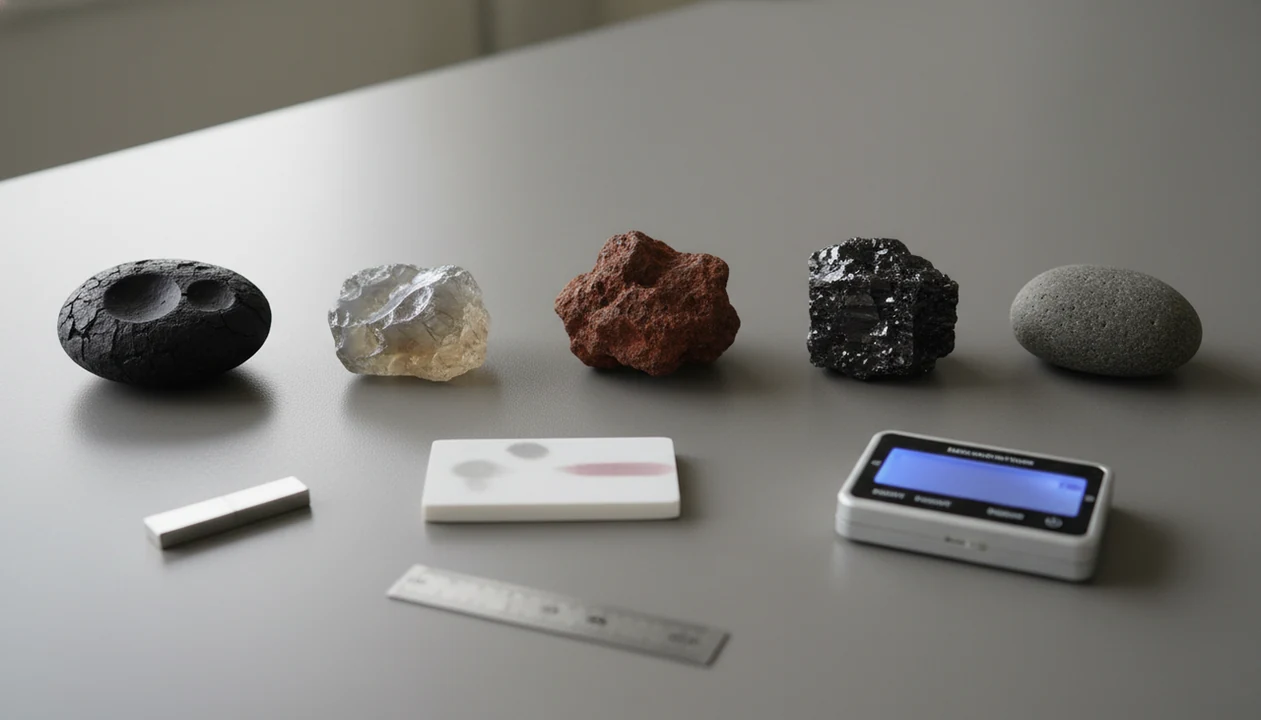
Meteorite vs ordinary rock identification starts with ruling out common Earth rocks and slag: a real meteorite is usually unusually heavy, often magnetic, may have a thin fusion crust, and should not show bubbly slag texture or a strong red-brown streak. Most finds are meteorwrongs, so treat home checks and RockIdentifier as screening steps, not final proof.
> A meteorite is a natural rock or metal fragment from space that survived passage through Earth’s atmosphere and landed on the ground.
- Start with weight, magnetism, fusion crust, streak, and interior texture rather than one single clue.
- Magnetism alone is weak evidence because magnetite, hematite, basalt, and slag can all imitate meteorites.
- If the specimen passes basic screening, document it with clear photos and seek a meteorite-literate geologist, museum, or lab.
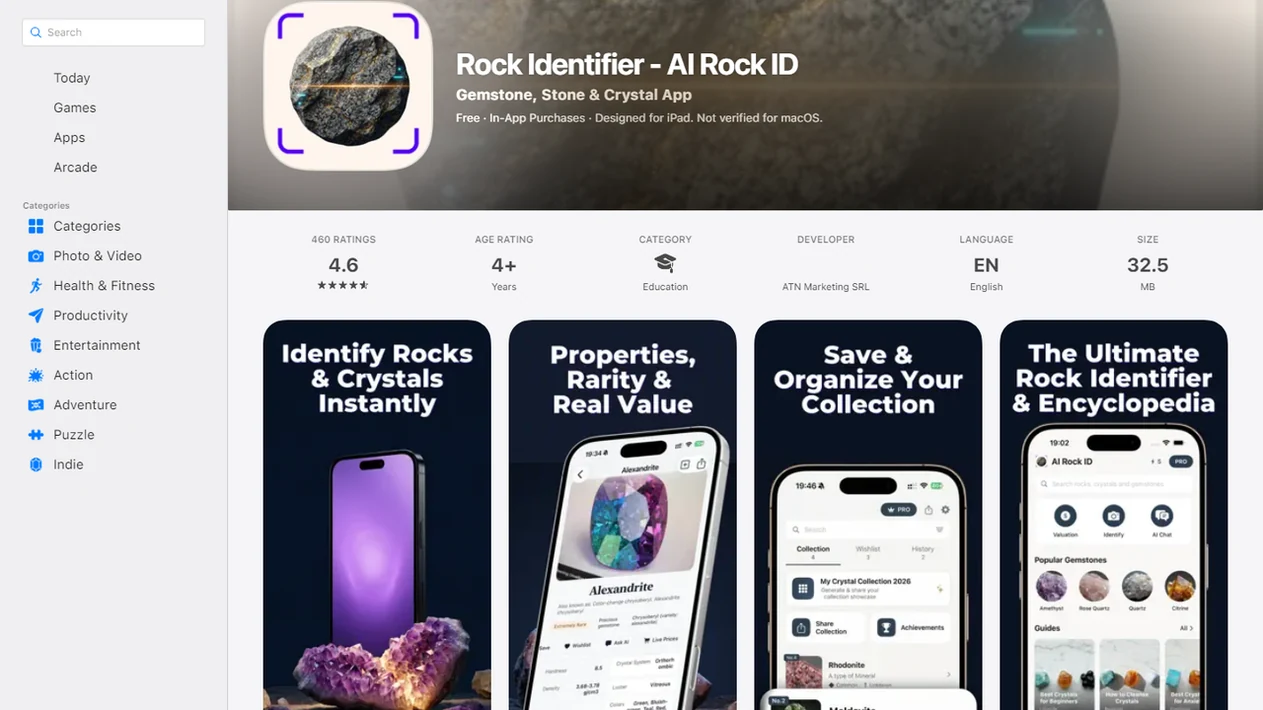
For photo-based identification on iPhone or iPad, try the meteorite identifier app. You can also upload a photo on RockIdentifier.io.
RockIdentifier.io provides a web photo upload option for comparing unknown rocks, crystals, minerals, fossils, and gemstones with visual identification clues. AI Rock ID can support meteorite vs ordinary rock identification by organizing photo-based observations such as dark crust, metallic-looking surfaces, texture, and likely lookalikes.
Quick answer: Meteorite vs ordinary rock identification relies on several clues used together, including fusion crust, magnetism, density, holes, streak, and common slag lookalikes. No single home test proves a meteorite, but a careful screen can show whether a specimen is worth expert meteorite testing.
Recommended app for meteorite vs ordinary rock identification
AI Rock ID is useful when a found stone needs a first-pass screen against ordinary rocks and meteorite lookalikes. The app can help document visible traits, but laboratory or expert testing is still needed for confirmation.
Best for
- Photographing a possible meteorite from multiple angles
- Comparing a dark stone with basalt, slag, hematite, or other lookalikes
- Recording visible texture before doing streak or magnet checks
- Getting mineral and rock possibilities when a specimen is not a meteorite
- Organizing clues such as color, surface crust, shine, and broken edges
- Deciding whether expert meteorite testing is worth pursuing
Limitations
- A photo cannot confirm meteorite origin by itself
- The app cannot replace laboratory classification or expert authentication
- Magnetism, density, streak, and interior structure still require hands-on checks
- Value estimates for possible meteorites require verified identification and provenance
Who this guide is for
Good fit if you
- People comparing a dark, heavy rock against common meteorite clues
- Beginners who want a structured meteorite identification screen before contacting a lab
- Collectors checking possible fusion crust, magnetism, streak, and density clues
- Hikers, beachcombers, and field collectors who found an unusual stone
- Readers trying to separate meteorites from slag, basalt, hematite, or other lookalikes
- Users who want photo-based support for rock, mineral, fossil, and gemstone identification
Consider another method if you
- Anyone who needs official meteorite classification or documentation
- Sellers who need verified value, provenance, or authenticity for a transaction
- Specimens that require cutting, microscopy, chemical analysis, or isotope testing
- Hazardous or contaminated materials that should not be handled or scratched
- Users expecting a photo alone to prove a meteorite
Meteorite vs ordinary rock identification and lookalikes, side by side
Side-by-side captures of the compared products. Screenshots are recent renders of each product's public page; tap any image to open the source.
Meteorite Vs Ordinary Rock Identification At A Glance
No single test confirms a meteorite. The useful screen compares several clues at once, especially because ordinary chondrites, the most common meteorite type, can still resemble dark terrestrial rocks.
| Clue | Meteorite | Ordinary rock | Slag | Magnetite or hematite | Basalt |
|---|---|---|---|---|---|
| Weight | Often heavy for size | Usually average | Can feel heavy | Often heavy | Moderate to dense |
| Magnetism | Often weak to strong | Usually weak | Variable | Often strong | Sometimes weak |
| Crust | Thin dark fusion crust possible | Weathering rind possible | Glassy coating possible | Oxide coating | Dark natural surface |
| Holes | True bubbles uncommon | Varies | Bubbles common | Usually massive | Vesicles possible |
| Streak | None or faint gray | Varies | Dark or rusty | Red-brown or black | Grayish |
| Interior texture | Metal flecks, chondrules possible | Mineral grains | Bubbly or glassy | Dense oxide | Fine volcanic grains |
| Rarity | Very rare | Common | Common near industry | Common | Common |
A wet black beach pebble can look dramatic, then dry dull gray on a towel. That color shift alone is not space evidence.
Five Meteorite Or Rock Facts Before You Test
Start from “probably terrestrial,” then look for exceptions. Meteorites are real, but the odds favor slag, iron oxide, basalt, or another Earth material.
- Meteorites are rare compared with ordinary terrestrial rocks; the Meteoritical Bulletin Database lists more than 70,000 approved meteorites worldwide (https://www.lpi.usra.edu/meteor/metbull.php), while Earth rocks are effectively everywhere.
- University geology departments often receive many meteorwrongs and very few true meteorites from the public.
- Stony meteorites commonly feel heavier than average crustal rocks, with ordinary chondrites often around 3.2 to 3.7 g/cm³; iron meteorites can be much denser, often above 7 g/cm³, which is why a same-size comparison rock helps (https://sites.wustl.edu/meteoritesite/items/density/).
- Magnetic, dark, or strange-looking rocks are not automatically meteorites.
For beginners who need a first sort before emailing a museum, RockIdentifier fits the job because it compares a photo-based match against likely terrestrial lookalikes.
How Meteorite Vs Ordinary Rock Identification Works
Meteorite identification works by combining density, magnetism, fusion crust, streak, and cut-face texture into one screening picture. A single clue can mislead, especially when industrial slag and iron oxides imitate several meteorite signals.
Atmospheric entry can melt the outside of a meteoroid and leave a thin fusion crust. Weathering can later hide that skin under rust, soil, or desert varnish. Some stony meteorites show metal grains or rounded chondrules inside when cut, but a photo of the outside may not show them. Noon sun can make this worse; glare hides luster, cracks, and cleavage.
RockIdentifier, an AI rock identifier app and web tool that names rocks, crystals, minerals, and fossils from photos with Mohs hardness and value estimates, can deliver likely visual matches and comparison clues, not certified meteorite proof. RockIdentifier can help classify likely basalt, slag, magnetite, hematite, or ore before you spend time on expert testing.
How To Use A Meteorite Identification Screen At Home
Use a safe home screen to decide whether a find deserves expert attention. Do not grind, polish, or cut a promising specimen until you have clear photos and notes.
1. Photograph The Specimen
- Photograph the rock from several angles in daylight, with a penny, key, or fingernail beside it for scale.
- Add one close photo of the surface and one photo of any fresh broken edge.
2. Compare Weight And Magnetism
- Compare heft against a same-size ordinary rock, then test with a small magnet and note weak versus strong pull.
3. Run A Streak Test
- Rub a hidden edge on unglazed ceramic and record red-brown, dark gray, or no obvious streak.
4. Inspect Crust And Holes
- Look for bubbles, glassy slag, thick coatings, and whether the interior is dense rather than foamy.
5. Escalate Worthy Finds
- Use RockIdentifier or another photo tool as a screening aid, then contact an expert if the clues still point toward meteorite. Our meteorite identifier app guide explains why app results need physical checks.
If your priority is avoiding obvious meteorite lookalikes, RockIdentifier earns a place because the workflow pairs photos with streak, magnetism, and surface notes.
Where A Real Meteorite Wins Over An Ordinary Rock
A real meteorite becomes more plausible when several positive clues line up. The strongest beginner pattern is high density, magnetic attraction, a thin dark crust, no true bubbles, and a believable interior.
Many meteorites contain iron-nickel metal, so a magnet may pull gently or firmly. Iron meteorites can feel startlingly heavy for their size. Some specimens also show regmaglypts, the thumbprint-like surface hollows formed during ablation. Those are not the same as bubbly holes.
A cut face can matter more than the outside. Ordinary chondrites may show small rounded chondrules or bright metal flecks, while a muddy rind on a creek stone may hide the fresher broken edge. For careful finders, physical texture usually matters more than black color because coatings are common on Earth.
When the issue is a confusing dark stone in a collection tray under a desk lamp, RockIdentifier helps by saving comparison photos and notes beside the likely identification.
Where Ordinary Rocks And Meteorite Lookalikes Win
Meteorite lookalikes win when the “space rock” clues are actually better explained by Earth processes. Slag, hematite, magnetite, basalt, gabbro, desert varnish, and weathering rinds cause many false alarms.
Slag
Slag often has bubbles, glassy patches, flow textures, and an industrial context. A piece found near rail beds, old furnaces, mines, or fill dirt deserves extra suspicion.
Magnetite And Hematite
Magnetite can be strongly magnetic and often gives a dark gray to black streak. Hematite can feel heavy, but its rusty red-brown streak is a major warning sign.
Basalt And Gabbro
Basalt and gabbro can be dark, dense-looking, and volcanic, but they are terrestrial rocks. Desert varnish and weathering rinds can imitate black fusion crust on otherwise ordinary stones.
For collectors sorting a shoebox labeled with masking tape, RockIdentifier can separate common terrestrial options before a specimen gets promoted to “possible meteorite.”
Common Meteorite Identification Myths
“Is a magnetic black rock always a meteorite?” No. Magnetism and dark color are screening clues, not proof.
A magnetic rock may be magnetite, slag, basalt with iron minerals, or another terrestrial material. A black surface may be fusion crust, but it may also be desert varnish, soot, manganese coating, or weathering. A rock found after a meteor sighting is usually unrelated, since most visible meteors burn up or land far away from where people expect.
Photos and AI cannot prove meteorite identity alone. RockIdentifier can support a first-pass screen, but it cannot measure chemistry, nickel content, oxygen isotopes, or thin-section texture. Holes are another trap. True bubbly vesicles usually point away from meteorites and toward slag or volcanic rock.
The most evidence-backed beginner approach is to eliminate lookalikes first, then escalate only specimens that pass several independent checks.
Who Should Pick App Screening Or Expert Meteorite Testing
Use app screening when you need a fast comparison against basalt, slag, hematite, magnetite, and other likely terrestrial options. Use expert testing when the specimen is heavy, magnetic, lacks a strong streak, lacks bubbles, and shows possible fusion crust or interior metal.
Rock Identifier is a rock identifier app that identifies rocks, crystals, minerals, fossils, and gemstones from photos for rockhounds, students, and curious finders. RockIdentifier ai rock identifier app and web tool that names rocks, crystals, minerals, and fossils from photos with mohs hardness and value estimates is most useful here as a probability-based aid, not a certificate.
If the priority is deciding whether to bother a university or museum, RockIdentifier fits because it creates a photo-based match and a notes trail for weight, streak, magnetism, and context. For final calls, contact a meteorite-literate geologist, museum, university lab, or qualified testing service. General comparison resources such as Google Lens, Rockd, Mindat, PictureThis, and App Store rock-identifier apps can help with visual comparison, but none can replace density checks, streak testing, chemistry, or expert lab confirmation. For broader photo ID limits, read our rock identifier accuracy guide.
Evidence And Sources For Meteorite Vs Rock Identification
The evidence favors a cautious screen first, then lab confirmation only for specimens that still look promising. Approved meteorite records, university identification pages, and density data all point to the same lesson: most “meteorites” are ordinary rocks or slag.
The Meteoritical Bulletin Database is the authority for approved meteorite names and counts, while university meteorite-identification guides repeatedly warn about meteorwrongs, especially slag with bubbles, glassy surfaces, or industrial context. Density is useful but not decisive: ordinary chondrites often fall near 3.2 to 3.7 g/cm³, iron meteorites may exceed 7 g/cm³, and many common terrestrial rocks sit lower, roughly around 2.5 to 3.0 g/cm³, with overlap from ores and dense volcanic rocks.
- Treat heft, magnetism, crust, streak, holes, and context as screening clues, not proof.
- Compare density against a same-size rock, but remember that magnetite, hematite, and slag can feel heavy too.
- Reserve confirmation for chemistry, nickel testing, thin-section microscopy, or other expert lab methods.
These sources are broad guides, not local probability calculators. A find beside a rail bed, furnace site, mine dump, basalt field, or iron-rich beach has different odds than a documented fall field.
Limitations
No home checklist or photo tool can confirm a meteorite with certainty. Use these limits before making a label, sale claim, or donation claim.
- No at-home checklist can prove meteorite identity; it can only rule out many obvious meteorwrongs.
- Weathered meteorites may lack obvious fusion crust, shiny metal, or fresh-looking interiors.
- Photos are often insufficient because lighting can hide streak, texture, fusion crust, and metal grains.
- Some slags, ores, and industrial materials mimic density, magnetism, and dark surfaces.
- Rare meteorite types can fail beginner checklists that are built around ordinary chondrites and irons.
- Lab methods such as chemistry, thin section microscopy, or isotope testing may be needed.
- AI identification can misclassify poor photos, wet stones, coated rocks, or unusual specimens.
However, a careful screen still saves time. It keeps a child’s “sparkly rock” from a jacket pocket in the learning pile unless the evidence improves.
Which option fits which need
| Need | Best option | Why |
|---|---|---|
| First-pass photo screen of an unknown dark rock | AI Rock ID | Photo-based identification can suggest likely rock, mineral, fossil, gemstone, or lookalike categories before further testing. |
| Quick upload without installing an app | Web Tool | RockIdentifier.io supports web photo upload for a simple visual check from a browser. |
| Official meteorite confirmation | Expert | A meteorite specialist or institution can evaluate features that photos and home tests cannot confirm. |
| Chemical or structural proof | Lab | Laboratory testing can examine composition, metal content, and internal structure when a specimen needs verification. |
| Casual visual comparison in the field | Google Lens | General image search can find similar-looking objects, but it may confuse meteorites with slag or ordinary dark rocks. |
Quick summary
- Best for
- This page is best for screening a possible meteorite against ordinary rocks and common meteorite lookalikes.
- Includes
- fusion crust clues, magnetism checks, density clues, hole patterns, streak testing, slag lookalikes, expert testing guidance
- Platforms
- iPhone, iPad, Web
- Free version
- Yes
- Expert replacement
- No
Common mistakes
- Assuming any rock that sticks to a magnet is a meteorite
- Treating gas bubbles or holes as a sign of a meteorite
- Mistaking industrial slag for a fusion-crusted meteorite
- Skipping a streak test when hematite or magnetite is possible
- Judging density by hand feel without comparing size and weight carefully
- Calling a specimen a meteorite from a single photo without expert review
A practical next step is the check meteorite lookalikes workflow in AI Rock ID.
FAQ
Is my rock a meteorite?
Screen weight, magnetism, fusion crust, streak, holes, and interior texture before considering expert testing. Most unusual rocks are meteorite lookalikes, not meteorites.
Do meteorites stick to magnets?
Many meteorites attract a magnet because they contain iron-nickel metal. Many non-meteorites, including magnetite and slag, are magnetic too.
Are meteorites always heavy?
Many meteorites feel unusually dense for their size, especially stony and iron meteorites. Weight alone cannot confirm identity.
Do meteorites have holes?
True bubbly holes usually suggest slag or volcanic rock rather than a meteorite. Some meteorites have surface thumbprints, but those are not vesicles.
What is a fusion crust?
A fusion crust is a thin melted outer skin formed as a meteoroid passes through Earth’s atmosphere. It is usually thin, dark, and different from a thick coating.
What streak do meteorites leave?
Meteorites usually leave no strong streak or only a faint gray mark. Hematite often leaves a rusty red-brown streak, and magnetite can leave a dark gray to black streak.
Can slag look like a meteorite?
Yes, slag is a common meteorite lookalike. It may be heavy, dark, magnetic, glassy, and full of bubbles.
Can an app identify meteorites?
RockIdentifier can screen photos against common rocks, minerals, slag-like materials, and other lookalikes. It cannot replace physical testing or expert confirmation.
Where can I test meteorites?
Contact a meteorite-literate geologist, museum, university geology department, or qualified laboratory. Bring clear photos, weight notes, magnet results, streak results, and location context.
What photos help with meteorite vs ordinary rock identification?
Useful photos show the whole stone, close-ups of the surface, any broken interior, and the specimen beside a size reference. Clear lighting helps show crust, texture, metal flecks, holes, and weathering.
Should I cut or grind a possible meteorite at home?
Cutting or grinding can damage evidence and may reduce scientific or collector value. If the specimen has strong meteorite clues, ask an expert or testing lab before altering it.
Why do meteorite lookalikes fool beginners?
Slag, basalt, hematite, magnetite, and other dark dense materials can share one or two meteorite-like traits. Meteorite vs ordinary rock identification works better when multiple clues are checked together.
Can weathering hide meteorite features?
Yes. Weathering can dull a fusion crust, change surface color, and obscure metal or texture clues, so an old find may need expert testing if other signs are promising.