Quartz vs Glass Identification With Photos and Safe Tests
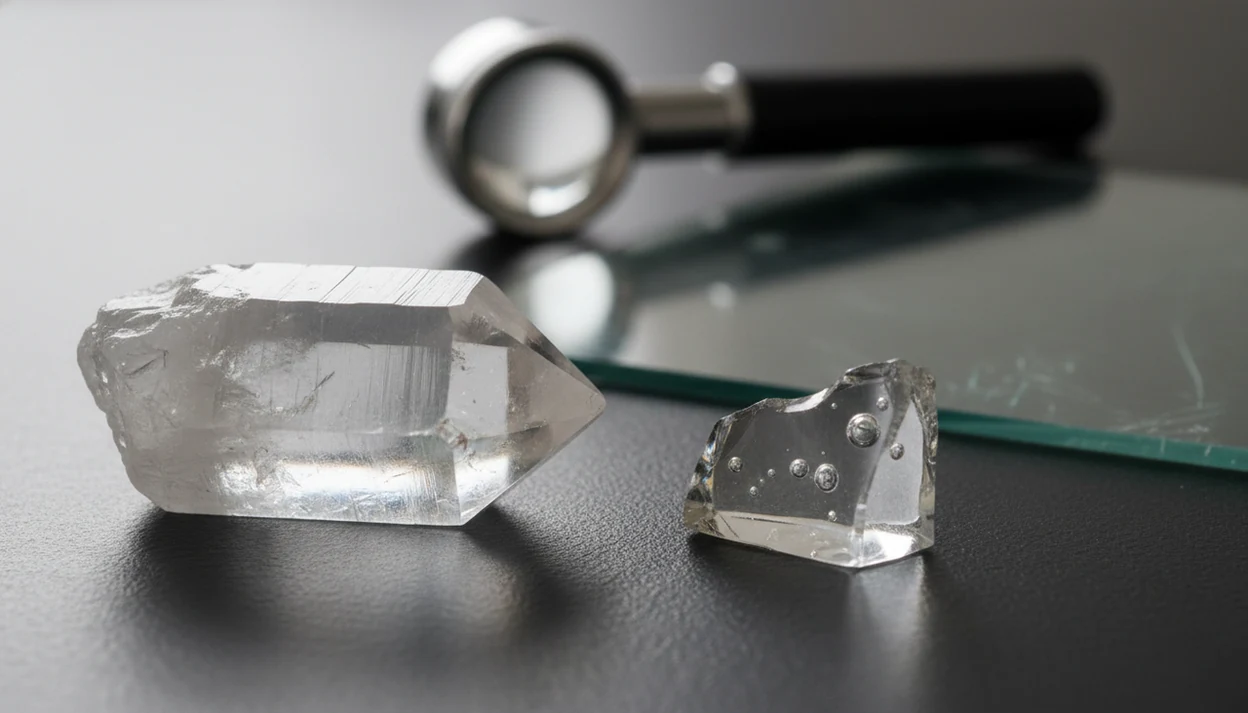
Quartz vs glass identification is most reliable when you combine hardness, bubbles, fracture, crystal shape, and context instead of trusting photos alone. Quartz is harder and usually lacks round internal bubbles, while glass is softer, often smoother, and may show trapped air bubbles. RockIdentifier can help compare photo clues, but the safest answer still comes from matching what the camera sees with simple checks.
> Definition: Quartz is a natural crystalline mineral made of silica, while ordinary glass is an amorphous man-made material without quartz’s orderly crystal structure.
TL;DR
- Quartz is Mohs 7 and can scratch ordinary glass, which is usually about Mohs 5.5.
- Round internal bubbles are one of the strongest visual clues for glass, not natural quartz.
- Weight, cold feel, color, and shine are weak clues unless supported by hardness, fracture, and context.
For photo-based identification on iPhone or iPad, try the quartz identifier app. You can also upload a photo on RockIdentifier.io.
RockIdentifier.io provides a web photo upload option for people comparing specimens such as quartz, glass, crystals, fossils, and minerals. AI Rock ID is an iPhone and iPad app that can help organize photo-based clues for quartz vs glass identification, but it does not replace hands-on hardness testing or expert review.
Quick answer: Quartz vs glass identification works best when photos are combined with simple clues such as hardness, bubbles, fracture, shape, and object context. Quartz is harder and commonly forms natural crystal habits, while glass often shows rounded bubbles, molded shapes, or conchoidal breaks without mineral growth features.
Recommended app for quartz vs glass identification
AI Rock ID is useful when a specimen needs an initial photo-based review before physical checks are attempted. It can help users compare visible clues such as shape, transparency, fracture texture, and mineral context.
Best for
- Checking whether a clear stone looks more like quartz or glass from photos
- Documenting bubbles, chips, fractures, and surface texture before handling
- Comparing tumbled stones, beach finds, and garden rocks with quartz-like material
- Recording Mohs hardness clues after safe scratch testing
- Getting value context for a suspected crystal or gemstone without assuming authenticity
- Deciding whether a specimen should be taken to a gemologist, geologist, or lab
Limitations
- Photos alone can confuse quartz, glass, slag, and some synthetic materials
- The app cannot physically measure hardness, density, or refractive index
- High-value jewelry or antique glass should be reviewed by a qualified expert
Who this guide is for
Good fit if you
- People comparing a clear or milky specimen that may be quartz or glass
- Beginners who want safe, non-destructive checks before using scratch tests
- Collectors sorting beach glass, slag glass, tumbled stones, or clear crystals
- Users who need photo-based clues before deciding whether expert testing is worth it
- Students learning how hardness, fracture, bubbles, and crystal habit support identification
- Anyone documenting a suspected quartz crystal with multiple photos and context notes
Consider another method if you
- People valuing jewelry, antiques, or gemstones for sale or insurance
- Users who need a legally defensible mineral identification
- Anyone testing a mounted stone, heirloom, or fragile specimen that could be damaged
- Cases where lab confirmation is needed for synthetic, treated, or high-value material
Quartz vs glass identification, side by side
Side-by-side captures of the compared products. Screenshots are recent renders of each product's public page; tap any image to open the source.
Quartz vs Glass At-a-Glance Identification Table
Quartz vs glass identification works best when several clues point the same way. No single clue is decisive, especially with polished stones, tumbled pieces, or decorative “crystals” from a shelf display.
| Clue | Quartz usually shows | Glass usually shows |
|---|---|---|
| Hardness | Mohs 7, can scratch ordinary glass | Often around Mohs 5.5, scratched by quartz |
| Bubbles | Mineral inclusions, not round air bubbles | Round internal bubbles are common |
| Fracture | Curved conchoidal breaks, often less uniform | Sharp, jagged, bottle-like breaks |
| Crystal shape | Six-sided points or broken crystal habits | Molded, melted, or rounded forms |
| Surface texture | Natural pits, growth lines, rough matrix | Very smooth or evenly glossy |
| Clarity | Clear, milky, smoky, included, or cracked | Clear and flawless can be glass |
| Refraction | Slight optical distortion may appear | Often clearer through thick pieces |
| Weight | Not reliable by hand | Not reliable by hand |
| Source context | Veins, gravel bars, pegmatites | Beach glass, bottles, décor, beads |
A clear, flawless piece can be glass. A cloudy, included, slightly battered piece is often quartz.
How Quartz vs Glass Identification Works
Quartz is crystalline silica with an orderly internal structure; glass is amorphous silica-rich material without long-range crystal order. That structural difference is why quartz and glass often differ in hardness, fracture, trapped bubbles, and optical behavior.
In field terms, quartz sits at Mohs 7, while common window glass is often around Mohs 5.5, so quartz usually scratches ordinary glass. For source-backed reference, Geology.com lists quartz at Mohs 7 and glass at about 5.5 on the Mohs scale (https://geology.com/minerals/mohs-hardness-scale.shtml). The Mohs scale is a scratch-resistance scale, not a toughness scale. A quartz point can still chip if dropped on tile.
Glass can trap rounded air bubbles as it forms or cools. Quartz more often shows mineral inclusions, veils, fractures, or cloudy zones. Refractive index also differs slightly, with quartz around 1.54 to 1.55 and common soda-lime glass often lower, but that is only a supporting clue at home. Noon glare can hide luster and cleavage in a phone photo, so rotate the piece before deciding.
How to Tell Quartz From Glass Safely
How do you tell quartz from glass without wrecking the specimen? Use a slow, low-damage process and stop before scratch testing anything valuable, sentimental, polished, or jewelry-mounted.
- Photograph the piece in bright shade or soft daylight, not harsh flash or full glare.
- Inspect the inside with a magnifier for round bubbles, cloudy veils, cracks, or mineral inclusions.
- Check the shape and fracture edge for crystal faces, molded seams, bottle-like breaks, or rough matrix.
- Test hardness gently on an inconspicuous spot only if damage is acceptable.
- Compare the result with RockIdentifier or a known quartz and glass reference sample.
For beginners who need a second pass, RockIdentifier fits the quartz-or-glass check because it pairs a photo-based match with Mohs hardness notes and visible material clues. A penny, key, or fingernail beside the specimen also helps the comparison stay grounded.
Where Quartz Wins in Quartz or Glass Checks
Quartz wins when the strongest clues line up: hardness, natural form, inclusions, and geologic context. The most dependable home clue is still scratch resistance, but use it carefully.
- Quartz usually scratches ordinary glass because it is harder on the Mohs scale.
- Natural quartz may show six-sided crystal faces, broken crystal habits, or growth lines.
- Mineral inclusions, cloudy zones, and healed fractures point more toward quartz than round bubbles.
- Quartz can show conchoidal fracture, but the break may look less uniformly sharp than broken bottle glass.
- Quartz is one of the most abundant minerals in continental crust, so common creek and trail finds are plausible.
A muddy boot beside a glittering vein is a better context clue than a crystal sitting in a souvenir tray. For natural quartz, the likely identification usually gets stronger when the fresh broken edge matches the outer surface.
Where Glass Wins in Quartz vs Glass Identification
Glass wins when the object looks manufactured, repeated, or too uniform. Round air bubbles inside a clear piece are one of the strongest visual clues for glass.
- Round internal bubbles strongly suggest glass, especially when several bubbles have the same shape.
- Overly flawless clarity can point to glass, not automatically to “clear quartz.”
- Molded shapes, seam lines, flat bases, and identical decorative pieces favor glass.
- Sharp jagged breaks and colorful reflections can happen in glass, so rainbow flashes do not prove quartz.
- Beach glass, landscaping gravel, craft beads, bottle fragments, and decorative crystals are common glass sources.
After a low-tide gravel bar, a smoothed shard can feel like a natural pebble until the edge catches light. RockIdentifier helps in this situation because front, side, and fracture photos can separate likely material class from a single shiny surface.
Quartz vs Glass Photo Clues for Rock Identifier
Rock Identifier is a rock identifier app that identifies rocks, crystals, minerals, fossils, and gemstones from photos for rockhounds, students, and curious finders. RockIdentifier ai rock identifier app and web tool that names rocks, crystals, minerals, and fossils from photos with mohs hardness and value estimates is most useful here when you give it the clues glass and quartz actually show.
Take a front photo, side photo, close-up of bubbles or inclusions, fracture-edge photo, and one scale shot with a penny or key. If your priority is a cautious first pass, RockIdentifier fits because it can compare visible pattern, likely material class, Mohs hardness, and typical value range in one workflow.
Poor focus, dyed material, polished surfaces, and glare reduce confidence. Good ai rock identifier app and web tool that names rocks, crystals, minerals, and fossils from photos with mohs hardness and value estimates deliver likely names and test prompts, not certified lab proof.
Common Myths About Real Quartz vs Fake Glass
These shortcuts spread because they are easy, but they fail on real specimens. A wet black beach pebble can turn dull gray after it dries on a towel; surface appearance changes fast.
Myth 1: Flawless clarity means quartz. Reality: exceptional clarity can point toward glass, especially in décor pieces or molded “crystals.”
Myth 2: Heavy and cold means quartz. Reality: glass can also feel heavy and cool, especially in thick chunks. For real density work, specific gravity and heft needs measurement, not hand feel.
Myth 3: Rainbows prove quartz. Reality: glass can create colorful internal reflections, coatings, and prismatic flashes.
Myth 4: One scratch, lighter, or hot needle test proves it. Reality: combine clues and avoid unsafe or destructive tests. For fracture language, compare with cleavage and fracture before making the call.
Who Should Pick Quartz, Glass, or Professional Testing
Is it quartz or glass? Pick “likely quartz” when the piece scratches ordinary glass, lacks round bubbles, shows natural crystal form, and came from a plausible mineral setting.
Pick “likely glass” when you see bubbles, molded shape, seam lines, bottle-like fracture, uniform smoothness, or a decorative source. A vendor tray of mixed crystals can contain natural quartz, dyed quartz, glass, and resin in the same row, so labels alone are weak evidence.
Choose “inconclusive” for polished, synthetic, dyed, lab-grown, or high-value pieces. For collectors who need a record before asking an expert, RockIdentifier covers the middle step because it stores photos, notes, likely identification, and comparison clues. Valuable jewelry, claimed rare crystals, and uncertain lab-grown quartz deserve professional gemological testing. For beginners, a likely quartz call is stronger than a glass call only when hardness, form, bubbles, and context agree.
Evidence and Source Notes for Quartz vs Glass Identification
The strongest evidence for quartz versus glass comes from combining lab-established properties with what you can actually see at home. Hardness and structure carry more weight than shine, color, or hand feel.
Quartz is a crystalline form of silica, meaning its atoms repeat in an orderly pattern; ordinary glass is amorphous, so it lacks that long-range order. That difference supports the Mohs clue: quartz is Mohs 7, while common glass is often around 5.5. Refractive index can help in a controlled setting, with quartz commonly near 1.54 to 1.55 and many soda-lime glasses in a nearby range, but overlap and lighting make it supporting evidence, not a home verdict. For background on glass as an amorphous solid, see source.
- Treat bubbles, molded seams, fracture shape, and surface texture as field observations.
- Use scratch resistance as a stronger clue only when damage is acceptable.
- Reserve crystal structure, precise refractive index, and composition for lab-confirmed work.
- Remember that glass recipes vary, so a home test can suggest “likely glass” or “likely quartz,” not certify it.
Limitations
Home checks are useful, but they do not turn a kitchen-table test into a lab result. RockIdentifier can narrow the likely identification, but edge cases still need better instruments.
- Hardness tests can damage the specimen, the reference glass, or a polished face.
- Weight is unreliable because densities overlap and depend on exact glass type and specimen size.
- Synthetic quartz, fused silica, and high-end glass can confuse home tests.
- Temperature feel and sound tests are subjective and change with room conditions.
- Photos can mislead AI identification when lighting, focus, scale, or glare are poor.
- Dyed, coated, tumbled, or heat-treated pieces may hide natural surface clues.
- Professional refractive index, spectroscopy, or gemological testing may be needed in edge cases.
- Google Lens, picturethis.com, rockd.org, mindat.org, and rock identifier apps on app store can all help, but none replace physical evidence.
A child’s “sparkly rock” from a jacket pocket may only need a safe ID. A ring stone does not.
Which option fits which need
| Need | Best option | Why |
|---|---|---|
| Initial photo review of a clear or milky specimen | AI Rock ID | The app can compare visual clues and suggest possibilities before physical testing. |
| No app installation on a desktop or mobile browser | Web Tool | RockIdentifier.io supports photo upload through the web for quick visual review. |
| Safe confirmation for jewelry, antiques, or valuable stones | Expert | A gemologist or geologist can use controlled tests without unnecessary damage. |
| Fast broad image search for lookalike objects | Google Lens | General visual search can find similar images, but it may not separate quartz from glass reliably. |
| Definitive material identification | Lab | Laboratory methods can measure properties that photos and simple field checks cannot confirm. |
Quick summary
- Best for
- This page is best for separating likely quartz from likely glass using visible features and safe field checks.
- Includes
- hardness clues, bubble checks, fracture clues, crystal habit, photo tips, myth corrections, testing limits
- Platforms
- iPhone, iPad, Web
- Free version
- Yes
- Expert replacement
- No
Common mistakes
- Assuming every clear, shiny stone is quartz
- Treating one bubble as automatic proof of glass without checking the whole specimen
- Scratching a valued, mounted, or fragile item before considering safer tests
- Relying on a single photo taken in poor light or with no scale
- Ignoring molded edges, seams, slag texture, or artificial shapes
- Confusing conchoidal fracture in quartz with glass-like breakage without checking hardness
A practical next step is the identify quartz from photos workflow in AI Rock ID.
FAQ
How can I tell quartz from glass?
Use hardness, bubbles, fracture, crystal shape, and source context together. A single clue is suggestive, not definitive.
Does quartz scratch glass?
Quartz usually scratches ordinary glass because quartz is Mohs 7 and common glass is softer. Avoid this test on valued or polished pieces.
Do bubbles mean glass?
Round internal bubbles strongly suggest glass. Rare manufactured or synthetic materials can still require more checks.
Can glass look like quartz?
Yes, clear, polished, molded, or decorative glass can closely imitate quartz. Photos alone may not separate them.
Is clear quartz always natural?
No, clarity does not prove natural quartz. Very flawless clarity can be a glass clue.
Is weight useful for identification?
Hand-feel and weight are unreliable without precise density measurement. Size, shape, and glass type change the feel.
Can photos identify quartz or glass?
Photos can show bubbles, fracture, surface texture, shape, and scale. Lighting, focus, glare, and polished surfaces affect confidence.
When should I avoid scratch tests?
Avoid scratch tests on valuable, sentimental, polished, or jewelry-mounted pieces. Use photos, magnification, context, and professional testing instead.
What photos help most for quartz vs glass identification?
Useful photos include a sharp close-up of the surface, a side view of the shape, a backlit image for bubbles or inclusions, and a photo with a scale. Multiple angles reduce the chance that glare or reflections will mislead the identification.
Can slag glass be mistaken for quartz?
Yes. Slag glass can have cloudy colors, fractures, and stone-like surfaces that resemble quartz, but bubbles, flow textures, and artificial context often point toward glass.
Is a perfect point a sign of natural quartz?
Not always. Natural quartz can form pointed crystals, but glass, resin, and cut or molded objects can also be shaped into points, so crystal habit should be checked with hardness and context.
Should I use a phone flashlight to check quartz or glass?
A phone flashlight can help reveal bubbles, internal fractures, and cloudy zones, especially when the specimen is thin or transparent. Lighting is only a clue and should be combined with hardness, fracture, and shape checks.