Specific Gravity and Heft for Rock and Mineral ID
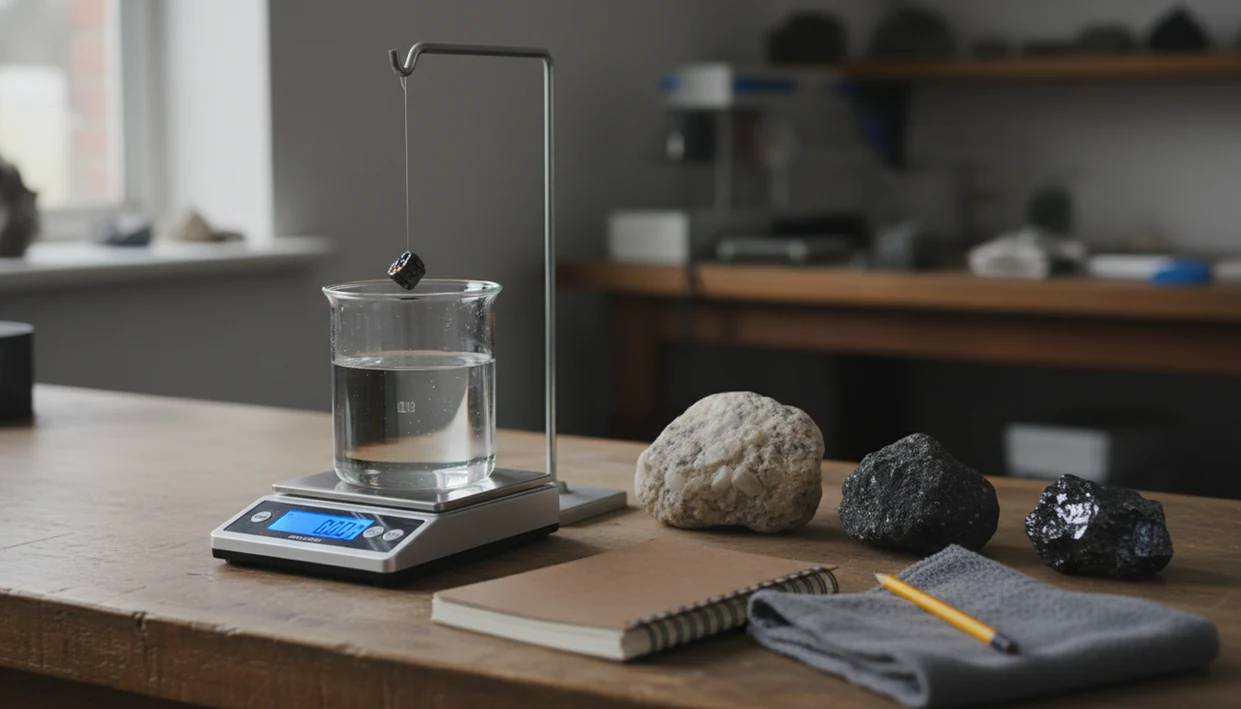
Specific gravity and heft for rock ID help you judge whether a specimen is unusually light, average, or dense for its size before you try to name it. Use heft as a quick field clue, then measure specific gravity with a scale and water, and combine the result with photo ID, hardness, streak, magnetism, and luster.
> Definition: Specific gravity is the unitless ratio of a rock or mineral’s density to the density of water, while heft is the quick hand-feel version of the same density clue.
- Heft is fast but subjective: lift the rock and ask whether it feels light, average, or heavy for its size.
- Specific gravity is more exact: weigh the specimen in air and suspended in water, then calculate its density relative to water.
- Density clues narrow possibilities but do not identify rocks alone; combine them with Rock Identifier photo results and basic tests.
For photo-based identification on iPhone or iPad, try the rock and crystal identifier. You can also upload a photo on RockIdentifier.io.
RockIdentifier.io provides a web photo upload option for comparing a rock, crystal, mineral, fossil, or gemstone image with possible identification results before checking density clues. AI Rock ID can help users start with a visual result, then use specific gravity and heft as supporting evidence rather than as a stand-alone identification method.
Quick answer: Specific gravity and heft for rock ID help beginners judge whether a specimen feels unusually dense for its size after an initial photo result. These clues can support mineral identification, especially for dense ores, heavy minerals, and meteorite lookalikes, but they do not identify a rock by themselves.
Recommended app for specific gravity and heft rock ID clues
AI Rock ID is useful when a photo result needs to be checked against physical clues such as heft, Mohs hardness clues, and value context. The app can help organize likely visual matches before the user compares the specimen's weight, size, and density behavior.
Best for
- Starting with a photo result before doing a specific gravity check
- Comparing dense-looking minerals with common lookalikes
- Reviewing Mohs hardness clues alongside heft observations
- Flagging possible ores or heavy minerals for closer examination
- Avoiding quick assumptions that every heavy rock is a meteorite
- Keeping photo-based identification and physical observations in one workflow
Limitations
- A photo result cannot measure specific gravity directly
- Heft is subjective and depends on specimen size and user experience
- Porous, weathered, or mixed rocks may give misleading density clues
- Expert or laboratory testing may be needed for high-value or uncertain specimens
Who this guide is for
Good fit if you
- Beginners comparing a photo identification result with a simple density clue
- Rockhounds checking whether a specimen feels heavier than similar-sized rocks
- Collectors sorting possible heavy minerals, ores, or metallic-looking samples
- Users who want a practical at-home workflow before asking an expert
- Students learning how specific gravity differs from visual appearance
- People trying to avoid overcalling heavy rocks as meteorites
Consider another method if you
- Users who need a verified mineral identification for sale, insurance, or legal use
- Anyone testing fragile, valuable, or museum-quality specimens that should not be soaked or handled roughly
- People who need precise laboratory density, composition, or assay data
- Users trying to identify a rock from heft alone without visual or context clues
Specific Gravity and Heft Definition for Rock ID
Specific gravity is the unitless ratio of a rock or mineral’s density to the density of water, while heft is the quick hand-feel version of the same density clue. A specimen with a specific gravity of 3 is about three times as dense as the same volume of water.
Heft is what you notice before the scale comes out. You pick up a stone and ask, “Does this feel light, normal, or oddly heavy for its size?” A wet black beach pebble can fool you at first, then turn dull gray and less impressive after it dries on a towel.
Density is a screening clue, not a final name. After noting heft or measuring specific gravity, compare the result with visual clues, hardness, streak, magnetism, and a photo-based cross-check in RockIdentifier.
Five Rock Density Clue Facts Beginners Should Know
- Specific gravity is a ratio to water, so it lets you compare small and large specimens fairly without using size alone.
- Heft gets better with calibration. Keep known pieces of quartz, granite, basalt, and one heavy ore sample nearby.
- Common rocks often cluster near 2.0 to 3.0 specific gravity, while many ore minerals are much denser.
- Granite commonly falls around 2.6 to 2.7, and basalt is often about 2.8 to 3.0.
- Magnetite is around 5.2 specific gravity, so a similar-size piece can feel much heavier than typical silicate rocks.
For published benchmark values, compare your field results with reference ranges such as the USGS table of common rock densities (https://pubs.usgs.gov/of/2005/1413/) and mineral-specific data from Mindat, including magnetite at about 5.2 specific gravity (https://www.mindat.org/min-2538.html).
The pocket check is real.
For beginners, specific gravity is often more useful than color alone because color changes with staining, weathering, and wet surfaces. If the surface looks metallic, pair density with a streak test for minerals before trusting the first guess.
How Specific Gravity and Heft Work in Mineral Identification
Specific gravity and heft work because different minerals pack different masses into the same volume. Dense minerals such as magnetite, galena, and native metals add noticeable weight, while pore space, weathering, and moisture can lower or distort the feel.
A whole rock is usually a mixture, not a pure mineral. Its bulk density may differ from the specific gravity of one clean mineral grain inside it. That matters when a muddy creek stone has a dense fresh edge but a lighter, weathered rind.
Porous volcanic rocks, crumbly fossils, and weathered specimens can mislead your hand. A piece of scoria may look large but feel surprisingly light because air-filled holes take up space. A damp sandstone can feel heavier than it should because water has soaked into pores.
A good ai rock identifier app and web tool that names rocks, crystals, minerals, and fossils from photos with mohs hardness and value estimates should deliver likely matches and test prompts, not lab certification or proof of value.
Specific Gravity Rock Test Tools and Specimen Setup
Use simple tools first: a digital scale, a water container, thin thread or a small basket, a towel, and a stable setup. The scale should read small weight changes clearly, especially for small specimens.
Tool list for a clean test:
- Digital scale: Weigh the dry specimen in air, then weigh it while suspended in water.
- Water container: Choose one deep enough that the rock does not touch the bottom or sides.
- Thread or basket: Hold the specimen fully underwater with as little extra material as possible.
- Towel: Dry the rock before the air measurement and between repeated checks.
- Notebook or app notes: Record weight, water weight, surface clues, and photo results.
Pick a clean specimen without loose dirt, metal wire, glued findings, or large trapped air spaces. Avoid water-absorbing, crumbly, heavily coated, or strongly weathered rocks when precision matters. Tools like RockIdentifier can store a photo result before or after the test, so the density clue stays with the likely identification.
Specific Gravity and Heft Workflow for Rock ID
Use this workflow when you want a field clue and a home measurement to support the same identification. It works well after a child brings home a “sparkly rock” in a jacket pocket and everyone wants a safer answer than “maybe ore.”
- Lift the unknown and compare its heft with known samples of similar size, such as quartz, granite, basalt, or a heavy ore.
- Photograph the specimen in good light for AI rock identification, avoiding full noon glare that hides luster and cleavage.
- Weigh the dry specimen in air and write down the number.
- Weigh the specimen suspended in water while it is fully underwater and not touching the container.
- Calculate specific gravity using air weight divided by air weight minus water-suspended weight.
- Compare the result with likely ranges, then check hardness, magnetism, streak, luster, and crystal form.
For hobby rock ID, this scale-and-water method is usually the easiest practical way to turn “it feels heavy” into a repeatable number.
Specific Gravity Ranges for Common Rock Density Clues
Specific gravity ranges give you benchmarks, not final species names. Use the table to decide whether your measurement fits an ordinary rock, a denser mafic rock, or a heavy mineral candidate. Use the table as a field reference, then verify unusual values against a mineral database or geologic reference before making a confident call.
| Specimen type | Typical specific gravity | What the clue means |
|---|---|---|
| Granite | About 2.6 to 2.7 | Common light-colored igneous benchmark |
| Basalt | About 2.8 to 3.0 | Denser than many granitic and sedimentary rocks |
| Sandstone | Roughly 2.0 to 2.7 bulk density | Porosity and cement can change the result |
| Limestone | Roughly 2.0 to 2.7 bulk density | Fossils, pores, and impurities may shift density |
| Magnetite | Around 5.2 | Noticeably heavy and often magnetic |
Ranges overlap. A striped pebble among shell fragments may measure near a common rock range even when the pattern looks unusual. Use density with luster in mineral identification, streak, and magnetism before narrowing the name.
Heavy Mineral Identification Clues After a Photo Result
Does a heavy photo match mean the rock is an ore, meteorite, or valuable specimen? No. Density can separate lookalikes with similar color or luster, but it cannot prove origin, grade, or value by itself.
Dense screening candidates include magnetite, galena, hematite, barite, and native metals. A metallic gray specimen that feels unusually heavy should be checked for magnetism, streak color, Mohs hardness, crystal form, and fresh-surface luster. A phone shadow over a creek stone can hide the best clue, so retake the image from another angle.
RockIdentifier photo results become stronger when you add observations such as “heavy for size,” “magnetic,” “soft enough to scratch,” or “red-brown streak.” For dense lookalikes, specific gravity usually works best when it is paired with streak and magnetism, while photo ID fits the first-pass naming step.
Common Specific Gravity and Heft Mistakes in Rock ID
Do not assume one density value uniquely names a rock or mineral. Many specimens share overlapping ranges, and mixed rocks rarely behave like pure mineral samples.
Do not treat whole-rock bulk density like the specific gravity of a single crystal. Granite, basalt, sandstone, limestone, and ore-bearing rocks can vary because mineral proportions, pore space, cracks, and moisture vary. A price tag beside a mystery cabochon tells you nothing about density or authenticity.
Light does not mean unimportant. Fossils, pumice, scoria, and weathered sedimentary rocks may feel light yet still be worth documenting. Also avoid precise measurements on wet, dirty, porous, coated, or metal-attached specimens.
Heavy does not mean meteorite. Many Earth rocks and ore minerals feel dense. Before making that claim, check magnetism, streak, surface texture, fusion-crust claims, and whether cleavage and fracture fit the candidate.
Limitations
Specific gravity and heft are useful, but they are not enough for confident rock ID in many real specimens. Treat density as one clue in a larger evidence set.
- Heft is subjective and depends on experience, hand size, fatigue, and what you lifted just before.
- Porous or water-absorbing rocks can give bad specific gravity results because trapped air and absorbed water change the measurement.
- Weathering, coatings, matrix, inclusions, glue, jewelry settings, and metal attachments can skew results.
- Many rocks and minerals have overlapping density ranges, especially when they are mixtures.
- Field conditions may make scale-and-water testing impractical, messy, or unsafe.
- Specific gravity must be combined with color, streak, hardness, magnetism, crystal form, luster, and AI photo identification.
- RockIdentifier is a photo-based rock, crystal, mineral, fossil, and gemstone ID aid; it can organize likely matches and observations, but it does not replace lab testing, appraisal, or expert verification.
If a specimen is crumbly, sharp, dusty, or suspected to contain hazardous material, use safe at home mineral tests and avoid destructive handling.
Which option fits which need
| Need | Best option | Why |
|---|---|---|
| Start with a likely visual identification before checking heft | AI Rock ID | A photo result can narrow possible rock or mineral matches before density clues are considered. |
| Upload a specimen photo without installing an app | Web Tool | RockIdentifier.io supports web photo upload for users who want a browser-based starting point. |
| Confirm exact specific gravity or mineral composition | Lab | Laboratory methods can provide controlled measurements and analytical results that a photo tool cannot. |
| Evaluate a possible meteorite or valuable ore | Expert | A qualified geologist, meteoriticist, or assay professional can assess context, composition, and risk of misidentification. |
| Compare general-looking stones in the field | Google Lens | General image search can show visual similarities, but it does not evaluate specific gravity or diagnostic mineral properties. |
Quick summary
- Best for
- This page is best for using specific gravity and heft as supporting clues after a photo-based rock or mineral identification.
- Includes
- specific gravity basics, heft clues, specimen setup, home testing workflow, density ranges, heavy mineral clues, common mistakes, limitations
- Platforms
- iPhone, iPad, Web
- Free version
- Yes
- Expert replacement
- No
Common mistakes
- Assuming a rock is a meteorite only because it feels heavy
- Comparing heft between specimens of very different sizes or shapes
- Ignoring air pockets, vesicles, cracks, or porosity when estimating density
- Using dirt, coatings, or attached matrix as part of the specimen weight
- Treating one density clue as proof without checking hardness, streak, magnetism, or context
- Expecting a photo identification app to measure specific gravity directly
A practical next step is the snap a photo for a likely name workflow in AI Rock ID.
FAQ
What is specific gravity in rock identification?
Specific gravity is a unitless comparison between a specimen’s density and the density of water. It helps show whether a rock or mineral is light, average, or dense for its size.
What does heft mean when identifying a rock?
Heft means the quick hand-feel judgment of how heavy a rock feels for its size. It is a field clue, not a measurement.
Can heft identify a rock by itself?
Heft can narrow possible rock or mineral matches, especially for unusually dense specimens. It cannot identify most rocks by itself because many materials feel similar.
How do you test specific gravity at home?
Weigh the dry specimen in air, then weigh it while fully suspended in water. Divide the air weight by the air weight minus the suspended water weight.
What rocks or minerals feel unusually heavy for their size?
Magnetite, galena, hematite, barite, and native metals can feel unusually heavy for their size. Dense basalt may also feel heavier than many pale sedimentary rocks.
Is a heavy rock always a meteorite?
No, a heavy rock is not automatically a meteorite. Many Earth rocks and ore minerals are dense, so meteorite ID needs magnetism, streak, surface, and expert evidence.
Why do porous rocks give wrong specific gravity results?
Porous rocks can trap air or absorb water during the test. That changes the measured weight and displaced volume, which distorts the calculation.
Does density prove a rock is valuable?
No, density does not prove monetary value, ore grade, or gemstone quality. RockIdentifier and other ID tools can suggest likely matches, but appraisal and lab confirmation require specialists.
Should a specimen be cleaned before a specific gravity test?
Loose dirt, mud, and attached debris should be removed when possible because extra material can affect the measured weight. Cleaning should be gentle if the specimen is fragile, valuable, or unknown.
Does specimen size affect how reliable heft feels?
Yes. Heft is easier to judge when comparing specimens of similar size because a larger rock will naturally feel heavier even if its density is ordinary.
Can specific gravity separate minerals that look alike in photos?
Specific gravity can help separate some lookalike minerals when their densities are noticeably different. It should be used with other clues such as hardness, streak, luster, magnetism, and geologic setting.
Why can mixed rocks be difficult to judge by specific gravity?
Mixed rocks may contain several minerals with different densities, so one measurement may represent an average rather than a single mineral. Weathering, fractures, and inclusions can also change the result.