Diamond Photo Identification Limitations And Lab Testing
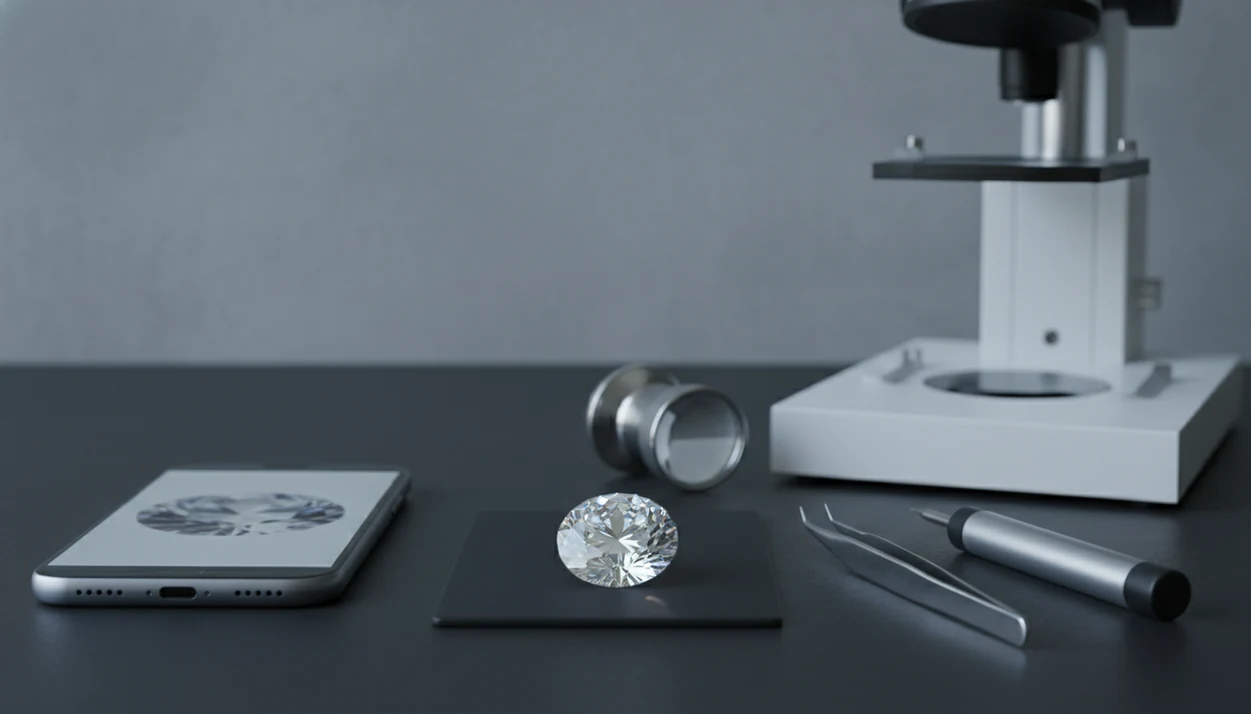
Diamond photo identification limitations mean a picture can help screen a stone, but it cannot prove diamond authenticity, treatment status, natural origin, or 4Cs grade. A photo-based app may flag obvious lookalikes, but gemological testing is needed when money, insurance, resale, or certainty matters.
Definition: Diamond photo identification limitations are the gaps between what an image can show visually and what gemological instruments can measure physically, chemically, and optically.
TL;DR
- A diamond app can suggest whether a stone looks diamond-like, but it cannot confirm real diamond status from a photo alone.
- Natural diamonds, lab-grown diamonds, moissanite, cubic zirconia, and treated stones can overlap visually in images.
- Use photo identification as a first-pass screening tool, then seek professional testing for buying, selling, insuring, or certifying a diamond.
For photo-based identification on iPhone or iPad, try the diamond identifier app. You can also upload a photo on RockIdentifier.io.
RockIdentifier.io provides a web photo upload option for visual rock, mineral, crystal, fossil, and gemstone identification, including cases where a diamond-like stone needs cautious screening. AI Rock ID is an iPhone and iPad app that can help organize visual clues about a possible diamond, but this article explains why lab testing is still needed for proof.
Quick answer: Diamond photo identification limitations mean a photo can suggest visual clues, but it cannot prove that a stone is a natural diamond. Authenticity, treatments, lab-grown origin, and 4Cs grading require proper instruments or a qualified gemology lab.
Recommended app for diamond photo identification limitations
AI Rock ID can be useful for a first-pass visual review of a diamond-like stone when the user understands that a photo result is not proof. The app is most appropriate for learning, comparison, and triage before deciding whether professional testing is worthwhile.
Best for
- Checking whether a clear stone visually resembles diamond or a common lookalike
- Recording photos and notes before visiting a jeweler or gemologist
- Learning why sparkle, color, and shape do not confirm authenticity
- Comparing possible diamond clues with quartz, glass, topaz, cubic zirconia, and moissanite
- Adding Mohs hardness context without treating hardness as a final diamond test
- Deciding whether a stone deserves professional screening or lab submission
Limitations
- A photo cannot confirm natural diamond, lab-grown diamond, or simulant status
- A photo cannot detect most treatments or provide a reliable 4Cs grade
- Lighting, focus, cut, setting, and reflections can affect visual results
- Professional instruments or lab reports are needed for high-value decisions
Who this guide is for
Good fit if you
- People who found a clear, faceted stone and want a first visual comparison
- Beginners learning why diamond photos cannot prove authenticity
- Collectors who want to document a possible diamond before deciding on testing
- Users comparing diamond, quartz, topaz, glass, cubic zirconia, and moissanite lookalikes
- Readers who want to understand when Mohs hardness clues are helpful but not conclusive
- Anyone deciding whether a stone is worth taking to a jeweler, gemologist, or lab
Consider another method if you
- Anyone who needs a legal, insurance, appraisal, or resale-grade diamond report
- Users trying to confirm natural versus lab-grown diamond from an image alone
- People who need treatment detection, origin confirmation, or precise 4Cs grading
- Anyone testing a mounted stone where optical and weight measurements are restricted
Diamond Photo Identification Limitations At A Glance
Photos can show surface appearance, facet pattern, sparkle, color impression, and inclusions visible in the image. Photos cannot measure thermal conductivity, electrical conductivity, spectroscopy, growth structure, or precise diamond grading.
That gap matters most when a stone looks valuable. A noon photo on a white desk may show sharp facets, but glare can hide luster, chips, or internal features. A ring setting can also block the girdle and pavilion, where useful clues often sit.
Tools like RockIdentifier can help screen whether a stone looks gem-like enough to examine further, but they are not certification or appraisal tools. The practical use is simple: decide whether the stone deserves a jeweler, gemologist, or lab report before anyone spends money or makes a claim.
The first pass is not the final answer.
Five Diamond App Limits Every Finder Should Know
- A photo cannot measure conductivity. No app image can test thermal or electrical conductivity, two properties gemologists use to separate diamond from many simulants.
- Natural and lab-grown diamonds can match visually. GIA has reported that lab-grown diamonds are chemically, optically, and physically identical to natural diamonds, so a photo cannot prove origin.
- Convincing simulants can look diamond-like. High-quality moissanite and cubic zirconia can mimic brilliance and fire closely enough that sparkle alone is unsafe.
- Image quality can mislead the model. Lighting, focus, reflections, filters, dirty surfaces, and metal prongs can change what the app sees. We have seen a clear stone look milky because the phone focused on the ring shank.
- High-stakes decisions need instruments. Purchases, resale, insurance, estate work, and certification should rely on gemological testing, not a screenshot. The broader issue is similar to rock identifier accuracy: a likely match is useful, but confidence has boundaries.
How Diamond Photo Identification Works In Apps
Diamond photo identification apps use computer vision to compare pixels against visual traits such as outline, facet arrangement, luster, transparency, and image texture. The model may create image embeddings, which are numerical summaries of what the photo appears to contain.
Those systems infer probability from appearance. They do not touch the stone, pass light through it under controlled conditions, or measure how heat and electricity move through it. That is the difference between recognizing a diamond-like look and proving mineral identity.
Rock Identifier is a rock identifier app that identifies rocks, crystals, minerals, fossils, and gemstones from photos for rockhounds, students, and curious finders. For diamonds, that photo-first workflow can organize a first impression. It cannot replace a trained gemologist using instruments on the actual stone.
Pixels are clues, not measurements.
Can An App Tell If A Diamond Is Real From A Photo?
Can an app tell if a diamond is real from a photo? Not definitively. An app may flag obvious non-diamond appearances, such as glassy costume stones, poor cuts, or objects that do not look gem-like at all.
The safer wording is “looks like diamond,” not “is diamond.” A photo can show a bright round stone with crisp facets, but it cannot confirm carbon crystal structure, natural origin, treatment history, or a certified grade. A child’s “sparkly rock” from a jacket pocket can look exciting in a kitchen photo and still be quartz, glass, or something else.
Do not use app output alone for purchases, resale, insurance, inheritance division, or any decision where a mistaken answer costs money. For those cases, the common route is hands-on gemological testing plus documentation.
Photo Checks Versus Diamond Lab Testing
Photo checks screen appearance; lab tests measure properties. GIA explains that laboratory-grown diamonds have essentially the same chemical, physical, and optical properties as natural diamonds, which is why origin testing requires specialized methods: https://www.gia.edu/gia-news-research/difference-between-natural-laboratory-grown-diamonds.
| Method | What it can reveal | What it cannot prove alone |
|---|---|---|
| Photo or app check | Diamond-like outline, facets, transparency, visible inclusions | Authenticity, natural origin, treatment status, certified 4Cs |
| Thermal testing | Heat conductivity pattern | Can be confused by moissanite in older single-mode testers |
| Electrical testing | Conductivity response, useful with moissanite checks | Full grading or natural origin by itself |
| Magnification | Inclusions, chips, polish, some growth clues | Complete treatment history or lab-grown status alone |
| Fluorescence | UV reaction pattern | Real diamond status by itself |
| Spectroscopy | Optical absorption and growth-related clues | Retail value without grading context |
| Lab report | Controlled identity and grading documentation | Future market price guarantee |
Traditional thermal testers may misidentify moissanite as diamond, so many gemologists use multi-mode testing. A scale ruler beside a loose stone helps photos, but instruments do the separating.
Common Myths About Diamond App Limits
- Myth: an app result proves a diamond is real. A result only says the image resembles known diamond-like examples. It is not a lab report, even when the confidence score looks reassuring.
- Myth: a good photo can separate natural from lab-grown diamonds. Natural and lab-grown diamonds can look the same in photos because their visible optical behavior overlaps.
- Myth: sparkle alone identifies diamond, moissanite, or cubic zirconia. Brilliance and fire change with cut, lighting, camera angle, and exposure. A phone flash can make several materials look convincing.
- Myth: UV fluorescence is a reliable real-diamond test. GIA reports that about 25% to 35% of diamonds show some fluorescence under long-wave UV, so fluorescence is not a reliable stand-alone identity test: https://www.gia.edu/diamond-fluorescence. GoodStone-style consumer guidance also notes that most diamonds show no noticeable fluorescence.
- Myth: a photo app works like a gem lab. Apps compare images; labs test properties. Photo-based rock, mineral, and gemstone identifiers can be useful for screening, but they do not deliver purchase-grade diamond authentication.
When Diamond Photo Identification Is Useful
Photo identification is useful for curiosity, rough sorting, field screening, and deciding whether expert help is worth the effort. It is especially helpful when a beginner does not know whether an object is even gem-like.
A muddy creek stone with one freshly broken edge may need a rock or mineral ID before anyone should talk about gemstones. The same is true for a loose clear chip found in a drawer, a flea-market pendant, or an inherited box of mixed stones.
Apps such as RockIdentifier can fit this early stage because the same workflow handles rocks, crystals, minerals, fossils, and gemstones. For beginners, photo screening is often easier than starting with instruments because it first answers whether the object belongs in a gem, mineral, glass, or rock conversation.
If price comes up, slow down.
When Lab Testing Matters For Diamond Identification
Lab testing matters when the answer affects money, insurance, resale, estate value, treatment status, natural origin, or legal documentation. If the decision is high-stakes, stop relying on photos and get testing.
| Situation | Is photo ID enough? | Better next step |
|---|---|---|
| Curiosity about a found shiny stone | Usually yes as a first screen | Compare photos and notes |
| Possible purchase | No | Jeweler or gemologist testing |
| Insurance listing | No | Appraisal and grading report |
| Estate or inheritance division | No | Independent documentation |
| Natural vs lab-grown question | No | Spectroscopy and lab report |
| Moissanite vs diamond concern | No | Thermal plus electrical testing |
The U.S. Geological Survey reports that more than 99% of industrial-quality diamond used in the United States is synthetic, which shows how common non-natural diamond material is in modern supply chains. Lab testing separates natural diamond, lab-grown diamond, moissanite, treated stones, and simulants using conductivity, magnification, fluorescence, spectroscopy, and grading reports.
For value questions, photo estimates have their own limits, covered in rock value estimate limitations.
Limitations
Photo-only diamond identification has firm boundaries. These limits apply to apps, social media opinions, and casual visual checks.
- Photo identification cannot prove a diamond is natural.
- Photo identification cannot reliably separate lab-grown diamond from natural diamond.
- Photo identification cannot measure thermal conductivity, electrical conductivity, refractive index, or specific gravity.
- Photo identification cannot provide a certified 4Cs grade for carat, cut, color, and clarity.
- Photo identification can be distorted by poor lighting, filters, dirt, metal settings, reflections, and low resolution.
- Photo identification cannot determine most treatments, growth history, mine origin, or legal documentation.
- Photo identification should not be used as the only basis for purchase, sale, insurance, appraisal, or estate decisions.
- Photo identification may miss a convincing simulant if the stone is clean, well cut, and photographed under flattering light.
RockIdentifier ai rock identifier app and web tool that names rocks, crystals, minerals, and fossils from photos with mohs hardness and value estimates can support first-pass sorting, but diamond certainty requires gemological testing. If you are comparing tool access or cost, the free vs paid rock identifier apps discussion is separate from professional diamond certification.
Which option fits which need
| Need | Best option | Why |
|---|---|---|
| First visual check of an unknown clear stone | AI Rock ID | A photo-based app can compare visible features and suggest possible matches, but the result remains preliminary. |
| Quick upload without installing an app | Web Tool | RockIdentifier.io can support a browser-based photo review when a user wants a fast visual starting point. |
| Confirm whether a stone is diamond or a simulant | Expert | A jeweler or gemologist can use instruments that test properties not visible in a normal photo. |
| Determine natural versus lab-grown diamond | Lab | Origin separation requires specialized testing that cannot be done reliably from appearance alone. |
| Estimate resale, insurance, or appraisal value | Expert | Value decisions need measured weight, grading, condition assessment, and market context beyond a photo. |
| Search visually similar stones online | Google Lens | General image search can find similar-looking items, but it does not provide gemological confirmation. |
Quick summary
- Best for
- This page is best for understanding what diamond photo identification can and cannot tell you before paid testing.
- Includes
- photo-based visual checks, diamond lookalike warnings, Mohs hardness context, value context, lab testing guidance
- Platforms
- iPhone, iPad, Web
- Free version
- Yes
- Expert replacement
- No
Common mistakes
- Assuming a photo match means the stone is definitely a diamond
- Treating sparkle or fire as proof of authenticity
- Ignoring moissanite, cubic zirconia, glass, quartz, and topaz as possible lookalikes
- Expecting an app to identify treatments, origin, or 4Cs from a normal image
- Using a scratch test carelessly and damaging a stone or another surface
- Making resale or insurance decisions without professional testing
A practical next step is the check diamonds from photos workflow in AI Rock ID.
FAQ
Can a photo identify a diamond?
A photo can suggest that a stone looks diamond-like. It cannot confirm diamond identity, origin, treatment status, or certified grade.
Can an app detect fake diamonds?
An app may catch obvious fakes or non-gem materials. It can miss convincing simulants such as high-quality moissanite or cubic zirconia.
Can photos show lab-grown diamonds?
Photos generally cannot separate lab-grown diamonds from natural diamonds. That distinction usually requires advanced gemological testing.
Does sparkle prove a diamond is real?
No. Moissanite, cubic zirconia, glass, and other materials can show strong sparkle under certain lighting.
Can moissanite fool diamond apps?
Yes. Moissanite can look very diamond-like in photos and may fool visual screening tools.
Does UV glow prove a stone is diamond?
No. Many real diamonds do not fluoresce, and fluorescence alone is not a reliable identity test.
Can apps grade diamond 4Cs?
Photo apps cannot provide certified carat, cut, color, and clarity grades. A grading report requires controlled measurement and expert assessment.
When should I test diamonds?
Test diamonds before purchases, resale, insurance, inheritance decisions, or any high-value claim. Use a jeweler, gemologist, or recognized grading lab.
Is a photo identification app a diamond tester?
No. A photo identification app is a screening aid, not a professional diamond tester or gemological lab. Use photo results for early sorting, then seek testing when certainty matters.
What photos are most useful for a first diamond-like stone review?
Clear photos in natural or neutral light are most useful for a first review. Include top, side, and close-up views, and avoid heavy reflections, filters, or blurry images.
Why do mounted stones make photo identification harder?
A setting can hide the pavilion, girdle, inclusions, and exact proportions of a stone. Reflections from metal and limited viewing angles can also make diamond lookalikes harder to separate.
Can a hardness clue prove a stone is diamond?
Hardness can provide context because diamond is extremely hard, but a simple visual photo cannot measure hardness. Unsafe scratch testing can damage objects and should not replace proper gem testing.
What should I bring to a jeweler after using a photo identification app?
Bring the stone, any existing paperwork, purchase details, and clear photos or notes from your preliminary review. This information can help the jeweler understand your question, but the final assessment should come from testing.