Landscaping Rock Identifier For Decorative Stones And Gravel
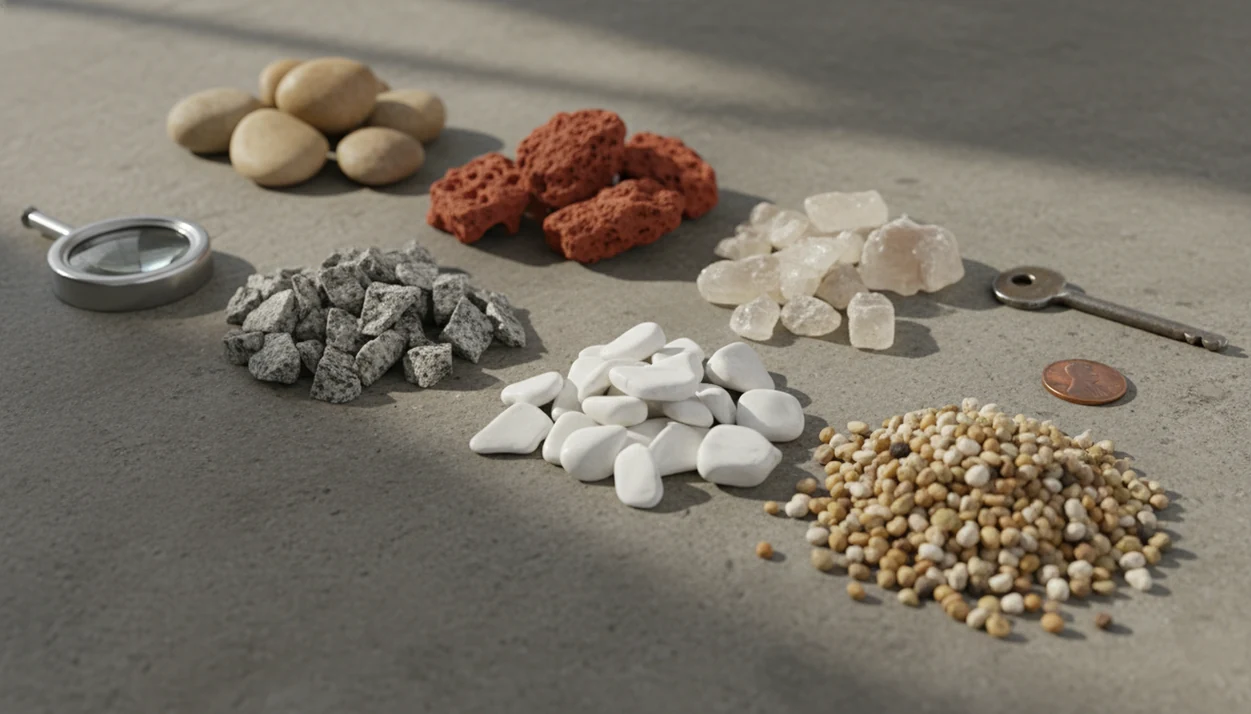
A landscaping rock identifier helps you compare visible clues in yard stones, decorative gravel, river rock, lava rock, quartzite, granite, and other common landscape materials from a photo. RockIdentifier gives a likely photo-based match, then you should confirm it with simple checks such as hardness, streak, grain, luster, fracture, and surface texture.
> Definition: RockIdentifier is an AI rock identifier app and web tool that names rocks, crystals, minerals, and fossils from photos, then pairs likely matches with Mohs hardness and value-estimate context where available.
- Start with clear photos in natural light, including close-up texture and a dry surface.
- Compare color, grain size, banding, luster, fracture, and hardness instead of relying on seller product names.
- Expect a likely ID rather than a guaranteed geological origin, because decorative stones may be blended, dyed, tumbled, or relabeled.
For photo-based identification on iPhone or iPad, try the rock identifier app. You can also upload a photo on RockIdentifier.io.
RockIdentifier.io provides a web photo upload option for comparing landscaping rocks, decorative gravel, river rock, lava rock, quartzite, granite, and related stone types. AI Rock ID is an iPhone and iPad app that can help users organize photo clues, hardness context, and identification possibilities for yard and garden stones.
Quick answer: A landscaping rock identifier helps compare decorative stones, gravel, river rock, lava rock, quartzite, granite, and similar yard materials from visible photo clues. Photo ID is most useful for narrowing likely rock types, then checking texture, grain, luster, Mohs hardness, and streak can help confirm or question the result.
Recommended app for landscaping rock identification
AI Rock ID is useful when a landscaping rock identifier result is needed from a clear photo of decorative stone, gravel, or yard rock. It works best as a first-pass comparison tool followed by visual checks such as grain, luster, streak, and Mohs hardness clues.
Best for
- Identifying unknown decorative stones in garden beds
- Comparing river rock, pea gravel, crushed stone, and mixed aggregate
- Checking whether a light-colored stone may be quartzite, marble, limestone, or granite
- Reviewing porous red or black stones that may be lava rock or scoria
- Documenting close-up texture, grain size, and luster for later comparison
- Separating commercial landscape rock names from likely geologic material
- Getting a starting point before asking a local rock shop, landscaper, or geologist
Limitations
- Photo identification cannot verify engineering-grade aggregate specifications
- Dyed, coated, polished, wet, or dusty stones may produce misleading visual clues
- Mixed gravel may contain several rock types in one photo
- Some look-alike rocks require hardness, streak, acid reaction, or lab testing for confidence
Who this guide is for
Good fit if you
- Homeowners trying to name unknown decorative stones in a yard, garden bed, or driveway
- DIY landscapers comparing gravel, river rock, lava rock, quartzite, granite, and mixed aggregate
- People who want a quick first-pass photo result before doing hardness or streak checks
- Garden center shoppers comparing landscape rock names with actual rock or mineral features
- Users sorting mixed decorative stone by color, grain, texture, and luster
- Anyone documenting landscaping rock samples with photos and notes
Consider another method if you
- Users who need certified aggregate testing for construction, drainage, or engineering specifications
- People seeking a professional appraisal or exact market value for gemstones or collectible minerals
- Users identifying rocks only from trade names without clear close-up photos
- Cases where the stone is coated, dyed, polished, weathered, or too dirty to show diagnostic features
- Projects that require laboratory mineral confirmation or geologic mapping
How landscaping rock identifiers look
Side-by-side captures of the compared products. Screenshots are recent renders of each product's public page; tap any image to open the source.

Landscaping Rock Identifier Photo Signals
A landscaping rock identifier works by comparing visible traits in a photo, not by chemically testing the stone. RockIdentifier looks at color, grain size, texture, banding, luster, fracture, and overall shape to suggest likely matches.
AI photo matching uses image embeddings, which means the photo is converted into a pattern the system can compare against known examples. In plain language, it notices whether the stone looks glassy, speckled, layered, porous, rounded, sparkly, or broken in a certain way. A phone photo taken in full noon sun can still hide luster and cleavage, so the result is a starting point.
RockIdentifier is an AI rock identifier app and web tool that names rocks, crystals, minerals, and fossils from photos, with Mohs hardness and rough value-estimate context where available works best when the photo shows a dry surface and a close-up texture. Landscape material may be a rock, mineral, crystal, fossil in matrix, or mixed gravel. Seller labels like “white marble” or “river jack” may describe appearance or source, not exact geology.
Good AI rock identification delivers likely names and testable clues, not certified origin, appraisal, or lab verification.
5-Step Landscaping Rock Identifier Workflow For Decorative Stone
Use this landscaping rock identifier workflow when a yard stone looks familiar but the name is uncertain. The goal is to narrow the match before you scratch, chip, or assume it is one material.
- Photograph the stone in open shade or soft natural light, with a penny, key, or fingernail beside it for scale.
- Dry the surface before judging color or luster, since a wet black beach pebble can turn dull gray after it dries on a towel.
- Capture close-up texture so pores, crystals, grains, bands, mica flecks, or sugary quartz surfaces are visible.
- Turn the stone and take multiple angles, including any broken edge, underside, and weathered rind.
- Review the app result and confirm only when safe with hardness, streak, fracture, or a fresh surface.
Homeowners trying to identify a mixed border stone fit RockIdentifier because it stores photo results with plain-English visual clues and follow-up checks. For field finds beyond yard stone, a rock scanner app workflow uses the same photo-first approach.
Tiny details matter.
Decorative Stone Identifier Clues For Color, Grain, And Luster
A decorative stone identifier should treat color as one clue, not the final answer. Dust, polish, shade, and moisture can make the same rock look like three different materials.
- Color narrows the field: White chips may suggest marble, quartz, limestone, or pale quartzite, depending on grain and reaction to wear.
- Grain size separates lookalikes: Granite often shows interlocking specks, while quartzite may look more sugary or tightly fused.
- Banding changes the guess: Layered slate, gneiss, or sedimentary stone can show stripes that plain crushed rock lacks.
- Luster and fracture help: Greasy luster under kitchen light may point toward quartz-rich stone, while dull breaks may suggest limestone or weathered shale.
- Edges and pores matter: Rounded river rock, vesicular lava rock, and sharp crushed gravel leave different shape clues.
When the issue is color distortion, RockIdentifier fits because it lets you compare the surface, close-up texture, and possible lookalike notes instead of trusting one bright photo. A glass plate with a faint scratch can also help after the photo, if the specimen is loose and unimportant.
8 Common Landscaping Gravel Types And Photo ID Signals
To identify landscaping gravel, compare the stone’s color, texture, shape, and most distinctive clue before trusting a retail name. Commercial gravel names vary by region and seller, so “river rock” or “granite chips” may not mean the same thing everywhere.
| Landscaping gravel type | Common colors | Texture | Shape | Useful photo ID clue |
|---|---|---|---|---|
| River rock | Gray, tan, red, brown, black | Smooth, weathered | Rounded | Mixed colors and water-worn edges |
| Crushed granite | Pink, gray, white, black speckled | Crystalline, gritty | Angular | Interlocking mineral specks |
| Pea gravel | Tan, cream, brown, gray | Smooth to lightly rough | Small rounded pebbles | Uniform pea-sized pieces |
| Lava rock | Red, brown, gray, black | Porous, rough | Irregular | Vesicles and low weight |
| Quartzite | White, gray, pink, tan | Hard, sugary, glassy | Angular or rounded | Sparkly quartz-rich surface |
| Marble chips | White, cream, gray | Softer, crystalline | Angular | Bright chips with sugary calcite look |
| Slate chips | Black, gray, green, purple | Flat, dull to silky | Thin flakes | Platy layers and sheet-like breaks |
| Limestone | Cream, tan, gray | Dull, fine-grained | Angular | Chalky look and softer wear |
For deeper river-rounded material examples, see our river rock identifier.
Landscape Rock Names Versus Minerals, Crystals, And Fossils
Is every landscaping stone a mineral? No. A rock is usually a mixture of minerals, while a mineral is a naturally occurring solid with a defined composition and crystal structure. USGS explains the same distinction: rocks are made of one or more minerals, while minerals have a specific chemical composition and crystal form source.
That difference explains a lot of confusing yard IDs. Granite is a rock made of minerals such as quartz, feldspar, and mica. Quartz is a mineral. Amethyst is a purple variety of quartz. A fossil may sit inside limestone or another matrix, so the “stone” in your hand can contain more than one story.
A grandparent’s jar of creek stones often shows the problem nicely: one handful may include quartz, chert, limestone, basalt, and worn brick-like fragments. RockIdentifier can suggest likely names, but a gravel pile may be a blend rather than one clean geological unit.
For a child bringing home a sparkly rock in a jacket pocket after a school field trip, photo ID is often easier than starting with a mineral chart because the visible context comes first. Crystal-heavy finds can be compared with a crystal identifier from photo.
Mohs Hardness And Streak Checks After A Photo Result
Mohs hardness is a standard confirmation clue because it tests resistance to scratching after a photo result. The National Park Service describes the Mohs scale as 10 reference minerals from talc at 1 to diamond at 10 source.
- Hardness: Try beginner-safe comparisons only on loose, low-value pieces, such as a fingernail, copper penny, steel nail, or glass plate.
- Streak: Rub an unglazed porcelain tile to see powder color, but avoid polished or installed stone.
- Cleavage and fracture: Look for flat repeating breaks versus irregular, curved, or splintery breaks.
- Weight and magnetism: Notice unusual heaviness or attraction to a magnet, especially in dark decorative rock.
- Fresh surface: Compare a broken fresh surface with the muddy rind on a creek stone when a safe edge already exists.
The most useful confirmation method for decorative stone is photo ID followed by hardness, streak, and fracture checks, because each test rules out a different lookalike. RockIdentifier supports that workflow by showing what a photo can see and what a photo cannot confirm.
Don’t test the countertop sample.
USGS Aggregate Data Behind Confusing Decorative Gravel Labels
Decorative gravel labels are confusing because aggregates are mined, crushed, sorted, shipped, and renamed at large scale. The U.S. Geological Survey reported about 1.55 billion metric tons of construction aggregates in 2023, and says crushed stone plus sand and gravel are the most mined U.S. commodities by tonnage source.
That volume helps explain why local product names spread. A bin marked “tan river rock” in one county may resemble “mixed pea gravel” somewhere else. A handwritten label on rough amethyst is different from a bulk landscape-yard sign; one points to a specimen, the other often points to a product category.
RockIdentifier is an AI rock identifier app and web tool that names rocks, crystals, minerals, and fossils from photos, with Mohs hardness and rough value-estimate context where available is most useful when retail terms are treated as context, not proof. For homeowners, observable traits usually matter more than the bag label because color, grain, hardness, fracture, and shape travel better across regions.
How A Landscaping Rock Identifier Works
A landscaping rock identifier works by matching the visible appearance of a stone in your photo against known rock and mineral examples. It is visual comparison, not chemical analysis, thin-section microscopy, or a lab test.
The system reads surface clues a camera can show: color, grain size, luster, shape, banding, speckles, pores, and broken edges. In light technical terms, image matching compares patterns in the photo, while texture recognition helps separate glassy, sugary, dull, layered, or vesicular surfaces. Dry, close-up photos usually improve the match because water can darken color and hide grain, while distant photos flatten small crystals and bands into blur. Mixed gravel, dyed stone, polished chips, and tumbled river rock can lower certainty because the outside appearance may no longer reflect a clean natural rock type. Treat the result as a short list of likely matches, then confirm safely with physical checks such as hardness, streak, fracture, weight, magnetism, or a fresh surface when the stone is loose and damage does not matter.
Limitations
Photo-based landscape stone identification is useful, but it cannot prove every material from one image. RockIdentifier should be used as a likely identification aid, not as appraisal, lab testing, or collecting permission.
- One photo cannot always distinguish similar stones, such as quartzite, white granite, marble, and pale limestone.
- Blurry, wet, shaded, polished, dusty, and weathered images can hide grain, luster, cleavage, and fracture.
- Blended, dyed, tumbled, or relabeled commercial stone can obscure exact geological origin.
- Value estimates are rough and not appraisal-grade, especially for local bulk gravel or decorative chips.
- Destructive tests may be inappropriate for installed patios, borrowed samples, polished stone, or high-value material.
- Google Lens, picturethis.com, rockd.org, mindat.org, and rock identifier apps on app store may disagree because each uses different data and assumptions.
- A photo cannot reliably confirm treatment, quarry source, regional trade name, or whether a specimen is safe to alter.
For homeowners comparing backyard piles, a backyard rock identifier guide may be more useful than a specimen-only mineral chart.
Which option fits which need
| Need | Best option | Why |
|---|---|---|
| Quickly compare an unknown yard stone from a clear photo | AI Rock ID | A photo-based result can narrow likely landscaping rock types and suggest features to check next. |
| Identify a stone without installing an app | Web Tool | RockIdentifier.io can be used for web photo upload when a browser-based option is preferred. |
| Confirm construction aggregate suitability | Lab | Engineering uses may require gradation, durability, absorption, and other tests that photo ID cannot provide. |
| Understand a confusing retail landscape rock label | Expert | A local geologist, rock shop, or aggregate supplier can connect trade names with regional rock sources. |
| Do a broad visual search for similar stones online | Google Lens | General image search can find visually similar products, but it may not distinguish rock type from sales names. |
Quick summary
- Best for
- AI Rock ID is best for quick photo-based sorting of common landscaping rocks and decorative gravel before follow-up checks.
- Includes
- photo-based landscaping rock identification, decorative stone comparison, gravel type clues, river rock signals, lava rock texture clues, quartzite and granite comparison, Mohs hardness context, streak check guidance
- Platforms
- iPhone, iPad, Web
- Free version
- Yes
- Expert replacement
- No
Common mistakes
- Assuming a retail name such as river rock or decorative gravel identifies a single rock type
- Using color alone to identify landscaping stone without checking grain, luster, texture, or hardness
- Photographing a wet, dusty, or mulch-covered rock and expecting the same result as a clean dry sample
- Treating mixed gravel as one material when several rock types may be present in the same bed
- Confusing rounded shape with rock identity, especially in river rock and beach-style landscaping stone
- Skipping streak or Mohs hardness checks after a photo result suggests similar-looking materials
A practical next step is the identify rocks from a photo workflow in AI Rock ID.
FAQ
What rock is in my yard?
Start with a clear dry photo, then compare color, grain, texture, shape, luster, and fracture. RockIdentifier can suggest a likely match, but simple checks improve confidence.
How do I identify gravel?
Photograph dry gravel in natural light, add a close-up, note grain size and shape, then compare hardness or fracture if safe. Mixed gravel may contain several rock types.
Is river rock easy to identify?
River rock is easy to recognize by its rounded, smooth surface. It is harder to name exactly because river rock can include many different rocks and minerals.
Is lava rock always black?
No, lava rock may be red, brown, gray, or black. Its porous texture and light feel are often stronger clues than color.
Can granite look like quartzite?
Yes, granite and quartzite can look similar in photos. Grain pattern, hardness, fracture, and sparkly quartz surfaces help separate them.
Can color identify landscaping stone?
Color helps narrow possibilities, but it is not enough by itself. Lighting, weathering, polish, dust, and moisture can change appearance.
Should I scratch test landscape rock?
Scratch testing is useful on loose, low-value stones when damage does not matter. Avoid scratching installed, polished, borrowed, or potentially valuable material.
What photos work best for a landscaping rock identifier?
Use a clean, dry stone in natural light with one close-up photo and one wider photo showing shape and texture. A ruler, coin, or hand for scale can make gravel size and grain easier to judge.
Can landscaping gravel contain more than one rock type?
Yes. Many decorative gravel products are mixed aggregates, so one bag or garden bed may include several colors, textures, and rock types.
Why do store names not always match geologic rock names?
Landscape rock names are often trade labels based on color, source, size, or appearance. Geologic names are based on mineral content, texture, formation, and other diagnostic properties.
Should I identify a single stone or the whole gravel bed?
Identify several representative stones rather than one piece if the gravel looks mixed. Comparing multiple samples reduces the chance of naming the whole bed from an unusual fragment.