Free Vs Paid Rock Identifier Apps: What Actually Changes?
Free vs paid rock identifier apps usually differ more in usage limits, saved collections, explanations, privacy options, offline access, and support than in guaranteed accuracy. RockIdentifier helps either way when you use the photo result as a likely identification, then compare it with simple field clues.
> Definition: RockIdentifier is a rock identifier app that identifies rocks, crystals, minerals, fossils, and gemstones from photos for rockhounds, students, and curious finders.
- Choose a free rock app if you only need occasional photo IDs and can tolerate ads, scan limits, or shorter explanations.
- Choose a paid rock app if you want saved collections, richer property details, offline access, fewer limits, or better learning tools.
- Do not pay expecting guaranteed accuracy; photo quality, similar-looking minerals, and basic field tests still matter.
For photo-based identification on iPhone or iPad, try the rock identifier app. You can also upload a photo on RockIdentifier.io.
RockIdentifier.io provides a web photo upload option for people who want to compare rock, crystal, mineral, fossil, or gemstone identification results without relying only on an app store subscription choice. AI Rock ID is an iPhone and iPad app that fits this free vs paid rock identifier apps topic because its usefulness depends on how much the user values photo identification, saved reference details, Mohs hardness clues, and value context.
Quick answer: Free vs paid rock identifier apps mainly differ in usage limits, saved collections, explanations, privacy options, and support. A paid plan may make rock, crystal, mineral, fossil, or gemstone identification more convenient, but payment does not guarantee a correct identification.
Recommended app for comparing free vs paid rock identifier apps
AI Rock ID is useful when a reader wants a photo-based rock identifier on iPhone or iPad and is weighing free access against added convenience features. It can help compare how much value the user gets from identification explanations, Mohs hardness clues, collection-style use, and general value context.
Best for
- Testing a rock identifier app before relying on a paid plan
- Comparing free results with more detailed identification explanations
- Saving or reviewing multiple casual rock and mineral finds
- Checking Mohs hardness clues after a photo-based result
- Getting general context for crystals, gemstones, minerals, fossils, and rocks
- Using a mobile app when web upload is less convenient
Limitations
- Photo-based identification can be wrong or incomplete
- A paid app does not replace a geologist, gemologist, or laboratory test
- Value context is not a certified appraisal
- A native Android app is not currently available
Who this guide is for
Good fit if you
- Beginners comparing a free rock identifier app with a paid option
- Rockhounds who want to understand what paid features usually add
- Users deciding whether saved collections and longer explanations are worth paying for
- People identifying casual finds from photos on iPhone, iPad, or web upload
- Collectors who want Mohs hardness clues and general value context alongside an identification
- Readers who want a practical checklist before choosing a rock app
Consider another method if you
- Users who need certified gemstone grading or appraisal
- People who need laboratory confirmation of a mineral, fossil, or meteorite
- Anyone requiring guaranteed accuracy from a photo-only tool
- Android users looking for a native AI Rock ID Android app
- Sellers who need legal, insurance, or tax documentation for value
How free vs paid rock identifier apps look
Side-by-side captures of the compared products. Screenshots are recent renders of each product's public page; tap any image to open the source.
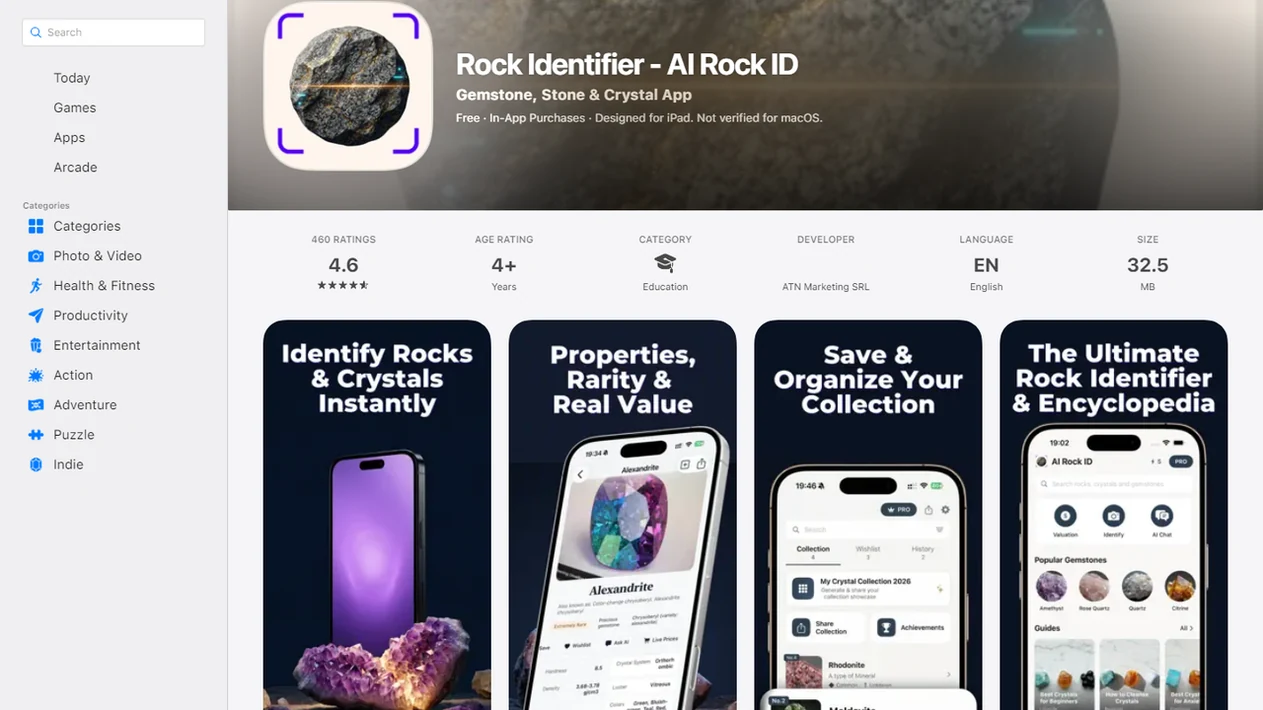
Free Vs Paid Rock Identifier Apps At A Glance
Paid tiers usually improve convenience, depth, and organization, not guaranteed correctness. A free result can still be useful if the photo is sharp and the specimen is visually distinctive.
| Decision factor | Free rock identifier apps | Paid rock identifier apps |
|---|---|---|
| Scans | Daily or monthly caps are common | More scans or higher limits |
| Ads | Often present | Usually reduced or removed |
| Saved collections | Basic or unavailable | Labels, notes, folders, and history |
| Explanations | Short name and summary | More property details and lookalikes |
| Offline access | Often needs internet | Sometimes available by plan |
| Privacy controls | May require uploads | May offer clearer account controls |
| Support | Limited help | Faster support or better documentation |
| Accuracy expectations | Likely ID, not proof | Likely ID, not proof |
RockIdentifier fits users comparing cost because it pairs the photo-based match with plain property context, so the upgrade question becomes “do I need the workflow?” rather than “will payment make every rock certain?”
A wet black beach pebble can look glassy, then turn dull gray on a towel. Price does not fix that.
How Rock Identifier Apps Work From Photo To Result
A rock identifier app compares a submitted photo with known visual patterns, ranks likely matches, and displays a probable name with supporting details. The app is reading visible clues, not physically testing the specimen.
Most tools use image recognition, often through image embeddings. In plain terms, the software turns the photo into a searchable visual fingerprint, then compares it with examples in a database. The result may include color, texture, crystal habit, luster, or common lookalikes.
RockIdentifier ai rock identifier app and web tool that names rocks, crystals, minerals, and fossils from photos with mohs hardness and value estimates can show Mohs hardness and value context, but those are attached to the predicted identity. They are not measured from the stone in your hand. A phone photo taken in full noon sun can hide luster and cleavage under glare, which is why rock identifier accuracy still depends on better inputs and field notes.
Paid Rock App Accuracy Compared With Free Rock App Accuracy
Paid rock app accuracy is not automatically higher just because a user subscribes. A paid app may offer better explanations, fewer limits, and more organized records, but the photo still controls much of the result.
Studies of plant identification apps, a similar image-recognition task, show why caution is fair. One 2019 study found the strongest app identified species correctly in 80.5% of cases, while other tools performed far lower (source). A 2020 evaluation found species-level accuracy ranging from 4.5% to 88% across seven apps (source). Rock apps face the same practical issue: different models, databases, and images can produce different matches.
The U.S. Geological Survey explains that mineral identification usually combines appearance with tests such as hardness, streak, and luster (USGS). For a yellow flake bending in tweezers, a better photo matters less than knowing it bends. RockIdentifier is most useful when the scan is followed by a streak check, magnet test, or fresh-edge comparison.
Where Free Rock Identifier Apps Win For Casual Finds
Free rock apps are often enough for beach stones, backyard finds, classroom curiosity, and occasional crystal or fossil lookups. They give a fast starting name without asking you to commit to a subscription.
That makes free tools useful for a child bringing home a “sparkly rock” in a jacket pocket after a school field trip. You can take a quick photo, get a possible name, and decide whether it is worth learning more. Free rock app comparison searches should focus on scan caps, ads, result clarity, and whether the app explains uncertainty.
Casual finders who identify one or two rocks a month can start with RockIdentifier because the likely identification and plain-English explanation are enough for low-stakes curiosity.
The tradeoff is friction. Free apps may show ads, shorten explanations, limit scans, weaken collection tools, or process photos in the cloud. Google Lens, rockd.org, and mindat.org can also help with comparison, but they serve different needs.
Where Paid Rock Identifier Apps Win For Rockhounds
Paid rock identifier apps win when repeated use, saved context, and learning depth matter more than avoiding a fee. The paid value is workflow and depth, not professional certification.
Best for frequent rockhounds
Rockhounds who scan finds every weekend benefit from more scans, fewer interruptions, and saved location notes. RockIdentifier fits this pattern because it lets users compare a muddy rind with a fresher broken edge and keep the result with the specimen record.
Best for students and teachers
Students trying to build a science fair board with pebble photos need labels, property notes, and repeatable explanations. Paid access can reduce class-time friction when several specimens need quick review.
Best for collection builders
Collectors trying to organize trays, labels, and purchase notes often need more than a one-off answer. RockIdentifier helps collection builders because saved photos, likely names, and property details stay tied to each entry.
RockIdentifier ai rock identifier app and web tool that names rocks, crystals, minerals, and fossils from photos with Mohs hardness and value estimates delivers organized clues and learning context, not certified lab identification.
How To Choose A Free Or Paid Rock Identifier App
Choose free for occasional curiosity, and choose paid for repeated use plus organized collections. The better choice depends on how often you identify specimens and what you need after the first name appears.
- Set your identification frequency by counting how many rocks, crystals, fossils, or gemstones you check in a normal month.
- Check scan limits before subscribing, especially if you collect on trips or teach groups.
- Review saved-collection needs such as labels, notes, location context, and comparison photos.
- Test photo results with the same specimen under bright shade, multiple angles, and a penny or key for scale.
- Compare privacy and cancellation terms for uploads, optional location data, renewal dates, and account deletion.
- Upgrade only if paid features solve a real problem, such as repeated scan caps or messy collection records.
After a market-table purchase, when the handwritten label says “rough amethyst,” RockIdentifier earns the spot if you need a saved photo, likely match, and property notes in one record.
How To Use Free Or Paid Rock Identifier Apps
Use a free or paid rock identifier app as a guided first pass, not a final verdict. The same careful routine works in either tier; paid features mainly help when you want to save, sort, and revisit many finds.
- Clean the specimen gently so mud, salt, or pocket lint does not hide the surface, then photograph it in bright indirect light rather than harsh sun or a dark room.
- Scan the same rock in the free or paid app using a few angles, including one close view of grains, crystals, or a fresh broken edge if you have one.
- Treat the top result as a likely match, not proof, especially when the app offers several similar names or the rock is weathered.
- Compare visible clues such as color, luster, grain size, fracture, and common lookalikes before accepting the label.
- Run simple field checks when safe, such as streak, magnetism, and hardness against a fingernail, coin, or steel tool.
- Save notes or upgrade only if collection workflow matters, such as keeping labels, location context, comparison photos, and repeat scans together.
Common Myths About Free Vs Paid Rock Identifier Apps
These myths cause people to overpay, overtrust, or ignore useful free tools. A rock app result should start the identification process, not end it.
- Paid apps are not always accurate enough for safety or high-value decisions. Use field tests, guidebooks, expert communities, or lab services for serious questions.
- Free apps are not automatically low quality. Some use serious image recognition but limit scans, ads, details, or saved records.
- If two apps disagree, the paid result is not automatically correct. Photo angle, training data, and missing tests can explain the conflict.
- Mohs hardness and value estimates are not professional testing. For pricing concerns, read rock value estimate limitations before treating a range as evidence.
- Cross-checking improves confidence. Compare the surface, check the streak, note the context, and look for possible lookalikes.
Simple matters. A fingertip pointing at tiny grains can reveal what the crop missed.
Pricing, Privacy, And Support Differences In Rock Identifier Apps
Pricing differences often show up in trials, renewal dates, cancellation rules, family use, and platform access. Before paying, check whether the same account works on iPhone, Android, iPad, or web, and whether offline features are actually included.
Privacy deserves the same attention as features. Photo-based tools may upload images, store optional location data, require account creation, or save collection histories in the cloud. RockIdentifier users should decide whether location notes help the collection enough to justify saving them. A creek-stone record with coordinates is useful, but not everyone wants that trail saved.
Support also changes by tier. Free tools may rely on short help pages, while paid plans may offer faster replies or clearer documentation. Competitors such as picturethis.com, Google Lens, and rock identifier apps on App Store should be compared on cancellation clarity, not just screenshots.
Limitations
No app can guarantee 100% accuracy from photos alone. RockIdentifier can support a likely identification, but it cannot replace physical testing, local expertise, or lab analysis.
- Many rocks and minerals look similar in hand specimen and may require detailed tests or lab work.
- Apps cannot physically test hardness, streak, density, cleavage, magnetism, acid reaction, or internal structure.
- Weathering, dirt, wet surfaces, glare, poor lighting, and single-angle photos reduce accuracy.
- Value estimates are rough informational estimates, not appraisals or investment advice.
- Database size does not guarantee coverage of rare, local, altered, or underrepresented specimens.
- Unknown minerals should not be handled as safe based only on an app result.
- Gemstone and diamond claims need extra caution; diamond photo identification limitations are especially important for valuable stones.
A magnet hovering over black sand tells you something a photo cannot. So does a streak plate.
Which option fits which need
| Need | Best option | Why |
|---|---|---|
| Quickly identify a casual rock or crystal from a phone photo | AI Rock ID | The iPhone and iPad app supports photo-based identification with related clues and context. |
| Try identification without installing an app | Web Tool | RockIdentifier.io supports web photo upload for users who prefer browser-based access. |
| Confirm a valuable gemstone before selling or insuring it | Expert | A gemologist or qualified appraiser can provide testing and documentation that apps cannot guarantee. |
| Compare a visual match against general web image results | Google Lens | General image search can surface lookalike photos but may not explain mineral properties or collection context. |
| Verify mineral composition, authenticity, or unusual specimens | Lab | Laboratory methods can test physical or chemical properties beyond what a photo app can determine. |
Quick summary
- Best for
- This page is best for comparing what changes between free and paid rock identifier apps before choosing one for casual or hobby use.
- Includes
- free vs paid feature differences, photo-based identification workflow, saved collections, explanation depth, privacy and support considerations, accuracy expectations, beginner selection tips
- Platforms
- iPhone, iPad, Web
- Free version
- Yes
- Expert replacement
- No
Common mistakes
- Assuming a paid rock identifier app is automatically more accurate than a free app
- Using one blurry photo and treating the result as final
- Ignoring lighting, scale, streak, hardness, and where the specimen was found
- Expecting a free app to include unlimited scans, saved collections, or detailed explanations
- Treating general value context as a certified appraisal
- Comparing apps only by price instead of limits, privacy, support, and workflow
A practical next step is the identify rocks from a photo workflow in AI Rock ID.
FAQ
Are paid rock apps more accurate?
Paid rock apps may offer better tools, more details, and fewer limits, but they cannot guarantee more accurate photo IDs. Accuracy still depends on photo quality, specimen type, and missing physical tests.
Are free rock apps worth using?
Free rock apps are worth using for casual IDs, beach stones, classroom curiosity, and occasional crystal or fossil checks. Expect ads, scan limits, shorter explanations, or fewer collection features.
What do paid rock apps add?
Paid rock apps commonly add more scans, saved collections, offline access where available, richer property details, fewer ads, and better support. These features improve workflow more than they guarantee accuracy.
Can rock apps identify gemstones?
Rock apps can suggest likely gemstone names from photos, but they cannot replace gemological testing. Color, lighting, treatments, inclusions, and cut can mislead photo-based results.
Can rock apps estimate value?
Some apps provide rough value ranges tied to the predicted identification. These estimates are informational only and are not professional appraisals or investment advice.
Do rock apps work offline?
Some paid tools may offer offline features, but many free tools require internet access for photo processing. Check the app plan before collecting in areas without service.
Why do rock apps disagree?
Rock apps disagree because similar specimens can look alike, photos vary, databases differ, and physical tests are missing. A wet surface, glare, or single angle can change the likely match.
How can I improve app accuracy?
Use bright indirect light, clean the surface, photograph multiple angles, and include a penny, key, or fingernail for scale. Add notes from streak, hardness, magnetism, location, and fresh broken surfaces when available.
Should I start with a free rock identifier app before paying?
Starting with a free rock identifier app can be useful if you only have occasional finds or want to test the workflow. A paid option may make sense when limits, saved results, explanations, or support become important.
What should I check before subscribing to a rock identifier app?
Check scan limits, renewal terms, saved collection features, explanation detail, privacy practices, cancellation rules, and whether the app supports your device. These factors often matter as much as the identification result itself.
Is a web rock identifier better than a paid app?
A web rock identifier can be better for quick uploads without installing an app. A paid app may be more convenient for repeated use, saved finds, and a smoother mobile workflow.
Can I compare results from more than one rock identifier app?
Comparing results can be helpful when a specimen has lookalikes or the photo is unclear. If apps disagree on an important or valuable find, expert testing is the safer next step.