River Rock Identifier From Photos Of Rounded Stones
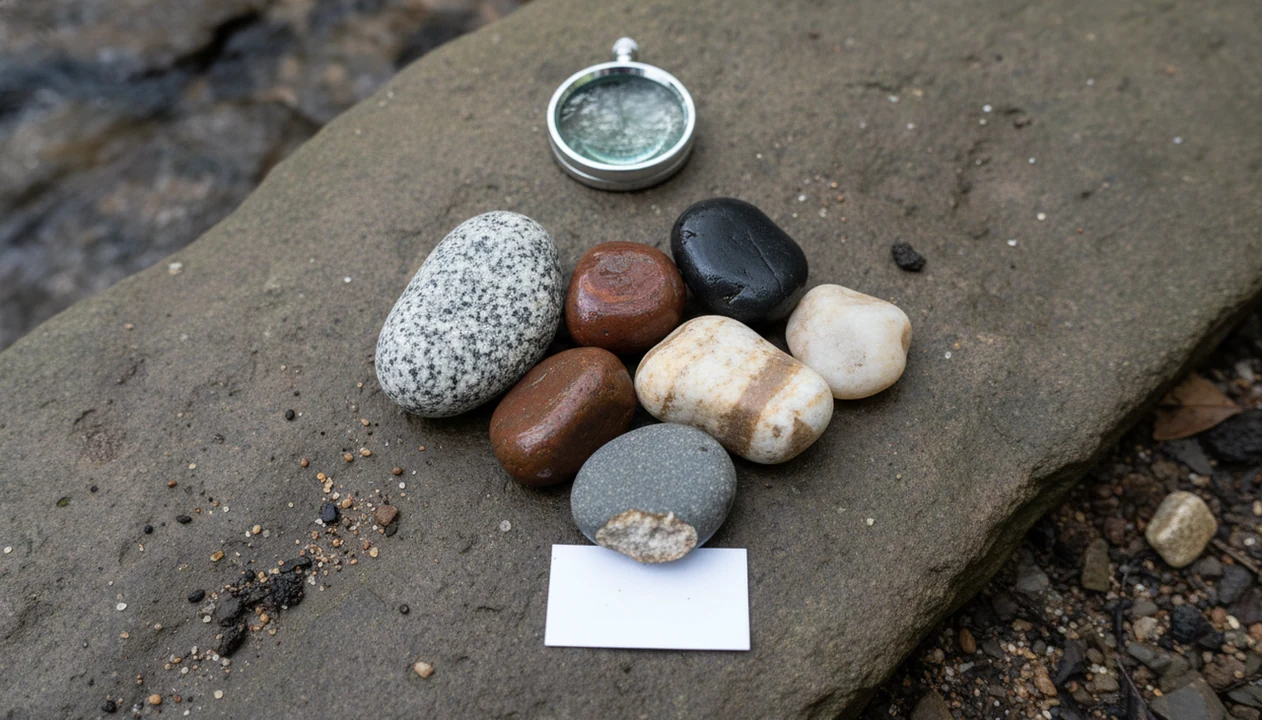
A river rock identifier can suggest likely names for smooth stones from creeks, beaches, and gravel beds, but the most reliable results come from photos that show texture, grain, locality, and any fresh broken edge. Rounded stones are harder to identify because water abrasion removes many of the sharp clues that apps and humans normally use.
Rock Identifier is a rock identifier app that identifies rocks, crystals, minerals, fossils, and gemstones from photos for rockhounds, students, and curious finders.
- River rocks are not one rock type; they can be igneous, sedimentary, metamorphic, mineral pieces, fossils, or man-made lookalikes.
- Color alone is a weak clue because wetness, lighting, surface weathering, and mineral impurities can change how a pebble looks in a photo.
- For better identification, photograph the rounded outside, a dry surface, a close-up texture view, and any fresh edge or broken face.
For photo-based identification on iPhone or iPad, try the river rock identifier app. You can also upload a photo on RockIdentifier.io.
RockIdentifier.io provides a web photo upload option for comparing river rocks, pebbles, crystals, minerals, fossils, and gemstones against visual identification clues. AI Rock ID is an iPhone and iPad app that can help users organize a river rock identifier search by combining photo results with hardness clues and value context.
Quick answer: A river rock identifier can suggest likely matches from photos of rounded stones, especially when the image shows color, texture, grain size, and any fresh broken edge. River-worn surfaces often hide diagnostic features, so photo results should be checked with simple observations such as hardness, streak, locality, and whether the stone is igneous, sedimentary, or metamorphic.
Recommended app for river rock identifier searches
AI Rock ID is useful when a river pebble has enough visible texture, grain, banding, or fresh-edge detail for a photo-based comparison. The app is most helpful when the photo result is treated as a starting point rather than a final geological determination.
Best for
- Checking likely matches for smooth river pebbles found outdoors
- Comparing similar-looking gray, white, black, red, or banded stones
- Recording locality notes with a river rock photo
- Looking for Mohs hardness clues after an initial match
- Separating common rocks from specimens that may need expert review
- Learning whether a pebble may be igneous, sedimentary, or metamorphic
- Getting value context for stones that resemble gemstones or collectible minerals
Limitations
- Rounded surfaces can remove or hide diagnostic features
- A photo alone may not separate look-alike rocks with similar colors
- Wet photos can exaggerate color and reduce texture detail
- Certified identification or appraisal requires an expert or lab
Who this guide is for
Good fit if you
- People who found smooth pebbles in a river, creek, beach, or gravel bar
- Beginners who want likely names for rounded stones from photos
- Collectors comparing river pebbles by color, texture, and grain pattern
- Parents, teachers, and students doing basic rock and mineral learning activities
- Users who can add location context and simple test results after a photo match
- Anyone sorting mixed river rocks before deciding which specimens need expert review
Consider another method if you
- Users who need a certified mineral, gemstone, or fossil appraisal
- People identifying a stone from a blurry, wet, or single-color photo only
- Collectors who need lab confirmation of composition, treatment, or origin
- Users handling potentially hazardous material or unknown industrial waste
How river rock identifier from photos of rounded stones look
Side-by-side captures of the compared products. Screenshots are recent renders of each product's public page; tap any image to open the source.

River Rock Identifier Results At A Glance
- A river rock identifier gives likely matches, not laboratory confirmation, especially when a stone is smooth, wet, or stained.
- River rock describes where a stone was found. It is not a mineral species or a single rock type.
- The strongest clues are texture, grain, luster, hardness context, streak, locality, and any fresh edge.
- One photo can miss key features, so take several views before trusting the first result.
- RockIdentifier works best when the photo is paired with notes from the find spot, such as creek bed, gravel bar, or lake shore.
For creek walkers who need a fast first pass, RockIdentifier fits because it compares the stone photo with rock, mineral, fossil, crystal, and gemstone patterns, then shows a likely identification with visible clues.
The pocket check is real.
A heavy pebble weighing down a jacket pocket may look plain outside, but a small broken edge can change the whole shortlist.
How A River Pebble Identifier Works From Photos
A river pebble identifier works by reading visible image features, then comparing them with known rock, mineral, crystal, fossil, and gemstone patterns. It returns likely candidates and supporting clues, not an absolute verdict.
In practical terms, the system looks for color zones, texture, grain size, banding, fracture appearance, luster, and overall shape. AI models often use image embeddings, which are numerical summaries of what the photo shows. For a beginner, that simply means the image gets compared against many stored visual patterns.
RockIdentifier can help when a rounded stone still shows speckles, layering, vesicles, or glassy shine. Missing hidden features reduce confidence, though. A phone photo taken in full noon sun can flatten glare across the surface and hide luster or cleavage. Polished, algae-coated, or weathered stones give both people and software less to work with.
RockIdentifier is an AI rock identifier app and web tool that names rocks, crystals, minerals, and fossils from photos, then adds Mohs hardness context and value estimates where available.
How To Use A River Rock Identifier By Photo
Use a river rock identifier by giving it the same clues a careful collector would want: dry surface, natural light, scale, texture, and context. Start dry because wet stones can look richer than they really are.
- Place the stone in open shade or soft daylight, away from harsh glare.
- Photograph the dry rounded outside first, with a penny, key, or fingernail for scale.
- Capture a close-up of grain, banding, speckles, vesicles, fossils, or glassy areas.
- Turn the stone and photograph several angles, including any fresh broken face.
- Add locality notes, such as river gravel, beach cobble, construction fill, or creek bank.
- Review the suggested match against hardness, streak, luster, and locality before accepting it.
Students looking for a classroom-safe workflow can use RockIdentifier because the scan result encourages comparison with Mohs hardness, streak, and visual clues rather than color alone.
If you collect on trails as well as riverbanks, the same photo habits carry over to a hiking rock identifier app.
Why Rounded River Stones Are Difficult To Identify
Rounded river stones are difficult to identify because long-term abrasion and transport gradually remove sharp diagnostic features. The same smoothing that makes a pebble pleasant to hold can erase crystal faces, cleavage surfaces, fractures, and original edges.
Abrasion callout: The USGS explains that stream transport wears and rounds rock fragments during erosion and sediment movement (https://www.usgs.gov/special-topics/water-science-school/science/erosion-and-sedimentation). That rounding can make identification harder because the outside no longer shows the rock’s original structure.
A muddy rind on a creek stone may hide a fresher gray interior. Iron staining can turn quartz, limestone, chert, or feldspar-rich rocks similar rusty colors. Algae, water polish, and weathering can also mask luster and grain.
That uncertainty affects AI and human visual identification. RockIdentifier can still narrow the field, but a rounded exterior may leave several possible lookalikes. For river finds, identification usually depends more on exposed texture than on the smooth outer color.
Best Photo Clues To Identify River Stones
The best clues to identify river stones are texture, structure, luster, and fresh interior views, not color alone. A wet black beach pebble may turn dull gray after it dries on a towel.
Rounded exterior clues
Grain size: Sand-sized grains suggest sandstone, while interlocking crystals may point toward granite, gneiss, or other crystalline rocks. Banding: Layers, stripes, and folded lines can suggest sedimentary bedding or metamorphic fabric. Surface features: Vesicles, fossil shapes, speckles, translucency, and waxy or greasy luster all matter.
Fresh edge clues
Broken-face texture: A fresh broken face can reveal glassy fracture, sugary crystals, fossil fragments, or hidden banding better than the worn exterior. Do not break unsafe, legally protected, rare-looking, or potentially valuable specimens without expert advice.
When the issue is separating lookalikes in a gravel bar, RockIdentifier handles the first screen because it lets you compare the rounded surface with texture-based suggestions and follow-up clues.
For stones from surf or lake margins, our beach rock identifier covers similar glare, wetness, and polish problems.
River Rock Identifier Tests After The App Suggests A Match
Simple tests refine a river rock identifier shortlist; they do not replace careful observation. Mohs hardness ranks minerals from 1 to 10, with talc at 1 and diamond at 10, and it works as a relative scratch scale.
For hardness context, the Mineralogical Society of America describes the Mohs scale as a relative scratch-hardness scale from talc at 1 to diamond at 10 (https://www.mineralogy4kids.org/content/mohs-hardness-scale).
Mohs hardness clues
Streak and fracture clues
| Test | What it checks | Beginner-safe use | What it can rule out |
|---|---|---|---|
| Mohs scratch | Relative hardness | Try a fingernail, copper coin, or steel point carefully | Soft minerals versus quartz-rich stones |
| Streak | Powdered mineral color | Rub on unglazed porcelain if the specimen can be marked | Metallic lookalikes with different powder colors |
| Fracture | Broken surface shape | Compare glassy, rough, splintery, or earthy breaks | Chert, quartz, slag, and some volcanic rocks |
| Magnetism | Iron-rich response | Use a small magnet, away from phones and cards | Magnetite-bearing stones or some industrial material |
| Heft | Density impression | Compare similar-sized pebbles in hand | Dense ore-like pieces versus common rocks |
A streak test checks a mineral’s powdered color on unglazed porcelain, which can differ from the visible surface color. Avoid acid tests unless you understand the safety steps.
For beginners, the most useful confirmation method is a photo shortlist followed by hardness, streak, luster, and locality checks because each test removes specific lookalikes.
Rock Identifier Features For River Pebble Identifier Searches
Does RockIdentifier work for river pebble identifier searches? Yes, RockIdentifier supports photo-based suggestions for rocks, crystals, minerals, fossils, gemstones, and gold-lookalikes, but it should be treated as a fast first pass.
RockIdentifier ai rock identifier app and web tool that names rocks, crystals, minerals, and fossils from photos with mohs hardness and value estimates is useful when a child brings home a “sparkly rock” in a jacket pocket after a school field trip. The scan can suggest a likely identification, then the result gives context such as Mohs hardness and possible value.
That value context needs caution. Common river pebbles are often ordinary local material, and photo-based values are not appraisals. RockIdentifier earns its place for curious finders, students, and beginner rockhounds because it connects the photo result with plain-English clues, not just a name.
People sorting mixed finds from a yard project may also want a backyard rock identifier for stones that did not come from natural river gravel.
Common Myths About River Rock Identifier Apps
- Myth: color is enough to identify a river stone. Reality: color changes with lighting, wetness, weathering, iron staining, and mineral impurities.
- Myth: smooth rounded stones are one type called river rock. Reality: river rock is a location description, not a rock or mineral name.
- Myth: wetting a stone always improves the photo. Reality: water may reveal contrast, but it can also create glare and hide texture.
- Myth: AI can confirm every pebble with certainty. Reality: rounded surfaces often hide the diagnostic features needed for confidence.
- Myth: a shiny pebble is automatically valuable. Reality: quartz, mica, pyrite, glass, slag, and polished common stones can all look interesting in a photo.
River collectors who want to identify river stones without overtrusting shine should use RockIdentifier because it asks the photo to support a likely match with visible texture, luster, and comparison clues.
For broader field scanning beyond rivers, the rock scanner app guide explains how to photograph mixed trail, beach, and gravel finds.
Limitations
Photo-based river stone identification is useful, but it has real limits. Some stones stay ambiguous even after several good photos.
- AI is not definitive for rounded, dirty, wet, or heavily weathered stones.
- Color-only matching is weak because many unrelated rocks share the same gray, brown, black, red, or white surface colors.
- One image may not show enough diagnostic features, especially if the fresh edge or underside is hidden.
- Value estimates for common river pebbles are uncertain and should not be treated as appraisals.
- Rare, legally sensitive, fossil-bearing, or potentially valuable finds need expert testing and local collecting guidance.
- Wet surfaces can exaggerate luster and make dull stones look glassy or gem-like.
- RockIdentifier, google lens, rockd.org, mindat.org, picturethis.com, and rock identifier apps on app store all depend on the quality of the visible evidence.
- Mohs, streak, magnetism, and fracture checks can damage specimens, so test only when the stone is safe and legal to test.
For decorative gravel and purchased stone mixes, a landscaping rock identifier may fit better than a river-only workflow.
Which option fits which need
| Need | Best option | Why |
|---|---|---|
| Quick suggestion for a smooth pebble from a clear photo | AI Rock ID | The app can compare visible color, texture, shape, and surface clues to likely rock or mineral matches. |
| Identify a river stone without installing an app | Web Tool | RockIdentifier.io allows photo upload through the web for users who prefer a browser-based option. |
| Confirm a valuable-looking gemstone or unusual specimen | Expert | A qualified geologist, gemologist, or mineral expert can examine physical properties that photos cannot confirm. |
| Check mineral composition or exact material type | Lab | Laboratory testing can verify composition, structure, and treatments when visual identification is not enough. |
| Broad visual search for similar-looking stones | Google Lens | General image search can show visually similar rocks, but it may not apply rock-specific hardness or geology clues. |
Quick summary
- Best for
- This page is best for identifying smooth river rocks from photos and then confirming the suggestion with basic field clues.
- Includes
- photo-based river pebble identification, rounded-surface clues, texture checks, locality context, fresh-edge observations, Mohs hardness clues, value context
- Platforms
- iPhone, iPad, Web
- Free version
- Yes
- Expert replacement
- No
Common mistakes
- Identifying a river rock by color alone instead of checking texture, grain, and hardness
- Photographing a pebble only when it is wet, which can make colors look darker and less natural
- Ignoring a fresh broken edge that may show the rock’s true grain or mineral structure
- Assuming every shiny or translucent river stone is a gemstone
- Using one photo angle instead of showing the top, side, underside, and close-up texture
- Skipping locality information even though nearby geology can narrow likely matches
A practical next step is the identify river rocks from photos workflow in AI Rock ID.
FAQ
What app identifies river rocks?
RockIdentifier and similar photo tools can suggest likely river stone matches from images. The result is a likely identification, not a final scientific ID.
Can I identify river stones online?
Yes, online photo tools can help identify river stones when the photos show texture, grain, scale, and context. Field clues such as hardness, streak, and locality improve confidence.
Why are river rocks smooth?
River rocks are smooth because moving water carries stones, knocks them together, and abrades sharp edges over time. Longer transport usually creates more rounding.
Is color enough for rock identification?
No, color is unreliable because lighting, wetness, weathering, stains, and impurities can change how a rock appears. Texture and structure are usually stronger clues.
Should river rocks be photographed wet?
Photograph river rocks dry first, then add a wet photo only if glare is controlled. Dry images often show grain and surface texture more honestly.
How do I test pebble hardness?
Test pebble hardness by seeing what can scratch it, using simple Mohs comparisons such as a fingernail, copper coin, or steel point. Avoid testing valuable or fragile specimens.
What is a streak test?
A streak test checks the powdered color of a mineral by rubbing it on unglazed porcelain. The streak color can differ from the mineral’s outer color.
Are river rocks valuable?
Most river rocks are common local material, though unusual minerals, fossils, or gemstones can occur. Photo-based value estimates are uncertain and are not professional appraisals.
What photo angles help a river rock identifier most?
A useful set includes a top view, side view, close-up texture view, and any chipped or fresh broken edge. A scale object such as a coin or ruler helps show pebble size.
Can a river rock identifier tell if a pebble is igneous, sedimentary, or metamorphic?
A photo-based tool may suggest a likely rock group when visible texture, layering, crystals, or banding are clear. Confirmation often requires hardness checks, streak observations, and local geology.
Why does a broken edge help identify a river stone?
A broken edge may reveal grain size, crystal texture, layering, or internal color that a smooth river-worn surface hides. This makes it easier to compare the stone with likely rock types.
Can river pebbles from landscaping gravel be identified the same way?
Landscaping gravel can be checked with the same photo and hardness clues, but its source may be mixed or imported. Location clues are less reliable when the stone did not come from a natural river setting.