Benefits Of Mineral Identification For Beginners
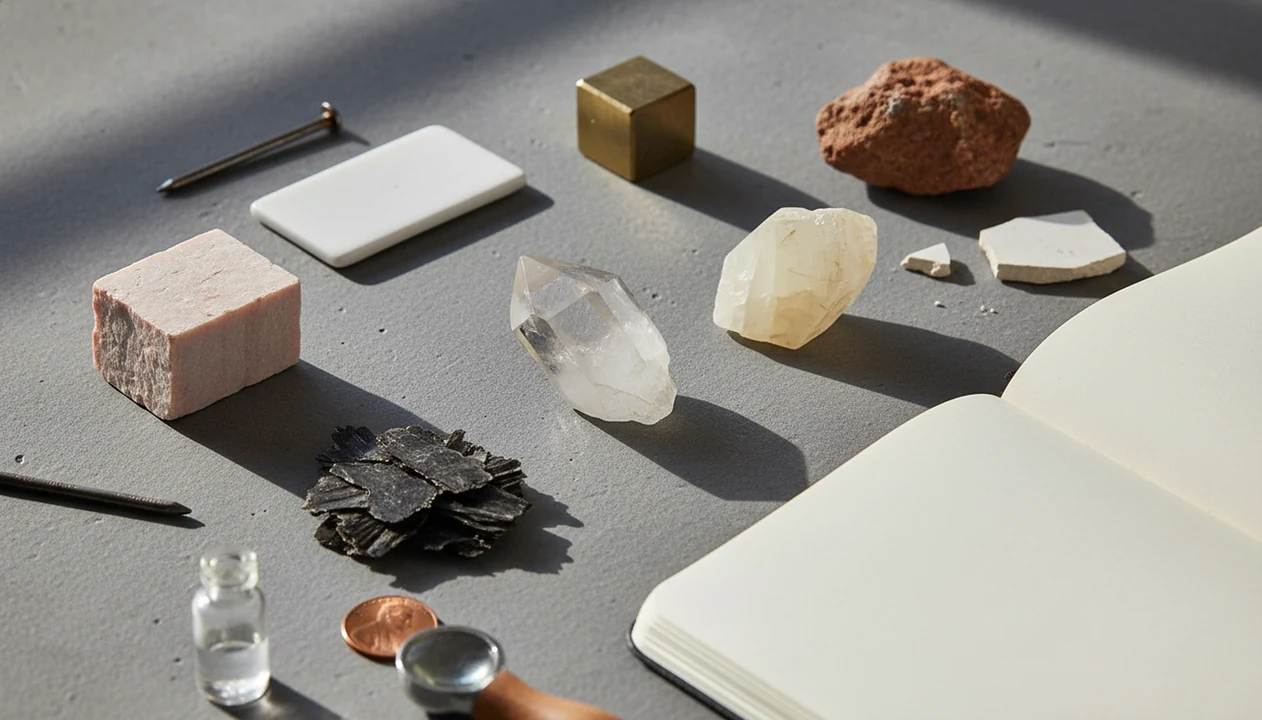
The benefits of mineral identification include better labels, safer testing, stronger school learning, fewer lookalike mistakes, and a clearer understanding of what a specimen is made of. For beginners, mineral ID is most useful when it connects a name to observable properties such as hardness, streak, cleavage, magnetism, and acid reaction.
> Definition: Mineral identification is the process of using visible clues, simple physical tests, and sometimes photo-based or spectral tools to determine what mineral a specimen contains and what properties it is likely to have.
TL;DR
- Mineral ID helps beginners move beyond color and learn test-based clues like Mohs hardness, streak, cleavage, luster, and acid reaction.
- Identifying minerals improves rock collection labels, classroom learning, field notes, safety decisions, and rock ID accuracy.
- Photo-based tools can speed up the first pass, but many minerals still need physical testing or expert confirmation.
For photo-based identification on iPhone or iPad, try the mineral identifier app. You can also upload a photo on RockIdentifier.io.
RockIdentifier.io provides a web photo upload option for people who want a quick first-pass look at rocks, crystals, minerals, fossils, or gemstones. AI Rock ID is an iPhone and iPad app that can support the mineral identification benefits discussed in this article by helping beginners compare visual clues with organized ID suggestions.
Quick answer: Benefits of mineral identification include better specimen labels, safer beginner testing, clearer school learning, and fewer mistakes with lookalike minerals. Mineral identification helps beginners compare visible clues such as color, luster, crystal shape, hardness, streak, and context before making a more confident ID.
Recommended app for mineral identification benefits
AI Rock ID is useful when a beginner wants a photo-based first pass before comparing hardness, streak, luster, and other mineral identification clues. The app can help organize observations, but important specimens should still be checked with field guides, tests, or expert review.
Best for
- Getting an initial ID suggestion from a specimen photo
- Comparing common mineral lookalikes before labeling a collection
- Adding context to school geology activities
- Recording clues such as appearance and possible hardness range
- Separating mineral ID questions from broader rock ID questions
- Checking whether a specimen may need expert or lab verification
Limitations
- Photo results can be affected by lighting, focus, angle, and surface condition
- The app cannot replace lab testing for chemistry or crystal structure
- Value context is not the same as a certified appraisal
- Some weathered, mixed, or coated specimens may remain uncertain
Who this guide is for
Good fit if you
- Beginners who want to label a mineral collection more accurately
- Students learning basic geology, mineral properties, and observation skills
- Collectors trying to separate common lookalike minerals
- Rockhounds who want a safer first pass before hardness or streak testing
- Families using mineral specimens for hands-on learning
- Users who want photo-based help before checking field guides or expert sources
Consider another method if you
- Users who need a legally defensible gemstone appraisal
- Collectors who require laboratory confirmation of mineral chemistry
- People identifying hazardous or unknown industrial materials
- Users who need Android app support right now
- Sellers who need certified valuation before a transaction
Mineral Identification Benefits In One Plain Definition
Mineral identification connects a specimen name to its likely composition, physical properties, and practical meaning. It answers more than “what is this?” because a mineral name points to traits such as hardness, streak, cleavage, luster, magnetism, and acid reaction.
Minerals are the building blocks of rocks. That means mineral ID also supports rock ID, especially when a rock contains visible quartz, feldspar, mica, calcite, or iron-rich grains. A muddy creek stone may look plain until a fresher broken edge shows sparkle, glassy grains, or a pale mineral vein.
RockIdentifier is an AI rock identifier app and web tool that names rocks, crystals, minerals, and fossils from photos with Mohs hardness and value estimates. Used carefully, photo matching gives beginners a starting name, not a final laboratory result.
How Mineral Identification Works
Mineral identification works by narrowing a specimen from many possible names to fewer likely candidates using independent, observable properties. Each clue acts like a filter, so the final name depends on agreement between tests rather than one quick impression.
Color is often the weakest clue because staining, impurities, weathering, and lighting can change what the eye sees. Stronger checks include streak, which reveals the powdered color, and Mohs hardness, a scratch comparison that shows relative resistance to being scratched. Cleavage, luster, magnetism, density feel, and safe reaction tests add more evidence. This matters for beginners because lookalikes are common: a shiny gray sample, a white crystal, or a green pebble may fit several minerals until two or three properties line up.
Photo tools help by comparing visible shape, texture, color pattern, and crystal habit, especially before any destructive test. They cannot prove hardness, streak, heft, or acid reaction, so physical testing is still needed when the answer matters. Confidence rule: label uncertain specimens with cautious terms like “likely,” “possible,” or “unknown” until several clues agree.
Mineral Identification Clues From First Look To Confident ID
Mineral ID works by narrowing possibilities with several independent clues, not by making one visual guess. Color starts the process, but it is weak evidence because quartz, fluorite, calcite, and many other minerals can appear in several colors.
How mineral identification works: you compare observations, then test properties that should stay consistent for that mineral. Hardness shows what can scratch what. Streak shows the powdered color. Cleavage shows how a mineral breaks along flat planes. Acid reaction can point toward calcite or other carbonate minerals.
A phone photo taken in full noon sun can make luster and cleavage almost disappear under glare. Photo-based AI can compare shape, color patterns, texture, and visible crystal habit quickly, but it cannot feel density or prove a scratch result. The strongest beginner IDs usually combine a photo-based match with two or three physical checks.
Beginner Mineral ID Requirements Before Testing Specimens
Beginners need a few simple tools and cautious habits before testing minerals. A small kit prevents random scratching, messy acid drops, and lost evidence from the first photo.
- Clean workspace: Use a white tray, paper towel, or table mat so chips and powder are easy to see.
- Light and magnification: Use daylight shade, a hand lens, or a phone camera with focus lock.
- Notes and scale: Keep a notebook, locality note, and a penny, key, or fingernail beside the specimen for size.
- Test tools: Use a streak plate, hardness kit or substitutes, magnet, and vinegar or dilute acid only with supervision.
- Safety habits: Wash hands, avoid tasting minerals, avoid breathing dust, and keep acid tests minimal.
Use a photo-based app before destructive testing if the specimen is borrowed, fragile, valuable-looking, or unknown. Tools like RockIdentifier can help decide whether scratching is even worth considering.
How To Use Mineral Identification For Better Beginner Results
A good beginner workflow protects the specimen first, then builds evidence. For most new collectors, mineral identification works best when the label records both the likely name and the clues behind it.
- Observe the specimen dry and clean, noting color, crystal shape, visible grains, and any weathered coating.
- Photograph several sides with a scale object, including a close view and a whole-specimen view.
- Test beginner-safe properties such as hardness, streak, magnetism, and reaction only when appropriate.
- Compare your results with reference examples, possible lookalikes, and the specimen’s collecting location.
- Label the specimen with the likely name, locality, date, and observed evidence.
- Verify with a teacher, club member, museum, or lab when clues conflict or the sample may be valuable, hazardous, or rare.
Stop before cutting, grinding, acid soaking, or heavy scratching. A child’s “sparkly rock” from a jacket pocket deserves notes before damage.
Five Mineral ID Benefits Beginners Notice First
- Better collection labels: Mineral ID lets beginners record a likely name, locality, date, and observed evidence instead of writing “shiny gray rock.”
- Safer testing choices: Hardness, dust risk, acid reaction, and fragility affect which tests are reasonable for a beginner.
- Stronger school learning: Students learn geology by comparing real clues, not just memorizing pictures in a worksheet.
- Fewer lookalike mistakes: Color can mislead, so streak, cleavage, hardness, and luster help separate possible matches.
- Better rock identification: Rocks are made of mineral components, so recognizing the main minerals makes rock names more reliable.
The mineral ID benefits show up fast during a kitchen table rock sorting night. One specimen gets a streak note. Another gets set aside because it flakes too easily. The label starts to explain the evidence, not just the guess.
Mineral Identification Uses In School, Fieldwork, And Collecting
Why identify minerals in school, fieldwork, and collecting? Mineral identification teaches people to connect visible evidence with material properties, whether they are labeling a beginner tray or making a field classification.
Students use mineral ID to practice observation, classification, and evidence-based comparison. A streak plate result can change the answer, which is a useful lesson. Collectors use it to improve labels, sorting, storage, and confidence in trades or club discussions.
Engineers often work with a practical subset of minerals rather than every possible species. The Federal Highway Administration’s Rock and Mineral Identification for Engineers notes that a practicing engineer often needs to recognize about 20 common minerals for many field classification tasks: https://rosap.ntl.bts.gov/view/dot/14126 In exploration and mapping, mineral ID can also help interpret deposits, alteration zones, and likely rock behavior.
For students and hobby collectors, a mineral name is most useful when it is backed by observable evidence.
Mineral ID Benefits For Rock Identification Accuracy
Rocks are mixtures of minerals, while minerals have more specific compositions and properties. That is why mineral ID improves rock ID without requiring beginners to name every tiny grain.
Granite identification often depends on recognizing quartz, feldspar, and mica together with coarse texture. Limestone may react with acid because it contains calcite. A flat skipping stone with red bands might need both texture notes and mineral clues before anyone names it confidently.
The same Federal Highway Administration guide explains that most aggregate rock samples can be classified by identifying the two or three main mineral components: https://rosap.ntl.bts.gov/view/dot/14126 That is useful for beginners too. Rock ID often depends on dominant minerals, texture, and grain relationships, not a complete catalog of every speck. The role of luster in mineral identification is especially clear when glassy quartz and dull weathered coatings appear on the same sample.
Modern Mineral Identification Tools For Faster First Passes
Modern mineral ID tools speed up screening, but they do not make every identification definitive. Beginner photo tools, field instruments, and remote sensing methods each answer different questions.
| Tool type | What it helps with | What it cannot always confirm |
|---|---|---|
| Photo-based mineral ID | Fast visual comparison of color, shape, texture, and crystal habit | Hardness, streak, density, exact composition, and hidden coatings |
| Near-infrared spectroscopy | Multiple constituents in one scan with little to no sample preparation, according to industry mineral analysis guidance | Some mixtures, surfaces, and fine-grained samples may still need expert review |
| Hyperspectral analysis | Over 100 unique minerals from satellite or aerial data, according to hyperspectral mapping providers | Ground truth, sample context, and small hand-specimen details |
For source context, the USGS describes spectroscopy as a method for identifying minerals from diagnostic light absorption patterns, while NASA’s EMIT mission maps surface mineral composition from imaging spectroscopy data: https://www.usgs.gov/labs/spec-lab and https://earth.jpl.nasa.gov/emit/
A good ai rock identifier app and web tool that names rocks, crystals, minerals, and fossils from photos with mohs hardness and value estimates should deliver fast screening and plain-language clues, not certified appraisal or lab composition. RockIdentifier ai rock identifier app and web tool that names rocks, crystals, minerals, and fossils from photos with mohs hardness and value estimates fits that first-pass role when users still check physical evidence.
Common Mineral Identification Mistakes Beginners Can Avoid
Most beginner errors come from treating one clue as enough. A wet black beach pebble can turn dull gray after it dries on a towel, so the first impression may not survive ten minutes.
- Using color alone: Color is helpful for description, but it rarely proves the mineral.
- Confusing rock ID with mineral ID: A rock may contain several minerals, while a mineral has a more specific composition.
- Scratching too early: Photograph and document the specimen before any destructive test.
- Treating a photo result as final: Hardness, streak, acid reaction, and cleavage and fracture may change the likely identification.
- Trusting value estimates too much: Value depends on size, quality, locality, condition, authenticity, and market demand.
Pause first. The clean photo and notes are harder to replace than the scratch.
Mineral Identification Verification Checklist For Beginners
Verify at least three independent clues before labeling a specimen confidently. If the clues disagree, use a softer label such as “likely quartz,” “possible calcite,” or “unknown feldspar-rich sample.”
Use this checklist before sharing, trading, or filing a specimen:
- Photo match from several angles
- Hardness range from a safe scratch comparison
- Streak color, when the specimen can be tested
- Cleavage or fracture pattern
- Luster observed in low-glare light
- Density feel or specific gravity and heft when practical
- Locality, field setting, or rock type
- Reaction tests only when appropriate and safe
Save photos, notes, and test results with the specimen label. A good label tells the next person what you saw, not just what you concluded. For beginners, a cautious evidence trail is often more valuable than a confident but unsupported name.
Limitations
Mineral identification has real limits, especially for beginners working from photos and simple tools. These limits do not make mineral ID useless, but they do affect confidence.
- Color alone is unreliable because many minerals occur in several colors.
- A single photo may miss hardness, streak, cleavage, magnetism, density, and acid reaction.
- Mixed rocks, weathered surfaces, coatings, and tiny grains can hide the true mineral components.
- Some tests are destructive and should not be used on valuable, fragile, borrowed, or unknown specimens.
- AI and spectral tools can speed up screening, but they do not replace expert verification for difficult samples.
- Mineral identification does not automatically prove commercial value, safety, purity, or exact chemical composition.
- Beginners should avoid tasting minerals or creating dust from unknown samples.
- Acid testing is not a casual kitchen experiment; use minimal amounts and supervision when needed.
When a result matters for sale, safety, construction, or research, ask a qualified geologist, gemologist, lab, museum, or local mineral club.
Which option fits which need
| Need | Best option | Why |
|---|---|---|
| Quick first-pass mineral identification from a photo | AI Rock ID | A photo-based app can help beginners start with possible IDs and then compare physical clues. |
| Identify a specimen without installing an app | Web Tool | RockIdentifier.io supports web photo upload for a fast browser-based first pass. |
| Confirm a valuable gemstone or sale item | Expert | A gemologist or qualified appraiser can inspect the specimen directly and provide more reliable value guidance. |
| Verify mineral chemistry or exact composition | Lab | Laboratory methods are needed when visual clues and simple tests cannot confirm composition. |
| Search visually similar images online | Google Lens | General image search can show similar-looking specimens, but it does not provide mineral-specific verification. |
Quick summary
- Best for
- This page is best for beginners who want to understand how mineral identification improves learning, collection organization, and rock identification accuracy.
- Includes
- mineral ID benefits, beginner observation clues, safer testing habits, lookalike reduction, school and fieldwork uses, verification checklist
- Platforms
- iPhone, iPad, Web
- Free version
- Yes
- Expert replacement
- No
Common mistakes
- Using color alone even though many minerals occur in multiple colors
- Skipping streak, luster, hardness, and crystal habit observations
- Testing hardness on a finished, valuable, or fragile specimen without caution
- Assuming a rock and a mineral are identified the same way
- Trusting one photo result without checking field guides or other clues
- Ignoring weathering, coatings, or mixed mineral surfaces that can change appearance
A practical next step is the identify minerals from photos workflow in AI Rock ID.
FAQ
Why should beginners identify minerals?
Beginners should identify minerals because mineral ID reveals composition clues, physical properties, safe handling needs, and better labels. It also helps them understand why a specimen scratches, reacts, breaks, or shines the way it does.
What are the main mineral ID benefits for a beginner rock collection?
The main mineral ID benefits are better learning, clearer labels, safer testing, fewer lookalike errors, and more accurate rock identification. A labeled collection is stronger when each name includes evidence such as hardness, streak, or locality.
Is color enough to identify a mineral?
Color is not enough to identify most minerals because many minerals occur in several colors. Combine color with hardness, streak, cleavage, luster, magnetism, and reaction tests when appropriate.
How does mineral identification help students learn geology?
Mineral identification helps students learn geology by turning specimens into evidence-based comparisons. Students practice observation, testing, classification, and careful uncertainty instead of memorizing pictures.
Can a photo identify a mineral accurately?
A photo can give a strong first-pass mineral match when lighting, focus, scale, and surface condition are good. It may not confirm hardness, streak, density, magnetism, or acid reaction, so physical tests can still be needed.
Is mineral identification the same as rock identification?
Mineral identification is not the same as rock identification. Minerals are components of rocks, and rock ID often depends on recognizing the main minerals plus texture and grain relationships.
Do beginners need acid testing to identify minerals?
Beginners do not need acid testing for every mineral. Acid reaction checks are mainly useful for certain minerals, especially carbonates, and should be done with safer alternatives or supervision.
What should a beginner record when identifying a mineral?
A beginner should record color, streak, luster, crystal shape, hardness clues, location if known, and any unusual features. Clear notes make it easier to compare the specimen with guides, apps, or expert feedback.
How can mineral identification improve collection labels?
Mineral identification helps labels include a more accurate name, key properties, and uncertainty when the ID is not confirmed. Better labels make a collection easier to study, share, and update later.
When should a beginner ask an expert to verify a mineral ID?
A beginner should ask an expert when the specimen may be valuable, hazardous, rare, or difficult to separate from similar minerals. Expert review is also useful when visual clues and simple tests give conflicting results.
Can mineral identification help avoid damaging specimens?
Yes. Mineral identification encourages beginners to observe visible clues first and choose tests carefully, which can reduce unnecessary scratching, acid use, or handling damage.