Benefits Of Identifying Rocks For Learning And Collecting
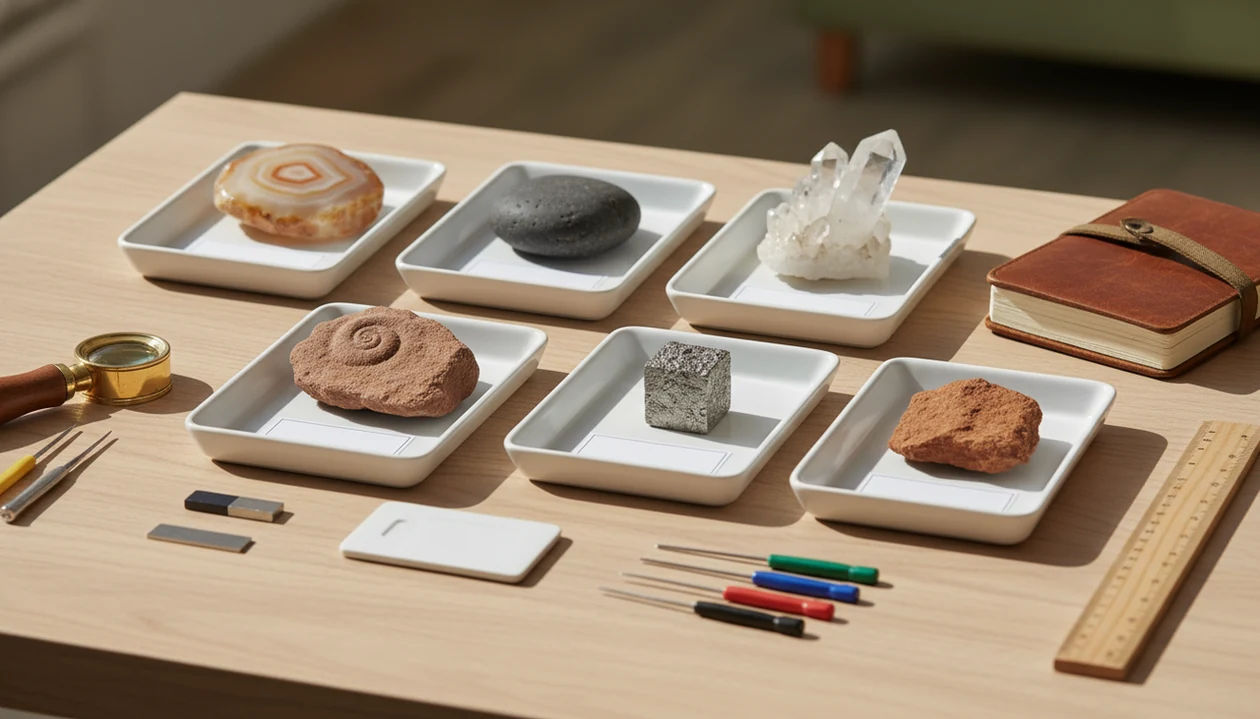
The benefits of identifying rocks include safer handling, stronger science learning, better collection records, and clearer decisions about which tests to do next. Rock identification turns a casual find into useful information about local geology, possible value, and how the specimen should be stored or studied.
> Definition: Rock identification is the process of naming a rock, mineral, crystal, fossil, or gemstone by observing features such as color, texture, hardness, streak, magnetism, shape, and geologic context.
- Rock identification helps beginners connect everyday stones to real Earth processes like volcanism, erosion, sedimentation, and fossil formation.
- A good ID workflow combines photo-based AI suggestions with simple checks such as Mohs hardness, streak, magnetism, and location notes.
- Accurate labels make collections safer, more organized, easier to teach from, and easier to discuss with clubs, teachers, or experts.
For photo-based identification on iPhone or iPad, try the AI Rock ID app. You can also upload a photo on RockIdentifier.io.
RockIdentifier.io provides a web photo upload option for people who want a starting point when comparing an unknown rock to visible identification clues. AI Rock ID is an iPhone and iPad app that can support the benefits described in this article by giving beginners a structured first pass before simple home tests or expert review.
Quick answer: Benefits of identifying rocks include safer handling, better collecting decisions, clearer learning, and more useful follow-up tests. Rock identification helps beginners connect a found specimen to observable clues such as color, texture, hardness, luster, and local geology.
Recommended app for rock identification benefits
AI Rock ID is useful when a beginner wants an initial photo-based identification and reminders about observable clues. It is most helpful when the result is treated as a starting point for learning, labeling, and deciding which simple test to try next.
Best for
- Getting an initial name for an unknown field find
- Comparing similar-looking rocks, minerals, crystals, fossils, or gemstones
- Adding clearer labels to a beginner collection
- Learning which visible features may matter for identification
- Checking Mohs hardness clues before doing scratch tests
- Recording finds before researching local geology
- Getting basic value context without assuming a formal appraisal
Limitations
- Photo identification can be affected by lighting, focus, wet surfaces, or scale
- Some rocks and minerals require hardness, streak, density, acid, or lab tests
- The app does not replace a geologist, gemologist, teacher, or laboratory
- It should not be used as the only source for safety, buying, or selling decisions
Who this guide is for
Good fit if you
- Beginners who want a practical reason to name rocks, minerals, crystals, fossils, or gemstones
- Students using found specimens for school science or local geology projects
- Collectors who want to label, sort, and compare specimens more consistently
- Families who want safer curiosity before handling or cleaning unknown finds
- Hobbyists deciding which simple tests to try next, such as streak, hardness, or magnetism
- People who want value context before assuming a rock or gemstone is rare
Consider another method if you
- Users who need a certified appraisal, insurance value, or legal documentation
- People identifying potentially hazardous materials such as asbestos-bearing rock or radioactive minerals
- Researchers who require petrographic, chemical, or laboratory confirmation
- Anyone making mining, buying, selling, or safety decisions from a photo alone
Rock Identification Benefits In One Practical Definition
Rock identification means matching observable features to likely rock, mineral, crystal, fossil, or gemstone names. Its practical value is simple: safer handling, better learning, clearer labels, and smarter next tests.
A wet black beach pebble may look like basalt until it dries dull gray on a towel. That small change matters. Color, luster, texture, and context all shape the likely identification.
RockIdentifier is an AI rock identifier app and web tool that names rocks, crystals, minerals, and fossils from photos, with Mohs hardness and value estimates for rockhounds, students, and curious finders. Still, a photo-based match is a starting point. Check the streak, compare hardness, note the location, and look for possible lookalikes before treating the result as settled.
Five Benefits Of Identifying Rocks For Beginners
- Local history becomes visible. Rock identification connects a striped pebble, roadcut stone, or creek cobble to past oceans, volcanoes, rivers, glaciers, erosion, or metamorphism.
- STEM skills get practical. Beginners practice observation, comparison, classification, evidence, and the scientific method without needing a lab bench.
- Safety improves. Some specimens may contain heavy metals, asbestos-like fibers, or dust hazards. A likely identification helps you decide whether to bag it, wash hands, or leave it alone.
- Collections become usable records. Names, dates, locations, hardness, photos, and notes turn an egg carton full of backyard finds into a learning set.
- Lookalikes become less confusing. Identification helps separate common quartz, calcite, slag, or glass from potentially interesting gemstones, fossils, or unusual minerals without promising riches.
The International Mineralogical Association maintains a current list of approved mineral species, now totaling more than 5,900 entries: https://mineralogy-ima.org/Minlist.htm. That number explains why a crystal identifier from photo should be paired with simple checks.
Why Identify Rocks Before Adding Them To A Collection
Why identify rocks before adding them to a collection? Because labels make a collection meaningful rather than merely decorative. A tray of “pretty stones” becomes more useful when each specimen has a likely name, group, date found, location, photo, hardness, streak, magnetism, and confidence level.
A notebook page with collection numbers beats memory. Every time.
Those records help beginners compare future finds and avoid keeping ten versions of the same common landscaping quartzite. They also make it easier to ask a teacher, club member, or museum educator a clear question.
Value estimates should stay cautious. Interest or price can depend on quality, size, rarity, condition, locality, and expert confirmation. For beach or river finds, a beach rock identifier can help sort likely names before anything gets boxed.
How Rock Identification Works From Photo To Test Result
Rock identification works by moving from visible clues to testable properties. You photograph the specimen, detect visual traits, compare likely matches, then confirm or weaken that match with physical properties.
AI tools can suggest likely rock, mineral, crystal, fossil, or gemstone categories from image patterns and reference data. In technical terms, they compare image embeddings, which are mathematical summaries of what the photo appears to show. The plain-English version: the tool looks for visual similarity, then offers likely names.
Good confirmation uses color, luster, texture, grain size, crystal habit, cleavage, fracture, streak, hardness, magnetism, and acid reaction where appropriate. Rocks can be mixed materials, while minerals have more specific compositions. That is why granite may be easier to name broadly than one pale grain inside it.
Dirty, wet, weathered, or poorly lit specimens reduce confidence. A phone photo taken in full noon sun can hide luster and cleavage under glare.
Before You Start Identifying Rocks
Before you start identifying rocks, set up a small, safe kit and record the specimen as found. The best first step is documentation, not cleaning, cutting, or polishing.
- Gather simple tools before testing. Bring a phone camera, notebook, small magnet, streak plate, and a hardness reference such as a fingernail, copper coin, steel nail, or Mohs pick set.
- Keep risky unknowns contained. If a specimen is fibrous, dusty, metallic-looking, unusually heavy, crumbly, or sharp, place it in a bag and avoid cutting, sanding, tumbling, or breathing dust from it.
- Photograph the rock before changing it. Take pictures dry and unwashed, from several angles, with something for scale. Surface dirt, weathering, fresh breaks, and attached material can all be clues.
- Record the setting before judging appearance. Note the creek, trail, yard, roadcut, beach, gravel pile, or landscaping bed before relying on color or shine.
- Supervise children with unknown finds. Adults should handle sharp edges, dusty pieces, and any specimen that might need bagging or expert review.
How To Use Rock Identification Benefits In A Simple Field Workflow
Use rock identification as a repeatable field workflow, not a single guess. The most useful results come from combining a photo-based match with beginner-safe tests and clear notes.
- Photograph the specimen in natural light from multiple angles. Add a penny, key, or fingernail for scale.
- Check an AI rock identifier or reference guide for likely matches. Tools like RockIdentifier can give a useful photo-based starting point without making the result final.
- Test simple properties such as hardness, streak, magnetism, and texture. Avoid acid tests unless you know the material and safety steps.
- Log the specimen with date, location, photo, likely ID, and confidence level. Include where it was found, such as trail, creek bed, yard, or gravel bar.
- Review uncertain finds with a teacher, rock club, field guide, or professional when safety or value matters. Do not cut or tumble a specimen first.
For beginners, recording context is often more useful than chasing a rare name because location narrows the possible lookalikes.
Rock Identification Benefits For School Science And Local Geology
Rock identification supports school science because it teaches observation, classification, evidence-based reasoning, and Earth systems through objects students can hold. A child bringing home a “sparkly rock” in a jacket pocket has already started asking a science question.
The Next Generation Science Standards list Earth and space science as a core discipline: https://www.nextgenscience.org/overview-dci. The National Park Service also documents fossils across U.S. park areas, where accurate fossil and rock identification supports research and public education: https://www.nps.gov/subjects/fossils/index.htm.
Examples stay concrete. Limestone can suggest marine conditions. Basalt can point to volcanic activity. Sandstone often records sediment transport by water or wind. In local work, a backyard rock identifier helps students connect ordinary yard stones to larger geologic patterns.
Common Rock Identification Mistakes That Reduce Benefits
The biggest mistake is assuming every shiny or colorful rock is valuable. Shiny flecks can be mica, pyrite, glass, slag, or fresh fracture surfaces. A muddy vial held to sunlight may look exciting, but the next test still matters.
Another mistake is trusting an AI result as final without checking physical properties. A good RockIdentifier result should give likely names, Mohs hardness clues, and rough value estimates — not lab certification, guaranteed appraisals, or proof that a backyard find is rare.
Color alone is weak evidence, especially for quartz, calcite, feldspar, slag, and glassy lookalikes. Cleaning, cutting, or tumbling an unknown specimen before documenting it can erase useful surface clues. Ignoring geologic setting also hurts accuracy.
The USGS reports that U.S. nonfuel mineral commodity production exceeds $100 billion in annual raw-material value, showing broad economic relevance. That does not mean backyard finds are automatically valuable. A hiking rock identifier app is most useful when it keeps the field notes attached to the find.
Limitations
Rock identification has real limits, especially when the question involves safety, value, or unusual material. Treat the likely identification as evidence, not a verdict.
- AI rock identifier apps can misread poor lighting, dirt, weathering, wet surfaces, glare, or rare specimens.
- Photo ID cannot reliably determine full chemical composition, internal flaws, treatment history, or precise economic value.
- Mohs hardness and value estimates are rough ranges, not professional gemological grading.
- Some minerals and rocks may pose safety concerns. Do not cut, powder, tumble, or store uncertain fibrous or metallic specimens casually.
- Mixed rocks, metamorphic textures, slag, concrete, and manufactured lookalikes may remain uncertain after basic tests.
- High-value, safety-critical, legal, or construction-related questions need expert or laboratory assessment.
- Location clues can be incomplete if the specimen came from fill dirt, landscaping stone, a souvenir bag, or imported gravel.
When in doubt, slow down. The label can wait.
Which option fits which need
| Need | Best option | Why |
|---|---|---|
| Quick first look at a rock found outdoors | AI Rock ID | A photo-based result can help a beginner choose a likely name and next test. |
| Identify a specimen without installing an app | Web Tool | RockIdentifier.io allows photo upload from a browser for a simple starting point. |
| Confirm a valuable gemstone or collectible sale item | Expert | A gemologist, geologist, or appraiser can inspect the specimen directly and provide more reliable context. |
| Check hardness, streak, magnetism, or acid reaction | Home Tests | Physical tests add evidence that a photo alone cannot always show. |
| Determine exact mineral chemistry or rock composition | Lab | Laboratory methods can confirm details that visual identification cannot prove. |
| Find broad visual matches on the open web | Google Lens | General image search can show similar-looking photos but may not provide geology-specific testing guidance. |
Quick summary
- Best for
- This page is best for beginners who want to understand the practical benefits of identifying rocks before collecting, testing, or researching them further.
- Includes
- safer handling, collection organization, school learning, field workflow, Mohs hardness clues, value context, common mistakes, limitations
- Platforms
- iPhone, iPad, Web
- Free version
- Yes
- Expert replacement
- No
Common mistakes
- Assuming a rock is valuable because it looks shiny, colorful, or unusual
- Relying on color alone instead of checking texture, luster, hardness, streak, and location
- Cleaning, cutting, or polishing a specimen before recording its original field context
- Using one app result as final proof without comparing it to simple tests
- Ignoring local geology, which can make some identifications more or less likely
- Handling unknown minerals carelessly before considering dust, sharp edges, or other safety concerns
A practical next step is the photo-based rock and mineral ID workflow in AI Rock ID.
FAQ
Why should I identify rocks I find?
Identifying rocks helps you learn local geology, handle specimens more safely, organize a collection, and choose better next tests. It turns a casual find into evidence you can compare and discuss.
Is rock identification useful for beginners?
Yes. Rock identification is useful for students, teachers, collectors, rockhounds, and curious finders because it builds observation and comparison skills.
Can identifying rocks improve safety?
Yes. Some specimens may contain hazardous fibers, heavy metals, or dust risks, so a likely identification can guide safer handling and storage.
Do rock names affect value?
Rock names can help estimate interest or possible value, but condition, rarity, size, locality, and expert grading matter more. An app estimate should not be treated as an appraisal.
Can apps identify rocks accurately?
Apps such as RockIdentifier can suggest likely IDs from photos, but results should be checked with hardness, streak, magnetism, texture, and reliable references. Poor lighting and lookalikes can reduce accuracy.
What tests can identify rocks at home?
Beginner tests include hardness, streak, magnetism, luster, texture, transparency, and acid reaction when safe. Always avoid destructive testing on uncertain, valuable, or potentially hazardous specimens.
Should kids learn rock identification?
Yes. Rock identification helps kids practice observation, classification, Earth science, and outdoor curiosity with real objects. Adult supervision is wise for unknown, sharp, dusty, or fibrous specimens.
How does identifying rocks help organize a collection?
Identifying rocks helps collectors group specimens by rock type, mineral, location, texture, or hardness. Clear labels make a collection easier to study, compare, and expand.
What should I record when I identify a rock?
Record the date, location, photos, color, texture, luster, hardness clues, streak if tested, and any unusual features. These notes make later comparisons and expert checks more useful.
Can rock identification help with local geology?
Yes. Identifying common local rocks can show patterns in bedrock, rivers, beaches, mountains, or construction fill. Local geology also helps narrow down which names are plausible.
When should I move beyond photo identification?
Move beyond photo identification when a specimen may be valuable, hazardous, scientifically important, or difficult to separate from similar materials. In those cases, physical tests or expert review provide stronger evidence.