Diamond Identifier App Limits For Rough And Cut Stones
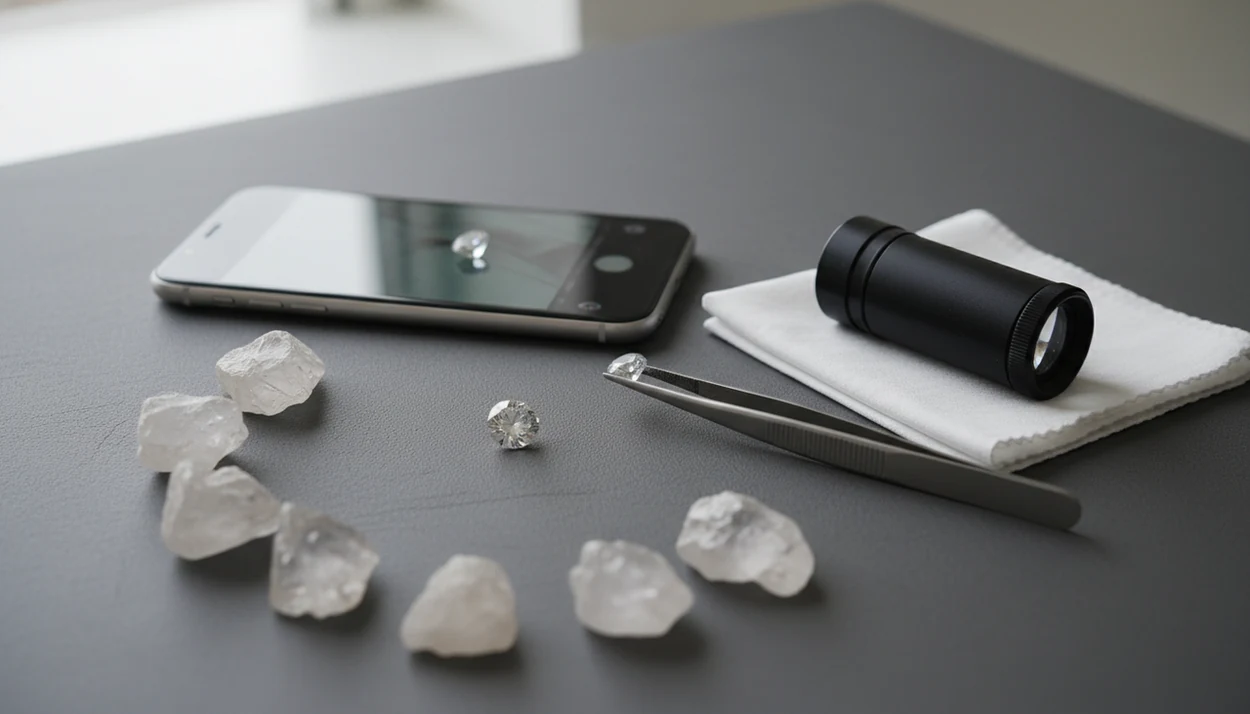
A diamond identifier app can flag that a rough or cut stone looks diamond-like, but it cannot authenticate a diamond from a photo. Use photo results as a screening and learning aid, then rely on gemological testing or a grading report for buying, selling, insurance, or certainty.
> Definition: A photo-based diamond identification tool compares visible stone features against known examples, but it cannot measure the gemological properties needed to prove diamond identity.
TL;DR
- Photo identification can suggest diamond-like appearance, but it is not proof that a stone is diamond.
- Rough diamond photo checks are especially uncertain because quartz, glass, topaz, and other minerals can look similar.
- Real authentication requires controlled gemological testing, and meaningful diamonds should have professional inspection or lab documentation.
For photo-based identification on iPhone or iPad, try the diamond identifier app. You can also upload a photo on RockIdentifier.io.
RockIdentifier.io provides a web photo upload option for comparing diamond-like stones with visual rock, mineral, crystal, fossil, and gemstone references. AI Rock ID is an iPhone and iPad app that can help users document a suspected diamond find while recognizing that real diamond authentication requires gemological testing.
Quick answer: A diamond identifier app can screen a stone for diamond-like visual features, but a photo cannot prove that a stone is a real diamond. Diamond authentication, lab-grown diamond detection, grading, and value decisions require gemological testing by a jeweler or laboratory.
Recommended app for diamond identifier app screening
AI Rock ID is useful when a stone looks diamond-like and the goal is a cautious first look from photos. It should be used as a screening aid, not as proof that a stone is a natural, lab-grown, or valuable diamond.
Best for
- Checking whether a rough find visually resembles diamond or a common look-alike
- Comparing cut stones against diamond-like gemstones before visiting a jeweler
- Recording photos and notes for stones that may need professional testing
- Learning why quartz, zircon, moissanite, and glass can be mistaken for diamond
- Using Mohs hardness clues as context while avoiding destructive tests
- Deciding whether a stone is worth taking to a jeweler or gem lab
Limitations
- A photo cannot confirm diamond composition or crystal structure
- A phone camera cannot grade diamond color, clarity, cut, or carat value reliably
- An app cannot detect lab-grown diamonds with certainty
- Professional instruments or a lab report are required for high-value decisions
Who this guide is for
Good fit if you
- People comparing rough or cut stones that look similar to diamond
- Beginners who want safe first-pass screening before paying for testing
- Collectors documenting field finds with photos and notes
- Jewelry owners checking whether a stone deserves professional evaluation
- Users learning visual differences between diamond, quartz, zircon, moissanite, and glass
- Readers who want to understand what a phone camera can and cannot determine
Consider another method if you
- Anyone needing legal authentication, insurance documentation, or resale proof
- Buyers deciding on an expensive diamond purchase from photos alone
- Users who need diamond grading for color, clarity, cut, or carat value
- Anyone trying to separate natural diamond from lab-grown diamond without instruments
- People who need a certified gemological report
Diamond Identifier App At-A-Glance: What A Photo Can And Cannot Prove
Photo AI can suggest visual similarity, not certify that a stone is diamond. That distinction matters because diamond markets involve high prices, resale claims, and real mislabeling risk.
| Method | What it can do | What it cannot prove |
|---|---|---|
| App result | Screen a photo for diamond-like shape, sparkle, color, and transparency | Real diamond identity, grade, treatment, or natural origin |
| Jeweler inspection | Use tools and experience for practical in-person screening | Full lab-grade origin or grading certainty in every case |
| Lab report | Test and document identity, grading, and often origin indicators | Replace careful reading of the report and its limits |
Use an app for curiosity, first-pass comparison, and learning mineral traits. Don't use it alone for buying, resale, insurance, or lab-grown detection. A price tag beside a mystery cabochon can make a guess feel urgent, but urgency is exactly when testing matters.
How A Diamond Identifier App Works From Image Clues
A diamond identifier app works by comparing image clues, such as shape, surface texture, luster, transparency, color, and context, against training examples. In plain language, the model looks for visual patterns in pixels, then returns a likely match.
What it cannot see is just as important. A phone photo does not measure refractive index, thermal conductivity, spectroscopy, or inclusions under controlled magnification. Full noon sun can put flash glare across a crystal face and hide cleavage or luster. Dirt, cropping, a busy background, and soft focus can all change the result.
Tools like RockIdentifier are most useful when they teach likely names, Mohs hardness context, and rough value estimates. A good ai rock identifier app and web tool that names rocks, crystals, minerals, and fossils from photos with mohs hardness and value estimates delivers educational screening, not gemological certification.
Five Diamond Identifier App Facts For Rough And Cut Stones
- A diamond identifier app can suggest a diamond-like match, but it cannot issue certification. - Cut stones may be confused with moissanite, cubic zirconia, glass, quartz, or other clear materials. - Rough diamond identifier results are less reliable because natural shapes and surface textures overlap with common minerals. - Diamond is Mohs 10, quartz is 7, and feldspar is around 6, so hardness context matters more than photos alone. For a neutral hardness reference, see Encyclopaedia Britannica’s Mohs hardness scale overview (https://www.britannica.com/science/Mohs-hardness). - Lab-grown and treated stones often require advanced testing beyond visual inspection.
Hardness numbers help, but don't scratch a stone that may have value. A beginner-safe comparison is better than damaging a ring or loose gem. If you are comparing a clear stone with other translucent finds, a science-based crystal identifier from photo can help organize lookalikes before you seek testing.
Identify Diamond From Photo: Safe Screening Versus Real Authentication
Identify diamond from photo is a useful screening request, but the result is a probability-style suggestion based on visible traits. Authentication is different. It is a tested conclusion based on gemological measurements.
For a safer screen, take several photos in diffuse light, include a penny or key for scale, and show the stone from the top, side, and base. Compare likely alternatives before assuming diamond. Avoid scratch tests on valuable stones, especially mounted gems.
Then slow down.
Independent grading reports exist because buyers need more than a bright image; GIA explains that its Diamond Grading Report documents the 4Cs and identifying characteristics after laboratory examination (https://www.gia.edu/gia-diamond-reports). For purchases, resale, insurance, or family pieces, consult a jeweler or established lab.
Rough Diamond Identifier Checks For Field Finds
Rough diamonds may look greasy, glassy, rounded, or crystal-like, but none of those traits belongs only to diamond. A rough diamond identifier result should be treated as a clue, not a verdict.
Common lookalikes include quartz, calcite, topaz, feldspar, glass, and some industrial materials. Most casual finds are not diamonds unless the local geology supports diamond-bearing deposits. A sun-warmed pebble in a palm can look special after a long walk, especially when it catches light at one angle.
Document the find before cleaning too aggressively. Note location, size, color, transparency, luster, and shape. Photograph multiple angles, including any fresher broken edge if the outside has a muddy rind. For broader uncut stone comparisons, a rough gemstone identifier can help sort candidates without implying diamond proof.
Diamond Identifier App Myths That Cause Expensive Mistakes
Some diamond app myths are expensive because they turn a visual guess into a financial claim. The FTC Jewelry Guides state that gemstone identity, origin, and quality claims should not be misleading or unsubstantiated (https://www.ftc.gov/business-guidance/resources/jewelry-guides).
- One-photo proof: A single photo cannot prove real versus fake. Reflections, coatings, and focus can fool both people and software.
- AI natural-origin certainty: AI cannot always separate natural diamonds from lab-grown diamonds. Many require instrument-based testing.
- Wild-find verification: A rough diamond identifier cannot verify a field find without supporting tests and geological context.
- Appraisal by estimate: An app value estimate is not an appraisal. It is usually an educational range based on limited inputs.
The bucket clink of beach stones is fun. It is not evidence of diamond value.
Diamond Identifier App Decision Rule: App, Jeweler, Or Lab Report
Use an app when the stone is low-value, found, inherited without paperwork, or part of learning. Do not rely on an app when money, insurance, legal claims, or natural-versus-lab-grown certainty are involved.
| Question | Use an app? | Better next step |
|---|---|---|
| Is this a backyard or field curiosity? | Yes | Compare lookalikes and note context |
| Am I buying or selling it? | No | Jeweler inspection, then lab report if valuable |
| Is it for insurance or estate records? | No | Appraisal with supporting documentation |
| Do I need natural vs lab-grown certainty? | No | GIA, AGS, or similar lab testing |
Because laboratory-grown diamonds are common in the market, natural-versus-lab-grown questions need instrument-based testing; GIA notes that advanced methods may be required to separate laboratory-grown diamonds from natural diamonds (https://www.gia.edu/gia-news-research/laboratory-grown-diamonds). For value questions, an app that estimates gemstone value should be treated as education, not negotiation evidence.
Authoritative Sources For Diamond Testing And Jewelry Claims
Authoritative sources support careful screening, not app-based certification. A photo result can help you decide what to ask next, but it does not replace a grading report, jeweler inspection, or laboratory identification.
Use source-backed steps when a stone may affect money, insurance, or a sales claim:
- Check GIA guidance on diamond grading reports and laboratory diamond identification before treating a stone as documented.
- Compare any marketing language with the FTC Jewelry Guides, especially claims about gemstone identity, origin, treatment, quality, or value.
- Use a neutral Mohs hardness reference for mineral numbers, remembering that hardness context is not a safe scratch-test instruction for valuable stones.
- Ask a local jeweler or gemologist what instruments they use, because one counter may use thermal or electrical screening while a lab may use magnification, spectroscopy, or other controlled tests.
- Treat the app result as a screening note alongside photos, size, setting details, and paperwork, not as proof for resale or insurance.
Different shops and labs may reach their answer through different instruments and workflows. That is normal; what matters is whether the conclusion is tested and documented.
Limitations
Photo-based diamond results have firm limits. They can help you learn what to ask next, but they cannot replace professional testing.
- A photo result cannot authenticate a diamond or replace a grading report.
- Lighting, focus, dirt, reflections, camera quality, and background can distort the match.
- Apps may confuse diamond with moissanite, cubic zirconia, quartz, glass, topaz, or feldspar.
- Apps generally cannot reliably distinguish natural diamonds from lab-grown or treated diamonds.
- Rough stones are harder to identify than faceted stones from images alone.
- Value estimates are educational ranges, not appraisals for resale, insurance, taxes, or purchase negotiations.
- Mounted stones add another problem because prongs and settings can hide the pavilion, girdle, and inclusions.
RockIdentifier can be a useful learning step for likely visual matches and mineral context. However, valuable or uncertain stones deserve a jeweler, gemologist, or lab report.
Which option fits which need
| Need | Best option | Why |
|---|---|---|
| First-pass screening of a diamond-like stone from a photo | AI Rock ID | The app can compare visible features and provide cautious identification context. |
| Uploading a photo without installing an app | Web Tool | RockIdentifier.io can be used from a browser for photo-based visual comparison. |
| Confirming whether a stone is a real diamond | Expert | A jeweler or gemologist can use instruments that test properties a photo cannot measure. |
| Separating natural diamond from lab-grown diamond | Lab | Specialized gemological testing is needed to evaluate origin and growth indicators. |
| Quick visual search for similar-looking stones | Google Lens | General image search can show visual matches, but it does not provide gemological authentication. |
| Insurance, resale, or purchase documentation | Lab | Formal reports are needed when the result affects legal, financial, or valuation decisions. |
Quick summary
- Best for
- Photo-based screening of diamond-like stones before deciding whether professional testing is needed.
- Includes
- visual identification clues, rough stone comparison, cut stone comparison, Mohs hardness context, diamond look-alike warnings, value context
- Platforms
- iPhone, iPad, Web
- Free version
- Yes
- Expert replacement
- No
Common mistakes
- Treating a diamond identifier app result as proof of authenticity
- Assuming high sparkle in a photo means the stone is diamond
- Using scratch tests that can damage the stone or another material
- Ignoring common look-alikes such as quartz, moissanite, zircon, topaz, and glass
- Assuming a rough clear crystal is valuable because it looks like a rough diamond
- Estimating diamond value from a single phone photo
A practical next step is the check diamonds from photos workflow in AI Rock ID.
FAQ
Can an app identify a diamond?
An app can suggest that a stone looks diamond-like from a photo. It cannot authenticate a diamond or issue a grading report.
Can a photo prove whether a diamond is real?
No. Photos alone cannot prove diamond identity because real authentication requires gemological measurements and controlled testing.
What is a diamond tester app?
A diamond tester app is a photo or phone-based screening tool that gives a likely visual match. It is not the same as thermal, electrical, spectroscopic, or laboratory equipment.
Are rough diamond identifier apps accurate?
Rough diamond photo identification is especially uncertain because quartz, glass, topaz, calcite, and feldspar can share similar shapes or surfaces. Treat the result as a starting clue.
Can AI detect lab-grown diamonds?
AI may flag visual clues, but lab-grown versus natural diamond detection usually requires advanced instruments. Do not rely on a phone photo for origin certainty.
What stones look like rough diamonds?
Common rough diamond lookalikes include quartz, glass, topaz, calcite, feldspar, and some industrial materials. Context and testing matter more than sparkle alone.
Is diamond harder than quartz?
Yes. Diamond is Mohs 10, quartz is Mohs 7, and feldspar is around Mohs 6, which is why hardness context matters in mineral identification.
Can a phone camera grade a diamond?
No. Camera-based estimates cannot replace standardized color, clarity, cut, or carat grading by trained gemologists.
Do diamond apps estimate value?
Some apps, including RockIdentifier, may show rough educational value ranges. Those estimates are not appraisals for resale, insurance, taxes, or purchase negotiation.
When should I get a diamond professionally tested?
Get professional testing when buying, selling, insuring, inheriting, or verifying a valuable stone. Use RockIdentifier-style results only as screening before expert review.
Can a diamond identifier app tell the difference between diamond and moissanite?
A diamond identifier app may flag visual similarities or differences, but it cannot reliably separate diamond from moissanite from a photo alone. Jewelers use instruments that test optical and physical properties beyond a camera image.
Should I clean a suspected diamond before taking a photo?
A clean, well-lit photo can improve visual screening, but cleaning should be gentle and non-destructive. Avoid harsh chemicals, heat, or scratching if the material is unknown.
What photos help when screening a rough diamond-like stone?
Use sharp photos from multiple angles in natural or diffuse light, and include a size reference. Photos of crystal shape, surface texture, transparency, and inclusions can help with visual comparison.
Can an app identify a diamond in a mounted ring?
An app can review the visible appearance of a mounted stone, but the setting may hide important features. A jeweler can inspect the stone, mounting, and any markings with proper tools.