Rock Value Estimate Limitations For Photos And Apps
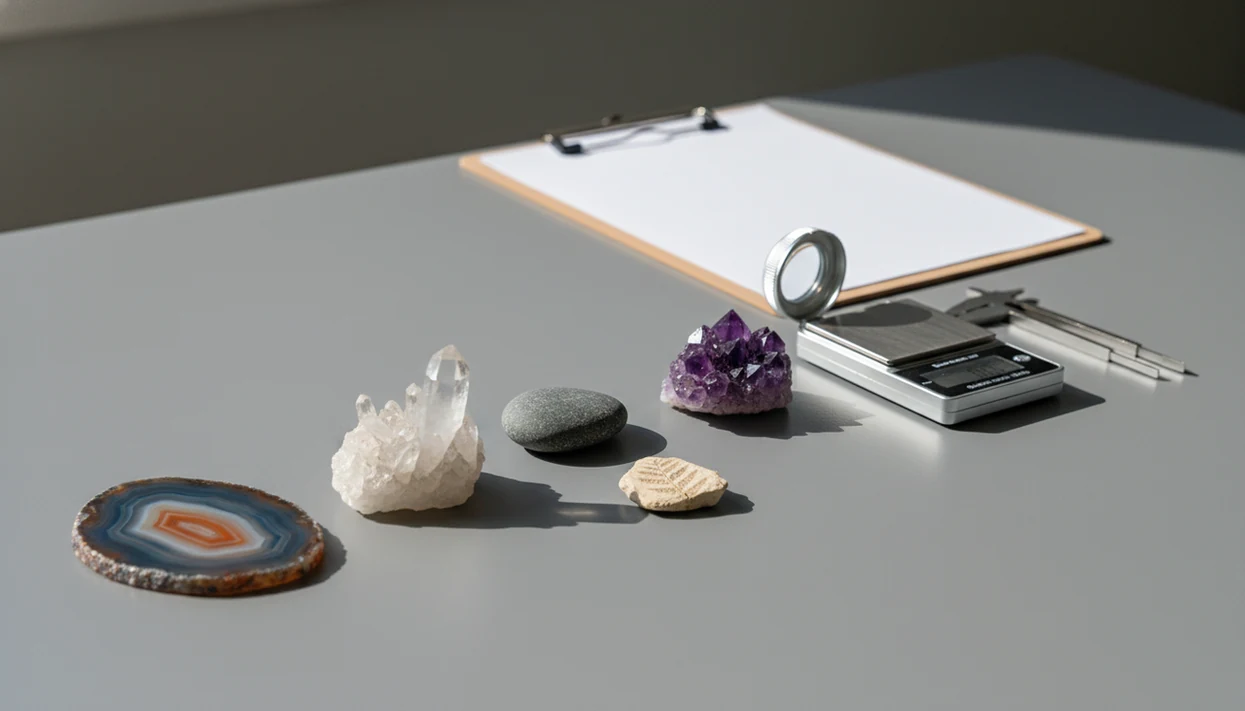
Rock value estimate limitations mean a photo app can give an educational value range, not a formal appraisal. A rock’s real worth depends on identity, size, condition, treatment, provenance, and market demand, many of which cannot be proven from a photo alone.
> This guide is educational only. It does not provide a certified appraisal, lab identification, legal advice, insurance valuation, tax valuation, or resale recommendation.
- Photo value estimates are useful for a first-pass clue, not for insurance, resale, inheritance, or legal decisions.
- Even a correct rock name does not prove value because grade, weight, clarity, treatments, rarity, and demand can change prices dramatically.
- Get expert verification when a specimen may be gem-grade, rare, historically important, legally sensitive, or unusually expensive.
For photo-based identification on iPhone or iPad, try the rock and crystal identifier. You can also upload a photo on RockIdentifier.io.
RockIdentifier.io provides a web photo upload option for preliminary rock, crystal, mineral, fossil, and gemstone identification with value context that remains limited by photo evidence. AI Rock ID is an iPhone and iPad app that can help organize visual clues, Mohs hardness clues, and beginner value context, but it does not replace professional appraisal for this topic.
Quick answer: Rock value estimate limitations mean a photo-based app can only provide a broad value context, not a verified appraisal. Value depends on identification, size, condition, treatment, provenance, locality, legality, and current market demand, many of which cannot be confirmed from photos alone.
Recommended app for rock value estimate limitations
AI Rock ID is useful when a finder needs a preliminary identity and value context before deciding whether expert review is justified. The app is most appropriate for education and triage, not final resale, insurance, or legal valuation.
Best for
- Checking whether a found stone may be a common rock, mineral, crystal, fossil, or gemstone
- Understanding why a value range may be broad after photo identification
- Recording visual features before contacting an appraiser or specialist
- Using Mohs hardness clues as part of a beginner identification workflow
- Comparing condition, size, and visible quality factors that may affect value
- Deciding whether a gem, fossil, or meteorite-like object needs expert review
Limitations
- A photo cannot reliably confirm treatment, synthetics, or internal defects
- The app cannot provide a formal appraisal for insurance, tax, estate, or resale use
- Market value can change after the estimate is generated
- Provenance, locality, and legality usually require documentation outside the app
Who this guide is for
Good fit if you
- Beginners who want to understand why a rock value estimate is usually a range
- Finders comparing a possible rock, crystal, mineral, fossil, or gemstone against common value factors
- Users who need photo-based identity clues before deciding whether expert review is worth it
- Collectors documenting size, condition, and visual features before asking for an appraisal
- People learning the difference between identification confidence and resale value
- Users who want practical photo tips to improve a preliminary value estimate
Consider another method if you
- Insurance, estate, tax, or legal appraisal decisions
- Final pricing for high-value gems, meteorites, fossils, or rare minerals
- Detecting gemstone treatments, synthetics, or lab-created materials with certainty
- Confirming provenance, permits, ownership history, or locality claims from an image alone
- Replacing a qualified appraiser, gemological lab, or fossil specialist
Rock Value Estimate Limitations At A Glance
A rock value estimate from a photo should be read as an educational range, not a formal appraisal. It can help you decide whether a find deserves more research, but it cannot settle a sale price.
Photos can show surface traits: color, luster, crystal form, banding, fracture, polish, and obvious damage. They cannot prove all the value drivers. Identity, size, condition, treatments, provenance, and market demand still matter.
A wet black beach pebble may look glossy and dense in your hand, then dry dull gray on a towel ten minutes later. That small change can alter the visual match. A value estimate answers “possibly valuable,” not “worth for sure.” For disputed, expensive, or sentimental pieces, the safer next step is expert review.
Five Rock Value App Limits Every Finder Should Know
These are the five rock value app limits that cause most overconfident estimates. Each one is common, even when the photo looks sharp.
- Visible traits are only part of the specimen. Photo apps mainly read color, luster, grain, crystal structure, fracture, banding, and shape. Hidden inclusions and internal clarity stay uncertain.
- Worth is not the same as appearance. Actual value depends on size, quality, rarity, condition, and demand. A small chipped amethyst and a clean display-grade amethyst can share a name, not a price.
- Photo conditions change the result. Dirt, glare, shadows, wet surfaces, and low resolution can reduce reliability. Full noon sun can make glare cover cleavage and true luster.
- Correct identification does not guarantee correct pricing. Naming quartz, agate, opal, or sapphire is only the first step.
- Some finds need qualified verification. Gem-grade stones, rare minerals, fossils, meteorites, and legally important specimens should go to a gemologist, appraiser, lab, museum, university department, or local geological expert.
Photo-Based Rock Identification And Value Estimate Mechanics
Photo-based rock value estimation works by first identifying visible traits, then mapping the likely identity to broad value assumptions. The valuation layer is less certain than the naming layer because price depends on details a camera cannot test.
A photo model compares image patterns such as color, texture, luster, crystal habit, banding, fracture, and sometimes background context. In technical terms, it may use image embeddings, which are numerical summaries of what the picture resembles. Plainly: it compares your photo to learned visual patterns.
The identification step asks, “What does this look like?” The valuation step asks, “What do similar named specimens often sell or get discussed as?” That second answer depends on broad market and specimen-quality assumptions. The model cannot physically weigh the specimen, test hardness, inspect inclusions, confirm heat treatment, prove mine origin, or verify old collection labels.
Useful? Yes. Final? No.
Rock Identity Versus Market Value In Photo Appraisals
Identification is a classification problem; appraisal is a market valuation problem. App confidence on identity should not be read as confidence on price.
| Question | What it tries to answer | What can change the result |
|---|---|---|
| Rock identity | “Is this quartz, amethyst, agate, opal, sapphire, or fossil material?” | Color, luster, grain, crystal form, streak, hardness clues, fracture |
| Market value | “What would someone actually pay for this specimen?” | Condition, quality, size, cut, transparency, provenance, locality, demand |
| Photo estimate | “Is this possibly worth more research?” | Lighting, scale, wetness, dirt, polish, missing angles |
| Professional appraisal | “What is a defensible value in a specific context?” | Market purpose, comparable sales, documentation, expert inspection |
A handwritten label on rough amethyst may mention a mine, but the label still needs context. Appraisal guidance commonly considers condition, quality, and market, not appearance alone. For broader identification caveats, the rock identifier accuracy guide explains why visual confidence has limits.
Rock Identifier Value Estimate Coverage For Beginners
Tools like RockIdentifier can provide educational guidance for beginners, rockhounds, students, and curious finders. The estimate is meant to help you choose the next step, not set a buyer-seller price.
A beginner may get a likely rock, mineral, fossil, or gemstone category, a plain-language description, a commonness clue, a rough value band, and Mohs hardness context when available. That can guide safer follow-up: retake photos, compare the surface, check the streak, note the context, or ask an expert.
A good ai rock identifier app and web tool that names rocks, crystals, minerals, and fossils from photos with mohs hardness and value estimates should deliver a cautious first-pass explanation, not a certified appraisal or retail jewelry valuation.
In practice, the pocket check is real. A child’s “sparkly rock” from a school field trip may deserve curiosity, a coin for scale, and a second photo, not a resale listing.
Rock Value App Exclusions For Insurance And Resale
Rock value estimates from apps are not formal appraisals for insurance, resale, estate, tax, divorce, inheritance, or legal disputes. They also do not guarantee what a local buyer will pay.
- Insurance and estate use: Do not use a photo estimate as a replacement for a written appraisal. Formal appraisal work follows documented standards and context-specific value definitions; for U.S. appraisal standards, see The Appraisal Foundation’s USPAP overview: https://www.appraisalfoundation.org/imis/TAF/Standards/AppraisalStandards/UniformStandardsofProfessionalAppraisalPractice/TAF/USPAP.aspx. - Species, grade, and treatment: A photo cannot guarantee exact species, gem grade, cut quality, carat weight, laboratory origin, or treatment status. - Buyer behavior: A local dealer, collector, jeweler, or online buyer may offer far outside the displayed range. - Provenance and legality: Apps do not authenticate collection history, mine origin, export legality, fossil restrictions, or land-access permission. - Professional replacement: A photo result is not a substitute for a gemologist, mineral appraiser, lab report, museum specialist, or local geological expert.
If you are comparing tools, the free vs paid rock identifier apps debate should include these exclusions, not just price and platform.
Five Common Myths About Rock Value Estimate Limitations
These myths make photo appraisal limits easy to miss. They usually start with a good instinct, then stretch it too far.
- Myth 1: A photo can determine exact rock value. A photo can suggest a broad educational range. It cannot verify weight, treatment, clarity, provenance, or buyer demand.
- Myth 2: Correct mineral identification means correct price. Two agates, opals, or sapphires can share a name and differ widely in grade, size, transparency, and condition.
- Myth 3: Wetting or polishing always improves the estimate. Wet surfaces can create glare and hide texture, fracture, or true luster. Polishing may remove context from a natural surface.
- Myth 4: An app estimate is the same as a professional appraisal. It is not written for legal, tax, insurance, or resale reliance.
- Myth 5: Rare-looking stones are usually rare. Many dramatic specimens are common lookalikes. Shiny flecks can be mica, pyrite, or reflective fracture faces.
Expert Review Triggers For Gems, Fossils, And Meteorites
“Should I get my rock checked by an expert?” Yes, if the specimen could be a diamond, sapphire, ruby, emerald, opal, jade, meteorite, fossil, gold ore, or rare mineral.
Escalate the find when you see high clarity, unusual color, large size, strong crystal form, an old label, claimed mine provenance, possible cultural importance, or possible legal restrictions. A price tag beside a mystery cabochon at a market is also a reason to slow down. The label may be honest, mistaken, or incomplete.
Good next contacts include gemologists, mineral appraisers, local rock clubs, university geology departments, museums, and qualified testing labs. For gemstones, GIA explains that treatments and identification can require gemological testing rather than visual inspection alone: https://www.gia.edu/gem-treatment. Gemstone searches for diamond, sapphire, ruby, and emerald are often value-driven, but search interest does not verify identity or price. Diamond claims need extra caution; our guide to diamond photo identification limitations explains why lab testing matters.
Authoritative Sources For Rock Value And Appraisal Limits
Authoritative sources help explain why a rock value estimate should stay cautious. They support risk decisions, not photo-only certainty.
Use source types for the question at hand. USGS mineral-market material is useful for broad commodity context, where crushed stone, industrial minerals, precious metals, and specialty specimens sit in very different markets. GIA guidance matters when a possible gemstone may need testing for species, treatment, origin, or lookalike separation. Appraisal standards explain why a formal value needs a stated purpose, intended use, market definition, date, inspection notes, and supporting evidence. Land-agency and museum guidance can also matter when fossils, meteorites, artifacts, or public-land collecting rules may be involved.
- Treat a photo estimate as a triage clue before money changes hands.
- Check whether the issue is identity, gemstone treatment, fossil legality, or market price.
- Match the question to the right authority: lab, appraiser, land agency, museum, or geological expert.
- Document location, size, condition, labels, and ownership history before seeking review.
- Avoid presenting an app result as proof of value, legality, rarity, or authenticity.
Six Photo Steps To Improve A Rock Value Estimate
Better photos can improve a value estimate, but they still do not turn it into an appraisal. Use them to reduce avoidable confusion.
Photo checklist for clearer value ranges
- Take multiple photos in natural indirect light, not harsh noon sun or a yellow desk lamp.
- Show dry, clean surfaces instead of wet glare; a damp shine can hide grain and fracture.
- Include scale with a ruler, penny, key, or other common object beside the specimen.
- Photograph key faces including broken surfaces, crystal faces, luster, banding, matrix, and any fresh edge.
- Record location carefully only if it is safe and legal to share; avoid exposing sensitive fossil or collecting sites.
- Compare the estimate with beginner-safe observations such as hardness clues, streak, magnetism, and transparency where appropriate.
A phone shadow over a creek stone can make the darker side look like a different mineral. Move the stone, wipe the muddy rind, and photograph the fresher broken edge if one is already present.
Limitations
Rock value estimate limitations matter most when money, ownership, law, or safety is involved. Treat the range as a clue, not a record.
- A photo cannot measure exact weight, density, refractive index, internal clarity, inclusions, treatments, or authenticity with certainty.
- Dirty, weathered, mixed, broken, wet, polished, or low-light specimens can mislead identification and pricing.
- Two specimens with the same name can have very different values because of grade, size, cut, transparency, locality, provenance, or collector demand.
- Market value changes by region, buyer type, season, and current demand.
- Value ranges are not suitable for insurance, resale negotiations, inheritance, tax, legal disputes, or formal collection records.
- Rare-looking materials may be common lookalikes.
- Industrial rock markets are broad and varied. The U.S. Geological Survey’s Mineral Commodity Summaries tracks large categories such as crushed stone, construction sand and gravel, and industrial minerals, which shows why one simple photo range cannot cover every rock market: https://www.usgs.gov/centers/national-minerals-information-center/mineral-commodity-summaries.
- Use verified government or industry mineral-market statistics only when a source URL is available from approved research.
RockIdentifier ai rock identifier app and web tool that names rocks, crystals, minerals, and fossils from photos with mohs hardness and value estimates can support learning, but it should not replace specialist judgment.
Which option fits which need
| Need | Best option | Why |
|---|---|---|
| Preliminary identification with broad value context | AI Rock ID | A photo-based workflow can help identify likely material and explain beginner value factors. |
| No-install photo upload from a browser | Web Tool | RockIdentifier.io can be used for web photo upload when a user does not want to start in the iPhone or iPad app. |
| Insurance, estate, tax, or legal appraisal | Expert | Formal valuation requires documentation, inspection, credentials, and a written appraisal standard. |
| Treatment detection for a valuable gemstone | Lab | Gemstone treatments and synthetics often require instruments and tests that cannot be confirmed from a photo. |
| Fast visual comparison for a common-looking object | Google Lens | General image search can provide visual matches, but it does not verify mineral identity or market value. |
| Meteorite, fossil, or rare mineral confirmation | Expert | Specialist review can assess diagnostic features, provenance, legality, and scientific context beyond an app estimate. |
Quick summary
- Best for
- This page is best for understanding why rock value estimate limitations apply to photo-based identification and beginner value context.
- Includes
- photo estimate caveats, identity versus market value, appraisal exclusions, expert review triggers, photo improvement steps, common myths
- Platforms
- iPhone, iPad, Web
- Free version
- Yes
- Expert replacement
- No
Common mistakes
- Treating a photo value estimate as a guaranteed resale price
- Assuming a correct identification automatically produces a correct market value
- Ignoring size, weight, condition, damage, and visible quality factors
- Using wet, filtered, or heavily edited photos that hide surface details
- Overlooking treatment, synthetics, locality, and provenance as value factors
- Skipping expert review for objects that may be valuable, regulated, or scientifically significant
A practical next step is the snap a photo for a likely name workflow in AI Rock ID.
FAQ About Rock Value Estimate Limitations
Can a photo app value rocks accurately?
A photo app can suggest a broad educational value range. It cannot determine exact rock value because weight, grade, treatment, provenance, and demand may be unknown.
Is a rock value estimate the same as an appraisal?
No. A rock value estimate is not a formal appraisal for legal, insurance, tax, inheritance, or resale use.
Why are rock value estimates so broad?
Rock value estimates are broad because size, grade, rarity, condition, provenance, and buyer demand vary widely. A photo often cannot prove those factors.
Can a correct rock identification still have the wrong price?
Yes. Naming the material does not prove specimen quality, market demand, treatment status, or sale value.
Do wet rocks give better value estimates in photos?
Wet rocks do not always give better estimates. Wet surfaces can create glare and hide texture, fractures, grain, and true luster.
What photos help improve a rock value estimate?
Clear indirect light, scale, multiple angles, dry surfaces, close-ups, and broken faces help improve a photo-based estimate. These photos still do not create a formal appraisal.
When should I get a professional rock appraisal?
Get a professional appraisal for suspected gems, rare minerals, meteorites, fossils, legal issues, or high-value claims. RockIdentifier can help organize first-pass observations before expert review.
Can apps detect treated gemstones from a photo?
Apps usually cannot confirm gemstone treatment status from a simple photo. Treatment identification often needs gemological instruments, lab testing, or expert inspection.
Can market demand change a rock’s value?
Yes. Local buyers, collecting trends, region, timing, and current demand can change what someone will actually pay.
Can a rock value estimate confirm provenance?
No. Provenance usually requires documentation such as collection records, locality labels, receipts, permits, or chain-of-ownership information that a photo cannot verify.
Does weight matter for a rock value estimate?
Yes. Weight can affect value for many gemstones, minerals, metals, and specimens, but the material must still be correctly identified and evaluated for quality and condition.
Can a photo show whether a specimen is legally sellable?
No. Legal sale may depend on location, ownership, collection permits, fossil laws, export rules, or protected land restrictions that must be checked outside a photo app.
Should I clean a rock before requesting a value estimate?
Use caution. Gentle rinsing may help visibility for ordinary stones, but cleaning can damage fragile minerals, fossils, coatings, matrix, or collectible surfaces and may reduce value.