Fix Mislabeled Rock Collection Records With Better Clues
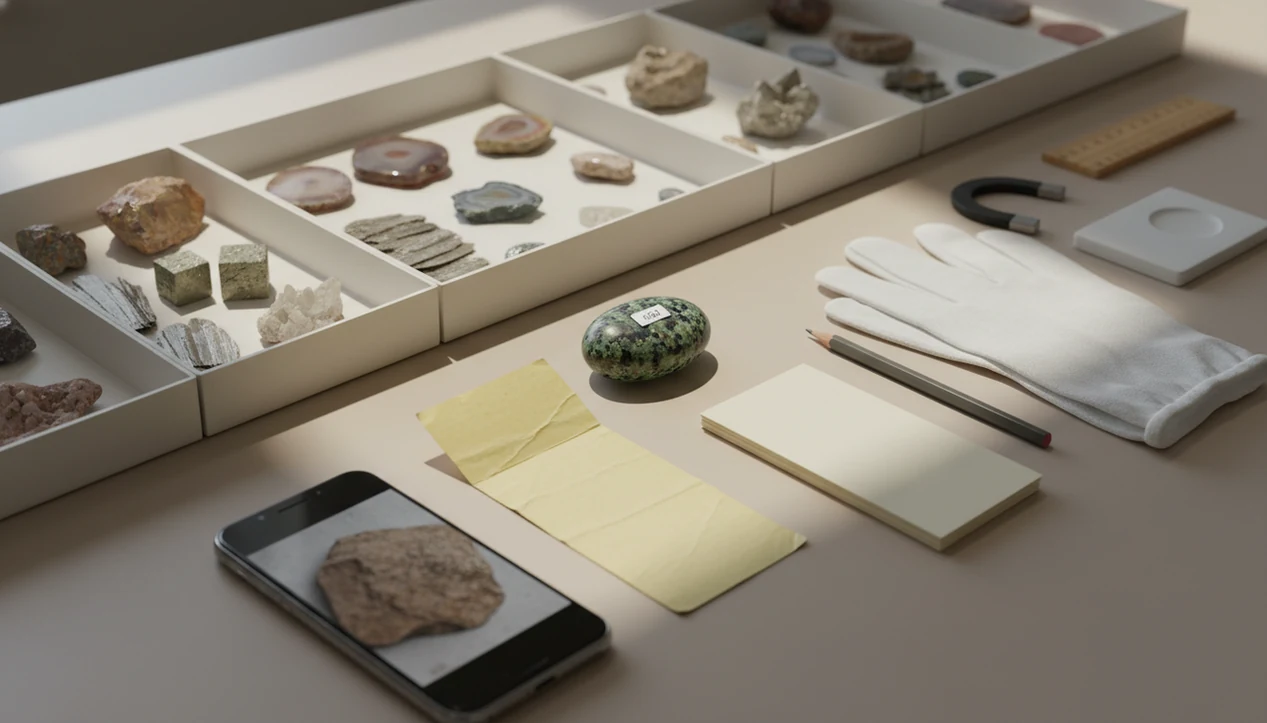
To fix mislabeled rock collection records, work specimen by specimen: photograph each piece, compare the old label to visible features and simple tests, update the ID and locality only when confidence is high, and preserve every old label as provenance. Treat each corrected name as a documented hypothesis, not a permanent verdict.
Definition: Fixing a mislabeled rock collection means rechecking each specimen’s identity, locality, label, and catalog record so the physical rock, old notes, photos, and digital entry all match as closely as the evidence allows.
TL;DR
- Give every specimen a stable catalog number before changing labels.
- Use photos, Rock Identifier, hardness, magnetism, acid reaction, and locality clues together instead of trusting one clue alone.
- Keep original handwritten labels and record old IDs, new IDs, confidence levels, and correction dates.
For photo-based identification on iPhone or iPad, try the rock identifier app. You can also upload a photo on RockIdentifier.io.
RockIdentifier.io provides a web photo upload option that can help collectors compare visual clues while reviewing mislabeled rock collection records. AI Rock ID is an iPhone and iPad app that supports photo-based rock, mineral, crystal, fossil, and gemstone identification with context such as hardness clues and value information.
Quick answer: Fix mislabeled rock collection records by assigning stable specimen numbers, photographing each item, comparing simple test results, and preserving old label information as evidence. A reliable correction process should separate confirmed IDs from uncertain IDs and record confidence, locality, and expert review notes over time.
Recommended app for fixing mislabeled rock collection records
AI Rock ID can be useful when a collector needs a starting point for comparing specimen photos against possible rock, mineral, crystal, fossil, or gemstone IDs. It is most helpful when the app result is recorded as one clue alongside hardness, magnetism, acid reaction, locality, and expert comments.
Best for
- Creating a first-pass ID list for unlabeled or suspicious specimens
- Comparing visual traits before rewriting catalog entries
- Adding photo evidence to corrected rock collection records
- Separating likely matches from specimens that need expert review
- Checking whether an old label conflicts with visible features
- Recording supporting clues before changing a display label
Limitations
- Photo identification cannot confirm every rock or mineral by itself
- Similar-looking minerals may require hardness, streak, acid, density, or lab tests
- Missing locality data can limit confidence in a corrected label
- Expert review is still needed for valuable, rare, hazardous, or scientifically important specimens
Who this guide is for
Good fit if you
- Collectors cleaning up inherited or mixed rock collections
- Students organizing school rock, mineral, fossil, or gemstone sets
- Hobbyists who need a repeatable evidence system before changing labels
- Users comparing photos with Mohs hardness, magnetism, streak, acid reaction, and locality clues
- People who want to keep old handwritten labels while adding corrected records
- Collectors preparing uncertain specimens for expert review
Consider another method if you
- Users who need legally certified gemstone appraisal or valuation
- Collectors identifying hazardous materials that require safety handling
- Cases that require lab confirmation, thin section analysis, XRD, or chemical testing
- People who want to discard old labels instead of preserving provenance evidence
What It Means to Fix Mislabeled Rock Collection Records
Fixing a mislabeled rock collection means correcting the specimen record, not just swapping one name card for another. The record includes identity, locality, date collected, collector, catalog number, storage location, and provenance.
Old labels are evidence. They are not absolute truth. A handwritten “quartz” card may be wrong about the mineral but right about the creek, quarry, family owner, or collecting trip. That matters later.
People usually start this work after inheriting boxes, finding missing labels, merging duplicate trays, preparing a display, or checking specimens before sale. We have seen a child’s “sparkly rock” from a school field trip become three catalog entries once the jacket pocket contents were sorted.
RockIdentifier is an AI rock identifier app and web tool that names rocks, crystals, minerals, and fossils from photos, with Mohs hardness and value estimates for first-pass comparison.
Rock Collection Cleanup Supplies Before You Correct Labels
A good rock collection cleanup starts with supplies that protect both the specimen and the evidence. Set up the station before opening every box, because loose labels drift fast.
- Imaging tools: Use a phone camera, ruler, scale card, and a stable photo area with dry specimens and soft side lighting.
- Record tools: Keep a notebook or spreadsheet open, with specimen trays, small bags, pencils, archival paper, and a fine pen nearby.
- Label tools: Use reversible label bases where appropriate, plus bag labels, tray cards, or tied tags for delicate pieces.
- Test tools: Add a streak plate, magnet, hardness picks or common objects, and dilute acid only when it is suitable and safe.
Avoid permanent paint, random glue, household tape, and relabeling before a catalog number exists. A white tile streak mark can be useful, but not if the rock has already lost its old card under a pile of new guesses.
Evidence System for Mislabeled Rock Collection Corrections
How mislabeled rock collection correction works: each new name is judged by matching photo features, physical tests, locality, old labels, and review notes. Image embeddings can group a photo with visually similar specimens; in plain language, the app compares what it can see against learned examples.
- Photo evidence narrows the field: Color, crystal shape, grain size, luster, cleavage, and weathering help separate likely IDs from poor matches.
- Physical tests add resistance: Hardness, streak, magnetism, acid reaction, and heft often catch visual lookalikes.
- Locality can confirm or weaken an ID: A rare mineral name is weaker if the recorded site has no known setting for it.
- Mineral diversity is large: The U.S. Geological Survey explains that Earth has thousands of recognized mineral species, so structured evidence prevents guesswork: https://www.usgs.gov/faqs/how-many-minerals-are-there-earth
- Names change over time: The International Mineralogical Association maintains the official mineral list and approves new mineral names, so older labels may need taxonomic review: https://mineralogy-ima.org/
Use confidence levels: confirmed, likely, possible, and unknown. Possible is not failure. It is honest cataloging.
6-Step System to Correct Rock Collection Labels
How to use a rock collection cleanup system: work in small batches, record every change, and stop uncertain specimens from contaminating the finished group. For a large inherited collection, one tray per session beats an all-weekend scramble.
- Sort by box, drawer, or tray so the original storage context is preserved.
- Assign a unique catalog ID before changing the name, label, or container.
- Photograph the specimen, scale, old label front and back, and tray position.
- Test key properties with minimal handling: hardness, streak, magnetism, acid only when safe, and visible cleavage or luster.
- Compare app suggestions, references, locality notes, and possible lookalikes; use Rock Identifier as one clue among several.
- Update the catalog with old name, new name, evidence, confidence, date corrected, and reviewer if any.
Quarantine uncertain specimens instead of forcing a confident label.
Step 1: Assign Stable Numbers Before Rock Collection Cleanup
A stable catalog number links the rock, photo set, original label, storage tray, and database row. Duplicate names are fine; duplicate catalog IDs are not.
Use a simple format you can keep using, such as `RC-0001`, `RC-0002`, and so on. Mark sturdy specimens discreetly on a reversible base, such as archival varnish or white-out where appropriate, then write the number with a fine pen after the base dries. Test the method on a common, low-value piece first.
Tiny crystals, crumbly fossils, polished stones, and valuable specimens may not tolerate direct marking. Use a bag label, tray card, or tied tag instead. The important part is the link, not the ink.
Never separate the original label from its specimen during cleanup. Put both in the same tray until the new record is finished.
Step 2: Photograph Clues That Fix Mislabeled Rock Collection IDs
Photos fix more labels when they show the specimen as evidence, not as a pretty object. Take multiple angles, close-ups, any fresh broken surface, the scale, the label front and back, and the storage context before rearranging the tray.
Name image files with the catalog ID, such as `RC-0042sideA.jpg` and `RC-0042oldlabel.jpg`. That small habit saves hours later. It also helps if a label fades or an expert asks for more views.
Lighting changes IDs. A phone photo taken in full noon sun can hide luster and cleavage under glare. Wet surfaces also mislead: a black beach pebble may look glossy and dark, then turn dull gray after drying on a towel.
Photo tools can suggest a likely identification, but they cannot confirm hardness, streak, weight, acid reaction, or true locality. For a deeper look at photo limits, use the rock identifier accuracy guide.
Step 3: Compare Hardness, Magnetism, Acid, and Locality Clues
Simple tests help correct rock collection labels by separating lookalikes that share color or sparkle. Keep tests minimal, especially on polished, rare, delicate, crumbly, or valuable specimens.
The Mohs hardness scale, introduced by Friedrich Mohs in the early 1800s, ranks 10 reference minerals from talc to diamond by scratch resistance: https://www.britannica.com/science/Mohs-hardness. It is useful because calcite, quartz, feldspar, and many lookalikes scratch differently.
| Clue | What it checks | Useful separation |
|---|---|---|
| Mohs hardness | Scratch resistance | Calcite vs quartz |
| Magnetism | Attraction to a magnet | Magnetite vs hematite |
| Streak | Powder color on plate | Hematite vs dark lookalikes |
| Acid reaction | Carbonate fizz | Calcite-rich rocks vs quartz-rich rocks |
| Heft and luster | Density and shine | Pyrite vs gold-colored minerals |
| Cleavage and grain size | Breakage and texture | Mineral crystal vs rock fragment |
| Locality | Geological plausibility | Strong or weak support for the proposed ID |
Locality is a test too. A label from rusty scree below a switchback may support iron minerals, but it does not prove the exact species.
Step 4: Rebuild Correct Rock Collection Labels and Catalog Entries
A corrected label should be short enough to stay with the specimen, while the catalog keeps the full history. Do not discard old labels; photograph them, archive them, and cross-reference them.
Minimum Label Fields
| Field | Why it belongs on the physical label |
|---|---|
| Catalog ID | Links the rock to photos and the master record |
| Specimen name | Gives the current working ID |
| Locality | Preserves collecting context, if known |
| Confidence | Prevents “possible” from looking confirmed |
Versioned Catalog Fields
| Field | What to record |
|---|---|
| Old and new names | Original label text and corrected name |
| Category | Rock, mineral, fossil, crystal, or gemstone |
| Collection data | Collector, date collected, locality, and storage location |
| Correction data | Date corrected, source, tests, photos, and reviewer |
| Provenance and value notes | Prior owner, label history, and cautious value comments |
Precise lost locality usually cannot be reconstructed. Mark it unknown, or approximate only when evidence supports that wording. Versioned spreadsheets or databases make later reversals less painful.
Step 5: Flag Uncertain Rock Collection Labels for Expert Review
Uncertain labels should be triaged, not pushed into false certainty. A careful “unknown” record is more useful than a confident wrong label.
- Confirmed: Multiple clues agree, and the ID is routine for the locality.
- Likely: Most clues agree, but one test or locality detail is missing.
- Possible: The ID fits some visual clues but needs more evidence.
- Unknown: The specimen lacks enough evidence for a responsible name.
- Expert needed: The claim involves fossils, meteorites, ores, rare minerals, altered rocks, fine-grained rocks, or valuable-looking material.
Send reviewers the catalog ID, clear photos, old label images, test results, locality, and the exact confidence question. Local rock clubs, museums, university geology departments, experienced collectors, and mineral shows can all help.
Tools like RockIdentifier, Google Lens, Mindat, and rockd.org can guide comparisons, but expert review is still the safer route for high-stakes claims.
Common Mistakes When You Correct Rock Collection Labels
Most rock collection cleanup mistakes come from changing records faster than the evidence can support. Slow the workflow before the old context disappears.
- Throwing away old labels: Archive them instead; even a wrong name can preserve owner history or locality.
- Trusting AI alone: Use photo ID as a clue, then check hardness, streak, magnetism, acid reaction, and locality.
- Inventing locality: Write “unknown” rather than turning a family story into a precise quarry name.
- Testing destructively: Avoid scratch, acid, or streak tests on delicate, polished, rare, or valuable pieces.
- Using poor materials: Skip non-archival ink, random glue, tape, and thick paint that can harm specimens.
- Changing too many records without notes: Record old ID, new ID, date, reason, and confidence each time.
Detailed labels matter for learning, display, resale, insurance, and future review. The U.S. Fish and Wildlife Service reported about 317 million U.S. participants in wildlife- and nature-related outdoor recreation in 2016, so amateur collections often move through families and estates.
Verification Checklist for Fixed Mislabeled Rock Collection Records
A fixed rock collection record is usable when the specimen, label, photos, and catalog entry agree. Before closing a box, audit a random sample and make sure the links still work.
- Unique ID present: The specimen, tray, bag, photo names, and spreadsheet row use the same catalog number.
- Photo evidence saved: Images show the specimen, scale, close-ups, old label, and storage context.
- Corrected record complete: New name, old name, locality status, tests, confidence, correction date, and storage location are filled in.
- Uncertainty visible: Likely, possible, unknown, and expert-needed items are flagged for later review.
- Backup created: The spreadsheet and photo folder are copied to another drive or cloud location.
For beginners, a verified catalog is often better than a prettier display because it keeps evidence attached to each specimen. Schedule future review for high-interest pieces. A cut stone under crowded hall lights can look convincing until better notes reveal the gap.
Limitations
Home cleanup can improve a mislabeled rock collection, but it cannot solve every record. Some specimens need lab work, a specialist, or acceptance that the answer remains uncertain.
- Fine-grained, altered, weathered, coated, or mixed rocks may not be identifiable from photos and beginner-safe tests.
- Lost locality data usually cannot be reconstructed with certainty.
- AI suggestions can be wrong when lighting, scale, surface condition, or specimen angle is poor.
- Acid, scratch, and streak tests can damage delicate, polished, rare, or valuable specimens.
- Old labels may contain partial truth, such as a wrong mineral name but useful locality or owner history.
- Meteorite claims, rare ores, valuable gemstones, and unusual fossils need expert or lab confirmation.
- Non-archival ink, glue, tape, or paint can reduce value or harm fragile pieces.
- Photo-based tools can describe what the app can see, not hidden chemistry, treatment, synthetic origin, or legal collecting history.
RockIdentifier, an AI rock identifier app and web tool that names rocks, crystals, minerals, and fossils from photos with Mohs hardness and value estimates, should deliver cautious first-pass clues, not certified appraisal or final laboratory identification. For sale questions, read about rock value estimate limitations before relying on a photo price.
Which option fits which need
| Need | Best option | Why |
|---|---|---|
| First-pass review of many unlabeled specimens | AI Rock ID | Photo-based suggestions can help create a starting list before tests and catalog corrections. |
| Quick check from a desktop or shared computer | Web Tool | RockIdentifier.io can support photo upload when an iPhone or iPad is not the main workflow. |
| Correction of valuable, rare, or unusual specimens | Expert | A qualified geologist, mineralogist, gemologist, or museum specialist can review evidence and reduce mislabeling risk. |
| Confirming mineral chemistry or crystal structure | Lab | Laboratory methods are needed when visual clues and simple field tests cannot distinguish similar materials. |
| Finding visually similar images for comparison | Google Lens | General image search can surface visual matches, but it does not replace a specimen-specific evidence record. |
Quick summary
- Best for
- This guide is best for correcting mislabeled rock collection records using photos, stable numbers, basic tests, locality clues, and confidence notes.
- Includes
- stable specimen numbering, photo evidence, hardness clues, magnetism clues, acid reaction notes, locality review, confidence flags, expert correction workflow
- Platforms
- iPhone, iPad, Web
- Free version
- Yes
- Expert replacement
- No
Common mistakes
- Changing a label before assigning a stable specimen number
- Throwing away old handwritten labels instead of storing them as provenance evidence
- Trusting a photo result without checking hardness, magnetism, acid reaction, streak, or locality clues
- Using vague catalog notes such as “pretty rock” or “maybe quartz” without confidence levels
- Mixing confirmed IDs and uncertain IDs in the same record field
- Correcting a specimen label but forgetting to update the photo filename or catalog entry
A practical next step is the identify rocks from a photo workflow in AI Rock ID.
FAQ
How do I relabel rocks without losing important information?
Assign a catalog ID, photograph the rock and old label, verify the evidence, write a new label, and archive the original label with the record. Never replace an old card without recording what it said.
Should I keep old handwritten rock labels?
Yes. Old handwritten labels document provenance and may preserve useful partial information, even when the mineral name is wrong.
Can photos identify rocks accurately enough to fix labels?
Photos can narrow likely IDs, especially with RockIdentifier, but they are strongest when paired with hardness, streak, magnetism, acid reaction, and locality. Treat the photo match as evidence, not final proof.
What information should go on a rock collection label?
A rock collection label should include catalog ID, specimen name, and locality. When possible, add collector, date collected, and confidence level.
How should I number specimens in an inherited rock collection?
Give each specimen a unique catalog number and link that number to the rock, old label, photos, and spreadsheet row. Do this before sorting names or moving pieces between boxes.
What should I write if a rock’s locality is missing?
Write “locality unknown” unless evidence supports a broader phrase such as “probably Arizona” or “Smith family collection.” Do not invent a precise site.
Are AI rock identification apps reliable for correcting old labels?
AI rock identification apps are useful clues, but corrected labels should be checked against physical tests, locality, and expert review when needed. RockIdentifier can support comparison photos, but it should not be the only evidence.
When should I ask an expert to check a rock or mineral ID?
Ask an expert about fossils, meteorite claims, rare minerals, ores, valuable-looking gemstones, and any specimen with conflicting evidence. Use a local rock club, museum, university geology department, experienced collector, or mineral show.
How should I record confidence when fixing mislabeled rock collection records?
Use simple confidence terms such as confirmed, likely, possible, and unknown. Add the evidence that supports the rating, including photos, tests, locality clues, app suggestions, and expert notes.
Should I change a display label before the catalog record is corrected?
It is safer to update the catalog record first and then make a new display label that matches the corrected entry. This keeps the physical specimen, photo record, and database consistent.
What should I do when two specimens have swapped labels?
Keep both original labels, photograph both specimens, and document why the labels appear swapped. Correct the records only after comparing physical clues, locality notes, and any available collection history.
Can a mislabeled fossil be corrected with the same workflow as a rock or mineral?
A fossil can use the same numbering, photo, and evidence workflow, but fossil identification often depends more on shape, preservation, rock matrix, age, and locality. Expert review may be more important when the fossil has scientific or collection value.