Fossil Identifier For Kids, Parents, And Class Trips
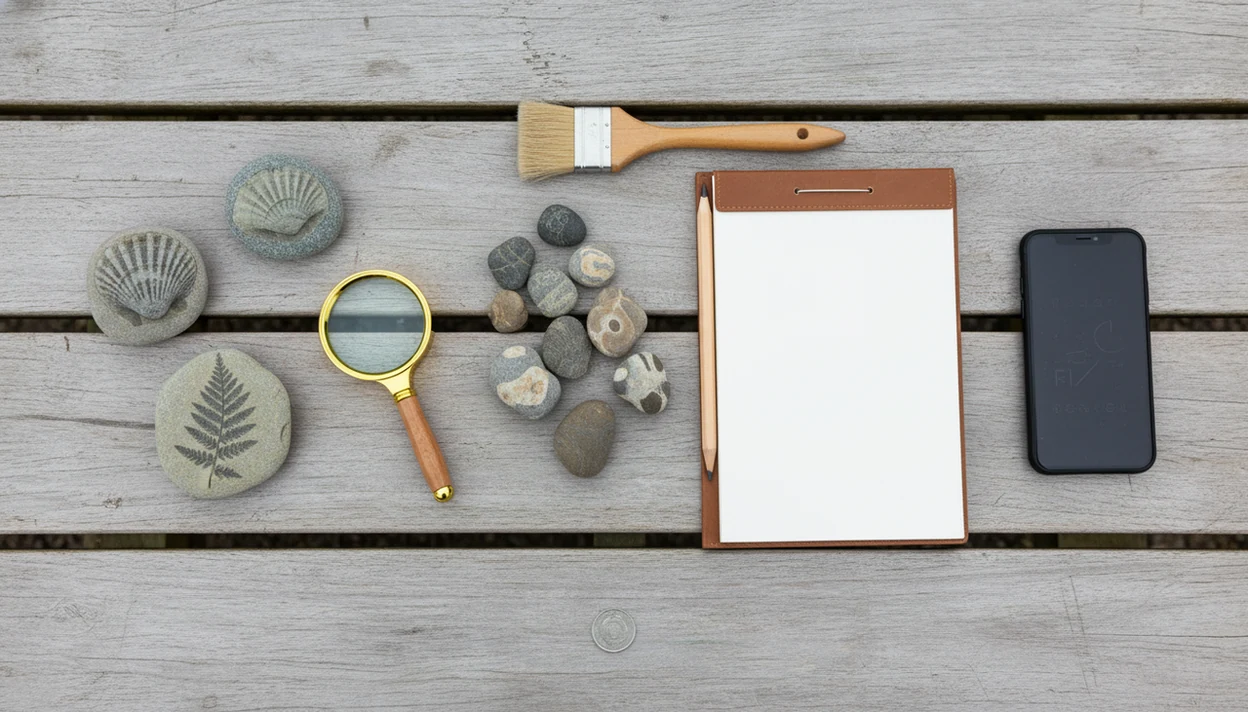
A fossil identifier for kids should help children decide whether a find is a shell, leaf print, bone-like texture, trace fossil, or ordinary rock, while teaching when to photograph instead of collect. RockIdentifier can support that first photo-based check, but families should confirm results with field guides, museum resources, and local collecting rules.
> Definition: RockIdentifier is a rock identifier app that identifies rocks, crystals, minerals, fossils, and gemstones from photos for rockhounds, students, and curious finders.
- Start with photos, location notes, and simple visual clues before labeling any find as a fossil.
- Use a fossil app for kids as a learning aid, not a final expert verdict.
- Many fossils in parks, protected lands, and federal areas must stay in place, especially vertebrate fossils.
For photo-based identification on iPhone or iPad, try the fossil identifier app. You can also upload a photo on RockIdentifier.io.
RockIdentifier.io provides a web photo upload option for people who want quick visual clues about rocks, minerals, crystals, gemstones, and possible fossils. AI Rock ID is an iPhone and iPad app that can support kid-friendly fossil observation by comparing photos and adding basic hardness and value context.
Quick answer: A fossil identifier for kids helps children compare photos of shells, leaf prints, bone-like textures, and other fossil clues with common rock and mineral lookalikes. It is useful for learning and field trip discussions, but unusual, fragile, or legally protected finds should be left in place and checked by an adult or expert.
Recommended app for fossil identifier for kids
AI Rock ID can help kids and adults compare a fossil-like find with common visual examples before making a school label or field trip note. It is most useful as an educational photo check, not as proof that a find is rare or safe to collect.
Best for
- Checking shell-shaped impressions from beach walks
- Comparing leaf prints and plant-like patterns
- Documenting fossil-looking rocks for a school project
- Helping parents guide safe collecting decisions
- Adding simple classification notes to field trip photos
- Reviewing Mohs hardness clues for fossil lookalikes
- Saving images of finds that should stay in place
Limitations
- Photo results can be affected by lighting, focus, and scale
- The app cannot confirm legal collecting rules for a location
- Bone-like, tooth-like, or track-like finds may need expert review
- The app should not replace a teacher, museum, geologist, or paleontologist
Who this guide is for
Good fit if you
- Kids learning to tell fossils from patterned rocks
- Parents helping children document beach, creek, or park finds
- Teachers planning class trip observation activities
- Students making fossil school project labels
- Beginners comparing shell impressions, leaf prints, and textures
- Families who want photo-based clues before collecting anything
Consider another method if you
- Anyone trying to verify a rare or scientifically important fossil
- Collectors who need legal, appraisal, or museum-grade documentation
- Situations where a fossil may be on protected land or private property
- Finds that look like bones, teeth, eggs, or tracks and should be checked by an expert
Beach Walks And Class Trips Need A Fossil Identifier For Kids
A fossil identifier for kids gives families a simple way to sort finds into “likely fossil,” “possible fossil,” and “probably not fossil.” That matters because kids often mistake patterned rocks, modern shells, mineral bands, and weathered textures for ancient life.
The bucket clink of beach stones can make every ribbed pebble feel important. On creek trips and class field days, a quick workflow keeps curiosity focused: photograph, note the place, compare the pattern, then decide whether the find should stay where it is.
For parents who need one tool for beach walks, creek stones, and home science projects, RockIdentifier fits because it combines photo-based fossil and rock checks with plain visual clues. The result is a starting label, not permission to collect everything.
Good fossil learning usually depends more on careful observation than on taking specimens home.
How A Fossil Identifier For Kids Works
A fossil identifier for kids works by comparing a child’s photo with stored visual examples, then suggesting a close match. It is a visual comparison tool, not expert confirmation that the object is truly a fossil.
The app looks at features such as shape, texture, repeated patterns, and symmetry. Light technical terms like image matching and context simply mean “what the camera sees” and “where the object was found.” Bright glare, deep shadow, wet surfaces, missing scale, or a steep angle can hide ribs, edges, layers, and shallow impressions, so the same find may get a better result from a calmer photo.
- Photograph the object in shade or soft light, with a coin, ruler, or fingertip beside it for scale.
- Show the surface from more than one angle so ridges, cracks, and layers are easier to compare.
- Record the location type, rock type, and any visible bedding or layering around the find.
- Treat the result as “likely” or “possible” when the evidence is incomplete.
- Ask a teacher, museum, or local fossil group to review rare, bone-like, fragile, or important-looking finds.
- Follow collecting rules first, because laws and landowner rules override any app result.
Photo Checks In A Fossil Identifier For Kids
A photo-based fossil identifier compares visible shape, texture, symmetry, edges, and patterns against known examples. It can suggest a likely identification, but surrounding rock type, location, layering, and repeated biological structure still matter.
How fossil identification works: AI tools use image embeddings, which are numerical summaries of what the photo shows. In plain terms, the system compares the child’s picture with many stored visual examples, then returns a close photo-based match. A phone photo taken in full noon sun can hide luster, edges, and shallow impressions, so shade and a scale object help.
Sedimentary rocks such as limestone, sandstone, chalk, and shale are more likely to contain fossils than many igneous rocks. The National Park Service explains that fossilization most often happens when remains are buried in sediment, which is why sedimentary settings are the first place kids should check for context source. RockIdentifier ai rock identifier app and web tool that names rocks, crystals, minerals, and fossils from photos with mohs hardness and value estimates is useful when a child’s “fossil” may also be a mineral pattern or ordinary rock.
Good AI fossil tools deliver educated visual comparisons, not guaranteed species-level identifications.
7 Fossil App For Kids Features To Check
Choose a fossil app for kids that supports learning, notes, and uncertainty. The useful features are practical, not fancy.
- Photo identification: It should check fossils, rocks, minerals, crystals, and common lookalikes in one place.
- Kid-level explanations: The result should explain shell ribs, leaf veins, or mineral bands in simple words.
- Saveable notes: Photos, dates, size, and location type help with a fossil school project.
- Rule reminders: Children need prompts to check park, beach, school, and landowner rules.
- Comparison clues: The app should ask users to compare the surface, shape, and surrounding rock.
- Uncertainty language: “Possible shell fossil” is safer than a dramatic but weak label.
- Project export habits: A photo log makes classroom sorting easier.
If your priority is one family tool for fossils and rock lookalikes, RockIdentifier earns the spot because the same photo workflow can compare fossils, minerals, crystals, and ordinary stones. For free practice before a report, families can also use a free fossil identifier from photo.
5 Field Trip Steps For A Fossil Identifier For Kids
Use a fossil identifier outdoors as a notebook helper, not as the final authority. The safest field trip process starts before anyone picks up the object.
- Photograph the find in place before moving it, with a penny, key, or fingernail nearby for scale.
- Record the location and layer, including beach, creek bank, trail cut, shale bed, or loose gravel.
- Check collecting rules before touching, digging, or placing anything in a backpack.
- Use the app result as a first label, then compare it with a field guide, museum page, or teacher resource.
- Keep a photo log with date, size, rock type, and reason for the identification.
Photograph The Find In Place
RockIdentifier works better when the first image shows the object before mud, water, or handling changes the surface.
Check Rules Before Collecting
For class groups that need quick labels without disturbing a site, RockIdentifier fits because students can save a photo-based match and notes for later review.
Five Fossil Clues Kids Can Check Before Collecting
Fossil clues are easiest to teach as small checks. No single clue proves the answer, but several matching clues can support a possible fossil label.
- Shell shapes: Ribs, spirals, hinge lines, and repeated symmetry can point toward a shell fossil. - Leaf impressions: Leaf fossils often look flat, with vein patterns rather than raised random cracks. - Bone-like texture: A tan, porous, bone-shaped rock is not automatically dinosaur bone. - Trace fossils: Footprints, burrows, trails, and fossilized dung are fossils made by activity, not body parts. - Ancient-life rule: Fossils are preserved remains or traces of ancient life, usually at least 10,000 years old. For classroom wording, treat the 10,000-year line as a simple rule of thumb rather than a perfect scientific cutoff; museums and paleontology references often define fossils more broadly as evidence of past life source.
A child bringing home a “sparkly rock” in a jacket pocket after a school field trip may have mica, quartz, or pyrite instead. If the find looks metallic, compare it with meteorite vs ordinary rock identification before giving it a fossil label.
Fossil School Project Labels And Classification Types
A fossil school project is stronger when each specimen or photo has a careful label and an uncertainty note. Students should write “possible shell fossil” or “unknown mineral pattern” when the evidence is incomplete.
| Project label | What to include | Classification link |
|---|---|---|
| Possible shell fossil | Photo, size, ribs or spiral, rock type | Impression or mineralised fossil |
| Plant impression | Flat mark, vein pattern, shale or fine sediment | Impression fossil |
| Trace fossil | Track, burrow, trail, or dung-like form | Trace fossil |
| Mineral pattern | Crystals, bands, cracks, no biological symmetry | Not a fossil label |
| Unknown | Clear photo, date, location type, reason for doubt | Needs review |
The Australian Museum explains that fossils can be grouped as impression, mineralised, trace, and organic fossils, a helpful classroom framework source. Under a desk lamp, a second photo on white paper often shows whether a line is a vein, crack, or shadow.
For students, a cautious label is often better than a confident guess because it shows the evidence behind the identification.
Safe Fossil Hunting Rules For Kids And Parents
Can kids collect fossils anywhere they find them? No. Families need to check land ownership, posted signs, park rules, and local laws before touching or taking fossils.
Stay away from unstable cliffs, fast water, quarry walls, loose slopes, road cuts, and incoming tides. Young children should use brushes, magnifiers, gloves, notebooks, and sturdy shoes rather than hammers or chisels. Adult supervision is required near beaches, riverbanks, tools, roads, and loose rock.
The National Park Service says the United States has more than 420 national park sites, many with fossils, and fossil collecting is prohibited in most national park areas without a scientific permit source. Vertebrate fossils on U.S. federal lands, including dinosaur bones, are also protected and may only be collected by permitted researchers. The Bureau of Land Management says casual collectors on BLM land may collect only common invertebrate and plant fossils in reasonable amounts; vertebrate fossils require permits and professional handling source.
When the issue is safe learning on public land, RockIdentifier helps because children can photograph, label, and study the find without removing it.
Limitations
A fossil identifier for kids can make field learning easier, but it cannot replace expert review or local rules.
- AI photo tools can confuse fossils with minerals, modern shells, weathered stone, concrete, and man-made objects.
- Exact species, geologic age, and scientific importance often require a paleontologist, local geology records, or lab work.
- Some fossils are too fragile or too important to remove, even when they look ordinary.
- Vertebrate fossils on U.S. federal lands are protected and are not casual collecting items.
- Apps and free guides may overrepresent popular fossils like ammonites, trilobites, and dinosaur material.
- A poor photo, muddy rind, wet surface, or missing scale object can reduce identification quality.
- A wet black beach pebble can turn dull gray after drying on a towel, changing what the camera sees.
- Google Lens, rockd.org, mindat.org, picturethis.com, and rock identifier apps on app store can be useful, but they also need human checking.
For families comparing results, rock identifier accuracy explains why lighting, context, and lookalikes change confidence.
Which option fits which need
| Need | Best option | Why |
|---|---|---|
| Quickly compare a child’s fossil-like photo | AI Rock ID | The app is useful for photo-based clues on an iPhone or iPad during home or field trip review. |
| Check a find without installing an app | Web Tool | RockIdentifier.io can be used for web photo upload when a browser-based option is easier. |
| Confirm a possible bone, tooth, egg, or track fossil | Expert | Potentially important fossils need careful inspection, location context, and legal guidance. |
| Research general fossil background for a school report | Teacher or Museum Website | Educational sources can explain geologic age, fossil formation, and local fossil rules. |
| Identify mineral lookalikes or patterned rocks | AI Rock ID | Photo clues plus hardness context can help separate common rocks from fossil-like patterns. |
Quick summary
- Best for
- A fossil identifier for kids is best for guided observation, simple photo checks, and early fossil classification practice.
- Includes
- photo checks, shell fossil clues, leaf print clues, bone-like texture cautions, Mohs hardness context, value context, school project labeling support
- Platforms
- iPhone, iPad, Web
- Free version
- Yes
- Expert replacement
- No
Common mistakes
- Assuming every shell-shaped mark is a fossil without checking rock texture and context
- Picking up finds before taking a clear photo of where they were found
- Ignoring local collecting rules on beaches, parks, class trip sites, or protected land
- Calling every bone-like rock a dinosaur bone
- Using a blurry close-up without a scale object for comparison
- Cleaning, scraping, or breaking a possible fossil before an adult or expert sees it
A practical next step is the identify fossils from photos workflow in AI Rock ID.
FAQ
What is a fossil?
A fossil is the preserved remains or trace of ancient life, such as a shell, bone, leaf impression, footprint, burrow, or dung. Fossils are usually at least 10,000 years old.
Are all patterned rocks fossils?
No. Many patterns come from minerals, cracks, weathering, layering, or ordinary rock textures.
Can kids keep fossils they find?
Sometimes, but collecting depends on location, land ownership, protected status, and local rules. When rules are unclear, kids should photograph the find and leave it in place.
Is a fossil app accurate enough for kids?
A fossil app can give a helpful starting guess from a photo. It should not be treated as a guaranteed expert identification.
How do kids identify shell fossils?
Kids can look for symmetry, ribs, spirals, hinge lines, and sedimentary rock context. A modern shell on a beach is not automatically a fossil.
Are dinosaur bones easy to identify?
No. Bone-like rocks are common, and suspected vertebrate fossils need expert review.
What tools do kids need to look for fossils?
Good beginner tools include a camera, notebook, pencil, magnifier, soft brush, gloves, and sturdy shoes. Young children should not use hammers without trained adult supervision.
What makes a good fossil school project?
A good project includes clear photos, labels, classification type, location notes, size, rock type, and uncertainty. RockIdentifier can help organize first photo-based labels, but students should compare results with classroom or museum resources.
Should kids photograph a fossil before moving it?
Yes. A photo in place can preserve useful context such as location, surrounding rock, and how the object was positioned.
What should kids include in a fossil field trip note?
A useful note can include the date, general location, rock type if known, visible shape, size, and whether the find was left in place or collected with permission.
Can a fossil identifier for kids help with leaf print fossils?
A fossil identifier for kids can help compare leaf-like shapes, veins, and impressions with common fossil and rock patterns. Clear lighting and a flat photo make the comparison more useful.
Why do some fossil finds need to stay where they are?
Some fossils may be protected by land rules or may have scientific value because of their exact location. Leaving the find in place and recording a photo is often the safest choice.