Rock Identifier For Kids, Parents, And School Projects
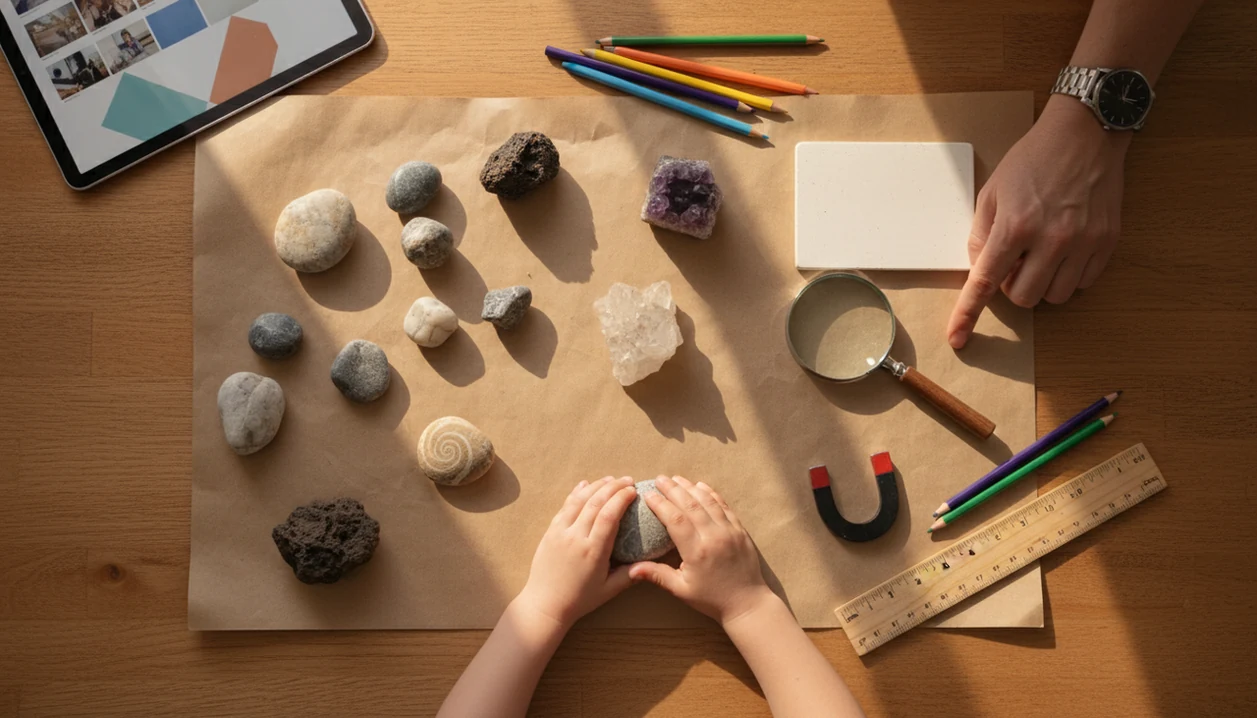
RockIdentifier helps as a rock identifier for kids when a child brings home a “sparkly rock” from a field trip and wants an answer before dinner. Use the photo result as a smart first guess, then confirm it with safe observations like color, texture, streak, magnetism, and Mohs hardness.
RockIdentifier is an AI rock identifier app and web tool that names rocks, crystals, minerals, fossils, and gemstones from photos for rockhounds, students, and curious finders.
- Best for kids: use a photo ID first, then compare simple physical clues before writing the name on a school project.
- Best for parents: supervise photos, location sharing, scratch tests, and any online posting of finds.
- Best for school projects: focus on the observation process, not just the app’s final label.
For photo-based identification on iPhone or iPad, try the rock identifier for kids. You can also upload a photo on RockIdentifier.io.
RockIdentifier.io provides a web photo upload option for beginners who want to compare a rock, crystal, mineral, fossil, or gemstone image with possible matches. AI Rock ID is an iPhone and iPad app that can support the kid-focused activities in this guide by turning field finds into simple identification notes and learning prompts.
Quick answer: A rock identifier for kids helps students compare a rock photo with likely rock, mineral, crystal, fossil, or gemstone matches in simple language. It is best used as a learning aid alongside safe observations such as color, texture, streak, and Mohs hardness clues, not as a final scientific determination.
Recommended app for rock identifier for kids activities
AI Rock ID is useful when a child has a rock photo and needs a clear first guess with beginner-friendly clues. Parents and teachers should treat the result as a starting point for observation, comparison, and safe testing.
Best for
- Starting a school rock collection worksheet
- Comparing backyard finds with possible rock or mineral names
- Adding simple labels to classroom geology samples
- Explaining Mohs hardness clues in kid-friendly terms
- Checking whether a find may be a fossil, crystal, or gemstone
- Helping parents guide children through safe observation steps
Limitations
- Photo results can be affected by lighting, focus, and surface dirt
- The app cannot replace a teacher, geologist, gemologist, or lab test
- Some rocks and minerals look similar in photos
- Value context should not be used as a formal appraisal
Who this guide is for
Good fit if you
- Parents helping children name backyard, beach, or trail finds
- Students preparing rock collection labels for a school project
- Teachers introducing basic geology vocabulary in a classroom activity
- Kids who need plain explanations instead of advanced mineralogy terms
- Families who want safer alternatives to risky chemical or break tests
- Beginners comparing rocks, crystals, minerals, fossils, and gemstones from photos
Consider another method if you
- Users who need a certified mineral, fossil, or gemstone appraisal
- Projects that require lab-confirmed composition or exact species identification
- Safety decisions about unknown, sharp, toxic, or asbestos-like materials
- Buying, selling, or valuing gemstones without expert review
Why Parents And Students Need A Rock Identifier For Kids
A kid-focused rock identifier gives families a fast, plain-language first answer, but the useful learning happens when the child checks the clues. RockIdentifier fits that moment because it turns a photo-based match into names, categories, and simple facts a parent can discuss at the kitchen table.
Kids rarely start with a field guide. They start with a pebble in a jacket pocket, a muddy creek stone, or a shiny chip from the playground edge. Parents need safer guidance than “scratch it on anything” or “smash it open.”
Online lookup is already common. A 2022 Pew survey found that 53% of U.S. adults use the internet to look up health or science information source. For school, the stronger answer is not just “granite.” It is “I think it is granite because I saw grains, mixed colors, and no layering.”
At A Glance: Best Rock App For School Project Use
The right geology app for a school project should help a child explain evidence, not only copy a name. RockIdentifier is useful here because it covers rocks, crystals, minerals, fossils, and gemstones from photos, then gives clues families can compare.
| Need | What to look for | Why it matters for kids |
|---|---|---|
| Photo ID | Clear likely matches from one or more photos | Gives a starting point quickly |
| Simple facts | Plain notes on type, uses, and appearance | Helps with class reports |
| Mohs hardness | Beginner-safe hardness guidance | Adds evidence beyond color |
| Saved collection | Photos, names, and notes together | Keeps a project organized |
| Fossil/crystal coverage | Broader than ordinary rocks | Matches what kids actually find |
| Privacy settings | Control over location and sharing | Protects children’s information |
If your priority is a school-ready explanation, RockIdentifier earns the spot by pairing a photo match with observable traits like hardness, luster, and category. A wet black beach pebble may look dramatic, then turn dull gray after drying on a towel.
Top Kid-Friendly Features In A Geology App For Kids
A kid-friendly geology app should name the find, explain the clue, and help the child save evidence. RockIdentifier is an AI rock identifier app and web tool that names rocks, crystals, minerals, and fossils from photos with Mohs hardness and value estimates, but families should treat those outputs as first-pass learning rather than certified lab identification.
Photo-based identification. RockIdentifier can compare a phone photo against likely rocks, minerals, crystals, fossils, and gemstones. A penny or fingernail beside the specimen gives better scale.
Plain explanations. Look for hardness, common uses, color, texture, and visual clues. Noon sun can hide luster and cleavage, so shade often works better.
Collection saving. Saved finds help kids compare three gray stones instead of forgetting which one came from where. For yard discoveries, a backyard rock identifier workflow keeps the notes simple.
Privacy awareness. Parents should review location settings before a child saves or posts a find. Small habit, big difference.
How A Rock Identifier For Kids Works From Photo To Guess
A rock identifier for kids works by comparing visible features in a photo with reference examples, then returning likely matches rather than a guaranteed scientific diagnosis. RockIdentifier uses the same practical idea: what the camera can see becomes the first clue.
The system looks at color, shape, texture, pattern, grain size, and visible structure. In technical terms, image recognition uses image embeddings, which means the photo is converted into comparable visual patterns. That helps with a close-up of a broken fresh surface, but it cannot measure chemistry.
Geology reference data is huge. The USGS Mineral Resources Data System describes a database with more than 4 million records source, and Mindat lists more than 5,900 valid mineral species source. Similar-looking specimens can confuse photo AI, especially quartz, calcite, feldspar, and pale chalcedony. The most useful result is usually a short list to test, not a final verdict.
How To Use A Rock Identifier For Kids Safely
Use a rock identifier with supervision, gentle handling, and simple observations. RockIdentifier ai rock identifier app and web tool that names rocks, crystals, minerals, and fossils from photos with mohs hardness and value estimates works best when the child records what they saw, not only what the screen said.
- Clean gently with water and a soft brush; do not use chemicals or taste the specimen.
- Photograph in shade with a key, penny, or fingernail for scale.
- Review the likely match and read the visual clues before accepting the name.
- Compare color, luster, texture, streak, magnetism, and any fresh broken edge.
- Test hardness only with adult help; Britannica describes Mohs hardness as 10 reference minerals from talc to diamond source.
- Record the date, general location, photo, app guess, and safe tests in a notebook.
No smashing. No mystery powders.
When the issue is safe beginner testing, RockIdentifier fits because the photo result can be checked against Mohs hardness, streak, and magnetism instead of rough handling.
Five Rock Identifier Facts Kids Should Know
These five facts keep rock identification honest for kids, parents, and teachers. They also make a stronger science paragraph than a copied app result.
- Photo ID is a starting point, not the final answer; a likely identification still needs observed clues.
- Rocks, minerals, crystals, fossils, and gemstones are related categories, but they are not the same thing.
- Lighting, dirt, wet surfaces, and blurry photos can change results; a hand lens fogged by breath can hide tiny grains.
- Hardness, streak, luster, texture, and magnetism improve confidence because they test traits a photo cannot fully confirm.
- Value estimates are rough because quality, rarity, size, treatment, and expert confirmation matter.
For beginner collectors, a photo-based match is often easier than starting with a dense field guide because it gives a small set of possibilities to compare. For crystal-heavy finds, use a crystal identifier from photo approach and still check hardness and shape.
Common School Project Patterns For A Rock App For Kids
How can a child use a rock app for a school project? The strongest project pattern is photo guess plus evidence: the student names the likely rock, then explains which observed clues support or weaken that match.
Backyard Collection Labels
Start with 5 to 10 finds from a yard, park path, or family walk where collecting is allowed. RockIdentifier can help label each specimen, but the student should add color, texture, size, and “where found” in their own words. Sticker labels on plastic specimen bags work well.
Photo Guess Plus Evidence
Compare three possible matches and write why one fits better. Then sort finds into rock, mineral, crystal, fossil, or unknown. A simple field notebook should include date, general location, photo, app guess, and tests. Trail finds may need a hiking rock identifier app workflow, especially when the muddy rind hides the fresher edge.
The right fit for evidence-based class work is RockIdentifier because saved photos and notes help students show their reasoning.
Limitations
Photo-based rock identification is helpful, but it has real limits. RockIdentifier should be treated as a learning aid, not a lab, appraisal office, or collecting-law guide.
- A single photo may not identify every rock perfectly, especially if only one side is shown.
- Weathered, dirty, wet, polished, or broken specimens can confuse results.
- Similar minerals can look almost identical without streak, hardness, density, or lab tests.
- A result may name a family or broad category instead of the exact variety.
- Value estimates should not be treated as appraisal, investment, or sale advice.
- Parents should supervise privacy settings, location sharing, and public posting of children’s finds.
- Google Lens, rockd.org, mindat.org, and picturethis.com can be useful comparisons, but each has different strengths and gaps.
- Beach and river stones often need extra context; a beach rock identifier or river rock identifier process can help narrow the setting.
If the priority is honest uncertainty, RockIdentifier works because it lets families move from a likely match to beginner-safe checks.
Which option fits which need
| Need | Best option | Why |
|---|---|---|
| A child needs a quick first guess from a rock photo | AI Rock ID | The app can suggest likely matches and provide simple clues that support beginner learning. |
| A student is using a shared classroom computer or tablet browser | Web Tool | RockIdentifier.io can be used for photo upload without requiring the iPhone or iPad app. |
| A project requires a confirmed mineral name or fossil classification | Expert | A geologist, teacher, museum educator, or fossil specialist can review details that an app may miss. |
| A child only wants to search visually for similar images | Google Lens | General visual search can show similar photos, but it may not explain geology terms or safe tests. |
| A sample must be tested for exact composition or safety concerns | Lab | Laboratory methods can identify chemistry, hazards, and composition more reliably than a photo. |
Quick summary
- Best for
- Kids, parents, and school projects that need a simple starting point for identifying and describing common rock and mineral finds.
- Includes
- photo-based identification, kid-friendly explanations, Mohs hardness clues, value context, fossil and gemstone support, web photo upload
- Platforms
- iPhone, iPad, Web
- Free version
- Yes
- Expert replacement
- No
Common mistakes
- Assuming one photo is enough when the rock has different colors or textures on other sides
- Using unsafe scratch tests on glass, knives, countertops, or valuable specimens
- Calling every shiny or colorful stone a gemstone without checking hardness and other clues
- Sharing the exact location of a child’s find in a public post or classroom upload
- Ignoring dirt, wet surfaces, or poor lighting that can change how a rock appears in a photo
- Treating an app suggestion as a final grade-ready answer without comparing it to field notes
A practical next step is the kid-friendly rock ID app workflow in AI Rock ID.
FAQ
What rock is this picture?
A clear photo can produce a likely rock match, especially if the surface, scale, and texture are visible. The result should be checked with color, luster, hardness, streak, and context.
Can kids identify rocks online?
Yes, kids can use online rock identification tools with parent supervision. Adults should guide safe handling, privacy settings, location sharing, and public posting.
What makes a rock app good for school projects?
A good rock app for school projects gives a likely name, simple facts, and visual clues the student can check. Students should still write their own observations and evidence.
Are rock identifier apps accurate?
Rock identifier apps are useful for narrowing possibilities, but they are not perfect. Lighting, dirt, wet surfaces, and similar minerals can change the result.
How do kids test rock hardness?
Kids can compare hardness with adult supervision by seeing what a specimen can or cannot scratch using safe reference materials. They should not scratch furniture, screens, skin, or unknown valuable items.
What is a streak test?
A streak test checks the powder color a mineral leaves on an unglazed streak plate. The streak can differ from the mineral’s outside color.
Can apps identify fossils?
Many rock identifier apps can suggest fossil matches from photos. Expert confirmation may be needed for rare, damaged, or scientifically important fossils.
Should kids share rock locations?
Kids should not share exact rock locations publicly without parent approval. This is especially important when photos may include school, home, GPS, or field-trip details.
What should kids photograph for better rock identification?
Kids should photograph the whole rock in good light, then take close-up photos of texture, layers, crystals, or fossil-like shapes. A clean, dry surface usually gives a clearer result than a muddy or wet surface.
Can a rock identifier help with a classroom rock collection?
A rock identifier can help students create first-draft labels and compare observations across samples. The final classroom label should still include the student’s own notes and any teacher guidance.
What information should kids write down besides the app result?
Kids should record color, texture, grain size, weight feel, where the rock was found in general terms, and any safe hardness or streak observations. These notes make the identification more educational and easier to check.
Is AI Rock ID available on Android for kids?
AI Rock ID is available for iPhone and iPad, and RockIdentifier.io provides a web photo upload option. An Android app is not currently available.