Safe At Home Mineral Tests To Check AI Rock Results
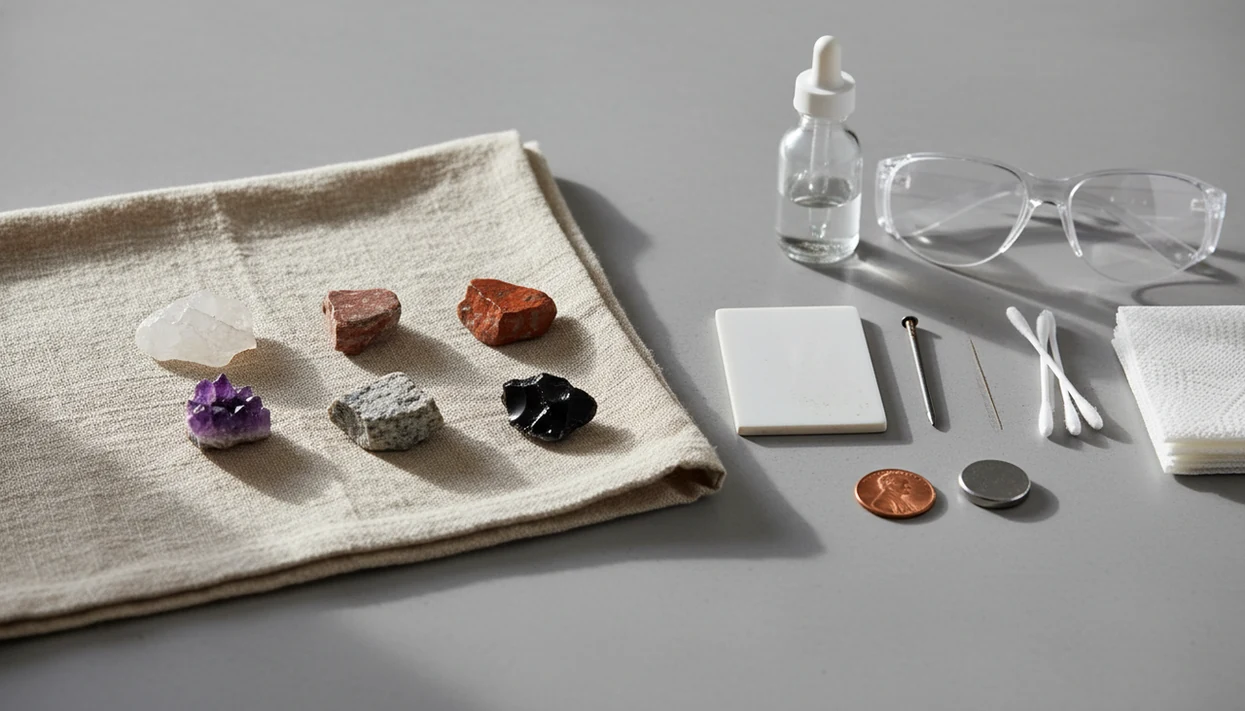
Safe at home mineral tests are low-risk checks you can use to support an AI rock ID result, including clear photos, streak, magnetism, heft, simple hardness comparisons, and cautious vinegar testing on tiny spots. Avoid tasting, heating, grinding, harsh acids, and any test that creates dust, fumes, sharp fragments, or unnecessary specimen damage.
> Definition: Safe at-home mineral testing means using beginner-friendly observations and low-risk tools to identify rocks, crystals, and minerals while avoiding unsafe chemicals, dust, heat, and destructive methods.
- Use several clues together: photos, color, luster, streak, hardness, magnetism, heft, cleavage, and reaction to mild vinegar only when appropriate.
- Do not taste, burn, crush, sand, or acid-test unknown minerals with strong chemicals at home.
- AI rock identification can narrow the possibilities, but physical tests and expert confirmation are still important for look-alikes, rare finds, and potentially valuable specimens.
For photo-based identification on iPhone or iPad, try the mineral identifier app. You can also upload a photo on RockIdentifier.io.
RockIdentifier.io lets users upload rock, crystal, mineral, fossil, or gemstone photos on the web and compare the result with safe at home mineral tests. AI Rock ID is an iPhone and iPad app that can help organize photo-based identification clues before a user decides whether additional testing or expert review is needed.
Quick answer: Safe at home mineral tests help check AI rock results by adding simple clues such as streak, magnetism, heft, glass scratch behavior, and cautious vinegar reaction observations. These tests should be low risk, non-destructive when possible, and stopped if the mineral is unknown, fragile, valuable, dusty, or potentially hazardous.
Recommended app for safe at home mineral tests
AI Rock ID is useful when a photo result needs supporting clues from simple mineral testing at home. The app can help compare appearance-based identification with observations such as streak, magnetism, heft, and hardness clues.
Best for
- Checking whether a photo-based ID matches safe physical clues
- Recording multiple photos before doing any streak or scratch test
- Comparing similar-looking minerals that differ in magnetism or hardness
- Adding Mohs hardness clues to an identification workflow
- Keeping notes on mild vinegar reactions without relying on them alone
- Reviewing whether a specimen should be left untested and shown to an expert
Limitations
- Photo identification cannot confirm every mineral species or variety
- The app cannot replace laboratory testing for hazardous or high-value specimens
- Home tests can damage specimens if used on polished, rare, or fragile material
- Vinegar, streak, and scratch clues may be inconclusive for many minerals
Who this guide is for
Good fit if you
- Beginners who want low-risk ways to check a photo-based mineral identification
- Rock, crystal, fossil, or gemstone collectors sorting common finds at home
- Students learning how visual clues connect with basic mineral properties
- Users who want to compare AI results with simple observations before asking an expert
- Collectors who need reminders about tests that should be avoided on unknown minerals
- Anyone documenting streak, magnetism, heft, and scratch clues alongside photos
Consider another method if you
- People handling suspected asbestos, radioactive minerals, mercury minerals, or toxic ore without expert guidance
- Anyone trying to identify a valuable gemstone with destructive testing
- Users who need a certified appraisal, legal identification, or laboratory report
- Collectors testing fragile, historic, polished, or sentimental specimens
- People considering taste, flame, acid, or powder tests on unknown minerals
Safe At Home Mineral Tests At A Glance
The safest beginner mineral checks are photo review, visual inspection, streak, magnetism, heft, cautious hardness comparisons, cleavage, and mild vinegar on a tiny hidden spot. These tests help identify rocks and minerals; they do not diagnose human mineral deficiencies, prove rarity, or guarantee market value.
Use the clues together. A wet black beach pebble can turn dull gray after it dries on a towel, which changes the photo result and the first guess. Color alone is a weak clue.
A low-risk sequence is simple: photograph the specimen, compare the surface, check the streak, try a small magnet, note heft, and test hardness with a penny or steel nail. A glass scratch test can help, but it can damage glass and the specimen. Tools like RockIdentifier can be a photo-based starting point, not a final laboratory verdict.
How Safe Rock Tests Work With AI Photo Results
Safe rock tests work by adding physical evidence to a photo-based match. Image tools compare visible traits such as color, texture, crystal habit, luster, surface pattern, and shape; home tests add clues the camera cannot measure.
Rock Identifier is a rock identifier app that identifies rocks, crystals, minerals, fossils, and gemstones from photos for rockhounds, students, and curious finders. Photo AI uses pattern matching, often through image embeddings, which means the software compares visual features against learned examples. It is useful, but probabilistic.
A phone photo taken in full noon sun can hide luster and cleavage under glare. Wet surfaces, weathered rinds, shadows, missing scale, and similar-looking minerals can also bend the result. Streak color, scratch resistance, magnetism, density impression, and acid reaction give the ID more footing.
For beginners, physical tests are often more useful than another photo because they reveal properties the camera cannot see.
Five Facts About Mineral Testing At Home
- Home mineral tests support identification, but they do not prove rarity, value, authenticity, or treatment history.
- The safest tests are visual inspection, streak, hardness, magnetism, cleavage, and cautious mild acid reaction only when the specimen is suitable.
- Taste, heat, crushing, sanding, drilling, and harsh-acid tests are poor choices for unknown minerals because they can create exposure risks.
- No single home test identifies every mineral; the International Mineralogical Association recognizes more than 5,900 valid mineral species, so overlap is normal: https://mineralogy-ima.org/Minlist.htm.
- AI rock ID can narrow possibilities, but physical tests and expert confirmation improve confidence, especially for lookalikes and valuable-looking finds.
The pocket check is real.
A child may bring home a “sparkly rock” after a school field trip. Start with photos, scale, and a clean surface before reaching for any test tool. If the specimen is powdery, fibrous, or crumbly, stop.
Beginner Safe Rock Tests And What Each Result Means
Beginner tests are safest when they answer one question at a time. Streak often beats outer color because it reveals the mineral’s powder color.
| Test | Simple tool | What to observe | Safety note | Best use |
|---|---|---|---|---|
| Photo check | Phone, indirect light, coin | Color, habit, luster, texture, scale | Avoid glare and wet-only photos | First-pass comparison |
| Streak plate | Unglazed porcelain | Powder color | Skip fragile or valuable pieces | Metallic minerals and lookalikes |
| Magnet | Small magnet | Attraction strength | Do not force loose grains | Magnetite clues |
| Heft | Hand, similar-size rock | Heavy or light feel | Wash hands after handling | Density impression |
| Penny or steel nail hardness | Copper penny, nail | What scratches what | Test a hidden spot | Mohs comparison |
| Glass scratch caution | Scrap glass, eye protection | Whether it scratches glass | Risk of chips and damage | Hardness clue only |
| Cleavage or fracture | Hand lens | Flat planes or irregular break | Do not break specimens | Crystal structure clue |
| Mild vinegar caution | Household vinegar | Fizzing on tiny spot | Avoid unknown powders | Carbonate clue |
Mohs compares scratch resistance, not toughness or value. See cleavage and fracture for fracture examples.
Mineral Testing At Home Supplies That Stay Low Risk
A safe kit is small and boring on purpose. Use a phone camera, bright indirect light, white paper, a ruler or coin for scale, an unglazed porcelain streak plate, a small magnet, a copper penny, a steel nail, eye protection, and mild household vinegar.
Phone and scale cue: Place a penny, key, or ruler beside the specimen so size does not become a guess.
Streak and hardness tools: A streak plate, penny, and nail cover many beginner checks. The full streak test for minerals is worth learning before rubbing a specimen hard.
Magnet and heft check: A small magnet and careful hand comparison can flag dense or magnetic possibilities. Notes on specific gravity and heft help keep that clue grounded.
Gloves are fine for cleanliness, but they do not make unsafe tests safe. Skip blowtorches, strong acids, grinders, rotary tools, and mystery chemical kits.
Safe Rock Tests To Avoid For Unknown Minerals
“Which rock tests should I avoid at home?” Avoid tasting, licking, smelling powders, heating, burning, crushing, sanding, drilling, and strong-acid reactions on unknown minerals.
These methods can create toxic dust, fumes, sharp chips, acid burns, contaminated work surfaces, and ruined specimens. Some minerals contain hazardous elements. Others occur in fibrous, powdery, or crumbly forms that should not be disturbed in a kitchen, classroom, or garage.
For dust risk, NIOSH warns that respirable crystalline silica can cause serious lung disease when rock or mineral material is cut, ground, drilled, or crushed: https://www.cdc.gov/niosh/silica/about/index.html.
Old field guides and online folklore sometimes mention taste, flame, or aggressive acid tests. That does not make them good beginner tests. A vinegar fizz on a limestone chip is one thing; a strong acid bottle on an unknown metallic mineral is another.
The safest answer is restraint. If the test needs heat, dust, fumes, or force, leave it out of home mineral testing.
Common Myths About Safe At Home Mineral Tests
Scratching glass does not prove a mineral is valuable. It only suggests the specimen is harder than common glass, and many ordinary minerals can do that.
Gloves do not make every test safe. They reduce grime on your skin, but they do not stop airborne dust, sharp fragments, fumes, or specimen damage. Eye protection and restraint matter more.
One photo or one test cannot identify every mineral. A vendor tray of mixed crystals can include dyed, coated, natural, and mislabeled pieces that look convincing under bright lights. The better habit is to compare luster, streak, hardness, magnetism, heft, and context.
Rock mineral testing is also not medical testing. It cannot check iron levels, vitamin status, or any human deficiency. Mineral identification usually works best when several physical clues agree, while medical mineral testing belongs with clinicians and lab-based health tests.
When Mineral Testing At Home Should Stop
Stop testing when a specimen is fibrous, powdery, crumbly, unusually heavy, metallic and unknown, sharp, iridescent with an unknown coating, or collected from a contaminated site. Also stop if the sample may be radioactive, industrial waste, or coated with residue you cannot identify.
Destructive tests should also stop on collectible, rare, fossil-bearing, or sentimental pieces. A grandparent’s jar of creek stones may not be financially valuable, but a scratch across the nicest surface is still permanent.
For uncertain or high-stakes specimens, ask a local rock club, mineral society, university geology department, museum, or certified lab. Value estimates depend on rarity, quality, provenance, size, condition, and demand, not just the name. RockIdentifier can help you compare a photo result with Mohs hardness and rough value estimates, but it is not certification, appraisal, or collecting permission.
Sources And Safety References For At-Home Mineral Testing
Use authoritative sources to shape safe habits, not to certify a specimen from the kitchen table. The International Mineralogical Association is the naming authority to check whether a mineral name is accepted, while NIOSH or OSHA guidance is the better reference when a test could make dust.
A practical source check looks like this:
- Start with the IMA list when a name seems unusual, misspelled, commercial, or too good to be true.
- Compare hardness language with USGS or university geology material, because Mohs is scratch resistance, not toughness, price, or purity.
- Treat cutting, grinding, sanding, drilling, and crushing as exposure issues, not identification shortcuts, and check NIOSH or OSHA dust guidance before assuming a mask makes it safe.
- Call poison control or follow local public-health advice if an unknown powder, residue, coating, or chemical touches skin, gets inhaled, or may have been swallowed.
- Remember that these references support safer decisions and better questions; they do not provide lab chemistry, appraisal, provenance, or legal collecting approval.
Limitations
Safe at-home mineral tests are useful, but they cannot reliably identify every specimen. They work best as a careful filter before expert help, not as a final verdict.
- Look-alike minerals can share color, luster, hardness, streak, magnetism, or crystal shape.
- Weathering, coatings, polish, dirt, and broken surfaces can distort the result.
- A muddy rind on a creek stone may hide the fresher broken edge that matters for identification.
- Hardness tests and acid tests can damage specimens, even when done carefully.
- Mild vinegar does not replace proper acid testing and may show weak or no reaction on some carbonates.
- AI photo identification is probabilistic and can be wrong when photos are blurry, wet, shadowed, altered, or taken without scale.
- Home testing cannot confirm exact chemical composition, market value, treatment history, authenticity, or legal collecting status.
- Apps such as RockIdentifier, Google Lens, and other rock identifier apps should be checked against physical clues and expert sources.
If a result feels too good, slow down.
Which option fits which need
| Need | Best option | Why |
|---|---|---|
| Quickly check a common rock or mineral from photos | AI Rock ID | Photo-based identification can provide a starting point before safe at home mineral tests are used. |
| Identify a specimen without installing an app | Web Tool | RockIdentifier.io supports web photo upload for users who prefer a browser workflow. |
| Confirm a valuable gemstone or appraisal question | Expert | A qualified gemologist or mineral expert can use proper instruments and provide professional judgment. |
| Test suspected hazardous minerals | Expert | Unknown toxic, fibrous, radioactive, or dusty minerals should not be scratched, powdered, tasted, or acid-tested at home. |
| Confirm exact chemistry or mineral species | Lab | Laboratory methods can identify composition and structure beyond what photos and home tests can show. |
Quick summary
- Best for
- This page is best for using safe at home mineral tests to add evidence to AI rock identification results.
- Includes
- photo review, streak clues, magnetism checks, heft observations, glass scratch cautions, mild vinegar cautions, unsafe test warnings
- Platforms
- iPhone, iPad, Web
- Free version
- Yes
- Expert replacement
- No
Common mistakes
- Using a scratch test on a polished, rare, or fragile specimen before taking clear photos
- Assuming a vinegar fizz proves the entire rock is one mineral
- Tasting an unknown mineral instead of using safer observation-based tests
- Grinding or powdering a specimen and creating avoidable dust exposure
- Treating magnetism as a complete identification rather than one clue
- Ignoring safety stops when a specimen may be toxic, fibrous, radioactive, or unusually valuable
A practical next step is the identify minerals from photos workflow in AI Rock ID.
FAQ
What mineral tests are safe?
Safe mineral tests include clear photos, visual inspection, streak, magnetism, heft, penny or nail hardness, cleavage observation, and mild vinegar on a tiny suitable spot. Avoid any test that creates dust, fumes, heat, sharp chips, or strong acid exposure.
Can I test minerals at home?
Yes, you can test minerals at home for identification clues, but the results are not definitive. Home tests should be combined with photos, context, and expert confirmation for unusual, valuable, or uncertain specimens.
Is the streak test safe?
The streak test is usually low risk when done gently on a stable specimen and an unglazed porcelain plate. Do not streak fragile, powdery, fibrous, rare, or valuable-looking specimens.
Can rocks scratch glass safely?
A rock can scratch glass, but the test can chip glass, damage the specimen, and should use eye protection. Scratching glass only shows a hardness clue; it does not prove value or identity.
Should I taste a mineral?
No, do not taste or lick unknown minerals. Some minerals may contain hazardous elements, coatings, salts, dust, or contaminants.
Does vinegar identify minerals?
Vinegar can suggest carbonate minerals if a tiny spot fizzes, especially on fresh surfaces. It is not a universal test and weak reactions do not rule minerals in or out.
What does magnetism show?
Magnetism can suggest minerals such as magnetite or magnetic iron-rich material. It is only one clue and cannot identify a specimen by itself.
Are mineral tests medical tests?
No, rock and mineral identification tests are not medical mineral or vitamin deficiency tests. Health-related mineral testing should be handled through clinicians and appropriate labs.
Can AI identify minerals?
AI can narrow mineral possibilities from photos, especially when images show scale, fresh surfaces, and good lighting. RockIdentifier results should still be checked with streak, hardness, magnetism, heft, context, or expert review.
Should I photograph a mineral before doing any home test?
Yes. Clear photos should be taken before streak, scratch, vinegar, or other tests because some tests can mark or change the specimen.
What should I do if a home test gives mixed results?
Mixed results are common because rocks can contain more than one mineral. Record each clue and treat the identification as uncertain until an expert or lab can review it.
Are safe at home mineral tests destructive?
Some tests can be destructive even when they are simple. Streak and scratch tests can leave marks, so they should be avoided on valuable, polished, fragile, or sentimental specimens.
When should gloves or eye protection be used for mineral testing at home?
Gloves and eye protection are sensible when handling rough, sharp, dusty, or unknown specimens. Testing should stop if the mineral may release dust, fibers, fumes, or other hazards.