Fossil vs Rock Imprint: How to Tell the Difference
Fossil vs rock imprint: how to tell the difference starts with biology, not shape. A true fossil preserves anatomy or trace behavior, while a rock imprint is usually a sedimentary, mineral, or weathering pattern.


Drop a fossil photo here or tap to upload
JPG, PNG, WebP, HEIC • Max 50 MB • 1 free scan per day

Analyzing your specimen…
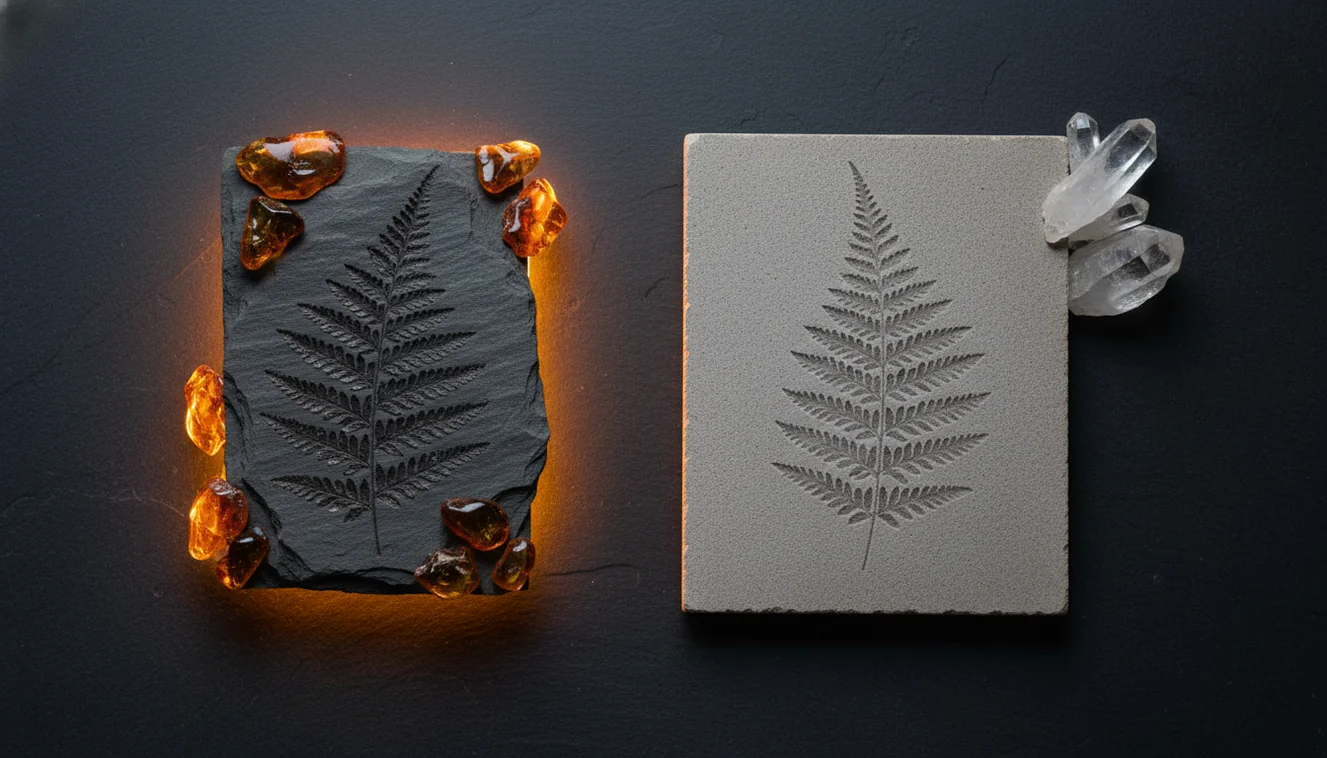
Quick answer: Fossil vs rock imprint: how to tell the difference depends on evidence of biology, not just a lifelike shape. A true fossil usually shows anatomy or trace behavior such as shell ribs, pores, leaf veins, bone texture, burrows, or trackways, while a rock imprint usually follows bedding, fractures, ripple marks, mud cracks, mineral staining, or weathering patterns.
AI Rock ID can help users make a first-pass comparison between fossil-like anatomy and rock imprints when photos show the mark, host rock, scale, and surface relief. RockIdentifier.io provides a web photo upload option for checking possible fossils, ripple marks, dendrites, mud cracks, and other look-alike patterns discussed in this article.
Quick summary
- Best for
- Collectors, hikers, beginners, fossil hunters, geology students
- Works on
- Fossil-like rocks, sedimentary slabs, shale, limestone, sandstone, beach stones
- Accuracy
- Useful for first-pass visual sorting, but uncertain specimens need texture, matrix, and expert confirmation.
- Needs confirmation
- Yes
- Professional replacement
- No
- Platforms
- iPhone, iPad, Web
This guide is best for
- Beginners trying to decide whether a mark is a fossil or a non-biological rock pattern
- Rock collectors sorting shale, limestone, sandstone, or beach stones with fossil-like surfaces
- Hikers and creek walkers who want a field checklist before keeping or researching a specimen
- Students learning the difference between biological structure and sedimentary patterning
- Fossil hobbyists comparing shells, leaves, burrows, ripple marks, mud cracks, and dendrites
- Anyone photographing a possible fossil and needing to include matrix, scale, and raking light
Consider another approach if you
- People seeking a final scientific identification for a rare or museum-quality fossil
- Anyone trying to determine legal ownership, collecting permission, or commercial value
- Specimens that are blurry, wet, polished, coated, heavily weathered, or photographed without context
- Users who need microscopic, chemical, or lab-based confirmation
- Claims that require stratigraphic documentation or review by a paleontologist
A true fossil shows organized evidence of past life, such as shell ribs, pores, bone texture, leaf venation, segments, burrows, or trackways. A rock imprint may look organic, but it usually follows bedding, fractures, ripple physics, mud cracking, or mineral growth rather than anatomy. Use photo identification as a first pass, then confirm with matrix, relief, repetition, and diagnostic structure.
What Is fossil vs rock imprint: how to tell the difference?
A fossil is preserved evidence of past life, while a rock imprint is a non-biological mark that only resembles life. Body fossils include shell, bone, wood, teeth, and plant material; trace fossils include tracks, burrows, trails, borings, and coprolites. A rock imprint can be a ripple mark, mud crack, pressure seam, tool mark, concretion edge, dendrite, or weathering stain.
The practical difference is diagnostic structure. Fossils tend to show anatomical organization, such as bilateral symmetry, hinge lines, growth bands, pores, sutures, leaf veins, or repeated segments. Rock imprints tend to repeat by sedimentary process or mineral habit, not biology. For a baseline definition of fossils, see the USGS overview: https://www.usgs.gov/faqs/what-fossil.
How fossil vs rock imprint: how to tell the difference Works
The method works by separating biological organization from geological patterning. First, inspect morphology: fossils should have features that make sense as anatomy or behavior, not just a suggestive outline. Second, check relief with raking light; shell ribs, bone texture, and leaf venation often have fine structure, while ripple marks and drag marks are smoother and more uniform.
Third, read the matrix. Fossils are commonly found in sedimentary rocks such as limestone, shale, siltstone, and sandstone, often along bedding planes with compaction, infill, or partial burial. The scanner compares the photo with known rock, mineral, and fossil-like visual patterns, but the final call still depends on your field notes, hand lens observations, and whether the feature continues into the rock.
How to Use a Fossil vs Rock Imprint Photo Check
Photograph the whole specimen
Start with a wide image that includes the host rock, bedding plane, edge, and surrounding matrix. Use the iOS app link on this page if you want a quick first-pass result in the field.
Add raking light
Take a second photo with light from the side so relief, ribs, grooves, pores, and micro-texture are visible. Flat front lighting often hides the difference between anatomy and sedimentary texture.
Include a scale
Place a coin, ruler, lens cap, or finger near the mark. Scale helps separate shell fragments, trackways, burrows, ripple crests, plant fragments, and mineral dendrites.
Compare nearby patterns
Look at the rest of the slab before deciding. If the same grooves continue evenly across the bedding plane, you may be seeing ripple marks, tool marks, or mud cracks rather than a fossil.
Verify with texture
Use a hand lens to check for diagnostic detail such as hinge lines, pores, sutures, septa, leaf veins, shell micro-ridges, or bone surface. Photos are processed only to return an identification result; avoid including faces, labels, or private location details in the image.
When to Use fossil vs rock imprint: how to tell the difference and When Not To
Use it when
- Use it when a surface pattern looks organic but lacks an obvious shell, bone, leaf, track, or burrow shape.
- Use it when sorting creek finds, shale slabs, limestone fragments, sandstone blocks, or beach stones with fossil-like markings.
- Use it when you need fast triage before doing hand lens work, hardness checks, acid testing on carbonates, or reference comparisons.
- Use it when the matrix is visible and the specimen has not been heavily polished, painted, oiled, or coated.
- Use it when you can photograph both the interesting mark and the surrounding bedding context.
Skip it when
- Do not use it as the only evidence for a rare fossil claim, museum-quality specimen, or scientific record.
- Do not rely on it when the image is blurry, shadowed, overexposed, wet, or cropped tightly around the pattern.
- Do not use it to estimate monetary value, legality, provenance, or whether a specimen can be collected from a site.
- Do not assume branching marks are plants; manganese dendrites and iron stains commonly mimic leaves and ferns.
- Do not force an identification if the specimen is too weathered, broken, or coated to show diagnostic texture.
fossil vs rock imprint: how to tell the difference vs Google Lens and Rock Scanner
| Feature | Rock Identifier | Google Lens | Rock Scanner |
|---|---|---|---|
| Best use | Photo-based triage for rocks, minerals, crystals, gemstones, and fossil-like textures in one workflow. | Broad visual search for matching web images, articles, shopping results, and similar-looking objects. | General rock and crystal identification with photo matching and specimen descriptions. |
| Fossil-like look-alikes | Useful for separating likely fossils from ripple marks, dendrites, concretions, and mineral stains when matrix is shown. | Can surface similar images, but may match by outline without understanding bedding, relief, or sedimentary context. | Helpful for common rock textures, but fossil-vs-imprint interpretation still needs field confirmation. |
| Geology context | Works best when photos include host rock, grain size, bedding, luster, fracture, and close-up texture. | Depends heavily on indexed web pages and image similarity, not a structured field workflow. | Often provides a specimen label, but context quality depends on the image and database coverage. |
| Speed in the field | Fast for sorting likely fossil, likely imprint, and uncertain specimens from phone photos. | Fast for broad lookup, especially when the object resembles common online examples. | Fast for common crystals, stones, and visually distinctive rocks. |
| Final confirmation | Should be treated as a starting hypothesis before hand lens checks and locality research. | Should be treated as visual search, not a fossil determination. | Should be treated as an app-based suggestion, not a professional fossil authentication. |
For fossil-versus-imprint work, the best tool is the one that preserves geological context. A close-up alone can mislead any app; a wide matrix shot plus raking-light detail gives the strongest result.
Use Cases
- Checking shale slabs: Shale often preserves shells, leaves, fish parts, and trace fossils, but it also splits along bedding planes that can create convincing impressions. Compare repeated lamination with any candidate anatomy.
- Sorting limestone finds: Limestone may contain crinoid stems, brachiopods, bryozoans, corals, and shell fragments. Look for pores, chambers, radial structure, or repeated skeletal elements rather than random calcite veins.
- Avoiding dendrite mistakes: Manganese and iron dendrites can look like fern or moss fossils. They usually sit flat on fracture surfaces, have a dark metallic or sooty appearance, and lack true stems or veins.
- Interpreting sandstone marks: Sandstone commonly shows ripple marks, cross-bedding, load casts, mud cracks, and tool marks. These structures are geological records, but they are not body fossils unless diagnostic biological features are present.
- Documenting possible trace fossils: Tracks, trails, and burrows are fossils even when no body remains are present. Record orientation, spacing, depth, repetition, and relationship to bedding before moving the specimen.
fossil vs rock imprint: how to tell the difference Limitations
- Treated stones can mislead identification because dyes, oils, sealants, resin fills, or coatings may hide natural texture and relief.
- Polished specimens are harder to read because tumbling or lapidary work removes bedding context, weathered surfaces, and fine fossil detail.
- Rare minerals, unusual concretions, and uncommon sedimentary structures may be mistaken for fossils when the photo database has few close matches.
- Photo quality matters: blur, glare, wet surfaces, harsh shadows, and tight cropping can erase the very features needed for comparison.
- Value estimates are outside the scope of a photo ID; fossil importance depends on rarity, completeness, legality, locality, preparation, and expert verification.
- Internal structure is usually invisible in a surface photo, so bone, shell, cast, mold, and mineral fill may require magnification or professional examination.
- Highly weathered or iron-stained specimens may only support a probable identification, especially when anatomy and matrix are partly obscured.
- Location rules matter; do not collect from protected parks, private land, or restricted fossil sites without permission.
Common mistakes
- Assuming any leaf-shaped or shell-shaped outline is a fossil without checking for veins, ribs, pores, or other diagnostic structure.
- Ignoring the host rock, even though fossils and sedimentary imprints are interpreted through their matrix and bedding context.
- Mistaking manganese dendrites or iron stains for fossil plants because both can form branching patterns.
- Photographing only the interesting mark and cropping out the surrounding slab, which removes evidence of repeated sedimentary patterns.
- Using flat front lighting instead of raking light, which can hide relief, grooves, ribs, and surface texture.
- Calling ripple marks, mud cracks, or drag marks fossils because they look organized at first glance.
- Cleaning, oiling, wetting, or polishing a specimen before inspection, which can obscure fine fossil texture.
Check a possible fossil vs rock imprint with better photo context
A useful fossil vs rock imprint check should include the whole specimen, the host rock, a scale object, and a close-up under side lighting. Photo identification can help organize the first look, but the final interpretation should be confirmed with texture, matrix, and expert review when needed.
Related Articles

Frequently Asked Questions
Can ripple marks look like fossils?
Yes. Ripple marks can resemble ribs or shell texture, but they usually repeat evenly across a bedding plane and lack anatomical landmarks such as hinges, sutures, pores, or growth lines.
Do fossils always feel raised?
No. Many fossils are molds or impressions that are flat or recessed, especially in shale. Casts, shells, mineral infill, and some trace fossils may stand in relief.
How do I spot dendrites?
Dendrites are branching mineral growths, often manganese or iron oxides, that sit on fractures or bedding surfaces. They may look plant-like, but they do not show stems, veins, leaf margins, or consistent biological symmetry.
Is the host rock important?
Yes. Grain size, bedding, matrix, and rock type often decide whether a mark is biological or sedimentary. Fossils are most common in sedimentary rocks such as limestone, shale, sandstone, and siltstone.
What photo angles help most?
Take one straight-on image and one image with raking light from the side. Add a wide shot showing the surrounding matrix and a scale object for size.
Can a trace fossil be flat?
Yes. Tracks, trails, burrows, and resting marks can be shallow, flat, or slightly recessed. The key is whether the pattern records behavior and has consistent shape, spacing, or interaction with bedding.
Are mud cracks ever fossils?
Mud cracks are sedimentary structures, not fossils. They can still be geologically useful because they record drying, exposure, and ancient surface conditions.
Should I clean the specimen first?
Remove loose dirt gently, but avoid scraping, acid, oil, or aggressive washing until you know what you have. Cleaning can destroy fragile shell, bone, carbon film, or track detail.
When should I ask an expert?
Ask an expert when the specimen may be rare, scientifically important, legally sensitive, or unusually complete. Also seek help if the identification depends on internal structure, preparation, or precise locality data.