Pyrite vs Gold: How to Tell Them Apart
Use color, streak, hardness, crystal habit, and malleability to separate fool’s gold from native gold. A photo-based lookup can help you triage a specimen, but physical tests make the call.


Drop a mineral photo here or tap to upload
JPG, PNG, WebP, HEIC • Max 50 MB • 1 free scan per day

Analyzing your specimen…
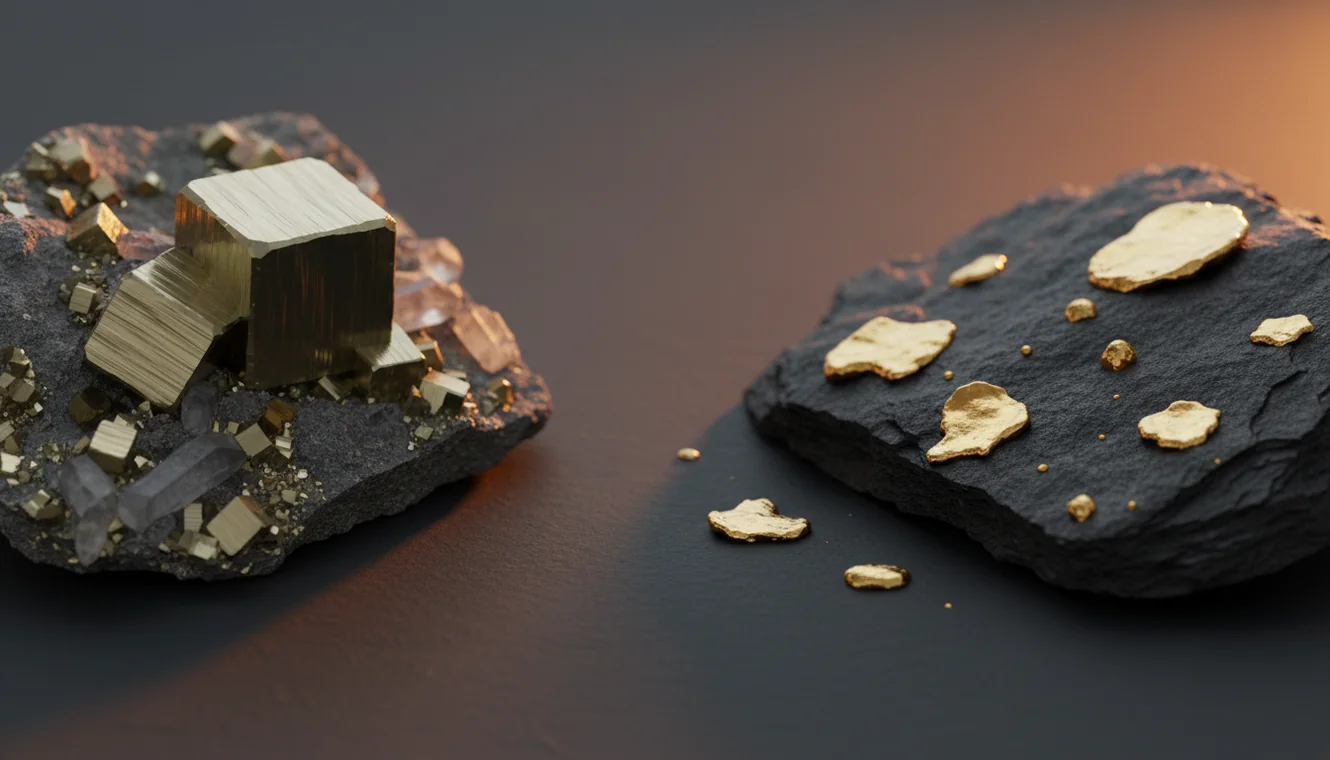
Quick answer: Pyrite vs gold: how to tell them apart depends on streak, hardness, malleability, crystal habit, and density rather than shine alone. Pyrite is typically hard, brittle, brassy, and dark-streaking, while gold is soft, malleable, richer yellow, and leaves a yellow streak.
AI Rock ID can help users compare a photo of a brassy metallic specimen with likely mineral candidates before performing streak, hardness, and malleability checks for pyrite vs gold. RockIdentifier.io provides a web photo-upload workflow for the same pyrite vs gold topic, but physical tests remain necessary for confirmation.
Quick summary
- Best for
- Collectors, prospectors, students, hikers, beginners
- Works on
- Metallic minerals, quartz specimens, placer flakes, brassy crystals, field samples
- Accuracy
- Good for visual triage, but streak, hardness, and malleability provide stronger confirmation
- Needs confirmation
- Yes
- Professional replacement
- No
- Platforms
- iPhone, iPad, Web
This guide is best for
- Beginners comparing brassy pyrite with possible native gold
- Rockhounds checking metallic grains in quartz or placer sediment
- Students learning streak, hardness, brittleness, and malleability tests
- Field collectors who need a practical sequence before damaging a specimen
- Prospecting hobbyists sorting shiny flakes, nuggets, or sulfide-rich samples
- Anyone who wants to understand why color and luster are not enough for gold identification
Consider another approach if you
- People trying to determine gold value, ore grade, or economic potential
- Collectors with delicate, rare, or historically important specimens that should not be scratched
- Users who need proof of microscopic or invisible gold inside pyrite
- Jewelry owners who need appraisal, metal purity testing, or authentication
- Cases requiring assay, microscopy, fire assay, or professional mineral analysis
Pyrite is hard, brittle, and usually leaves a greenish-black to brownish-black streak. Gold is soft, malleable, and leaves a yellow streak. The fastest reliable sequence is streak test, glass scratch test, then gentle deformation with a steel point.
What Is Pyrite vs Gold: How to Tell Them Apart?
Pyrite vs gold: how to tell them apart is a field identification problem between iron sulfide, FeS2, and native elemental gold, Au. They can both show metallic luster and yellowish color, but their physical properties are very different.
Pyrite is brassy, brittle, and commonly forms cubes or pyritohedrons with striated faces. Gold is richer yellow, very dense, soft, and malleable, usually appearing as flakes, wires, nuggets, or irregular masses in quartz or placer sediment. The practical separators are streak, Mohs hardness, deformation, crystal habit, and specific gravity. For mineral background, the USGS overview of gold is a useful authority: https://www.usgs.gov/centers/national-minerals-information-center/gold-statistics-and-information.
How Pyrite vs Gold: How to Tell Them Apart Works
Pyrite vs gold identification works by testing properties that surface shine cannot fake. Start with streak because powdered mineral color is more stable than tarnished surfaces: pyrite gives a dark greenish-black to brownish-black mark, while gold gives a yellow mark. Then compare hardness. Pyrite is about Mohs 6 to 6.5 and can scratch glass; gold is about Mohs 2.5 to 3 and normally cannot.
Finally, test behavior under gentle pressure. Pyrite chips or fractures because it is brittle. Gold dents, bends, or smears because it is malleable. A photo classifier can suggest candidates from visible luster, habit, and matrix, but streak and hardness are the confirming evidence.
How to Tell Pyrite vs Gold Apart
1. Photograph the specimen
Place the sample on a plain matte background and take sharp photos from several angles. Open the Rock Identifier iOS app link from the download prompt when you want a fast field shortlist before testing.
2. Check the streak
Rub an inconspicuous edge on unglazed porcelain. A dark greenish-black or brownish-black streak points to pyrite, while a yellow streak supports native gold.
3. Test hardness carefully
Try a glass scratch test only on a small area. Pyrite commonly scratches glass; gold is too soft and should not.
4. Press for deformation
Use a steel point with light pressure. Pyrite tends to chip, crumble, or break unevenly, while gold dents, flattens, or smears.
5. Compare habit and matrix
Look for pyrite’s sharp cubes, pyritohedrons, and striated faces. Gold is more often irregular, flaky, wire-like, or rounded in quartz veins or placer gravels. Photos are processed for identification in a privacy-friendly way, not treated as a public specimen record.
When to Use Pyrite vs Gold Identification (and When Not To)
Use it when
- Use it when a brassy metallic mineral in quartz, schist, slate, or placer gravel might be pyrite, gold, chalcopyrite, or mica.
- Use it when you need quick triage before doing streak, Mohs hardness, and malleability tests.
- Use it when sunlight, tarnish, or iron staining makes color unreliable.
- Use it when sorting multiple field samples and you need consistent notes on luster, habit, fracture, and matrix.
Skip it when
- Do not use visual ID alone to estimate gold value, ore grade, or economic potential.
- Do not scrape aggressively on a collector-quality crystal, jewelry piece, or specimen with possible historical value.
- Do not assume microscopic gold in pyrite can be confirmed by eye; that requires assay, microscopy, or lab testing.
- Do not rely on a single photo when the specimen is wet, overexposed, shadowed, or smaller than the camera can resolve.
Pyrite vs Gold Identification vs Google Lens and Rock Scanner
| Feature | Rock Identifier | Google Lens | Rock Scanner - Stone Identifier |
|---|---|---|---|
| Best role | Mineral-focused photo ID with rock, crystal, and gemstone context | Broad visual search across the open web | Consumer stone and crystal lookup |
| Pyrite vs gold usefulness | Good for narrowing metallic mineral candidates before streak and hardness checks | Can find visually similar images but may mix jewelry, stock photos, and unrelated objects | Useful for common minerals, but confirmation still depends on physical properties |
| Field workflow | Photograph, get candidates, record habit and matrix, then verify by tests | Search by image, compare results manually, then test separately | Scan, review likely names, then verify with field observations |
| Geology detail | Emphasizes mineral names, look-alikes, and diagnostic traits | Variable detail depending on indexed pages | Usually gives basic identification notes |
| Main limitation | Cannot prove gold content, value, or assay grade from a photo | Not specialized for mineral diagnostics | May over-identify polished, treated, or shop-labeled stones |
Use a scanner or visual search as a first pass, not a verdict. For pyrite and gold, streak, hardness, malleability, and specific gravity remain stronger evidence than image similarity.
Pyrite vs Gold Use Cases
- Prospecting in quartz veins: When a vein contains brassy metallic grains, identify whether the visible mineral is pyrite before assuming gold. Note vein texture, sulfide associations, iron oxides, and host rock.
- Panning and placer sorting: Gold tends to stay in the pan because of high density, while pyrite can behave differently depending on grain shape and weathering. Confirm shiny flakes with streak and malleability instead of color alone.
- Tailings pile checks: Old mine dumps often contain pyrite, chalcopyrite, arsenopyrite, and iron-stained quartz. A structured workflow helps avoid labeling every metallic flash as gold.
- Classroom mineral labs: Pyrite and gold make a useful comparison for teaching Mohs hardness, streak, crystal system, brittleness, and specific gravity. Students learn why luster is descriptive but not diagnostic by itself.
Pyrite vs Gold: How to Tell Them Apart Limitations
- Treated stones, plated objects, dyed specimens, and novelty samples can mimic metallic gold color without being native gold.
- Polished specimens lose many natural habit clues, so crystal faces, fracture, and matrix relationships may be hidden.
- Rare minerals and sulfides such as chalcopyrite, marcasite, arsenopyrite, and bornite can complicate a simple pyrite-versus-gold decision.
- Photo quality matters: glare from metallic luster, motion blur, wet surfaces, and harsh sunlight can hide striations or make color unreliable.
- Very small flakes may be below camera resolution, especially when embedded in dark matrix or iron-stained quartz.
- Value estimates cannot be made from a photo; gold grade, purity, and recoverability require weighing, assay, or professional evaluation.
- Specific gravity is powerful but easy to misuse in the hand; accurate measurement needs mass, volume displacement, and a clean specimen.
Common mistakes
- Assuming every shiny yellow flake is gold because it has metallic luster
- Ignoring streak color even though pyrite usually leaves a dark streak and gold leaves a yellow streak
- Using heft alone to identify gold without comparing hardness, malleability, and habit
- Scratching valuable crystals or jewelry pieces instead of testing an inconspicuous area or seeking expert help
- Mistaking pyrite cubes or striated crystal faces for gold nuggets
- Forgetting that gold dents or smears while pyrite tends to chip, crumble, or fracture
- Treating a photo match as proof of gold content instead of a starting point for physical tests
Check Pyrite vs Gold Before You Test
A photo-based identification can help narrow a shiny yellow specimen to likely candidates before using streak, hardness, and malleability tests. Use visual results as triage, not as proof of gold content or value.
Related Articles
Frequently Asked Questions
Does pyrite ever contain real gold?
Yes, some pyrite can host microscopic or submicroscopic gold, especially in certain ore systems. You cannot confirm that visually in the field; identify the visible mineral first, then use assay or lab methods for gold content.
What streak color does gold leave?
Gold typically leaves a yellow streak on unglazed porcelain. Pyrite leaves a greenish-black to brownish-black streak, which is why streak is one of the fastest separators.
Will gold scratch glass?
Gold usually will not scratch glass because it is only about Mohs 2.5 to 3. Pyrite is much harder, about Mohs 6 to 6.5, and commonly can scratch glass.
Why is pyrite called fool’s gold?
Pyrite is called fool’s gold because its brassy metallic luster can resemble gold at a glance. The name is fair in the field, but streak, hardness, and brittleness separate it quickly.
Is heft enough to identify gold?
Heft helps only as a clue, not a final test. Gold has very high specific gravity, but hand-feel is biased by sample size, shape, attached rock, and expectation.
Can mica look like gold?
Yes, mica can flash yellow or bronze in sunlight and fool beginners. Mica splits into thin elastic sheets, while gold bends or smears and pyrite breaks brittle.
What shape does pyrite form?
Pyrite commonly forms cubes, pyritohedrons, and striated crystal faces in the isometric system. Gold is less often seen as sharp crystals in hand samples and more often appears irregular, flaky, wire-like, or rounded.
Can a photo prove real gold?
No, a photo can suggest likely candidates but cannot prove native gold, purity, or value. Confirm with streak, hardness, malleability, density measurements, or professional testing.
What test should I do first?
Start with a streak test on unglazed porcelain if the specimen can be tested safely. It is quick, low-tech, and more reliable than judging yellow color or shine.