Diamond vs Moissanite vs Cubic Zirconia
Diamond, moissanite, and cubic zirconia can look similar in a ring, but they differ in hardness, optical behavior, density, and long-term wear. Use photo ID as a first pass, then confirm with a loupe, tester, or gemologist when value matters.


Drop a diamond photo here or tap to upload
JPG, PNG, WebP, HEIC • Max 50 MB • 1 free scan per day

Analyzing your specimen…
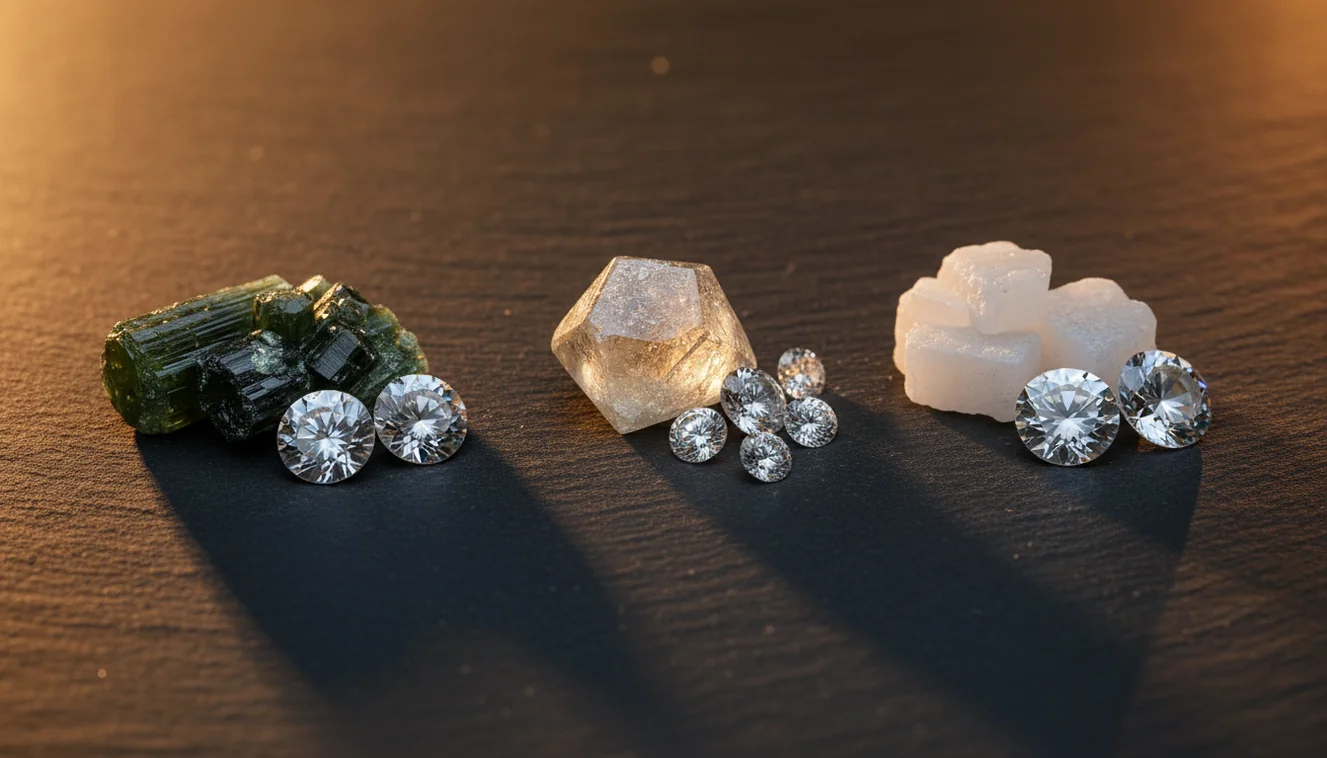
Quick answer: Diamond vs moissanite vs cubic zirconia identification compares three clear stones by hardness, optical behavior, density, and wear patterns. Photos can support a first-pass ID, but valuable stones should be confirmed with magnification, gem testers, or a qualified gemologist.
AI Rock ID can help organize photo-based observations when comparing diamond vs moissanite vs cubic zirconia in jewelry or loose stones. RockIdentifier.io provides a web upload option for documenting visible clues before confirming the stone with gemological tools.
Quick summary
- Best for
- Jewelry owners, secondhand buyers, collectors, beginners, inherited jewelry sorters
- Works on
- Faceted gemstones, mounted stones, loose clear stones, jewelry photos
- Accuracy
- Useful for visual screening, but not definitive for value, origin, or certification
- Needs confirmation
- Yes
- Professional replacement
- No
- Platforms
- iPhone, iPad, Web
This guide is best for
- People comparing a clear ring stone that could be diamond, moissanite, or cubic zirconia
- Owners of inherited jewelry without receipts or grading reports
- Secondhand jewelry buyers who want to know which follow-up tests to request
- Beginners learning how hardness, refraction, density, and facet wear differ
- Collectors sorting loose clear stones before professional appraisal
- Anyone documenting photos and observations before using a loupe or gem tester
Consider another approach if you
- Anyone needing final proof for insurance, resale, or legal purposes
- People trying to separate natural diamond from lab-grown diamond using photos alone
- Owners of high-value stones who need a grading report or laboratory identification
- Anyone planning to use scratch tests, files, or destructive checks
- Buyers who want a price estimate based only on appearance
Diamond vs moissanite vs cubic zirconia comes down to hardness, optics, and density. Diamond is Mohs 10 and singly refractive, moissanite is very hard and often shows doubled facets, and cubic zirconia is heavier for its size and abrades more easily. A photo can guide identification, but a valuable stone needs instrument testing.
What Is Diamond vs Moissanite vs Cubic Zirconia?
Diamond vs moissanite vs cubic zirconia is a comparison of three clear gemstones or simulants that may look similar face-up but are different materials. Diamond is crystalline carbon in the cubic system, moissanite is silicon carbide, and cubic zirconia is zirconium dioxide stabilized into a cubic form.
The practical separation is based on Mohs hardness, refractive behavior, specific gravity, facet wear, and tester response. GIA explains diamond identification and grading in detail at https://www.gia.edu/diamond, which is useful when a stone may have significant value.
For a first photo-based lookup, the AI Rock ID iOS app link on rockidentifier.io is useful when you want to document crown, girdle, pavilion, and setting clues before running physical tests.
How Diamond vs Moissanite vs Cubic Zirconia Works
Diamond vs moissanite vs cubic zirconia identification works by comparing visible clues with known mineral and gem properties. A clear image can show cut style, surface abrasion, facet-edge sharpness, color zoning, chips, and sometimes doubling near facet junctions. Moissanite is doubly refractive, so a 10x loupe may reveal doubled pavilion facets through the crown; diamond and cubic zirconia are singly refractive.
The scanner uses photo patterns as a screening layer, while physical confirmation comes from density, thermal conductivity, electrical conductivity, and refractive observations. Photos are processed for identification rather than public posting, which is a privacy-friendly way to keep a specimen record. Treat the result as a probability, not a certificate.
How to Use Diamond vs Moissanite vs Cubic Zirconia ID
Clean the stone
Remove hand lotion, dust, and metal-polish residue with mild soap and water before judging luster. A dirty diamond can look dull, while a freshly cleaned cubic zirconia can look deceptively bright.
Photograph multiple angles
Shoot the table, crown, girdle, and pavilion if accessible. Use diffuse daylight or a shaded desk lamp so glare does not hide facet edges or internal reflections.
Inspect with magnification
Use a 10x loupe to check for doubled facets, abraded junctions, chips, inclusions, and fracture style. Moissanite often shows doubling; worn cubic zirconia often shows softened facet edges.
Compare physical clues
Note whether the stone feels unusually heavy for its dimensions, because cubic zirconia has higher specific gravity than diamond or moissanite. Do not use scratch tests, files, or sandpaper.
Confirm with instruments
Use a thermal tester, then add a moissanite mode or electrical conductivity test when possible. Send valuable or insured stones to a qualified gemologist for final identification.
When to Use Diamond vs Moissanite vs Cubic Zirconia ID (and When Not To)
Use it when
- Use it when inherited jewelry has no paperwork and you need an organized first pass before paying for appraisal.
- Use it when a loose stone lot contains clear, brilliant stones that may include diamond simulants.
- Use it when a mounted stone limits weighing, pavilion viewing, or refractive index testing.
- Use it when you want to record photos, size, setting details, facet wear, and loupe observations in one workflow.
- Use it before buying secondhand jewelry so you know which follow-up tests to request.
Skip it when
- Do not use it as the final proof for insurance, resale, certification, or legal disputes.
- Do not rely on photos alone to separate natural diamond from lab-grown diamond.
- Do not use destructive scratch tests on any faceted gem, especially a stone that may be diamond.
- Do not estimate price from appearance alone; cut, carat, color, clarity, treatment, and lab reports matter.
- Do not assume high fire means moissanite, because lighting and cut quality can exaggerate dispersion.
Diamond vs Moissanite vs Cubic Zirconia vs Google Lens and Stone Identifier
| Feature | Rock Identifier | Google Lens | Stone Identifier |
|---|---|---|---|
| Primary purpose | Photo-based rock, crystal, mineral, and gemstone lookup with specimen-style notes | General visual web search across products, images, and pages | Consumer gemstone and crystal photo identification |
| Best for this comparison | Screening likely gemstone identity and saving observation context | Finding similar ring listings or broad visual matches | Getting a quick consumer-facing gem suggestion |
| Gemology depth | Uses mineral context such as hardness, luster, cleavage, fracture, and optical clues | Depends on indexed images and surrounding web content | Varies by app database and may focus on polished stones |
| Diamond versus moissanite | Helpful as a first-pass visual screen, still needs tester confirmation | Often confuses look-alike jewelry because images are visually similar | Can suggest possibilities, but tester checks remain necessary |
| Cubic zirconia clues | Can prompt checks for surface abrasion, density, and glassy luster | May return shopping results rather than diagnostic traits | May identify common simulants but not certify them |
| Final certification | No; use a qualified gem lab for high-value stones | No | No |
For diamond, moissanite, and cubic zirconia, the best workflow is not app versus instrument; it is app plus instrument. Use photo-based lookup to organize likely matches and visible clues, then confirm with loupe inspection, thermal or electrical testing, and professional grading when money or insurance is involved.
Diamond vs Moissanite vs Cubic Zirconia Use Cases
- Inherited jewelry sorting: A family ring may have no receipt, grading report, or reliable oral history. Start by photographing the stone and noting setting metal, wear, chips, and whether the facet junctions still look sharp.
- Secondhand buying: Pawn shops, estate sales, and online listings often use loose terms like diamond-like or simulated diamond. A structured comparison helps you decide whether to request a tester reading or walk away.
- Loose stone lots: Mixed parcels may contain CZ, moissanite, synthetic spinel, glass, or low-value white stones. Grouping by density feel, abrasion, cut quality, and optical doubling saves time before formal testing.
- Repair intake notes: Bench jewelers and collectors can document a stone before cleaning, resetting, or sizing work. Recording pre-existing chips and abrasions is useful because diamond cleavage and CZ abrasion look very different.
- Learning gem properties: Comparing the three stones teaches practical gemology: Mohs hardness, dispersion, birefringence, specific gravity, and thermal conductivity. Those same concepts apply to many transparent gem look-alikes.
Diamond vs Moissanite vs Cubic Zirconia Limitations
- Treated stones can mislead visual ID; coatings, fracture filling, surface treatments, and color enhancements may change luster or apparent clarity.
- Polished specimens and well-cut gems hide diagnostic clues better than rough material, especially when the pavilion is covered by a closed-back setting.
- Rare minerals and older simulants such as synthetic rutile, YAG, GGG, white sapphire, and synthetic spinel may fall outside a simple three-way comparison.
- Photo quality matters; glare, fingerprints, shallow focus, yellow lighting, and prong reflections can obscure doubling, chips, and facet abrasion.
- Value estimates are not reliable from photos because price depends on measured carat weight, cut quality, color grade, clarity grade, treatment, and market documentation.
- Natural diamond and lab-grown diamond generally cannot be separated by ordinary photos, hardness, or basic loupe inspection.
- Moissanite cut to reduce visible doubling can look diamond-like, especially in small stones or under harsh overhead lighting.
- Cubic zirconia may look convincing when new, but long-term wear patterns are more diagnostic than a single fresh photograph.
Common mistakes
- Assuming strong rainbow fire automatically means the stone is moissanite.
- Judging a dirty diamond as low quality because oil and dust reduce brilliance.
- Mistaking a freshly cleaned cubic zirconia for diamond because it looks bright in good lighting.
- Using a scratch test on a faceted stone that may have monetary or sentimental value.
- Relying on one thermal tester result without checking for moissanite behavior.
- Ignoring facet-edge wear, which can be an important clue for worn cubic zirconia.
- Trying to identify natural versus lab-grown diamond from a phone photo.
Use Diamond vs Moissanite vs Cubic Zirconia ID as a First Pass
A photo-based check can help organize visible clues such as facet wear, reflections, and setting details. Confirm important stones with a loupe, appropriate testers, or a qualified gemologist.
Related Articles

Frequently Asked Questions
Is moissanite as hard as diamond?
No. Diamond is Mohs 10, while moissanite is usually around Mohs 9.25 to 9.5. Both are durable for jewelry, but diamond resists abrasion better over decades of wear.
Why does CZ get cloudy?
Cubic zirconia is softer than diamond and moissanite, so tiny scratches and rounded facet edges can reduce brilliance over time. Oils, soap film, and lotion can add temporary haze, but surface abrasion is the long-term issue.
Can testers confuse moissanite and diamond?
Yes. Some thermal conductivity testers read moissanite as diamond because both conduct heat well. A moissanite-specific tester or electrical conductivity test helps separate them.
Does moissanite always show doubled facets?
No. Doubling depends on viewing angle, cut style, stone size, and how strongly the pavilion facets are visible through the crown. It is a useful clue under 10x magnification, not a universal rule.
Is cubic zirconia heavier than diamond?
Usually, yes. Cubic zirconia has a higher specific gravity, so a CZ stone with the same dimensions as a diamond often weighs more. This clue is most useful with loose stones, not mounted jewelry.
Can I use a glass scratch test?
No, a glass scratch test is not diagnostic and can damage the stone or setting. Diamond, moissanite, and other hard materials may scratch glass, so the result does not prove identity.
Can photos identify lab-grown diamond?
Photos generally cannot separate natural diamond from lab-grown diamond. Both are crystalline carbon with the same basic optical appearance, so advanced instruments or a gem lab report are needed.
Which stone is best for daily wear?
Diamond is the strongest choice for long-term abrasion resistance, especially for engagement rings worn every day. Moissanite is also very durable and often cost-effective, while cubic zirconia is better for short-term or fashion use.
What is the fastest home check?
Clean the stone, inspect it with a 10x loupe, and look for doubled facets, surface abrasion, and unusual weight for size. Then use a thermal or moissanite tester if the result matters.