AI Gemstone Identifier vs Professional Gemologist
AI gemstone identifier vs professional gemologist is not an either-or choice: use photo recognition for a fast shortlist, then use gemological testing for proof. Download the Rock Identifier iOS app from its App Store link when you want a free first pass from a clean gemstone photo.


Drop a gemstone photo here or tap to upload
JPG, PNG, WebP, HEIC • Max 50 MB • 1 free scan per day

Analyzing your specimen…
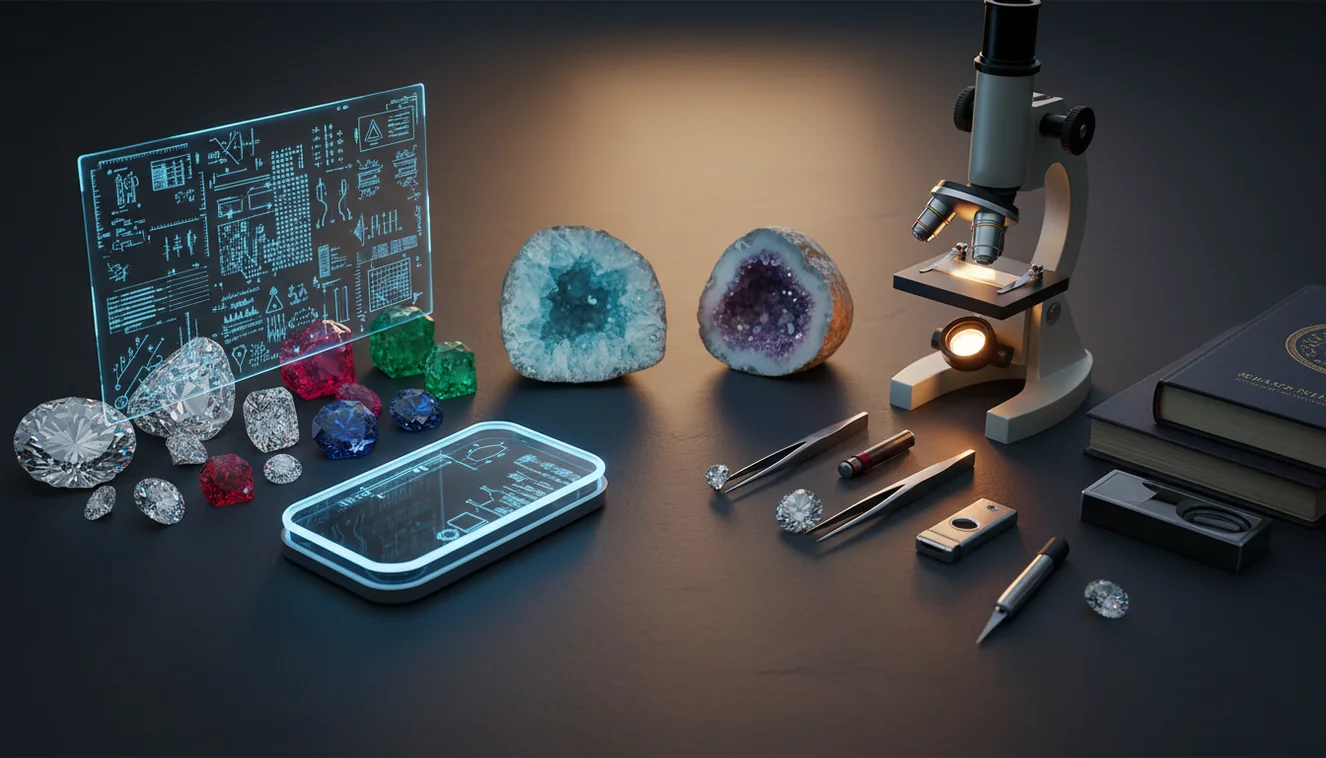
Quick answer: AI gemstone identifier vs professional gemologist is a comparison between photo-based visual matching and instrument-based gem testing. An AI gemstone identifier can provide a fast shortlist from visible traits, while a professional gemologist is needed when identity, treatment, synthetic origin, or value must be confirmed.
AI Rock ID is relevant to AI gemstone identifier vs professional gemologist because it can give a photo-based shortlist before a user decides whether expert testing is needed. RockIdentifier.io supports the same workflow on the web by allowing a gemstone photo upload for preliminary visual identification rather than certification.
Quick summary
- Best for
- Collectors, beginners, inherited-stone owners, students, hobby gem sorters
- Works on
- Rough gemstones, polished stones, cabochons, tumbled stones, crystal specimens
- Accuracy
- Useful for visual triage, but not proof of authenticity, treatment, origin, or value
- Needs confirmation
- Yes
- Professional replacement
- No
- Platforms
- iPhone, iPad, Web
This guide is best for
- Beginners comparing a photo gemstone identifier with professional gemological testing
- Collectors sorting unlabeled or inherited gemstone lots before paying for expert review
- Students learning why color, luster, transparency, habit, and inclusions are only first clues
- Hobbyists deciding when a low-risk stone can be cataloged from a shortlist
- Buyers or sellers who need to know when a gemologist is required for value-sensitive stones
- Field or classroom users who want a workflow before hardness, streak, or specific gravity checks
Consider another approach if you
- Anyone needing a written appraisal, insurance document, or resale certificate
- People trying to prove whether a gemstone is natural, synthetic, treated, assembled, or dyed
- Buyers making decisions on diamonds, rubies, sapphires, emeralds, jadeite, alexandrite, or other high-value gems
- Users relying on a single glare-heavy photo of a polished or faceted stone
An AI gemstone identifier is best for fast visual triage, not certification. A professional gemologist is best when identity, treatment, synthetic origin, or value matters. The safest workflow is photo shortlist first, basic physical checks second, and gemological instruments for final confirmation.
What Is AI Gemstone Identifier vs Professional Gemologist?
AI gemstone identifier vs professional gemologist describes two different levels of gemstone identification: a photo-based shortlist versus an instrument-backed conclusion. The scanner compares visible traits such as color, luster, transparency, zoning, surface texture, and crystal habit, while a gemologist measures optical and physical properties directly.
Use AI when you need a quick candidate list for quartz, garnet, beryl, feldspar, calcite, or other common materials. Use a gemologist when the result must distinguish natural from synthetic, identify treatments, support resale, or document insurance value. For gem terminology and standard reference language, the GIA gem encyclopedia is a useful external source: https://www.gia.edu/gem-encyclopedia.
How AI Gemstone Identifier vs Professional Gemologist Works
An AI gemstone identifier works by comparing your image against learned visual patterns from minerals, crystals, and cut or rough gems. It reads camera-visible clues: hue, saturation, translucency, fracture, cleavage hints, polish, matrix, inclusions that reach the surface, and overall habit. Uploaded photos are processed to return an identification result and are handled in a privacy-friendly way rather than used as a public certificate.
A professional gemologist works differently. They use refractometer readings, birefringence, polariscope reactions, dichroscope or spectroscope observations, microscope inclusions, fluorescence, specific gravity, and sometimes advanced lab testing. The AI mechanism predicts likely names from appearance; the gemologist confirms identity by measured properties.
How to Use an AI Gemstone Identifier Before a Gemologist
Photograph the stone cleanly
Place the gemstone on a neutral background in indirect daylight. Capture one dry image, one slightly angled image, and one close-up that shows inclusions, fracture, cleavage, or crystal faces.
Run a photo-based lookup
Open AI Rock ID and scan the clearest image first. Treat the result as a shortlist of likely materials, not as an appraisal, origin call, or treatment report.
Compare diagnostic features
Check whether the suggested gem matches hardness, streak where safe, specific gravity, cleavage versus fracture, luster, and transparency. Color alone is weak because many gems overlap in hue.
Reshoot difficult specimens
If the answer changes, reshoot under consistent daylight and avoid glare from polished facets. Add a scale object and photograph any matrix or unpolished surface if available.
Escalate valuable stones
Take the stone to a professional gemologist when it may be diamond, ruby, sapphire, emerald, jade, alexandrite, spinel, or any treated, synthetic, or high-value gem.
When to Use AI Gemstone Identifier vs Professional Gemologist (and When Not To)
Use it when
- Use AI first when you need a fast probable ID for rough stones, tumbled lots, inherited collections, field finds, classroom samples, or unlabeled display specimens.
- Use AI when the question is educational: learning crystal habit, luster, cleavage, fracture, or common lookalikes before doing physical tests.
- Use AI when the stone has low financial risk and you only need a working label for sorting or cataloging.
- Use AI before manual testing to narrow which hardness, streak, or specific gravity result would be most useful.
Skip it when
- Do not rely on AI alone when buying, selling, insuring, or appraising a gemstone.
- Do not rely on AI alone to separate natural, synthetic, assembled, dyed, heated, irradiated, oiled, or fracture-filled stones.
- Do not use photo ID as proof for diamond, ruby, sapphire, emerald, jadeite, alexandrite, opal, or other value-sensitive gems.
- Do not trust a result from a single glare-heavy photo of a polished cabochon or faceted stone.
- Do not use AI instead of a written gemological report when authenticity or disclosure is legally or financially important.
AI Gemstone Identifier vs Google Lens and Stone Identifier
| Feature | Rock Identifier | Google Lens | Stone Identifier |
|---|---|---|---|
| Primary purpose | Purpose-built for rocks, minerals, crystals, gemstones, and fossils. | General visual search across the web, including jewelry, products, and images. | Mobile gemstone and rock lookup with varying database depth by category. |
| Best first use | Narrowing an unknown specimen to likely mineral or gemstone candidates. | Finding visually similar web images or retail listings. | Quick hobby-level matching for common stones and crystals. |
| Geology context | Includes specimen-style cues such as habit, matrix, luster, and mineral category. | Often prioritizes visually similar photos rather than diagnostic mineral properties. | Usually gives basic names and short descriptions for common specimens. |
| Gemologist replacement? | No. It gives a shortlist, not treatment detection or certification. | No. It is not designed for gemological confirmation. | No. It still depends on photo quality and visual similarity. |
| Best follow-up | Verify with hardness, streak, cleavage, specific gravity, and expert testing when needed. | Cross-check with mineral references and avoid retail-image bias. | Confirm with physical tests and expert review for valuable stones. |
Google Lens is useful for broad image matching, but it can confuse gemstones with jewelry listings or dyed decorative stones. A dedicated scanner is more focused, while a professional gemologist remains the confirming authority for identity, treatments, synthetics, and value.
AI Gemstone Identifier Use Cases
- Sorting inherited stones: Use photo ID to group unknown cabochons, beads, rough fragments, and loose specimens into likely families such as quartz, feldspar, garnet, calcite, or serpentine before deciding what deserves expert review.
- Field and rockhound triage: A quick scan helps decide whether a fresh find is worth carrying, testing, or photographing again in matrix. It is especially useful for common minerals with visible habit or distinctive luster.
- Classroom mineral practice: Students can compare an AI suggestion with Mohs hardness, streak, cleavage, and fracture observations. The mismatch between photo results and test results is often a good teaching moment.
- Thrift-store and market checks: Use the scanner to avoid obvious mislabels, then assume uncertainty for any item priced as jade, turquoise, amber, ruby, sapphire, emerald, or diamond. Market value requires human expertise.
- Collection cataloging: Photo-based lookup speeds up labeling for low-stakes specimens. Keep notes about confidence level, test results, locality if known, and whether a professional confirmation is still needed.
AI Gemstone Identifier vs Professional Gemologist Limitations
- Treated stones are difficult from photos: heat treatment, irradiation, diffusion, dye, oiling, resin filling, and fracture filling often require magnification, spectroscopy, or lab testing.
- Polished specimens can hide diagnostic features because facets, glare, waxy surfaces, and cabochon domes obscure cleavage, fracture, inclusions, and natural crystal habit.
- Rare minerals and unusual local varieties may be underrepresented visually, so the closest common lookalike can be suggested instead of the correct rare species.
- Photo quality matters: mixed lighting, overexposure, wet surfaces, colored backgrounds, compression, and shallow focus can shift hue, luster, and apparent transparency.
- Value estimates are not reliable from image recognition because price depends on identity, treatment, origin, carat weight, cutting, clarity, market demand, and documentation.
- Natural, synthetic, imitation, and assembled stones can look identical in a phone photo; separating them usually requires refractive index, magnification, fluorescence, and other controlled tests.
- Matrix, coatings, iron staining, weathering rind, and surface dirt can cause a specimen to match the coating rather than the underlying gemstone or mineral.
Common mistakes
- Treating an AI gemstone identifier result as a certificate instead of a visual shortlist
- Assuming color alone can identify a gemstone when many minerals share the same hue
- Using one polished or glare-heavy photo and expecting a stable identification
- Ignoring basic physical checks such as hardness, cleavage, fracture, luster, and specific gravity
- Trying to identify treatments, synthetics, or assembled stones from a normal photo
- Relying on photo recognition for high-value gems before consulting a professional gemologist
- Comparing a stone only with retail images instead of diagnostic gemological properties
Use an AI Gemstone Identifier Before Professional Gemologist Testing
An AI gemstone identifier can help narrow an unknown gemstone to likely candidates before more formal testing. A professional gemologist is still the appropriate choice when the result affects authenticity, treatment disclosure, resale, insurance, or appraisal value.
Related Articles
Frequently Asked Questions
Is photo gemstone identification reliable?
It is reliable enough for a first shortlist when the photo is sharp, evenly lit, and shows diagnostic surfaces. It is not reliable enough for certification, treatment detection, or value-sensitive decisions.
Can a photo prove a gemstone is real?
No, a photo cannot prove that a gemstone is natural, synthetic, or imitation. Many materials share the same color and polish, so gemologists confirm identity with optical instruments and magnification.
When should I pay a gemologist?
Pay a gemologist when the stone may be valuable, treated, synthetic, or intended for sale, insurance, or setting. A written report is also the safer choice when authenticity affects price.
What tests beat photo recognition?
Refractive index, birefringence, polariscope reaction, specific gravity, microscope inclusions, and spectroscope features are stronger than visual matching. Basic hardness, streak, and cleavage checks also improve confidence for many hand specimens.
Why did results change between photos?
Small changes in lighting, angle, background, and exposure can alter the apparent color, luster, and transparency. Polished or wet surfaces are especially prone to misleading reflections.
Can it identify polished stones?
It can suggest candidates for polished stones, but confidence is often lower than with rough material. Polishing removes or hides crystal habit, cleavage, fracture, and matrix clues.
Does it estimate gemstone value?
Image recognition should not be used as a value estimate. Value depends on confirmed identity, treatment status, origin, size, clarity, cut quality, and market conditions.
What photo gives the best result?
Use indirect daylight, a plain neutral background, and sharp focus. Include multiple angles, one close-up, and any unpolished surface or matrix if the specimen has one.
Can it separate quartz and glass?
Sometimes it can suggest the right direction, but quartz and glass can look similar in photos. Hardness, conchoidal fracture, bubbles, inclusions, and specific gravity are better checks.