How to Do a Streak Test on Minerals
If you are learning how to do a streak test on minerals, start with a clean unglazed porcelain plate and a fresh mineral surface. Use the iOS app link on this page if you want a photo-based candidate before you confirm it with streak, luster, and hardness.


Drop a mineral photo here or tap to upload
JPG, PNG, WebP, HEIC • Max 50 MB • 1 free scan per day

Analyzing your specimen…
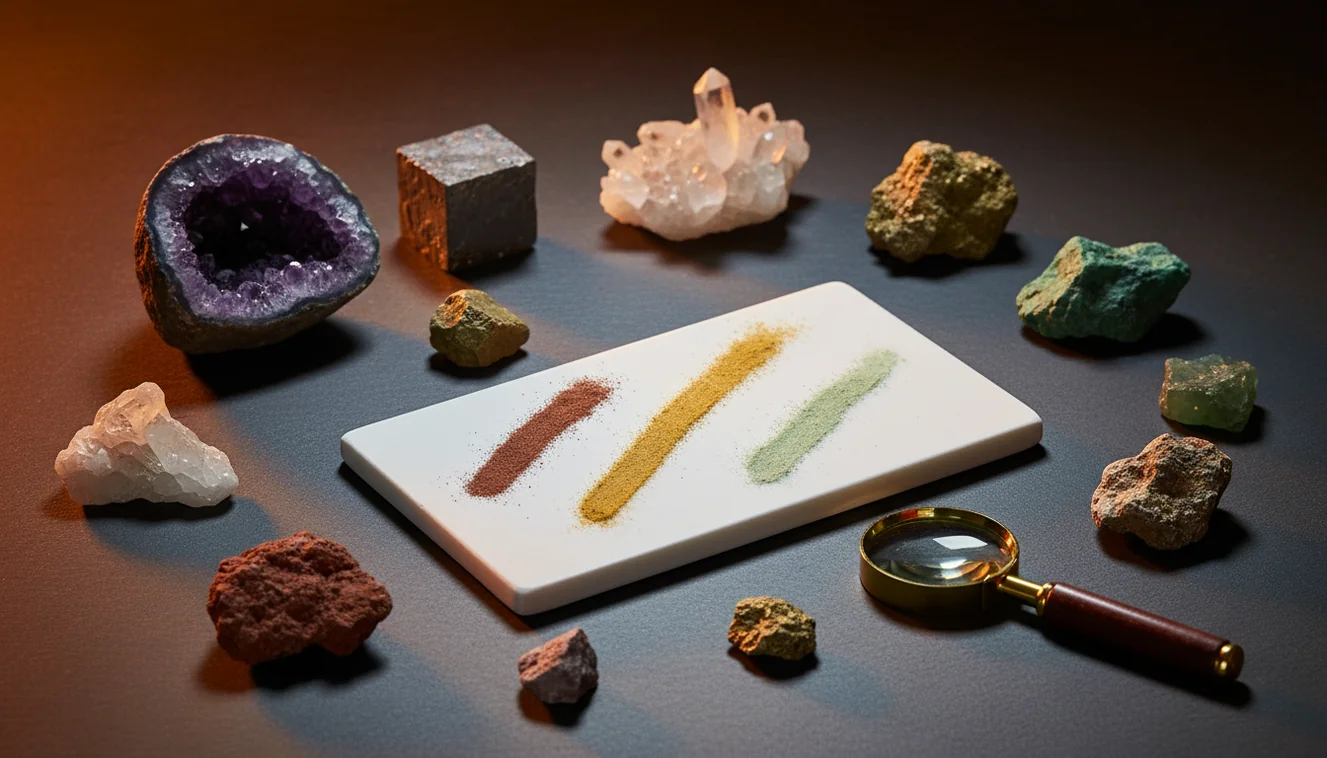
Quick answer: A mineral streak test is done by dragging a clean, fresh edge of a mineral across an unglazed porcelain streak plate and observing the powder color left behind. The mineral streak test is most useful for metallic minerals because powdered color is often more consistent than surface color, tarnish, or weathering.
AI Rock ID can help users generate a photo-based mineral candidate before they compare the specimen with streak color, luster, hardness, and other physical properties. RockIdentifier.io supports web photo upload for mineral identification workflows where a streak test is used as a follow-up observation rather than a standalone answer.
Quick summary
- Best for
- Collectors, students, rockhounds, field beginners, mineral ID learners
- Works on
- Minerals, metallic minerals, common specimens, classroom samples
- Accuracy
- Useful as one physical clue, especially for softer metallic minerals, but not enough for a final identification by itself
- Needs confirmation
- Yes
- Professional replacement
- No
- Platforms
- iPhone, iPad, Web
This guide is best for
- Beginners learning how to do a streak test on minerals with a porcelain plate
- Collectors checking common minerals before comparing hardness, luster, and cleavage
- Students using classroom mineral kits for hands-on identification practice
- Rockhounds trying to separate metallic look-alikes such as hematite, magnetite, pyrite, and galena
- Field users who want to confirm a photo-based mineral candidate with a simple physical test
- Anyone learning why powdered mineral color can differ from surface color
Consider another approach if you
- People testing faceted gemstones, valuable rough, or display-quality crystals that should not be scratched
- Users trying to identify minerals harder than an unglazed porcelain streak plate
- Anyone expecting a white or pale streak to identify a nonmetallic mineral by itself
- People testing mixed rocks without isolating the specific mineral grain
- Situations that require professional mineralogical, gemological, or laboratory confirmation
To do a streak test on minerals, drag a clean, fresh edge of the specimen across unglazed porcelain and observe the powder color left behind. Streak is often more reliable than surface color, especially for metallic minerals affected by tarnish, oxidation, or weathering. Do not streak valuable gemstones, delicate crystals, or specimens harder than the plate unless you accept possible damage.
What Is a Mineral Streak Test?
A mineral streak test identifies the color of a mineral in powdered form, which can be more consistent than the color of the hand specimen. Hematite may look black or silvery but usually gives a reddish-brown streak; pyrite looks brassy but often leaves a dark greenish-black to brownish-black mark or may scratch the plate poorly.
Use the test as one property in a mineral ID workflow, not as a final verdict. Compare streak with luster, Mohs hardness, cleavage, fracture, habit, and specific gravity. Rock Identifier can provide a photo-based shortlist before you test, and photos submitted through the lookup are processed for identification with privacy-friendly handling focused on the specimen image. For mineral terminology, see the USGS mineral resource overview: https://www.usgs.gov/centers/national-minerals-information-center.
How Doing a Streak Test on Minerals Works
A streak test works by abrading a tiny amount of mineral powder onto a harder, rough porcelain surface. The plate is usually about Mohs 6.5 to 7, so minerals softer than the plate leave powder while harder minerals tend to scratch the porcelain instead of producing a true streak.
Powder color matters because it reduces the visual effects of crystal face color, surface tarnish, iron staining, weathering rind, and mixed lighting. The mechanism is physical, not chemical: pressure plus friction breaks off fine grains, and those grains reveal the mineral’s inherent powdered color. Metallic and submetallic minerals tend to give the most diagnostic streaks; many silicates, carbonates, and quartz-family minerals leave a white or very pale streak that is less specific.
How to Use a Streak Plate for Mineral Streak Testing
Choose an unglazed plate
Use a dedicated unglazed porcelain streak plate, not glossy tile. A glazed surface is too smooth and can give weak, contaminated, or misleading marks.
Expose a fresh surface
Wipe off dust, clay, and loose matrix. If the specimen is weathered, test a freshly broken edge rather than an iron-stained rind.
Drag the mineral firmly
Press a corner or edge against the plate and pull it 2 to 5 cm in one steady motion. Use enough pressure to make powder, not to crush the specimen.
Read the powder color
Record the streak in natural light if possible. Note whether it is strong, faint, white, reddish-brown, greenish-black, gray, yellow, or absent.
Confirm with other properties
Compare the streak with luster, hardness, cleavage, fracture, habit, magnetism, and density. Clean or rotate the plate before the next test.
When to Use a Mineral Streak Test (and When Not To)
Use it when
- Use a streak test when metallic luster makes surface color unreliable, especially on hematite, magnetite, galena, pyrite, chalcopyrite, and manganese oxides.
- Use it when tarnish, oxidation, or weathering hides the fresh mineral color and you need the powdered color for a better comparison.
- Use it after a photo-based lookup gives two or three likely candidates and you need a quick property to rule one out.
- Use it on common, replaceable specimens where a small rubbed edge will not reduce scientific, display, or monetary value.
Skip it when
- Do not use it on faceted gems, valuable rough, museum-quality crystals, or specimens with delicate terminations.
- Do not rely on it when the sample is harder than the porcelain plate, because the mark may be scratched plate rather than mineral powder.
- Do not use it as the only identification method for pale nonmetallic minerals, since many leave a similar white streak.
- Do not test mixed rock surfaces unless you can isolate the mineral grain you actually want to identify.
Mineral Streak Test vs Google Lens and Stone Identifier
| Feature | Rock Identifier | Google Lens | Stone Identifier |
|---|---|---|---|
| Best first use | Photo-based mineral candidate list plus field notes | Broad visual web search from an image | Photo-based crystal and stone lookup |
| Streak test support | Useful when paired with entered observations like streak, luster, and hardness | Does not interpret physical streak results directly | May suggest names, but streak still needs manual confirmation |
| Geology specificity | Focused on rocks, minerals, crystals, and gemstones | General image recognition across many object types | Focused mainly on crystals, stones, and collectibles |
| Best limitation | Photo suggestions still need physical verification | Can match by color or shape without mineral context | Polished stones and trade names can blur results |
| Field workflow | Take photo, note streak, compare physical properties | Search image, then research likely matches separately | Scan specimen, then verify with tests |
A streak plate answers a physical-property question that image tools cannot fully solve from a photograph. The best workflow is practical: use a scanner for candidate names, then verify the candidate against streak color, hardness, luster, cleavage, and whether the specimen is a single mineral or a mixed aggregate.
Mineral Streak Test Use Cases
- Separating hematite from look-alikes: Hematite often gives a reddish-brown streak even when the specimen looks black, gray, or metallic. That streak helps distinguish it from magnetite, many sulfides, and dark iron-rich rocks.
- Checking metallic ore minerals: Sulfides and oxides can have misleading surface colors due to tarnish. Streak gives a fast clue before you move on to magnetism, density, cleavage, and acid reaction where appropriate.
- Sorting classroom mineral kits: A streak test is simple enough for beginners but still teaches careful observation. Students learn that mineral color and powder color are different properties.
- Verifying field identifications: When two minerals share similar habit or color, streak can break the tie quickly. It is especially useful at the end of a field day when lighting and surface weathering are inconsistent.
Mineral Streak Test Limitations
- Treated stones, dyed specimens, coated crystals, and heat-altered material may show surface-related colors that do not reflect a natural mineral streak.
- Polished specimens and tumbled stones can be hard to test because the rounded surface may not bite into the plate, and the test may visibly scar the finish.
- Rare minerals, locality-specific varieties, and mixed ore aggregates may share similar streak colors, so streak alone is not enough for a confident identification.
- Photo quality still matters when using a scanner alongside streak results; blur, harsh flash, wet surfaces, and poor scale can push the candidate list in the wrong direction.
- Value estimates cannot be made from streak color. Gem value depends on species, treatment, cut, clarity, size, provenance, market demand, and professional testing.
- Minerals harder than the streak plate may scratch porcelain instead of leaving powder, producing a false impression of a white or pale streak.
- Weathered crusts, clay, limonite staining, and matrix grains can contaminate the mark unless you test a clean, fresh mineral surface.
Common mistakes
- Using a glossy tile instead of an unglazed porcelain streak plate can produce weak or misleading marks.
- Reading the color of scratched porcelain as a mineral streak can misidentify minerals harder than the plate.
- Testing a weathered rind instead of a fresh mineral surface can record oxidation or dirt rather than true powder color.
- Pressing too hard can crush fragile specimens or mix debris into the streak.
- Assuming every white streak is diagnostic can lead to errors because many pale nonmetallic minerals leave similar streaks.
- Streak testing a valuable gemstone or delicate crystal can permanently damage the specimen.
- Relying on streak alone ignores other required clues such as hardness, luster, cleavage, density, and magnetism.
Use a Mineral Streak Test With Photo-Based Identification
A mineral streak test gives a physical clue that image recognition cannot fully confirm from a photo. Use photo-based identification to narrow possible names, then verify the specimen with streak color and other observable mineral properties.
Related Articles
Frequently Asked Questions
What color streaks are most diagnostic?
Strongly colored streaks from metallic or submetallic minerals are usually most diagnostic. Reddish-brown hematite, dark streaks from some sulfides, and yellow-brown iron oxides are more useful than the white streaks common in many nonmetallic minerals.
Why did it scratch the plate?
The specimen is probably harder than the porcelain streak plate, so it abraded the plate instead of leaving mineral powder. In that case, record the result as no true streak and use hardness, cleavage, habit, and luster instead.
Can I test without a streak plate?
Sometimes the unglazed underside of a ceramic tile or mug can work, but it is less consistent and may be contaminated. A dedicated streak plate gives better texture, contrast, and repeatability.
Should I streak test gemstones?
Usually no. Streak testing can damage faceted gems, valuable rough, polished stones, and well-formed crystals, so use non-destructive observations first.
How do I clean the plate?
Rinse the plate and scrub it with a stiff brush or mild abrasive cleanser, then dry it fully. If stains remain, rotate to a fresh area so old hematite, sulfide, or clay marks do not tint the next test.
Is streak better than color?
Streak is often more reliable than surface color because it shows the mineral in powdered form. It is still only one property, so confirm it with hardness, luster, cleavage, fracture, and crystal habit.
Can streak identify every mineral?
No. Many minerals have white, pale, or weak streaks, and some are too hard to leave powder on porcelain.
What if the streak is white?
A white streak usually means the result is less diagnostic, not useless. Many quartz, feldspar, carbonate, sulfate, and silicate minerals can leave pale streaks, so compare hardness, cleavage, reaction to acid, and habit.
How hard is a streak plate?
Most unglazed porcelain streak plates are roughly Mohs 6.5 to 7. Minerals softer than that usually leave powder, while harder minerals may only scratch the plate.