
Granite Identifier
Upload granite photos
Clear, well-lit images help the AI identify it more accurately.

Analyzing crystal structure and mineral composition...
Checking texture, color, structure, and lookalikes…
Upload a photo of your rock and let our AI determine if it's granite, gneiss, diorite, or another igneous rock. Get instant results with detailed mineral composition analysis.


Granite is one of the most recognizable rocks on Earth, prized for its durability and distinctive speckled appearance. However, distinguishing true granite from similar-looking rocks like gneiss and diorite can challenge even experienced collectors. The differences often come down to subtle variations in mineral arrangement, crystal size, and formation history that aren't immediately obvious in the field.
Our AI-powered granite identifier analyzes your uploaded photos to detect the characteristic features of granite, including its interlocking crystalline texture, specific mineral ratios, and color patterns. Whether you've found a potential granite sample on a hike or need to verify a specimen in your collection, this free tool provides instant, science-based identification.
Good fit for
- Coarse-grained rocks with visible quartz, feldspar, and mica crystals
- Specimens showing random, non-banded mineral distribution
- Rocks with pink, gray, or white base colors with dark speckles
- Samples from mountainous regions or exposed bedrock
- Building stones or countertop materials needing verification
Not for
- Fine-grained rocks where individual crystals aren't visible
- Specimens with obvious layering or banding patterns
- Rocks that are predominantly dark-colored throughout
- Heavily weathered samples with obscured mineral boundaries
At a glance
Granite is a coarse-grained intrusive igneous rock composed primarily of quartz, feldspar, and mica, formed from slowly cooling magma deep within Earth's crust. It is characterized by its interlocking crystalline texture and random mineral distribution, distinguishing it from metamorphic rocks like gneiss.
| Rock Type | Intrusive igneous (plutonic) |
|---|---|
| Primary Minerals | Quartz (20-60%), feldspar (35-90%), mica/hornblende |
| Crystal Size | Coarse-grained (1-5mm typical) |
| Texture | Phaneritic, interlocking crystals |
| Hardness | 6-7 Mohs scale |
| Common Colors | Pink, gray, white, with dark mineral flecks |
Understanding True Granite: Composition and Formation
True granite forms deep within Earth's crust when magma cools slowly over thousands to millions of years, allowing large, visible crystals to develop. This slow cooling process creates granite's signature phaneritic texture, where individual mineral grains are easily visible to the naked eye. The rock must contain between 20-60% quartz by volume to qualify as true granite according to geological classification standards, along with significant amounts of alkali feldspar.
The mineral composition of granite gives it distinctive visual characteristics. Quartz appears as glassy, translucent gray or slightly smoky crystals. Feldspar, which makes up the bulk of most granite, can range from white to pink to salmon-colored depending on its specific chemistry. Dark minerals like biotite mica or hornblende create the characteristic black or dark brown speckles scattered throughout the rock. When you photograph granite for identification, capturing these individual mineral grains clearly helps our AI accurately assess the specimen.
Granite vs Gneiss: The Critical Differences
The most common misidentification involves confusing granite with gneiss, a metamorphic rock that can contain identical minerals. Both rocks feature quartz, feldspar, and mica in similar proportions, making casual identification unreliable. The key difference lies in texture and mineral arrangement, granite displays a random, homogeneous distribution of minerals, while gneiss shows distinct banding or foliation where minerals have segregated into alternating light and dark layers.
Gneiss forms when existing rocks (including granite itself) undergo intense heat and pressure deep in the Earth, causing minerals to recrystallize and align perpendicular to the direction of pressure. This creates the characteristic striped or banded appearance. When photographing a specimen you suspect might be gneiss rather than granite, capture multiple angles to show whether mineral distribution is random or organized into bands. The RockIdentifier.io analysis specifically looks for these textural patterns to distinguish between the two rock types.
Some specimens fall into a gray area called 'granite gneiss' or 'gneissic granite,' where the rock shows weak foliation but retains much of granite's random texture. Our AI can identify these transitional specimens and explain the geological processes that created them.
Granite vs Diorite: Mineral Content Matters
Diorite represents another common lookalike that forms through similar processes as granite but with different magma chemistry. The fundamental difference is quartz content, diorite contains little to no quartz, while granite requires at least 20% quartz by definition. Visually, diorite typically appears darker overall because it contains more plagioclase feldspar (which tends toward gray-white) rather than the pink alkali feldspar common in granite.
When examining a potential granite specimen, look for the glassy, translucent quartz crystals that should be scattered throughout the rock. In diorite, you'll find the same coarse-grained texture but the light-colored minerals will be predominantly feldspar without the distinctive quartz grains. Diorite also typically contains more hornblende and less mica than granite, giving it a salt-and-pepper appearance with roughly equal amounts of light and dark minerals.
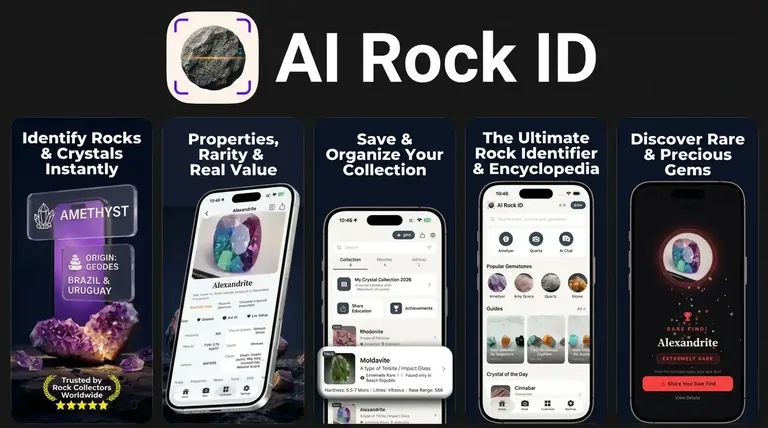
The AI Rock ID iPhone app excels at detecting these mineralogical differences because it analyzes the reflective properties and color signatures of individual mineral grains in your photos. For best results, photograph your specimen in natural daylight where quartz crystals will show their characteristic vitreous luster.
Other Granite Lookalikes to Consider
Beyond gneiss and diorite, several other rocks can resemble granite at first glance. Granodiorite occupies a compositional middle ground between granite and diorite, containing moderate quartz amounts and a mix of alkali and plagioclase feldspar. Tonalite and trondhjemite are quartz-rich like granite but contain predominantly plagioclase feldspar, giving them a grayer overall appearance.
Pegmatite presents an interesting case, it's essentially granite with extremely large crystals, sometimes measuring several centimeters or even meters across. Pegmatite forms from the last stages of magma crystallization when water-rich fluids allow rapid crystal growth. If your specimen has the right minerals but unusually large crystal sizes, it may be pegmatite rather than typical granite.
Rhyolite shares granite's chemical composition but cooled rapidly at Earth's surface, creating fine-grained or glassy texture rather than visible crystals. Some rhyolite contains larger crystals (phenocrysts) embedded in fine-grained groundmass, which can cause confusion. The RockIdentifier.io tool analyzes overall texture to distinguish between these compositionally similar but texturally different rocks.
Photography Tips for Accurate Granite Identification
Capturing high-quality photos dramatically improves AI identification accuracy for granite and similar coarse-grained rocks. Natural daylight provides the best illumination, revealing the true colors and luster of individual mineral grains. Avoid direct harsh sunlight, which creates strong shadows and washed-out highlights that obscure crystal boundaries. Overcast conditions or open shade produce ideal diffused lighting.
Focus on a fresh, unweathered surface whenever possible. Granite weathers to a rough, often discolored surface that masks its true mineral content. If you can safely break the specimen or find a naturally fresh face, photograph that surface. Include a scale reference like a coin or ruler to help convey crystal size, which aids in distinguishing granite from fine-grained equivalents.
Take multiple photos from different angles, including at least one close-up showing individual mineral grains and one showing the overall specimen. If you suspect the rock might be gneiss, specifically photograph any areas that might show banding or mineral alignment. Upload the clearest image to RockIdentifier.io for analysis, and consider using the AI Rock ID app in the field where you can capture multiple angles quickly.
Regional Granite Varieties and Their Characteristics
Granite occurs worldwide with regional variations in color and mineral content that reflect local geological conditions. Pink granites, common in areas like the Scottish Highlands and parts of Texas, contain abundant pink orthoclase feldspar. Gray granites from regions like New Hampshire and parts of Scandinavia feature more plagioclase feldspar. White granites, prized for monuments and building stone, contain predominantly white feldspar varieties.
Some famous granite varieties have distinctive characteristics worth knowing. Rapakivi granite from Finland displays large pink feldspar crystals rimmed with white plagioclase, a unique texture called rapakivi texture. Orbicular granite contains spherical structures of alternating mineral layers, creating eye-catching patterns. These unusual varieties can be identified through our AI system, which recognizes patterns beyond standard granite identification.
Understanding your local geology helps narrow identification possibilities. If you're collecting in an area known for granite batholiths (large intrusive bodies), finding granite is more likely. Conversely, in regions dominated by metamorphic terrain, apparent granite might actually be gneiss. The AI provides context about common rock types when possible, helping you understand your specimen within its geological setting.
Limitations of Photo-Based Granite Identification
While AI photo analysis provides valuable guidance, certain limitations apply to granite identification. Heavily weathered specimens may have altered surface minerals that don't reflect the rock's true composition. Very fine-grained granites approaching the boundary with aplite may be difficult to distinguish from other rock types without microscopic analysis. Similarly, rocks with unusual mineral assemblages may require professional geological assessment.
Color accuracy in photographs affects identification reliability. Camera white balance settings, artificial lighting, and image compression can all alter how mineral colors appear. When possible, include a color reference card in your photo or note the lighting conditions. If the AI identification seems inconsistent with your observations, try photographing under different lighting conditions.
Some identification questions ultimately require laboratory analysis. Distinguishing between specific feldspar types, confirming exact quartz percentages, or identifying trace minerals may need thin-section microscopy or chemical analysis. Our AI provides the most probable identification based on visible characteristics, but we recommend professional consultation for specimens requiring precise classification for scientific or commercial purposes.
Using Your Granite Identification Results
Once you've confirmed a specimen as granite, understanding its specific variety opens doors for collectors and geology enthusiasts. Note the dominant feldspar color, relative abundance of dark minerals, and any unusual features like large phenocrysts or graphic intergrowths between quartz and feldspar. These details help you identify the granite's probable source region and formation conditions.
For educational purposes, granite specimens make excellent teaching tools for understanding igneous rock formation and mineral identification. The large, visible crystals allow students to practice identifying quartz, feldspar, and mica without magnification. Comparing confirmed granite samples with gneiss and diorite specimens creates valuable reference sets for field identification practice.
If you're evaluating granite for practical applications like landscaping or building material, identification helps assess durability and aesthetic properties. True granite's high quartz content makes it harder and more weather-resistant than diorite. The specific mineral composition affects how the stone will weather over time and its suitability for different applications. Use the detailed analysis from RockIdentifier.io to make informed decisions about your granite specimens.
How to Use This Granite Identifier
Prepare Your Specimen
Find a fresh, unweathered surface on your rock. Clean off any dirt or debris that might obscure mineral grains. If possible, lightly wet the surface to enhance mineral visibility and color contrast.
Capture Quality Photos
Photograph in natural daylight, avoiding harsh shadows. Take a close-up showing individual mineral crystals and a wider shot showing overall texture. Include a scale reference if available.
Upload to RockIdentifier.io
Select your clearest photo and upload it to our free web tool. The AI will analyze crystal structure, mineral composition, and texture patterns within seconds.
Review Your Results
Examine the identification results, including confidence levels and similar rock types. Check whether the AI detected granite's characteristic random mineral distribution or gneiss-like banding.
Compare and Confirm
Use the detailed mineral breakdown to verify the identification matches your specimen. If uncertain, upload additional photos from different angles or try the AI Rock ID iPhone app for field verification.
More Identification Tools
Rock Identifier
General-purpose AI rock identification for all rock types and geological specimens
Mineral Identifier
Identify individual minerals like quartz, feldspar, and mica found within granite
Quartz Identifier
Specialized identification for quartz varieties, a key granite component
Stone Identifier
Identify building stones and decorative rocks including commercial granite
Crystal Identifier
Analyze crystal structures and formations found in igneous rocks
Obsidian Identifier
Identify volcanic glass and other rapidly-cooled igneous materials
Frequently Asked Questions
How can I tell if my rock is granite or gneiss?
Examine the mineral distribution pattern carefully. Granite displays randomly scattered minerals with no preferred orientation, while gneiss shows distinct banding where light and dark minerals have segregated into parallel layers. Rotate your specimen and look for any striping or foliation, if minerals align in bands, it's likely gneiss. Our AI specifically analyzes these textural patterns to distinguish between the two rock types.
What minerals should I look for to confirm granite?
True granite must contain visible quartz crystals (glassy, translucent, gray or slightly smoky), which should make up 20-60% of the rock. You should also see abundant feldspar (pink, white, or gray opaque crystals) and smaller amounts of dark minerals like biotite mica (black, flaky) or hornblende (black, elongated). If you can't identify quartz, the rock may be diorite or gabbro instead.
Why does my granite countertop look different from granite rocks I find outside?
Commercial 'granite' countertops often include rocks that geologists wouldn't classify as true granite, including gabbro, anorthosite, and various gneisses. The stone industry uses 'granite' broadly for any hard, polished igneous or metamorphic rock. Additionally, polished surfaces reveal colors and patterns differently than rough natural surfaces, and countertop slabs are selected for visual appeal rather than geological accuracy.
Can granite be black or very dark colored?
True granite is rarely very dark because it must contain significant quartz and alkali feldspar, both light-colored minerals. Rocks sold as 'black granite' are typically gabbro, diabase, or dark anorthosite. If your specimen is predominantly black with only minor light-colored minerals, it's likely not true granite. Our AI can identify these dark igneous rocks and explain their actual classification.
How accurate is AI identification for granite versus similar rocks?
AI identification achieves high accuracy for distinguishing granite from clearly different rock types and can reliably detect the banding patterns that separate granite from gneiss. However, rocks at compositional boundaries (like granodiorite) may receive multiple possible identifications. Photo quality significantly affects accuracy, clear images of fresh surfaces with visible mineral grains produce the most reliable results.
What's the difference between granite and granodiorite?
Granodiorite contains less alkali feldspar and more plagioclase feldspar than true granite, giving it a grayer overall appearance. Both contain similar quartz amounts. The distinction matters mainly for geological classification, both rocks form similarly and have comparable physical properties. Our AI analyzes feldspar color ratios to suggest whether your specimen falls into the granite or granodiorite category.
Can I identify granite from a weathered surface?
Weathered granite surfaces can be identified, but accuracy decreases because weathering alters mineral colors and obscures crystal boundaries. Feldspar weathers to clay minerals, changing from pink or white to tan or brown. Quartz resists weathering and may stand out as raised, glassy patches. For best results, find or create a fresh surface, or note that your specimen is weathered when interpreting AI results.
Is pink granite more valuable or different from gray granite?
Color differences reflect feldspar chemistry rather than quality or value. Pink granite contains potassium-rich orthoclase feldspar, while gray granite has more sodium-rich plagioclase. Both are equally 'true' granite geologically. Commercial value depends on aesthetics, rarity of specific patterns, and quarry location rather than color alone. Our AI identifies both varieties as granite while noting the dominant feldspar type.