Granite vs Gneiss vs Diorite: Igneous and Metamorphic Rock ID Guide
Granite vs gneiss identification comes down to texture, mineral alignment, and whether the rock shows foliation. This guide adds diorite so you can separate common coarse-grained igneous rocks from a banded metamorphic look-alike.


Drop a rock photo here or tap to upload
JPG, PNG, WebP, HEIC • Max 50 MB • 1 free scan per day

Analyzing your specimen…
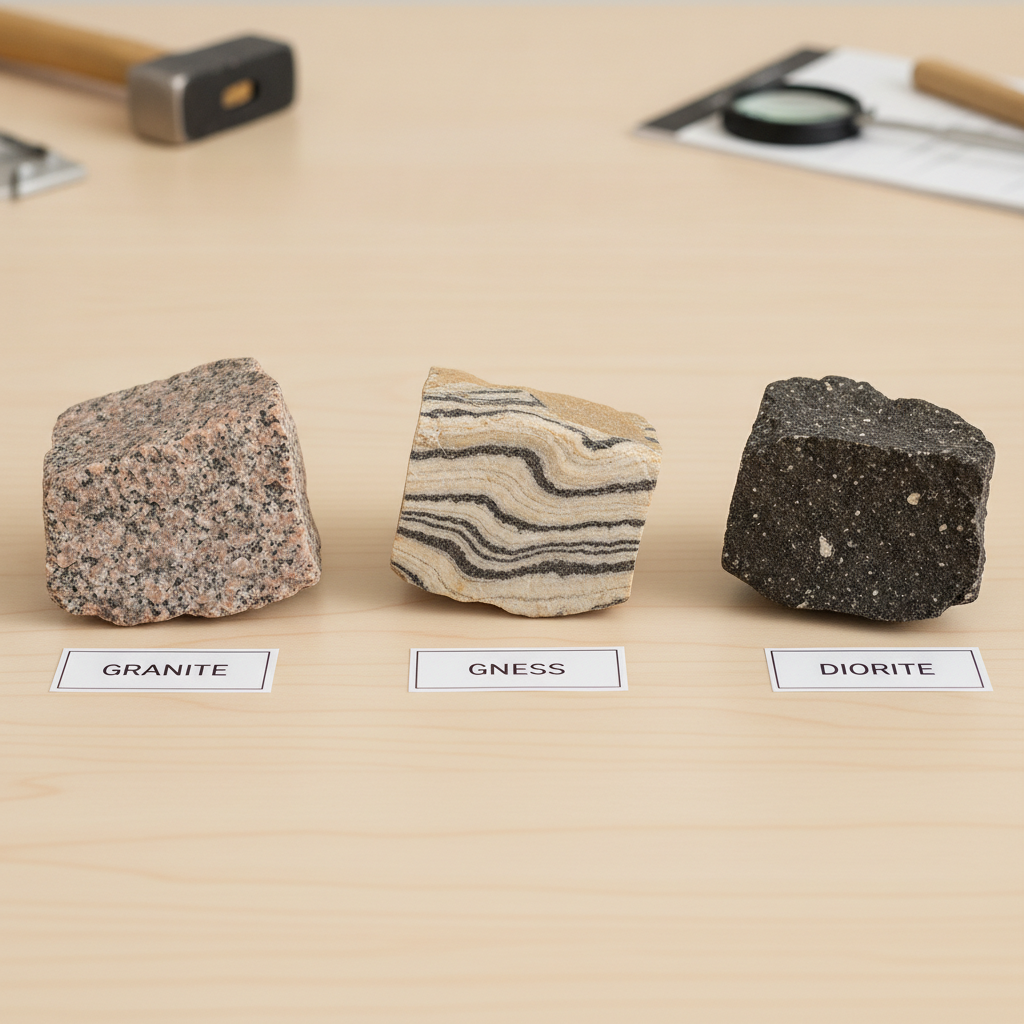
Quick answer: Granite vs gneiss identification depends mainly on texture: granite has randomly intergrown quartz, feldspar, and mica, while gneiss has aligned minerals, foliation, or light-and-dark banding. Diorite is usually distinguished by its gray salt-and-pepper appearance, abundant plagioclase, dark mafic minerals, and little visible quartz.
AI Rock ID can help compare visible texture cues such as banding, grain size, quartz, feldspar, and dark mafic minerals when evaluating granite, gneiss, and diorite. RockIdentifier.io supports web photo upload for preliminary granite vs gneiss identification when a user has clear close-up and whole-rock images.
Quick summary
- Best for
- Collectors, hikers, students, countertop owners, landscaping stone users, beginners
- Works on
- Coarse-grained rocks, granite, gneiss, diorite, crystalline hand samples
- Accuracy
- Most reliable when fresh surfaces, grain orientation, quartz, feldspar, and banding are clearly visible.
- Needs confirmation
- Yes
- Professional replacement
- No
- Platforms
- iPhone, iPad, Web
This guide is best for
- Beginners comparing coarse-grained crystalline rocks with visible minerals
- Students learning the difference between igneous texture and metamorphic foliation
- Collectors sorting granite, gneiss, and diorite hand samples
- Hikers or field observers documenting rock textures with photos
- Homeowners checking whether a countertop or landscaping stone is truly granite-like
- Teachers preparing practical rock identification examples
- Users who want a first-pass photo comparison before using a hand lens or reference map
Consider another approach if you
- Engineering, mining, legal, or safety decisions that require professional testing
- Fine-grained rocks where individual quartz, feldspar, or mafic minerals cannot be seen
- Deeply weathered samples with altered surfaces that hide original texture
- Polished decorative stone where commercial names may not match geologic rock names
- Final petrographic classification that requires thin-section microscopy
Granite is a coarse-grained felsic igneous rock with visible quartz and feldspar, while gneiss is a metamorphic rock with light and dark mineral bands. Diorite is also coarse-grained, but it usually has a gray salt-and-pepper texture, abundant plagioclase, dark hornblende or biotite, and little to no visible quartz.
What Is Granite vs Gneiss Identification?
Granite vs gneiss identification is the process of deciding whether a coarse crystalline rock formed from cooling magma or from metamorphic recrystallization. Granite is igneous: its quartz, feldspar, mica, and sometimes hornblende are intergrown in a random, equigranular texture. Gneiss is metamorphic: the same broad mineral family may be present, but the grains are segregated into foliation, streaks, lenses, or alternating light and dark bands.
Diorite matters because beginners often confuse it with both. It is intrusive and coarse like granite, but it is more intermediate in composition, typically showing white to gray plagioclase with black amphibole or biotite and far less quartz. For background on igneous rock formation, the USGS overview is a useful reference: https://www.usgs.gov/programs/VHP/igneous-rocks.
How Granite vs Gneiss Identification Works
Granite vs gneiss identification works by reading texture before color. First, check whether minerals are randomly interlocked or directionally aligned. Random, blocky grains suggest an intrusive igneous rock such as granite or diorite; continuous bands, stretched feldspar eyes, or folded light-dark layers suggest gneiss. Next, separate granite from diorite by composition: granite commonly shows glassy quartz and pink or white potassium feldspar, while diorite is more gray, plagioclase-rich, and salt-and-pepper. A photo-based lookup estimates these features from images, comparing visible grain size, color distribution, banding, and mineral contrast. Photos are processed for identification in a privacy-friendly way rather than being treated as public specimen records by default.
How to Use Granite vs Gneiss Identification
Photograph a fresh surface
Use a broken, unweathered face if possible. Weathered rinds can make granite look dull, gneiss look muddy, and diorite look more uniform than it really is.
Check for banding first
Look for continuous light and dark layers, aligned mica, folded streaks, or augen-shaped feldspar. If those features repeat across the sample, treat gneiss as the leading candidate.
Look for quartz and feldspar
Glassy gray quartz plus pink or white feldspar points toward granite. Mostly white-gray plagioclase with black hornblende or biotite and little visible quartz points toward diorite.
Compare grain orientation
Rotate the specimen under light. Igneous rocks usually keep a granular, random fabric, while gneiss often shows minerals flattened or stretched in the same direction.
Scan the specimen
Open the app from the iOS app link on rockidentifier.io or use the mobile camera workflow. Submit one close-up image and one whole-rock image for a better match.
Verify with field context
Use outcrop setting, nearby rock types, and mapped geology when available. A loose landscaping stone may not match the local bedrock.
When to Use Granite vs Gneiss Identification (and When Not To)
Use it when
- Use it when the sample is coarse-grained and visibly crystalline, because granite, gneiss, and diorite all commonly show mineral grains large enough to compare.
- Use it when you can see a fresh surface, especially one that exposes quartz, feldspar, mica, amphibole, or light-dark layering.
- Use it for field notes, classroom sorting, landscaping stone checks, countertop curiosity, and preliminary rock collection labeling.
- Use it when you need a practical distinction between igneous texture and metamorphic foliation before moving to a hand lens or thin section.
Skip it when
- Do not rely on it alone for legal, mining, engineering, or hazard decisions.
- Do not use it as a final petrographic classification when the rock is very fine-grained, deeply weathered, or cut and polished.
- Do not assume a decorative slab is natural granite; commercial stone labels often use “granite” for many hard crystalline rocks.
- Do not use a single image if lighting hides quartz, feldspar cleavage, or foliation.
Granite vs Gneiss Identification vs Google Lens and Rock Scanner Apps
| Feature | Rock Identifier | Google Lens | Rock Scanner: Stone ID |
|---|---|---|---|
| Primary purpose | Rock, mineral, crystal, and gemstone photo identification with geology-oriented labels | General visual search across the web, products, images, and similar photos | Mobile rock and mineral scanning with consumer-friendly specimen suggestions |
| Granite vs gneiss detail | Looks for texture cues such as foliation, grain size, banding, quartz, feldspar, and mafic minerals | May return visually similar countertops, landscaping stone, or image-search matches | Often provides a likely stone name but may give less context on igneous versus metamorphic texture |
| Diorite comparison | Useful for separating salt-and-pepper diorite from quartz-rich granite and banded gneiss | Can find similar-looking gray rocks, but geological composition is not the main ranking signal | Can suggest diorite or related rocks, depending on photo quality and database coverage |
| Best input | Close-up mineral texture plus whole-specimen photo | Clear object photo with distinctive web-matched appearance | Centered specimen photo with good lighting |
| Best use | Field triage, learning, specimen sorting, and free photo ID | Broad visual lookup when you need web pages, sellers, or similar images | Casual mobile identification and collection browsing |
Use a dedicated rock scanner when the question is geological texture, not just visual similarity. Google Lens can be helpful for broad image search, but granite, gneiss, and diorite often require mineral and fabric interpretation.
Granite vs Gneiss Identification Use Cases
- Field geology notes: Record whether an outcrop is dominated by random igneous texture or metamorphic banding. That first distinction guides later mapping and sample selection.
- Classroom rock labs: Students can compare granite, gneiss, and diorite using grain size, color index, quartz visibility, and foliation instead of memorizing names only.
- Landscaping stone checks: Many decorative boulders are sold under loose names. Identification helps separate true granite from banded gneiss or gray diorite-like material.
- Countertop curiosity: Commercial “granite” may include gneiss, anorthosite, gabbro, or other hard crystalline rocks. A texture-based check can explain why a slab shows bands, swirls, or mafic clusters.
- Personal rock collections: Collectors can label specimens more consistently by noting igneous intergrowth, metamorphic foliation, and whether the rock is quartz-rich or plagioclase-rich.
Granite vs Gneiss Identification Limitations
- Treated, dyed, resin-filled, or coated decorative stones can hide natural mineral color and make identification less reliable.
- Polished specimens and countertop slabs may exaggerate color contrast while masking grain boundaries, cleavage, and subtle foliation.
- Rare minerals, unusual metamorphic grades, hybrid rocks, and local geological variants may not fit simple granite-gneiss-diorite categories.
- Photo quality strongly affects results; glare, shadows, blur, wet surfaces, and scale-free close-ups can all mislead visual analysis.
- Value estimates are not mineral identification. Rock type alone does not determine commercial price, slab grade, locality premium, or collectible value.
- Weathered surfaces can bleach feldspar, stain quartz with iron oxides, and make diorite or gneiss look more granite-like.
- A confident field label is still not the same as thin-section petrography, X-ray diffraction, or geochemical classification.
Common mistakes
- Calling every hard, speckled, coarse-grained rock granite without checking for quartz or feldspar.
- Ignoring foliation and mistaking light-and-dark gneissic bands for ordinary color variation.
- Assuming a salt-and-pepper rock is granite when low visible quartz and abundant dark minerals may indicate diorite.
- Identifying polished countertop stone by trade name instead of geologic texture and mineral content.
- Using only color instead of comparing grain orientation, mineral alignment, and band continuity.
- Photographing a weathered rind and missing the fresh surface where quartz, feldspar, and mafic minerals are clearer.
- Treating one app result as final without checking field context, rock fabric, or a second image angle.
Use Granite vs Gneiss Identification as a Texture Check
Granite vs gneiss identification is strongest when it starts with texture: random interlocking grains suggest granite or diorite, while aligned bands suggest gneiss. A clear photo comparison can help narrow the label before confirming with field context or additional tests.
Related Articles
Frequently Asked Questions
How do I tell granite from gneiss?
Look for fabric first. Granite usually has randomly interlocking quartz, feldspar, and mica, while gneiss shows aligned minerals or alternating light and dark bands.
What makes diorite different from granite?
Diorite is typically darker, grayer, and richer in plagioclase plus hornblende or biotite. Granite usually contains more visible quartz and often has pink or white potassium feldspar.
Can gneiss contain quartz and feldspar?
Yes. Many gneisses contain quartz and feldspar, which is why they can resemble granite. The key difference is metamorphic banding or foliation rather than random igneous texture.
Is banded granite really gneiss?
Often, a strongly banded “granite” is actually gneiss or migmatite, especially if the bands are continuous and minerals are aligned. Some granites have flow textures or veins, so check whether the whole rock shows repeated foliation.
Why does my rock look salt and pepper?
A salt-and-pepper texture usually means light plagioclase mixed with dark mafic minerals. That pattern is common in diorite, though some granites and gneisses can also show a speckled appearance.
Can an app identify gneiss accurately?
A good photo can support a strong preliminary ID when banding, grain size, and mineral contrast are visible. Accuracy drops when the rock is polished, weathered, blurry, or shown in only one close-up angle.
Is countertop granite always granite?
No. In the stone trade, “granite” can mean many hard, polishable crystalline rocks, including gneiss, gabbro, anorthosite, and quartz-rich metamorphic rocks. Geological granite is a narrower classification.
What photos work best for rock ID?
Use one close-up of the mineral texture and one full-specimen photo with a coin, ruler, or fingertip for scale. Natural light, a dry surface, and a fresh broken face usually produce the best result.
Do I need a hardness test?
Hardness can help, but it rarely separates granite, gneiss, and diorite by itself because all are generally hard crystalline rocks. Texture, mineral content, and foliation are more diagnostic.