
Turquoise Identifier - Spot Fakes Instantly
Upload turquoise photos
Clear, well-lit images help the AI identify it more accurately.

Analyzing turquoise characteristics...
Checking texture, color, structure, and lookalikes…
Upload a photo of your turquoise specimen and let our AI analyze its authenticity. Quickly distinguish genuine turquoise from dyed howlite and other imitations.


Turquoise has captivated humanity for over 7,000 years, adorning everything from ancient Egyptian jewelry to Native American ceremonial pieces. Unfortunately, this enduring popularity has made turquoise one of the most frequently faked gemstones on the market, with dyed howlite being the most common impostor.
Our free turquoise identifier uses advanced AI image recognition to analyze your specimen's color patterns, matrix characteristics, and surface texture. Whether you've inherited a vintage piece or found a promising stone at a gem show, RockIdentifier.io helps you determine if you're holding genuine turquoise or a convincing imitation.
Good fit for
- Verifying turquoise jewelry purchases before buying
- Distinguishing natural turquoise from dyed howlite
- Identifying turquoise matrix patterns and origins
- Checking estate jewelry for authentic turquoise
- Learning visual differences between turquoise grades
Not for
- Appraising monetary value of turquoise pieces
- Detecting stabilized vs natural turquoise chemically
- Certifying turquoise for insurance purposes
- Identifying microscopic treatments or enhancements
At a glance
Turquoise is a hydrated copper aluminum phosphate mineral prized for its distinctive blue-to-green coloration. It forms in arid regions where copper-rich groundwater reacts with aluminum and phosphorus minerals, creating the characteristic veined matrix patterns.
| Chemical Formula | CuAl₆(PO₄)₄(OH)₈·4H₂O |
|---|---|
| Mohs Hardness | 5-6 |
| Color Range | Sky blue to green-blue |
| Crystal System | Triclinic |
| Primary Sources | Iran, USA (Arizona, Nevada), China |
| Common Imitation | Dyed howlite, magnesite, plastic |
Why Turquoise Identification Matters
The turquoise market presents a significant challenge for collectors and buyers alike. Industry estimates suggest that up to 90% of turquoise sold today has been treated, stabilized, or is outright fake. Dyed howlite, a white calcium borosilicate mineral that readily absorbs dye, accounts for the majority of turquoise imitations because it can be colored to closely mimic genuine turquoise at a fraction of the cost.
Understanding the difference between authentic turquoise and its imitations protects both your investment and your appreciation of this remarkable mineral. Natural, untreated turquoise commands premium prices, while stabilized turquoise (genuine turquoise infused with resin for durability) occupies a middle ground. Completely fake turquoise made from dyed howlite or plastic has minimal value beyond costume jewelry applications.
Our AI turquoise identifier examines visual characteristics that distinguish genuine specimens from fakes, giving you an informed starting point before making purchasing decisions or seeking professional gemological evaluation.
Turquoise vs Dyed Howlite: Key Visual Differences
Genuine turquoise displays a distinctive matrix pattern, the dark veining that runs through the stone. This matrix consists of the host rock (often limonite, sandstone, or other minerals) in which the turquoise formed. In authentic specimens, the matrix appears organic and irregular, with varying widths and natural branching patterns that reflect geological processes occurring over millions of years.
Dyed howlite, by contrast, has its own natural gray veining that becomes dark when dyed. However, these veins tend to appear more uniform and web-like compared to genuine turquoise matrix. The veining in howlite often looks too perfect or evenly distributed, lacking the random, organic quality of natural turquoise matrix patterns.
Color distribution offers another telling clue. Natural turquoise typically shows subtle color variations and gradients within the blue-green areas, reflecting the mineral's formation conditions. Dyed howlite often displays suspiciously uniform color saturation, though skilled dyers have become adept at creating more natural-looking variations. When photographing your specimen for AI analysis on RockIdentifier.io, capture these color nuances by using natural lighting and multiple angles.
Understanding Turquoise Grades and Types
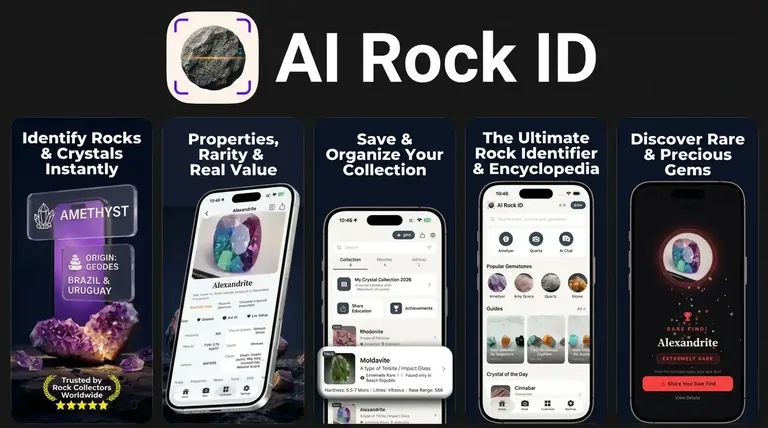
Natural turquoise exists along a quality spectrum that affects both appearance and value. Gem-grade natural turquoise, sometimes called "high-blue" or "Persian blue," displays intense, even coloration with minimal matrix. This top-tier material is increasingly rare and commands the highest prices. The AI Rock ID iPhone app can help you recognize these premium characteristics when evaluating specimens.
Matrix turquoise, featuring prominent veining patterns, represents the majority of genuine turquoise on the market. Famous varieties include Kingman turquoise from Arizona (known for its bright blue color and black matrix), Sleeping Beauty turquoise (prized for its pure robin's-egg blue with minimal matrix), and Bisbee turquoise (featuring distinctive chocolate-brown matrix). Each mine produces turquoise with characteristic patterns that experienced collectors can identify.
Stabilized turquoise is genuine turquoise that has been infused with clear resin or other hardening agents to improve durability. This treatment is widely accepted in the jewelry industry and doesn't constitute fraud when properly disclosed. However, stabilized turquoise should be priced lower than natural, untreated material. Our identifier can help you recognize the visual characteristics of different turquoise types, though chemical treatments may require laboratory testing to confirm.
How to Photograph Turquoise for Accurate AI Analysis
Capturing quality images significantly improves identification accuracy when using our turquoise identifier. Natural daylight provides the most accurate color representation, photograph your specimen near a window or outdoors in indirect sunlight. Avoid artificial lighting, which can cast color tints that alter the apparent hue of your turquoise.
Include multiple angles in your analysis. Photograph the face of the stone, any visible edges, and the back if accessible. Matrix patterns and color variations become more apparent from different perspectives. For jewelry pieces, try to capture areas where the turquoise meets the setting, as this junction sometimes reveals clues about the material's authenticity.
Place a white background behind your specimen to provide color reference, and include a common object like a coin for scale. Close-up shots that fill the frame with the turquoise surface allow our AI to analyze texture details, surface luster, and matrix characteristics more effectively. The RockIdentifier.io web tool accepts high-resolution images, so don't compress your photos before uploading.
Other Common Turquoise Imitations and Lookalikes
While dyed howlite dominates the fake turquoise market, several other materials masquerade as genuine turquoise. Dyed magnesite, another white mineral that accepts dye readily, produces imitations with a slightly different matrix pattern than howlite. Magnesite fakes often display a more porous surface texture visible under magnification.
Reconstituted turquoise, made from turquoise powder mixed with binding agents and pressed into shape, technically contains real turquoise but lacks the natural structure of genuine specimens. This material often appears too uniform in color and may show tiny air bubbles or an unnaturally smooth matrix pattern. Block turquoise, a similar product, uses larger turquoise fragments in a resin matrix.
Plastic and resin imitations represent the lowest-quality fakes. These materials feel warmer to the touch than genuine turquoise (which feels cool against skin) and may show mold lines or an unnaturally glossy surface. Some sophisticated plastic fakes incorporate weight additives to mimic turquoise's heft. Our AI identifier analyzes surface characteristics that often distinguish these synthetic materials from natural mineral specimens.
Traditional Testing Methods for Turquoise
Beyond AI photo analysis, several hands-on tests can help verify turquoise authenticity. The acetone test involves rubbing a cotton swab dampened with nail polish remover across an inconspicuous area, dyed howlite and magnesite will often transfer color to the swab, while genuine turquoise will not. However, this test can damage stabilized turquoise and should be performed carefully.
The hot needle test, where a heated needle is touched to the specimen's surface, causes plastic imitations to melt or emit a chemical odor. Genuine turquoise and howlite will not react this way. This destructive test should only be performed on areas that won't affect the piece's appearance or value.
Examining your specimen under magnification reveals surface characteristics invisible to the naked eye. Genuine turquoise displays a waxy to sub-vitreous luster with natural surface irregularities. Dyed materials may show dye concentrations in surface pits or along fracture lines. The AI Rock ID app provides a convenient first-step analysis before deciding whether to pursue these more invasive testing methods.
Turquoise Origins and Their Distinctive Characteristics
Geographic origin significantly influences turquoise appearance, and knowledgeable collectors often seek specimens from specific mines. Persian turquoise from Iran has been prized for millennia for its intense, even blue color and minimal matrix. This material set the standard by which all other turquoise is judged, though Iranian exports have become limited in recent decades.
American Southwest turquoise encompasses dozens of distinct mines, each producing material with recognizable characteristics. Nevada's Lander Blue turquoise, featuring dark spiderweb matrix against bright blue, ranks among the most valuable American varieties. Arizona's Morenci turquoise displays distinctive pyrite inclusions that create a unique sparkle effect. New Mexico's Cerrillos turquoise, mined by Native Americans for over a thousand years, shows characteristic green-blue coloration.
Chinese turquoise has flooded the market in recent decades, ranging from genuine high-quality material to heavily treated or fake specimens. Hubei Province produces significant quantities of turquoise, some rivaling American material in quality. However, Chinese turquoise is also frequently stabilized or enhanced, making careful evaluation essential. Upload photos of any turquoise specimen to RockIdentifier.io for AI-assisted analysis of these origin-specific characteristics.
Limitations of Visual Turquoise Identification
While AI photo analysis provides valuable insights, certain turquoise authentication questions require laboratory testing. Distinguishing natural turquoise from stabilized turquoise often requires specific gravity measurements, infrared spectroscopy, or other instrumental analysis that cannot be performed through photographs alone.
High-quality imitations continue to improve, and some dyed howlite specimens are expertly crafted to fool even experienced collectors at first glance. Our AI identifier serves as an excellent screening tool and educational resource, but significant purchases should be verified through gemological laboratory certification. Organizations like the Gemological Institute of America (GIA) provide definitive turquoise authentication services.
The AI Rock ID iPhone app and RockIdentifier.io web tool excel at identifying obvious fakes, teaching you to recognize authentic turquoise characteristics, and providing a knowledgeable starting point for further investigation. Use our free identifier to build your turquoise recognition skills and make more informed decisions when evaluating specimens in the field or marketplace.
How to Use This Turquoise Identifier
Capture Clear Photos
Photograph your turquoise in natural daylight against a white background. Include close-ups of the matrix pattern and any color variations visible on the surface.
Upload to RockIdentifier.io
Use our free web tool or the AI Rock ID iPhone app to submit your turquoise photos for instant AI analysis.
Review AI Analysis
Examine the identification results, including assessments of color characteristics, matrix patterns, and potential material matches.
Compare Characteristics
Cross-reference the AI findings with known turquoise characteristics from specific mines or common imitation materials like dyed howlite.
Seek Professional Verification
For valuable pieces or uncertain results, consult a certified gemologist or gemological laboratory for definitive authentication.
More Identification Tools
Gemstone Identifier
Identify various gemstones including turquoise, jade, and other precious stones from photos.
Mineral Identifier
Analyze mineral specimens and learn about their chemical composition and properties.
Stone Identifier
General stone identification for rocks, minerals, and lapidary materials.
Crystal Identifier
Identify crystal specimens and learn about their formation and characteristics.
Quartz Identifier
Specialized identification for quartz varieties and similar silicate minerals.
Rock Identifier
Our main AI rock identification tool for all types of geological specimens.
Frequently Asked Questions
How can I tell if my turquoise is real or dyed howlite?
Examine the matrix pattern carefully, genuine turquoise has irregular, organic veining while dyed howlite often shows more uniform, web-like patterns. Real turquoise also displays subtle color variations, whereas dyed howlite may appear suspiciously even in color. Upload photos to our AI identifier for detailed analysis of these distinguishing characteristics.
Does real turquoise have black lines in it?
Yes, many genuine turquoise specimens feature dark matrix lines, which are remnants of the host rock in which the turquoise formed. This matrix can appear black, brown, golden, or reddish depending on the mineral composition. The pattern and distribution of these lines help identify turquoise origin and distinguish it from imitations.
Why does some turquoise turn green over time?
Genuine turquoise can shift from blue toward green due to exposure to body oils, cosmetics, sunlight, or dehydration. This color change, called "greening," affects natural and stabilized turquoise differently. Heavily stabilized turquoise resists color change better, while natural turquoise may develop a desirable patina that some collectors prize.
Is stabilized turquoise considered fake?
No, stabilized turquoise is genuine turquoise that has been treated with resin or other hardening agents to improve durability. This widely accepted practice makes softer turquoise suitable for jewelry use. However, stabilized turquoise should be disclosed and priced lower than natural, untreated material. It's different from completely fake turquoise made from dyed howlite or plastic.
What is the most valuable type of turquoise?
Natural, untreated turquoise with intense blue color and minimal matrix commands the highest prices. Historically significant varieties include Persian turquoise and rare American specimens like Lander Blue or high-grade Bisbee turquoise. Provenance, color saturation, hardness, and lack of treatment all contribute to turquoise value.
Can the acetone test damage my turquoise?
The acetone test can potentially damage stabilized turquoise by dissolving the resin treatment, leaving a dull spot on the surface. It's generally safe for natural, untreated turquoise but should always be performed on an inconspicuous area. Consider using our non-invasive AI photo identifier first before attempting any chemical tests.
How accurate is AI turquoise identification from photos?
AI photo analysis effectively identifies obvious fakes and recognizes characteristic turquoise features like matrix patterns and color distribution. However, distinguishing natural from stabilized turquoise or detecting sophisticated treatments typically requires laboratory testing. Our AI identifier provides an excellent screening tool and educational resource for building your turquoise recognition skills.
Where does most fake turquoise come from?
The majority of fake turquoise consists of dyed howlite or magnesite, much of it produced in China for the global market. These imitations range from obvious fakes to sophisticated copies that challenge even experienced collectors. Learning to recognize authentic turquoise characteristics through tools like RockIdentifier.io helps protect you from purchasing misrepresented material.