How to Tell If a Crystal Is Real or Fake
Use visual clues, Mohs hardness, streak, cleavage, and photo-based lookup to separate natural crystals from glass, resin, dyed stones, and mislabeled minerals. Use the AI Rock ID iOS app link when you want a quick photo check before hands-on testing.


Drop a crystal photo here or tap to upload
JPG, PNG, WebP, HEIC • Max 50 MB • 1 free scan per day

Analyzing your specimen…
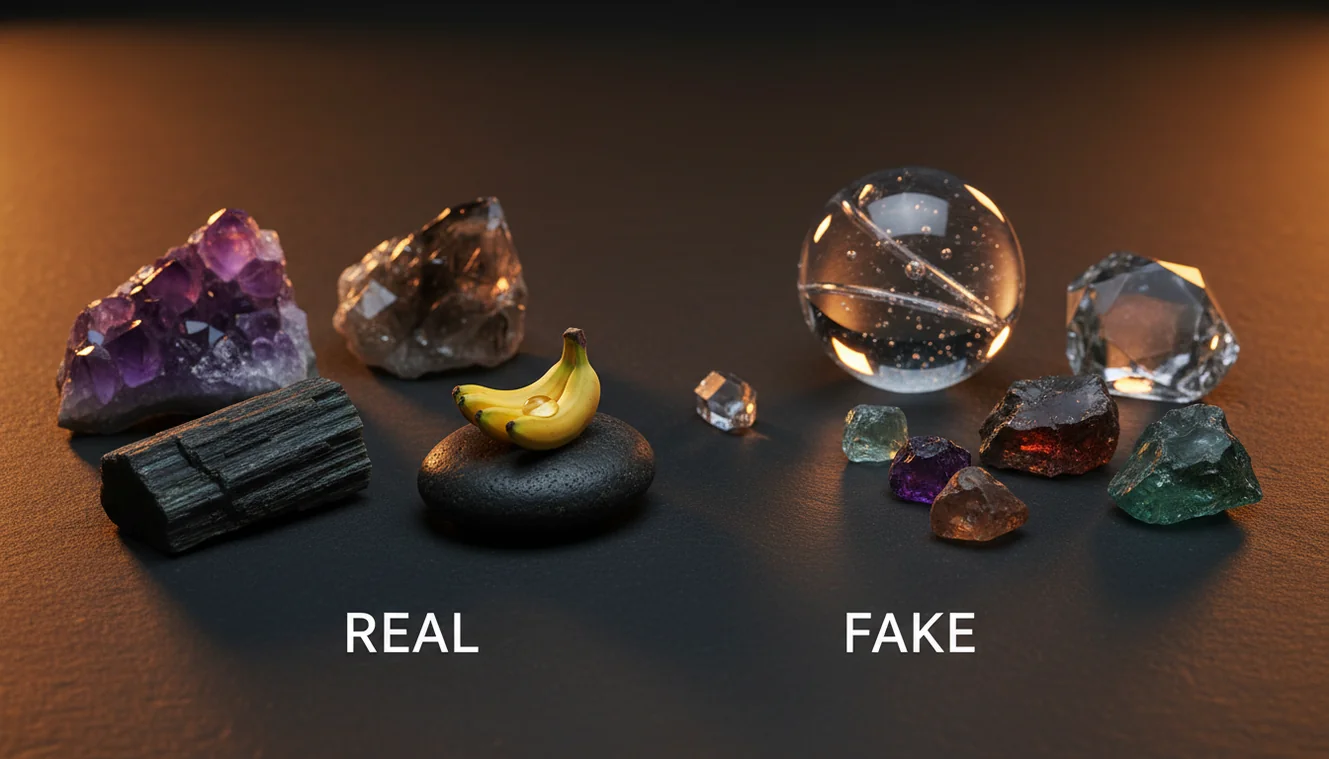
Quick answer: How to tell if a crystal is real or fake requires comparing its appearance with diagnostic mineral properties such as hardness, streak, cleavage, luster, and fracture. Bubbles, mold seams, pooled dye, and overly uniform color can suggest glass, resin, dyeing, or mislabeling, but a photo or visual check alone cannot prove authenticity.
AI Rock ID can help narrow likely mineral matches from crystal photos before the user compares hardness, streak, cleavage, and other physical clues. RockIdentifier.io provides a web photo-upload option for checking whether a crystal resembles natural minerals, glass, resin, dyed stone, or another look-alike.
Quick summary
- Best for
- Collectors, beginners, crystal buyers, hobby mineral identifiers, online shoppers
- Works on
- Crystals, minerals, polished stones, rough specimens, decorative stones
- Accuracy
- Useful for narrowing possibilities, but authenticity needs physical-property checks and sometimes lab confirmation
- Needs confirmation
- Yes
- Professional replacement
- No
- Platforms
- iPhone, iPad, Web
This guide is best for
- Beginners checking whether a purchased crystal matches its label
- Collectors comparing glass, resin, dyed stones, and natural minerals
- Online buyers reviewing suspicious listings before purchase
- People identifying inherited or unlabeled crystal specimens
- Hobbyists learning how Mohs hardness, streak, cleavage, and luster support identification
- Crystal owners deciding whether a specimen needs professional gem or mineral testing
Consider another approach if you
- Insurance, resale, legal, or appraisal decisions that require documentation
- Confirming origin, treatment history, or market value from a photo alone
- Testing valuable faceted gems or delicate specimens with scratch methods
- Identifying specimens that may be hazardous, soluble, porous, or chemically sensitive
- Replacing laboratory testing for high-value or disputed crystals
To tell if a crystal is real or fake, inspect it for glass bubbles, mold seams, unnatural color concentration, and surfaces that look cast rather than fractured. Then verify the suspected mineral with hardness, streak, cleavage, luster, and, when possible, specific gravity. A photo scan can narrow the likely species, but authenticity depends on matching physical properties to the claimed mineral.
What Is How to Tell If a Crystal Is Real or Fake?
How to tell if a crystal is real or fake means checking whether a specimen is the mineral it is sold as, whether its formation is natural, and whether treatments such as dye, coating, heat, or resin stabilization have been disclosed. A fake crystal may be cast glass, plastic resin, an assembled composite, or a cheaper mineral labeled as a rarer one.
The most reliable approach is not one test. Combine visual inspection with Mohs hardness, streak, cleavage, fracture, luster, and density clues. Color alone is weak evidence because quartz, fluorite, calcite, glass, and dyed agate can overlap visually. For mineral property references, compare your observations with Mindat at https://www.mindat.org.
How How to Tell If a Crystal Is Real or Fake Works
Crystal authentication works by testing whether the specimen behaves like the claimed mineral, not just whether it looks attractive. Start with visible evidence: rounded bubbles suggest glass, seam lines suggest molds, and color pooled in cracks suggests dye. Then move to mineral properties. Quartz should scratch glass and have no cleavage, calcite should react differently in hardness and cleavage, and fluorite should show lower hardness with distinct cleavage.
A photo-based lookup helps by proposing likely mineral candidates from color, habit, texture, and matrix. Photos are processed for ID in a privacy-friendly way so the scanner can return a match from the image rather than replacing physical testing. The final call comes from agreement between the photo suggestion and measurable properties.
How to Use It to Tell If a Crystal Is Real or Fake
Inspect the surface
Look for spherical bubbles, mold seams, rounded pits, repeating chip patterns, and overly uniform glassy luster. Natural crystals usually show irregular growth faces, cleavage planes, conchoidal fracture, or matrix contact that fits the mineral structure.
Photograph the specimen
Take one image in indirect daylight, one close-up of texture or inclusions, and one side view showing termination or broken edges. Avoid glare from polished faces because reflections can hide bubbles, coatings, and surface dye.
Run a photo check
Use the app to narrow the specimen to likely mineral candidates, especially when comparing look-alikes such as quartz versus glass, calcite versus fluorite, or dyed agate versus natural chalcedony.
Test hardness and streak
Use common Mohs points such as a copper coin, steel nail, and glass plate, then check streak on unglazed porcelain when safe. Test an inconspicuous area because polished or soft specimens can be scratched permanently.
Compare the full profile
Match the suspected mineral against hardness, streak, cleavage, fracture, luster, crystal habit, and specific gravity if available. Treat the crystal as questionable when the photo match and physical properties disagree.
When to Use How to Tell If a Crystal Is Real or Fake (and When Not To)
Use it when
- Use it before buying a crystal labeled as rare, premium, natural, untreated, or museum grade.
- Use it when a stone has unusually vivid color, color concentrated in cracks, or dye around drill holes.
- Use it for flea-market finds, inherited collections, online purchases, and mixed lots with missing labels.
- Use it when a specimen looks like glass, has suspicious bubbles, or has molded-looking rounded edges.
- Use it to decide which physical tests are worth doing before paying for a laboratory report.
Skip it when
- Do not rely on home checks alone for insurance, resale, or legal certification.
- Do not scratch a valuable polished face, faceted gem, or delicate specimen just to test hardness.
- Do not use photo identification as proof of treatment status, origin, or market value.
- Do not wet porous, soluble, mounted, or metallic specimens unless you know the mineral is safe to test.
- Do not assume a crystal is fake only because it has inclusions; many natural minerals contain internal features.
How to Tell If a Crystal Is Real or Fake vs Google Lens and Crystal Identifier
| Feature | Rock Identifier | Google Lens | Crystal Identifier |
|---|---|---|---|
| Best use | Photo-based mineral narrowing with geology-focused suggestions | Broad visual search across web images and shopping results | Crystal-focused lookup for common decorative stones |
| Authenticity help | Useful starting point when paired with hardness, streak, and cleavage | Can find similar-looking photos but may confuse glass, dyed stones, and listings | Helpful for common quartz, amethyst, agate, and jasper labels |
| Geology detail | Emphasizes mineral names, visual traits, and specimen comparison | Depends on indexed pages and image matches | Often simplified for collectors and metaphysical categories |
| Weakness | Cannot prove treatment, origin, value, or lab authenticity from a photo alone | Not specialized for mineral properties or fake crystal detection | May overfit to color and trade names rather than diagnostic properties |
| Best workflow | Scan first, then confirm with Mohs hardness, streak, cleavage, and luster | Use for quick web comparison or seller-label checking | Use for a second opinion on common retail crystals |
The strongest workflow is sequential: use photo-based lookup to form a short list, then test physical properties. Google Lens is useful for finding similar listings, while a crystal-specific competitor can help with common retail names, but neither replaces mineral property checks.
Use Cases
- Checking a shop label: If a tower is sold as smoky quartz but shows internal bubble trails and softened edges, treat it as possible glass. A real quartz specimen should match quartz hardness and fracture behavior.
- Sorting inherited crystals: For unlabeled collections, group specimens by luster, hardness, streak, cleavage, and habit before assigning names. This prevents color-based mistakes such as calling every purple stone amethyst.
- Spotting dyed stones: Dyed agate, howlite, and quartz often show stronger color in cracks, pores, drill holes, or along the surface. Magnification and a stable-material swab test can reveal uneven staining.
- Screening online purchases: Use the method when photos look too perfect, colors are unusually saturated, or the price is far below the claimed species. Ask sellers for daylight images, untreated status, and provenance when value matters.
How to Tell If a Crystal Is Real or Fake Limitations
- Treated stones can look natural in ordinary photos; heat treatment, diffusion, coatings, and resin stabilization may require magnification or laboratory instruments.
- Polished specimens hide diagnostic crystal faces, fracture texture, cleavage, and matrix relationships, making visual identification less certain.
- Rare minerals and unusual localities can be misidentified because they may resemble common species in color and habit.
- Poor photo quality, glare, shadows, filters, and close-up blur can make glass, quartz, calcite, and resin look misleadingly similar.
- Value estimates are outside a basic authenticity check; price depends on species, size, locality, treatment, clarity, damage, and market demand.
- Scratch testing can damage soft minerals, coated surfaces, tumbled stones, and faceted gems, so test only when the specimen can tolerate it.
- Specific gravity tests can be distorted by cavities, matrix, glue, metal mounts, fractures, or porous material that absorbs water.
Common mistakes
- Assuming bright color means a crystal is fake when some natural minerals are vivid
- Assuming a crystal is real only because it feels heavy in the hand
- Ignoring bubbles, mold seams, and rounded cast-looking edges on glass imitations
- Using a scratch test on a polished display face instead of an inconspicuous area
- Treating a photo match as proof of authenticity instead of a clue for further testing
- Confusing dyed color in cracks or drill holes with natural mineral zoning
- Relying on trade names instead of checking hardness, streak, cleavage, and luster
Check a crystal photo before testing if it is real or fake
A photo-based mineral check can help narrow the likely identity of a crystal before you use hardness, streak, cleavage, or density clues. For valuable, treated, or disputed specimens, use the result as a guide and seek professional confirmation when needed.
Related Articles
Frequently Asked Questions
Can a real crystal have bubbles?
Yes, some natural inclusions can look bubble-like, especially in fluid inclusions. Perfectly round gas bubbles, bubble trails, and evenly distributed spheres are much more typical of glass imitations.
Does weight prove a crystal is real?
Weight alone does not prove authenticity, but specific gravity can support or weaken an identification. Cavities, matrix, glue, and metal settings can make a specimen feel heavier or lighter than expected.
Is a scratch test safe?
A scratch test can damage polished faces, soft minerals, and coated stones. If you test, use an inconspicuous area and compare results with known Mohs hardness points instead of forcing a deep scratch.
How do I spot dyed stone?
Look for color concentrated in cracks, pores, drill holes, or along the surface rather than evenly distributed through the mineral. Dyed stones may also show unnatural saturation or a glossy coating that changes the normal luster.
Are glass crystals always obvious?
No, good glass imitations can look convincing in polished shapes and bright lighting. Check for bubbles, molded edges, overly smooth fracture, and a hardness profile that does not match the claimed mineral.
Can photos confirm authenticity?
Photos can narrow the likely identification, but they cannot confirm treatment status, origin, or authenticity by themselves. Use Rock Identifier as a first-pass check, then verify with hardness, streak, cleavage, and luster.
What test is most reliable?
No single home test is perfect, but hardness plus streak is a strong starting pair. Add cleavage, fracture, luster, and specific gravity when the specimen is safe to test.
When should I get lab testing?
Use a gemological or mineral lab when the crystal is expensive, insured, rare, faceted, or sold with a strong treatment claim. Lab tools can detect treatments and materials that home inspection and photo lookup cannot.