How to Spot Treated or Dyed Stones
How to spot treated or dyed stones starts with color placement: dye often pools in fractures, pores, pits, drill holes, or surface cracks. Use photo ID to narrow the host mineral, then verify with luster, hardness, streak, and fracture clues.


Drop a rock photo here or tap to upload
JPG, PNG, WebP, HEIC • Max 50 MB • 1 free scan per day

Analyzing your specimen…
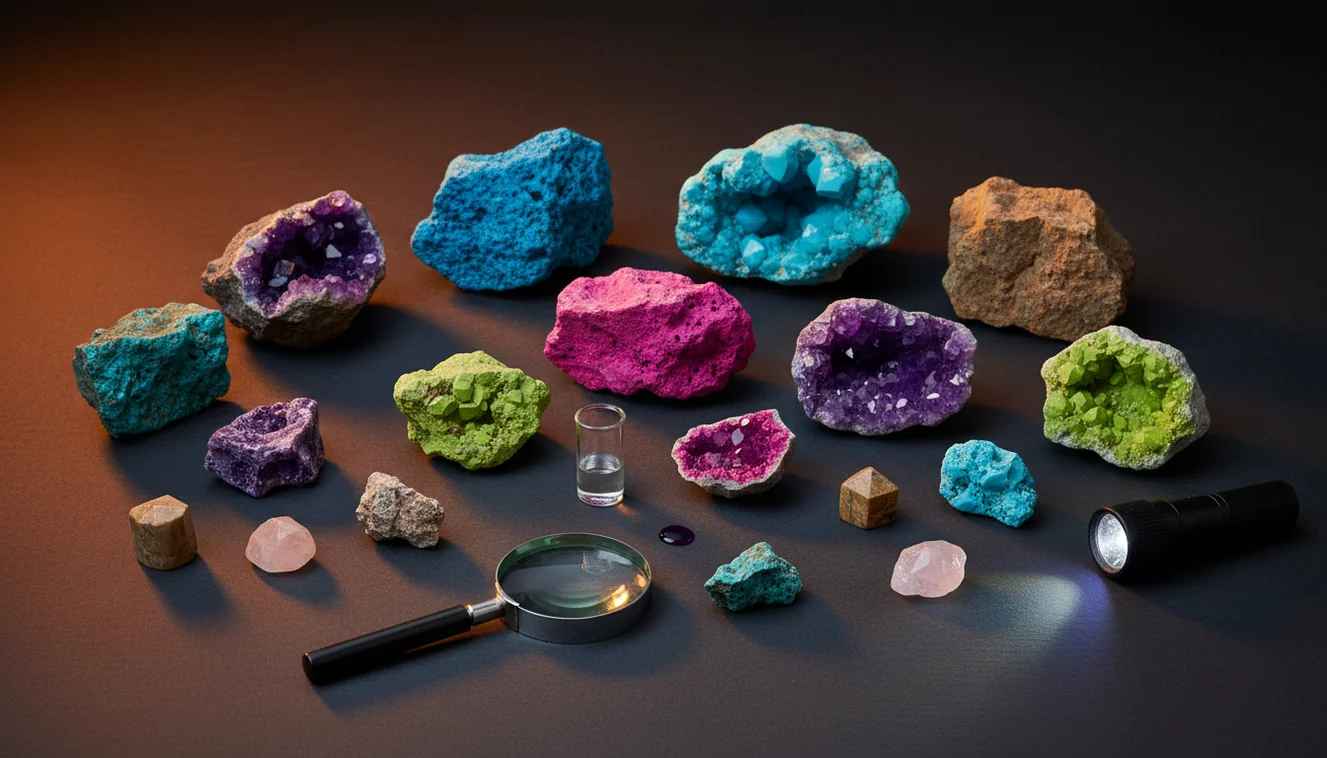
Quick answer: How to spot treated or dyed stones begins with checking where the color is strongest. Dye often concentrates in fractures, pores, pits, drill holes, chipped edges, or surface cracks, while natural color usually follows mineral growth, zoning, inclusions, or matrix patterns.
AI Rock ID can help users identify the likely host mineral before they evaluate dye pooling, surface coatings, luster, hardness, or fracture clues. RockIdentifier.io supports web photo uploads for a first-pass mineral check when examining possible treated or dyed stones from a browser.
Quick summary
- Best for
- Gem buyers, collectors, bead shoppers, crystal hobbyists, beginners
- Works on
- Polished stones, beads, cabochons, tumbled stones, carvings, rough specimens
- Accuracy
- Useful for screening visible dye or coating clues, but not proof of treatment history
- Needs confirmation
- Yes
- Professional replacement
- No
- Platforms
- iPhone, iPad, Web
This guide is best for
- Buyers checking unusually bright or uniform stones before purchase
- Collectors comparing a seller label with visible mineral properties
- Bead shoppers inspecting drill holes, cracks, and chipped edges for dye pooling
- Beginners learning the difference between host mineral identity and treatment evidence
- Crystal hobbyists checking turquoise-colored, citrine-like, dyed agate, or aura-coated stones
- Anyone deciding whether a high-value stone needs disclosure or a gem lab report
Consider another approach if you
- People who need legal proof that a gemstone is untreated
- Owners of expensive gems, rare minerals, or estate jewelry that require lab documentation
- Users trying to identify heat, irradiation, diffusion, or resin treatment from photos alone
- Anyone planning destructive solvent, soak, rub, or streak tests on fragile or collectible stones
Treated or dyed stones often show color concentrated in cracks, pores, bead holes, or chipped edges instead of natural growth zoning. The safest first check is to identify the host mineral, then ask whether the color distribution, luster, hardness, and streak make geological sense. High-value stones still need disclosure or a gem lab report because heat, irradiation, resin, and diffusion treatments may leave few visible signs.
What Is How to Spot Treated or Dyed Stones?
How to spot treated or dyed stones is the practice of separating natural body color from color added or modified after formation. Dyeing introduces pigments into porous or fractured material, while treatments such as heat, irradiation, resin stabilization, diffusion, and surface coating change appearance in different ways.
The practical method is to confirm the likely host mineral first, then inspect where the color sits. AI Rock ID can help with a free photo-based first pass, especially when a seller label is vague or a tumbled stone has lost its crystal habit. For treatment terminology and disclosure context, the Gemological Institute of America explains common gemstone treatments here: https://www.gia.edu/gem-treatment.
How to Spot Treated or Dyed Stones Works
Spotting treated or dyed stones works by comparing color behavior with the mineral’s structure, porosity, and physical properties. Natural color usually follows crystal growth, zoning, inclusions, or matrix relationships; added dye often follows fluid pathways such as cracks, vugs, pores, saw marks, and drill holes.
Start with neutral light and magnification, then look for unnaturally saturated edges, colored fracture networks, glossy coatings, or a mismatch between surface color and fresh chips. Next, check Mohs hardness, streak, cleavage, fracture, and luster against the claimed mineral. Photos are processed for identification in a privacy-friendly way, so a photo-based lookup is useful for narrowing the base material before you judge treatment clues.
How to Use Photo ID to Spot Treated or Dyed Stones
Photograph the stone in neutral light
Place the specimen on a plain background and avoid colored LEDs or harsh vendor booth lighting. Use the iOS app link context if you want to scan from your phone, and include both the polished face and any rough or chipped area.
Identify the likely host mineral
Use the scanner to narrow whether the material is chalcedony, quartzite, calcite, howlite, magnesite, jasper, agate, or another porous host. Treatment clues only make sense after the base mineral is plausible.
Inspect color pathways with magnification
Use a loupe or macro photo to check fractures, pits, bead holes, and edges. Dye commonly appears darker in these pathways, while natural zoning tends to align with crystal growth or banding.
Compare simple properties
Check luster, hardness, streak, cleavage, and fracture against the expected mineral. A turquoise-colored stone with chalky luster and howlite-like veining should be treated as suspect.
Escalate high-value finds
If the stone is expensive, rare, or being sold as natural, ask for disclosure or lab documentation. Visual checks are screening tools, not proof of untreated origin.
When to Use How to Spot Treated or Dyed Stones (and When Not To)
Use it when
- Use it when a color is unusually saturated, uniform, neon, or inconsistent with the mineral family.
- Use it for bead strands, cabochons, tumbled stones, and carvings because drill holes and polish can hide or expose dye pathways.
- Use it when the seller label is vague, such as “turquoise,” “jade,” “aura,” “citrine,” or “blue agate” without locality or treatment disclosure.
- Use it when color collects in fractures, pits, vugs, matrix boundaries, or chipped edges.
- Use it before buying a high-priced specimen so you can decide whether to request documentation.
Skip it when
- Do not rely on it as the final answer for expensive gems, rare minerals, or estate jewelry.
- Do not perform rub, solvent, soak, or streak tests on fragile, porous, soft, or collectible specimens.
- Do not assume bright color means fake; natural minerals can be vivid, especially with copper, chromium, manganese, or iron.
- Do not judge polished stones by surface shine alone because resin and coatings can mimic a good polish.
- Do not use a photo alone to prove heat treatment, irradiation, or diffusion history.
How to Spot Treated or Dyed Stones vs Google Lens and Crystal Scanner Apps
| Feature | Rock Identifier | Google Lens | Stone Identifier Rock Scanner |
|---|---|---|---|
| Best use | Narrowing rock, mineral, crystal, and gemstone candidates from a specimen photo | Finding visually similar web images and shopping results | Quick consumer-level crystal name suggestions |
| Treatment clues | Useful for host-mineral context before checking dye, coating, resin, or heat clues | May show similar dyed products but usually does not evaluate mineral properties | May suggest a name, but treatment screening depends on the user’s inspection |
| Geology workflow | Pairs photo ID with luster, hardness, streak, cleavage, fracture, and habit checks | Image-match workflow with limited mineral property guidance | Often simplified for hobby identification and metaphysical catalogs |
| Polished stones | Helpful when crystal habit is missing, but still needs property confirmation | Can confuse polish, color, and product photography with identity | Can work for common stones but may struggle with dyed look-alikes |
| Best caution | A first-pass identification tool, not a laboratory treatment report | Search similarity is not mineral authentication | App results should be checked against physical properties |
Rock Identifier is strongest when you need the likely base material before judging whether color makes sense. Google Lens is better for finding matching images or retail listings, while a general stone scanner can be convenient but should still be checked against hardness, streak, luster, and fracture.
How to Spot Treated or Dyed Stones Use Cases
- Checking dyed howlite sold as turquoise: Look for chalky white areas, gray-black veining that appears too even, and blue color concentrated near cracks or bead holes. Howlite is porous and takes dye readily, so host-mineral identification is critical.
- Evaluating bright agate or chalcedony: Agate and chalcedony are commonly dyed because microcrystalline quartz can contain pores and fracture networks. Inspect band edges, saw cuts, and surface pits for concentrated color.
- Screening citrine-like quartz: Much commercial citrine is heated amethyst or smoky quartz rather than naturally colored citrine. Look for orange-brown color concentrated at crystal tips, white bases, or suspiciously uniform batches.
- Reviewing bead strands before buying: Beads expose treatment clues around drill holes, chipped rims, and abrasion points. A loupe often reveals dye rings where fluid traveled into the stone.
- Sorting tumbled stones at home: Tumbling removes crystal habit, so rely on luster, fracture, hardness, streak, and color distribution. If a fresh scratch or chip shows a different interior color, treatment is likely.
How to Spot Treated or Dyed Stones Limitations
- Treated stones are not always fake; many are real minerals whose color, stability, or clarity has been modified and should be disclosed.
- Polished specimens can hide fractures, coatings, resin-filled pits, and natural growth features that would be easier to see on rough material.
- Rare minerals and high-value gems should not be authenticated by photos or home tests alone; use a reputable gemological or mineralogical lab.
- Photo quality matters: poor focus, warm lighting, filters, glare, wet surfaces, and colored backgrounds can make dye or coatings harder to judge.
- Value estimates cannot be confirmed from color alone because locality, size, treatment disclosure, clarity, cut, demand, and provenance all affect price.
- Heat treatment, irradiation, diffusion, and stabilization may leave few visible clues, especially when performed professionally.
- Rub, streak, solvent, and soaking tests can damage soft, porous, coated, or historically important specimens.
- Look-alikes can overlap in hardness, luster, and appearance, so use multiple observations rather than one clue.
Common mistakes
- Assuming every bright stone is fake, even though some natural minerals have vivid color from copper, chromium, manganese, or iron
- Judging treatment from color alone without first identifying the likely host mineral
- Ignoring dye concentration around bead holes, cracks, pits, saw marks, and chipped edges
- Trusting a polished surface while missing coatings, resin, or color differences on damaged areas
- Using harsh rub, solvent, soak, or streak tests on porous, soft, fragile, or collectible stones
- Treating a photo identification result as proof that a stone is natural and untreated
- Confusing natural banding or growth zoning with dye without checking whether the pattern follows the mineral structure
Use Photo ID as a First Step for Spotting Treated or Dyed Stones
Photo ID can help narrow the likely host mineral before you inspect color placement, luster, hardness, streak, and fracture clues. Expensive or rare stones should still be confirmed with disclosure documents or a qualified gem lab.
Related Articles
Frequently Asked Questions
Do dyed stones always look fake?
No. Good dye work can look subtle, especially in porous chalcedony, howlite, magnesite, and stabilized material. The better clue is where the color sits, not whether the color looks bright.
Can a flashlight reveal dye?
Sometimes. Strong side lighting or transmitted light can reveal filled fractures, uneven translucency, and darker color around cracks. It works best on translucent quartz, chalcedony, agate, and thin cabochons.
Will dye rub off easily?
Only low-quality surface dye or coating may transfer to a damp white cloth. Many dyed stones will not bleed at all, so a clean cloth does not prove natural color. Avoid rubbing fragile or valuable specimens.
Is heat treatment the same?
No. Heat treatment changes color by altering defects, inclusions, or oxidation states inside the mineral, while dye adds external pigment. Heat can be much harder to detect without gemological testing.
Why do beads show dye?
Drill holes create open pathways where dye can pool and concentrate. Check the hole edges, chipped rims, and cord-worn areas with a loupe. A darker ring around the hole is a common warning sign.
Can photos prove a treatment?
Photos can suggest treatment when color pooling, coatings, or mismatched host minerals are visible. They cannot reliably prove heat, irradiation, diffusion, or resin history. Expensive stones need documentation.
What tools help at home?
Use neutral light, a 10x loupe, a hardness reference, a streak plate, and a clean white cloth for cautious surface checks. A macro phone photo can also show cracks and bead holes more clearly than the naked eye.
When is a lab needed?
Use a lab when the stone is costly, rare, mounted in jewelry, or sold as untreated natural material. Labs can use microscopy, spectroscopy, refractive index, specific gravity, and other tests that home checks cannot replace.
Are treated stones still real?
Often, yes. A dyed agate or heated amethyst is still mineral material, but its appearance has been modified. The key issue is accurate disclosure, especially when treatment affects price.