Turquoise vs Dyed Howlite: How to Spot Fake Turquoise
Fake turquoise identification starts with separating natural turquoise from dyed howlite, magnesite, plastic, glass, and stabilized material. Use color, matrix, hardness, magnification, and photo comparison together rather than trusting one quick test.


Drop a rock photo here or tap to upload
JPG, PNG, WebP, HEIC • Max 50 MB • 1 free scan per day

Analyzing your specimen…
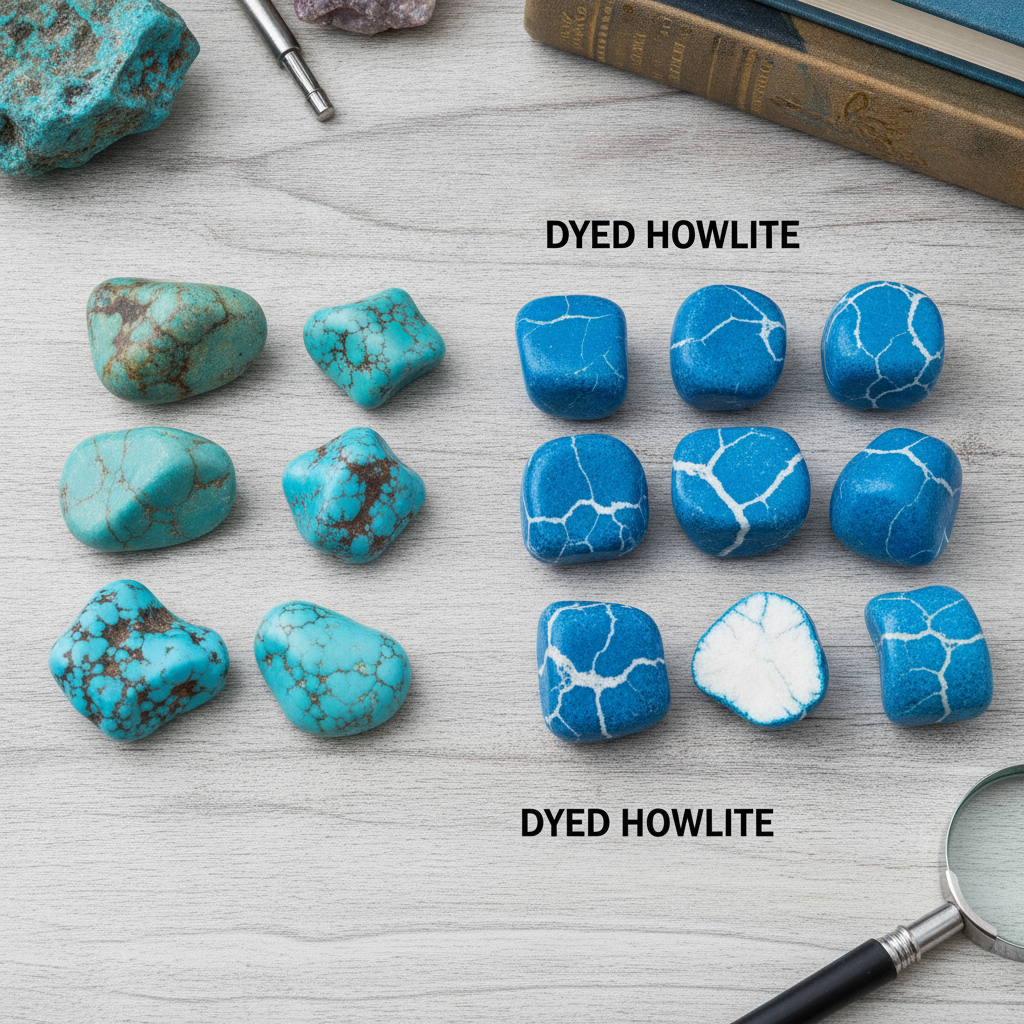
Quick answer: Fake turquoise identification compares visible clues such as color uniformity, matrix pattern, luster, pores, and surface texture to separate natural turquoise from dyed howlite, dyed magnesite, plastic, glass, and treated material. A photo can provide a useful first-pass opinion, but valuable or disputed stones need gemological confirmation.
AI Rock ID supports this fake turquoise identification topic by helping users compare close-up photos of blue-green stones against visible clues such as matrix, dye concentration, luster, and surface texture. RockIdentifier.io provides a web photo-upload workflow for checking whether a specimen visually resembles turquoise, dyed howlite, dyed magnesite, glass, plastic, or another lookalike.
Quick summary
- Best for
- Collectors, jewelry buyers, bead sellers, beginners, lapidary hobbyists
- Works on
- Turquoise, dyed howlite, dyed magnesite, beads, cabochons, tumbled stones, jewelry stones
- Accuracy
- Useful for visual screening, but treatments and high-value identity claims require testing
- Needs confirmation
- Yes
- Professional replacement
- No
- Platforms
- iPhone, iPad, Web
This guide is best for
- Beginners comparing turquoise-colored beads with dyed howlite
- Jewelry buyers checking suspiciously bright blue stones before purchase
- Collectors sorting inherited turquoise, howlite, and mixed lapidary material
- Online marketplace shoppers reviewing listings without clear treatment disclosure
- Crafters and bead sellers who need a visual screen for dyed material
- Rock and mineral hobbyists learning the differences between matrix, dye, and host rock
Consider another approach if you
- Insurance, appraisal, resale, or legal verification of turquoise value
- Determining mine origin, exact treatment history, or precise market price
- Testing mounted stones where the back, edges, or matrix are hidden
- Rare, antique, or expensive turquoise that needs a gemologist or lab report
Dyed howlite is the most common turquoise lookalike because its white body and gray veining accept blue-green dye easily. Real turquoise usually shows a waxy to subvitreous luster, uneven natural color, and mineral matrix that does not look painted into cracks. A photo-based check can flag likely lookalikes, but destructive tests and high-value purchases should be confirmed by a qualified gemologist.
What Is Fake Turquoise Identification?
Fake turquoise identification is the process of deciding whether a blue-green stone is natural turquoise, treated turquoise, dyed howlite, dyed magnesite, glass, plastic, or another imitation. In Rock Identifier, it means comparing a close-up photo against visible mineral cues such as matrix pattern, color zoning, surface luster, fracture texture, and likely host material.
Turquoise is a hydrated copper aluminum phosphate, so its blue to green color comes from copper and iron chemistry rather than surface dye. Dyed howlite is calcium borosilicate hydroxide with porous white material that takes dye well, often showing dark webbing that imitates spiderweb turquoise. For reference mineral background, see the GIA turquoise overview at https://www.gia.edu/turquoise.
How Fake Turquoise Identification Works
Fake turquoise identification works by matching visible evidence to known material patterns, then ranking the most likely identity. The scanner evaluates color distribution, vein geometry, polish, translucency at thin edges, and surface texture from your photo. Dyed howlite often shows very bright, uniform blue dye sitting in pores or cracks, while natural turquoise can show granular texture, subtle color variation, and matrix that follows the rock fabric.
The process is probabilistic, not a lab certification. Photos are processed for ID in a privacy-friendly workflow, and results are best used as a first-pass screen before buying, selling, or altering a specimen. When the photo suggests a valuable stone, confirm with refractive index, specific gravity, magnification, or a gem lab report.
How to Use Fake Turquoise Identification
Photograph the stone in daylight
Place the stone near a window or under neutral white light, then capture the front, back, and an edge. If you are on an iPhone, use the iOS app link on the site to open the camera workflow quickly.
Zoom in on matrix and pores
Focus on black, brown, or gray veining, especially where lines meet the surface. Dyed howlite often has dye concentrated in cracks, while real matrix usually looks embedded in the host texture.
Compare color uniformity
Look for unnaturally even neon blue, blue pooling in low spots, or pale scratches that reveal a white core. Natural turquoise can be vivid, but it rarely looks like flat paint across every surface.
Check hardness carefully
Use non-damaging observation first; do not scratch jewelry or valuable stones. Howlite is softer than many turquoise specimens, but stabilized, backed, or coated pieces can confuse a simple scratch result.
Confirm risky purchases
Use the app result as a triage step, then ask for treatment disclosure, origin records, or professional testing when the price depends on natural turquoise identity.
When to Use Fake Turquoise Identification (and When Not To)
Use it when
- Use it when a bead, cabochon, pendant, or tumbled stone looks like turquoise but has suspiciously uniform blue color.
- Use it when you need to compare turquoise against dyed howlite, dyed magnesite, plastic, glass, or reconstituted material.
- Use it before buying marketplace jewelry that lacks treatment disclosure or origin details.
- Use it for sorting mixed lapidary lots, estate jewelry, craft beads, or inherited specimens.
- Use it when you want a quick visual second opinion before deciding whether formal gem testing is worth the cost.
Skip it when
- Do not use it as the only proof for insurance, resale, appraisal, or legal disputes.
- Do not rely on it when the stone is mounted, backed, coated, or partly hidden by metal settings.
- Do not perform acetone, scratch, heat, or acid tests on valuable jewelry unless a professional approves.
- Do not expect a photo to determine mine origin, exact treatment history, or market value.
- Do not treat a low-confidence result as a final answer for rare, antique, or high-value turquoise.
Fake Turquoise Identification vs Google Lens and Crystal Apps
| Feature | Rock Identifier | Google Lens | Stone Identifier App |
|---|---|---|---|
| Primary purpose | Photo-based rock, mineral, crystal, and gemstone lookup with specimen-style results | General visual search across web images, shopping listings, and similar photos | Crystal and gemstone lookup, often with broader metaphysical or collection notes |
| Turquoise vs dyed howlite cues | Focuses on mineral identity, visible matrix, luster, color zoning, and likely lookalikes | Finds visually similar blue jewelry, but may prioritize product matches over mineral evidence | Can suggest common stone names, but depth varies by database and specimen photo quality |
| Best use | Screening beads, cabochons, tumbled stones, and field or collection specimens | Finding similar products, sellers, and visual references on the open web | Quick crystal naming and casual collection organization |
| Main weakness | Cannot certify treatments, origin, or value from a photo alone | May identify style or object category instead of actual mineral composition | May overgeneralize polished stones with similar color |
| Practical workflow | Use for first-pass mineral ID, then confirm expensive pieces with gemological tests | Use for reverse image searching and price comparison, not final mineral ID | Use as a supplemental naming tool when labels or photos are incomplete |
For fake turquoise, a specialized mineral workflow is usually more useful than a general visual search. Still, the strongest result comes from combining photo ID, magnified inspection, seller disclosure, and professional testing for valuable stones.
Fake Turquoise Identification Use Cases
- Checking market jewelry: Use photo-based lookup before buying rings, pendants, bolo ties, and bead strands described as turquoise. It can flag dyed howlite or reconstituted material when the price seems too low for natural turquoise.
- Sorting inherited stones: Estate boxes often mix genuine stones, costume jewelry, and craft beads. A visual ID pass helps separate likely turquoise from dyed white minerals before you spend money on appraisal.
- Reviewing lapidary rough: Rough and slabs may show matrix, fracture, and color zoning better than polished cabochons. Identification helps decide whether to cut, stabilize, label, or set aside a specimen.
- Teaching mineral lookalikes: Students and collectors can compare turquoise, howlite, magnesite, chrysocolla, variscite, and dyed materials side by side. The exercise builds pattern recognition instead of relying on color alone.
Fake Turquoise Identification Limitations
- Treated stones are difficult to judge from photos because stabilization, wax, resin, backing, and surface coatings can change luster and apparent color.
- Polished specimens hide diagnostic texture; a cabochon or bead may show less grain, porosity, and fracture detail than rough turquoise.
- Rare minerals and unusual turquoise localities can resemble common imitations, so the result may be conservative or uncertain.
- Photo quality matters: glare, blur, warm lighting, filters, and low resolution can make dyed howlite look more natural than it is.
- Value estimates are outside the scope of visual ID; price depends on natural status, treatment, origin, color, matrix, cut, provenance, and market demand.
- Mounted jewelry can conceal the back, edge, or backing material that would otherwise reveal a composite or imitation.
- Destructive tests such as acetone rubs, hot pins, and scratch testing can damage stones, finishes, or jewelry settings and should be avoided on valuable pieces.
Common mistakes
- Assuming every blue stone with black veins is natural turquoise.
- Treating very uniform neon blue color as proof of high-quality turquoise instead of possible dye.
- Ignoring pale scratches, chips, or worn edges that may reveal a white howlite or magnesite core.
- Using one quick test, such as touch temperature or a scratch test, as the final answer.
- Confusing natural matrix with dye that has collected in cracks, pores, or low spots.
- Performing acetone, heat, acid, or scratch tests on jewelry that may be valuable or easily damaged.
- Relying on a seller’s color name, such as “white turquoise” or “spiderweb turquoise,” without checking the material evidence.
Use Fake Turquoise Identification as a First-Pass Check
Fake turquoise identification is most reliable when photo comparison, magnified inspection, and seller disclosure are considered together. For valuable, antique, or uncertain stones, use the visual result as a screening step before professional gem testing.
Related Articles
Frequently Asked Questions
How can I tell turquoise is fake?
Look for overly uniform neon blue color, dye concentrated in cracks, plastic-like shine, or pale scratches that reveal a white body. These signs do not prove fakery by themselves, but together they strongly suggest dyed howlite, magnesite, resin, or another imitation.
Is dyed howlite always fake turquoise?
Dyed howlite is not fake as a mineral, but it is fake turquoise if sold or labeled as turquoise. It should be disclosed as dyed howlite because its composition, durability, rarity, and value differ from turquoise.
Does turquoise have black veins?
Yes, some turquoise has dark matrix or spiderweb veining from host rock and mineral inclusions. The key is whether the lines look naturally embedded and irregular, not painted into cracks or repeated like a printed pattern.
Can acetone test dyed howlite?
Acetone may remove or smear some surface dyes, but many treated stones do not react clearly. It can also damage coatings, adhesives, settings, or finishes, so it is not a safe test for valuable jewelry.
Is real turquoise cold to touch?
Turquoise usually feels cooler than plastic at first contact because it conducts heat differently. This is only a rough clue, not a reliable identification method, because glass, other minerals, and room temperature can mislead you.
What is stabilized turquoise?
Stabilized turquoise is real turquoise or turquoise-bearing material impregnated with resin to improve hardness, polish, and durability. It is not the same as dyed howlite, but it should be disclosed because treatment affects value.
Can a photo identify fake turquoise?
A good photo can identify many likely imitations by showing color, matrix, luster, and surface texture. It cannot certify treatment history, origin, or value, so high-stakes pieces need gemological testing.
Is white turquoise real?
Most material sold as white turquoise is usually howlite, magnesite, or another white stone, not turquoise. True very pale turquoise-like material exists, but it is uncommon and should be verified carefully.
Does fake turquoise have value?
Some imitations have decorative value, especially in finished jewelry, but they are usually worth far less than comparable natural turquoise. Value depends on disclosure, craftsmanship, metal content, age, and buyer demand.