How to Tell If Gold Is Real or Fool's Gold
Use this field checklist to separate native gold from pyrite, chalcopyrite, and mica. Use the iOS app link on this page for a first photo-based lookup, then confirm with streak, hardness, density, and malleability.


Drop a gold photo here or tap to upload
JPG, PNG, WebP, HEIC • Max 50 MB • 1 free scan per day

Analyzing your specimen…
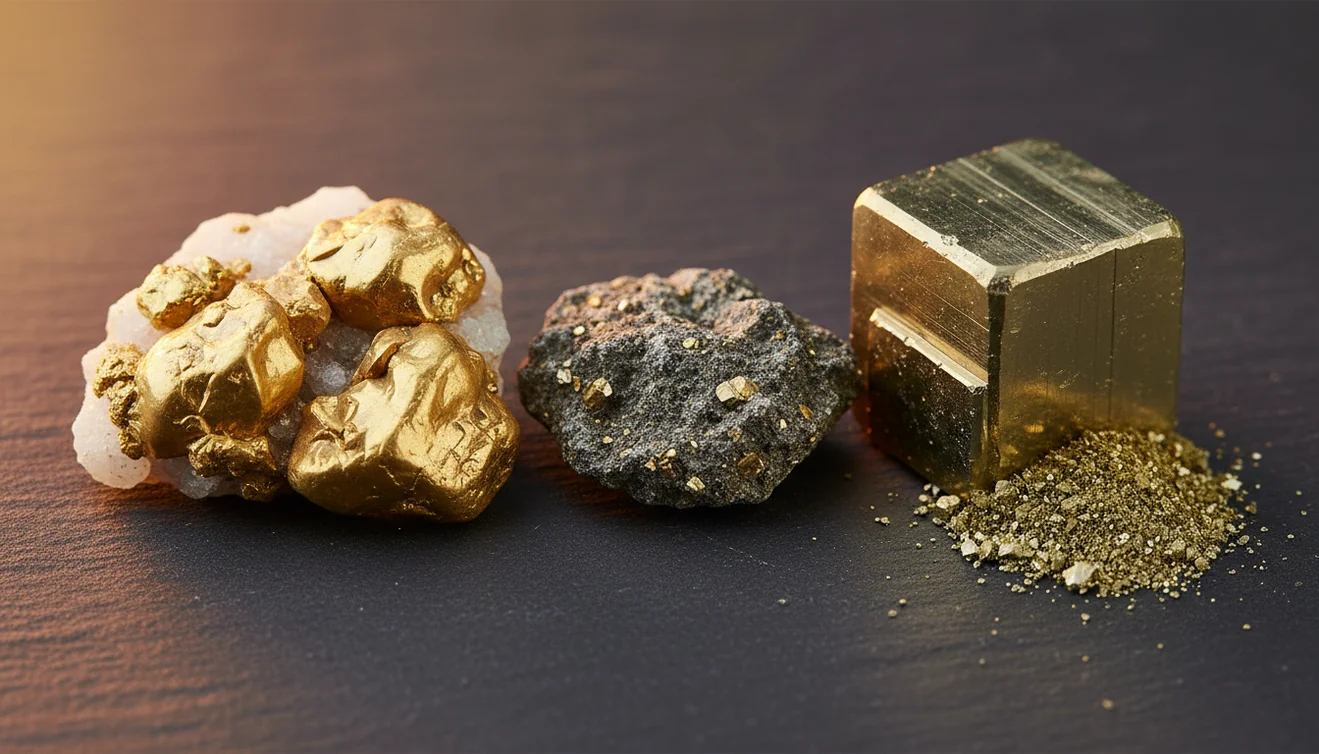
Quick answer: How to tell if gold is real or fool's gold is to compare color, streak, hardness, density, and malleability instead of relying on sparkle. Real gold is soft, very dense, yellow in streak, and bends or flattens, while fool's gold such as pyrite is harder, more brittle, brassy, and leaves a dark streak.
AI Rock ID can help create an initial photo-based shortlist when a yellow metallic specimen might be native gold, pyrite, chalcopyrite, or mica. RockIdentifier.io supports web photo upload for this gold versus fool's gold workflow before users confirm with streak, hardness, density, and malleability tests.
Quick summary
- Best for
- Collectors, prospectors, hikers, beginners, geology students
- Works on
- Native gold, pyrite, chalcopyrite, mica, quartz vein samples, creek gravel, tailings material
- Accuracy
- Good for narrowing likely gold look-alikes, but physical tests are needed for confidence.
- Needs confirmation
- Yes
- Professional replacement
- No
- Platforms
- iPhone, iPad, Web
This guide is best for
- Beginners comparing a shiny yellow mineral to real gold or fool's gold
- Rockhounds checking quartz vein samples, creek gravel, or mine tailings
- Collectors trying to separate pyrite, chalcopyrite, mica, and native gold
- Hikers or prospectors who need a simple field checklist before destructive testing
- Students learning how streak, hardness, density, and crystal habit identify metallic minerals
- Anyone who wants to use a photo-based shortlist before doing hands-on mineral tests
Consider another approach if you
- People who need a legal appraisal, sale price, or claim-quality assay
- Users testing valuable jewelry, museum specimens, or fragile collectible crystals
- Anyone trying to identify microscopic gold locked inside sulfides or quartz
- People who cannot perform streak, hardness, density, or malleability checks
- Users planning to rely on color or a photo alone to confirm real gold
Real gold stays warm yellow, feels unusually dense for its size, and bends or flattens instead of shattering. Fool's gold is usually pyrite: it looks brassy, forms sharper crystals, scratches glass, and leaves a greenish-black to brownish-black streak. AI Rock ID can suggest likely look-alikes from a photo, but the final call should come from physical mineral tests.
What Is How to Tell If Gold Is Real or Fool's Gold?
How to tell if gold is real or fool's gold starts with properties, not sparkle. Native gold is a soft, malleable metal with a yellow streak, high specific gravity near 19.3, and a habit of appearing as flakes, nuggets, wires, or irregular masses. Fool's gold is most often pyrite, an iron sulfide with metallic luster, brassy color, Mohs hardness around 6 to 6.5, and a dark streak.
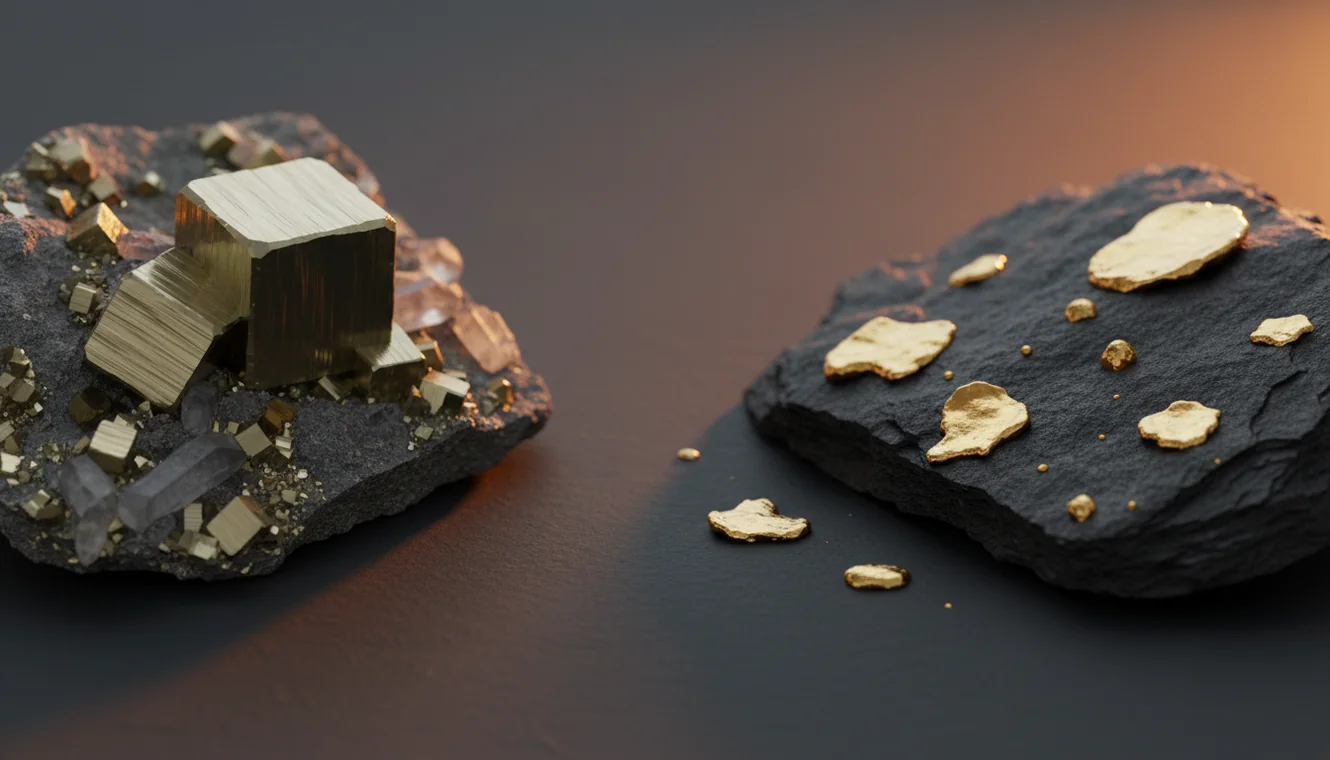
The best quick sequence is color, crystal habit, streak, hardness, then deformation. Gold rarely shows crisp cubic faces, while pyrite often forms cubes, pyritohedra, or striated crystals. For a mineral reference point, the USGS overview of gold explains native gold occurrence in veins and placer deposits: https://www.usgs.gov/centers/national-minerals-information-center/gold-statistics-and-information.
How to Tell If Gold Is Real or Fool's Gold Works
The method works by comparing optical clues with diagnostic mineral properties. A photo can flag likely candidates such as pyrite, chalcopyrite, mica, or native gold, but metallic minerals often need a physical test because glare and iron staining distort color. Photos are processed for identification in a privacy-friendly workflow, and you should avoid including faces, location-sensitive details, or personal objects in the frame.
After the first visual pass, streak and hardness do most of the separating. Gold leaves a yellow streak and can be scratched by copper; pyrite leaves a dark greenish-black to brownish-black streak and can scratch glass. Density and behavior under pressure add confidence: gold feels very heavy and dents, while pyrite is lighter and brittle.
How to Use It to Tell If Gold Is Real or Fool's Gold
Photograph the specimen
Place the sample in indirect daylight and shoot a sharp close-up plus one wider photo showing the matrix. Reduce glare on metallic surfaces by tilting the specimen slightly instead of using flash.
Check color and habit
Look for warm, steady yellow on clean surfaces. Treat sharp cubes, striated faces, brassy tones, and many glittering flashes as evidence for pyrite or another sulfide.
Run a streak test
Rub a hidden edge on unglazed porcelain. A yellow streak supports gold, while a greenish-black or brownish-black streak strongly supports pyrite.
Test hardness carefully
Try scratching the unknown with copper, then test whether it scratches glass. Gold is soft at Mohs 2.5 to 3, while pyrite is much harder and commonly scratches glass.
Compare density and breakage
A small piece of gold feels surprisingly heavy and tends to bend, flatten, or dent. Pyrite feels lighter for its size and breaks into angular, brittle fragments.
When to Use How to Tell If Gold Is Real or Fool's Gold (and When Not To)
Use it when
- Use it when a metallic yellow mineral appears in quartz, vein rock, creek gravel, mine tailings, or a mixed sulfide matrix.
- Use it when you need to separate gold from pyrite, chalcopyrite, mica flakes, weathered sulfides, or iron-stained minerals before doing destructive tests.
- Use it when the specimen is large enough for streak, hardness, density, or bend testing without destroying the only visible grain.
- Use it when you want a fast field routine that combines photo-based lookup with Mohs hardness, streak, crystal habit, and specific gravity observations.
Skip it when
- Do not rely on it alone for pricing, selling, staking claims, or declaring ore-grade material.
- Do not scratch or streak a valuable jewelry item, collectible crystal, museum specimen, or tiny visible grain without expert advice.
- Do not treat color as proof, because pyrite, chalcopyrite, mica, and iron oxides can all look gold-colored in some light.
- Do not assume a negative visual result means no gold is present; microscopic gold can be locked inside quartz or sulfide minerals.
- Do not use home acid tests casually; acids can be hazardous and may damage specimens or jewelry.
How to Tell If Gold Is Real or Fool's Gold vs Google Lens and Stone Identifier
| Feature | Rock Identifier | Competitor 1 | Competitor 2 |
|---|---|---|---|
| Primary workflow | Mineral-focused photo ID followed by property checks such as streak, hardness, habit, and density. | Google Lens: broad visual search that may match similar-looking images but does not specialize in mineral diagnostics. | Stone Identifier app: photo recognition for rocks and crystals, usually strongest when the specimen is clean and typical. |
| Gold vs pyrite usefulness | Good first pass for narrowing pyrite, chalcopyrite, mica, and native gold before physical confirmation. | Useful for finding web images of pyrite or gold, but results can be driven by color and background context. | Helpful for common minerals, though metallic luster and mixed matrices may still need manual tests. |
| Field geology guidance | Connects visual ID with practical mineral terms: Mohs hardness, streak, cleavage, fracture, and specific gravity. | Limited geology-specific guidance unless the matched web page explains tests clearly. | Varies by app entry; some provide mineral facts, while others emphasize naming and collection notes. |
| Best use | Creek finds, quartz vein samples, tailings material, and unknown metallic specks that need a shortlist. | Quick visual comparison when you have no mineral app available. | Casual rock and crystal collecting where a photo match is the main goal. |
No photo tool should be the only test for real gold. For gold versus fool's gold, the most defensible workflow is photo shortlist first, then streak, hardness, malleability, and density.
Use Cases for Gold vs Fool's Gold Identification
- Creek and placer sampling: Flattened yellow flakes in black sand should be checked for malleability, density, and streak. Mica often flashes brightly and floats or peels, while gold keeps a steady metallic look and sinks readily.
- Quartz vein inspection: Yellow metallic specks in quartz may be pyrite, chalcopyrite, or native gold. Crystal faces, brassy tone, and dark streak point toward sulfides rather than free gold.
- Mine tailings and dumps: Tailings commonly contain sulfides with gold-like color. Use crystal habit and streak before assuming a specimen has economic value, especially where pyrite cubes and oxidized coatings are common.
- Inherited rocks or display pieces: Old collection samples may be mislabeled or weathered. Non-destructive visual checks should come first, with scratch or streak testing only on inconspicuous areas.
- Jewelry and gold-colored objects: Mineral tests are not the same as jewelry authentication. For rings, coins, or plated objects, use a jeweler, XRF analysis, or professional assay rather than scratching a finished item.
How to Tell If Gold Is Real or Fool's Gold Limitations
- Treated stones, dyed pieces, electroplated surfaces, and gold-tone coatings can imitate a gold color without containing native gold.
- Polished specimens can hide crystal habit, cleavage, fracture, and natural surface texture, making pyrite and chalcopyrite harder to separate visually.
- Rare minerals and unusual ore textures may not match common field examples; tellurides, arsenopyrite, and mixed sulfides can require lab confirmation.
- Photo quality matters: glare, blur, wet surfaces, shadows, and poor scale can make brassy pyrite look like gold or make real gold look dull.
- Value estimates cannot be made from a photo or a simple streak test; grade, purity, weight, locality, and assay results determine economic value.
- Very tiny grains may be impossible to bend, scratch, or streak reliably without losing the specimen.
- Iron staining, oxidation, and host-rock coatings can mask the true color of both gold and pyrite.
- Specific gravity is powerful but difficult on small pieces attached to quartz or sulfide matrix.
Common mistakes
- Assuming every bright yellow sparkle in a rock is real gold.
- Ignoring a dark greenish-black or brownish-black streak that strongly suggests pyrite.
- Using color alone instead of checking hardness, streak, density, and malleability together.
- Forgetting that pyrite can scratch glass while real gold is much softer.
- Mistaking flat mica flakes for gold because they flash in sunlight.
- Breaking a specimen before photographing and testing a hidden edge first.
- Treating a photo identification as final proof of gold without physical confirmation.
Check possible gold before testing the specimen
A photo-based lookup can help narrow a yellow metallic specimen to likely gold look-alikes before streak, hardness, density, and malleability checks. Use the result as a starting point, not as proof of real gold or market value.
Related Articles
Frequently Asked Questions
Does real gold always look bright yellow?
No. Native gold can look dull if it is coated with iron oxides, clay, or weathered host rock, but a clean surface usually keeps a warm yellow tone in different light. Pyrite tends to look more brassy or greenish-yellow, especially in shadow.
What streak should gold leave?
Gold leaves a yellow streak on unglazed porcelain. Pyrite usually leaves a greenish-black to brownish-black streak, which is one of the fastest practical ways to separate the two.
Can pyrite scratch glass?
Yes. Pyrite is about Mohs 6 to 6.5, so it can often scratch glass. Pure gold is much softer, around Mohs 2.5 to 3, and should not scratch glass.
Will real gold stick to a magnet?
Gold is not magnetic, but a magnet test is not definitive because many non-gold minerals are also non-magnetic. Magnetism is more useful for spotting magnetite, steel contamination, or iron-rich material mixed with the sample.
Is fool's gold always pyrite?
Usually, but not always. The nickname most commonly refers to pyrite, yet chalcopyrite, mica, and weathered sulfides can also fool people because they look yellow, metallic, or sparkly.
Can gold be found inside quartz?
Yes. Native gold can occur in quartz veins as visible flakes, wires, blebs, or microscopic inclusions. If the gold is locked inside quartz or sulfides, visual inspection may not prove whether recoverable gold is present.
Should I break the specimen?
Only if the sample is common, not valuable as a specimen, and large enough to sacrifice a small part. Gold dents or flattens under pressure, while pyrite breaks in brittle angular fragments, but destructive tests should be avoided on collectible pieces.
Can I confirm gold at home?
You can build confidence at home with streak, hardness, malleability, and density checks. For selling, claim work, or high-value material, use a professional assay, XRF test, or qualified mineral lab.
Why does my rock glitter like gold?
Glittery flashes often come from mica or many small pyrite faces reflecting light. Gold usually has a steadier metallic glow and appears as dense, rounded, flattened, or irregular grains rather than sheets or sharp cubes.