Amethyst vs Fluorite: How to Tell the Difference
Amethyst vs fluorite: how to tell the difference is mainly a hardness, cleavage, and crystal habit problem, not a color problem. Rock Identifier’s iOS app link gives a free photo ID starting point before you confirm the specimen with hand tests.


Drop a rock photo here or tap to upload
JPG, PNG, WebP, HEIC • Max 50 MB • 1 free scan per day

Analyzing your specimen…
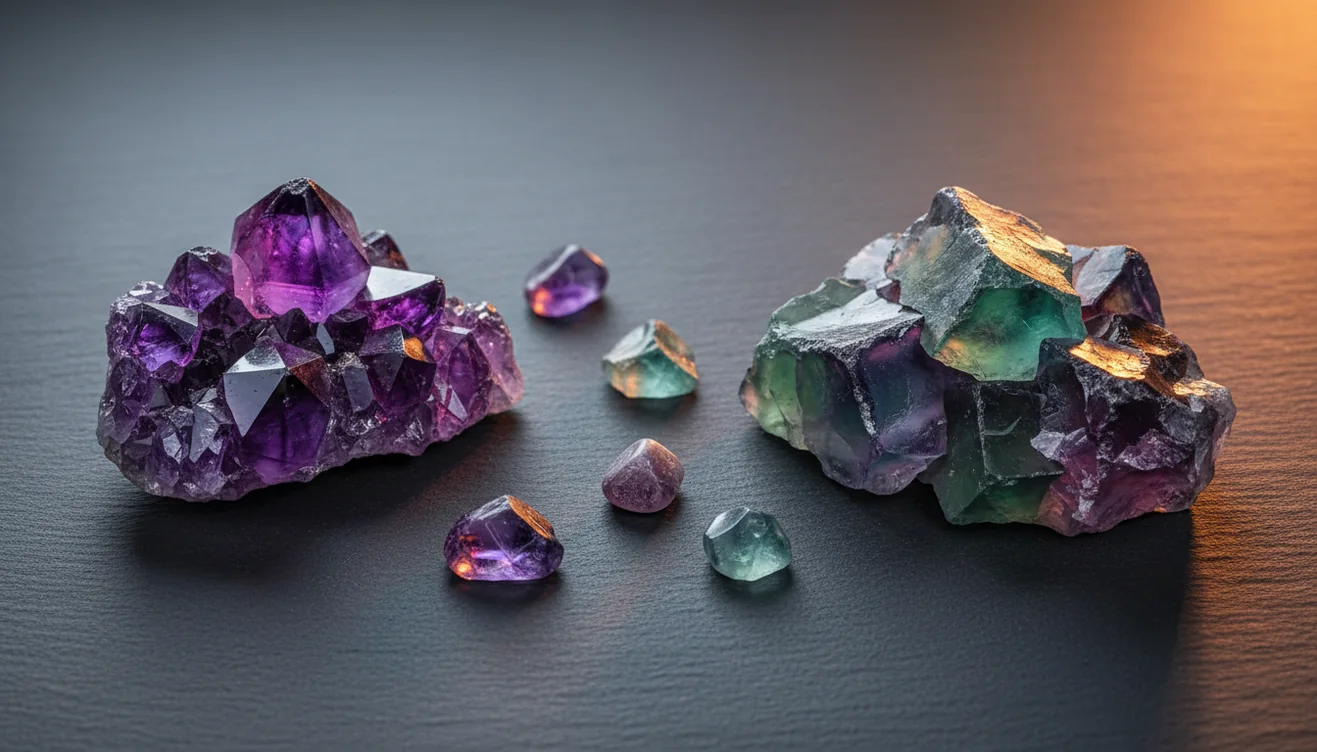
Quick answer: Amethyst vs fluorite: how to tell the difference depends mainly on hardness, cleavage, and crystal habit rather than purple color. Amethyst is quartz with Mohs hardness 7 and conchoidal fracture, while fluorite is softer at Mohs 4 and commonly shows perfect cleavage, cubes, octahedra, or stepped flat faces.
AI Rock ID can help compare a purple specimen against amethyst and fluorite visual traits before the user checks hardness, cleavage, and crystal habit. RockIdentifier.io supports web photo upload for a first-pass amethyst versus fluorite review, but the result should still be confirmed with physical mineral properties.
Quick summary
- Best for
- Collectors, beginners, crystal buyers, geology students, hobby mineral identifiers
- Works on
- Purple crystals, mineral specimens, tumbled stones, collection pieces, field finds
- Accuracy
- Good for first-pass identification when hardness, cleavage, and habit agree
- Needs confirmation
- Yes
- Professional replacement
- No
- Platforms
- iPhone, iPad, Web
This guide is best for
- Collectors sorting unlabeled purple mineral specimens
- Beginners learning why color alone is unreliable in mineral identification
- Crystal buyers checking whether a purple specimen has quartz or fluorite traits
- Students comparing Mohs hardness, cleavage, fracture, and crystal habit
- Hobbyists reviewing tumbled or polished purple stones with uncertain labels
- Field collectors who need a practical first-pass amethyst versus fluorite check
Consider another approach if you
- Fine jewelry owners who cannot risk scratching or damaging the stone
- Collectors needing a formal appraisal, treatment report, or gemological certificate
- Museum-grade or rare locality specimens that should not be tested destructively
- Users relying on a single edited marketplace photo under artificial purple lighting
Amethyst vs fluorite: how to tell the difference comes down to Mohs hardness, cleavage, and crystal form. Amethyst is quartz at Mohs 7 with conchoidal fracture, while fluorite is Mohs 4 with perfect cleavage that often forms flat stepped faces. Purple color alone is not reliable because both minerals can be transparent, zoned, or strongly saturated.
What Is Amethyst vs Fluorite: How to Tell the Difference?
Amethyst vs fluorite identification is the process of separating purple quartz from purple fluorite using diagnostic mineral properties rather than color. The most reliable clues are Mohs hardness, cleavage versus fracture, crystal habit, luster, and the way the specimen sits in its matrix.
Amethyst is a purple variety of quartz, so it is relatively hard, vitreous, and commonly forms hexagonal prisms or drusy coatings. Fluorite is softer, has perfect octahedral cleavage, and often appears as cubes, octahedra, or color-zoned masses. For a mineral reference baseline, compare properties with Mindat’s fluorite entry at https://www.mindat.org/min-1576.html.
How Amethyst vs Fluorite: How to Tell the Difference Works
Amethyst vs fluorite comparison works by testing traits that come from crystal structure. Quartz lacks cleavage and breaks with curved, shell-like conchoidal fracture; fluorite has perfect cleavage in four directions, so chips often show repeated flat planes and triangular or octahedral geometry.
A photo-based lookup can narrow the candidates by reading color, transparency, habit, matrix, and surface texture. Photos are processed for ID in a privacy-friendly workflow, and the result should be treated as a shortlist rather than a final lab determination. The strongest field workflow is visual scan first, then hardness, then cleavage and habit confirmation.
How to Use Amethyst vs Fluorite Tests
Inspect the crystal shape
Look for hexagonal prisms, pointed quartz terminations, or drusy coatings for amethyst. Look for cubes, octahedra, stepped flat faces, or strong zoning for fluorite.
Check hardness carefully
Test an inconspicuous spot only if the specimen is not valuable or fragile. Fluorite at Mohs 4 can be scratched by steel, while amethyst at Mohs 7 usually cannot.
Examine breaks and chips
Use angled light to see whether broken areas are curved and glassy or flat and repeating. Conchoidal fracture favors amethyst; perfect flat cleavage favors fluorite.
Compare luster and edges
Amethyst usually keeps sharper, glassier edges. Fluorite can look vitreous too, but edges often chip more easily and may show soft, planar cleavage surfaces.
Confirm with context
Note associated minerals, matrix, and locality if known. A single clue can mislead, but hardness plus cleavage plus habit usually resolves the identification.
When to Use Amethyst vs Fluorite Identification (and When Not To)
Use it when
- Use it when a purple transparent or translucent crystal could be quartz or fluorite and color is doing too much of the work.
- Use it when sorting mixed collection lots, estate specimens, gift-shop stones, or unlabeled field finds that need a practical first-pass ID.
- Use it when you can safely compare hardness, cleavage, crystal habit, and matrix without damaging an important face or termination.
- Use it before buying a specimen advertised as amethyst if the piece shows cubes, octahedra, or flat cleavage planes that look suspiciously fluorite-like.
Skip it when
- Do not use destructive scratch testing on fine jewelry, rare locality pieces, museum-grade specimens, or polished display stones with high sentimental value.
- Do not rely on this workflow for appraisal, treatment disclosure, or gemological certification; those require specialized instruments and documentation.
- Do not make the final call from a single saturated phone photo, especially under purple LED lighting or strong marketplace image editing.
Amethyst vs Fluorite Identification vs Google Lens and Crystal Apps
| Feature | Rock Identifier | Google Lens | Mineral Identifier Stone ID |
|---|---|---|---|
| Best use | Mineral-focused photo triage with prompts for hardness, cleavage, habit, and common look-alikes. | Broad visual search for similar web images, shopping results, and general pages. | Crystal and stone photo lookup with basic name suggestions and reference-style browsing. |
| Amethyst vs fluorite strength | Useful when the photo shows crystal habit, zoning, fracture, or matrix and you plan to verify physically. | Can find visually similar purple stones but may confuse color matches with mineral identity. | Helpful for casual comparison, though results still need Mohs and cleavage confirmation. |
| Geology detail | Focuses on mineral ID traits such as luster, hardness range, cleavage, and look-alike checks. | Depends on indexed pages and image matches rather than mineral diagnostic logic. | Often provides simple mineral descriptions, photos, and collection notes. |
| Risk | Still not a substitute for hand tests or professional gemological analysis. | High risk of image-match errors when purple color dominates the photo. | May struggle with tumbled, treated, or poorly lit specimens. |
Use any photo-based lookup as triage, not proof. For amethyst versus fluorite, the final identification should come from the agreement of hardness, cleavage, fracture, and habit.
Use Cases
- Sorting purple collection pieces: When labels are missing, start by separating obvious quartz habits from cubic or octahedral fluorite habits. Then verify doubtful pieces with hardness and cleavage.
- Checking a marketplace listing: If a listing calls a purple cubic specimen amethyst, pause. Cubic habit and stepped cleavage are stronger fluorite clues than the seller’s color description.
- Teaching mineral identification: This pair is excellent for explaining why color is a weak property. Students can compare quartz fracture against fluorite cleavage and see crystal systems in hand.
- Reviewing tumbled stones: Tumbled amethyst and fluorite lose obvious crystal faces, so hardness becomes more important. Fluorite also tends to show scratches, chips, and cleavage-related bruising more readily.
Amethyst vs Fluorite Identification Limitations
- Treated stones can mislead color-based identification; heat, dye, coatings, and lighting can make quartz or fluorite look more saturated than it is.
- Polished specimens often remove natural crystal faces, so habit and cleavage may be hidden until chips or internal planes catch the light.
- Rare minerals and unusual localities can resemble purple quartz or fluorite, especially in mixed pegmatite, hydrothermal, or vein material.
- Photo quality matters: blur, glare, white-balance errors, and purple LED lighting can hide cleavage or exaggerate amethyst-like color.
- Value estimates should not come from visual ID alone because size, locality, damage, treatment, clarity, and market demand all affect price.
- Scratch tests can damage specimens and can give false results if you test weathering, coating, glue, matrix, or a repaired area.
- UV fluorescence is supportive but not conclusive; many fluorites fluoresce, some do not, and other minerals can fluoresce too.
Common mistakes
- Assuming every purple transparent crystal is amethyst.
- Ignoring cubic or octahedral crystal shapes that strongly suggest fluorite.
- Treating purple color saturation as more important than hardness and cleavage.
- Scratch testing a visible face, termination, or jewelry stone instead of an inconspicuous area.
- Mistaking flat fluorite cleavage planes for ordinary broken quartz surfaces.
- Relying on UV fluorescence alone even though fluorescence is not a complete proof of fluorite.
- Trying to identify a tumbled stone from color only after polishing has removed the original crystal habit.
Check amethyst vs fluorite with photo clues and mineral tests
A photo can help narrow the identification, but amethyst vs fluorite should be confirmed with hardness, cleavage, fracture, and crystal habit. Use the visual result as a starting point, not a final laboratory determination.
Related Articles
Frequently Asked Questions
Is fluorite softer than amethyst?
Yes. Fluorite is Mohs 4, while amethyst is quartz at Mohs 7, so amethyst resists scratching much more strongly.
Do both minerals have cleavage?
No. Fluorite has perfect cleavage, commonly octahedral, while amethyst has no cleavage and usually breaks with conchoidal fracture.
What crystal shape should I expect?
Amethyst commonly forms hexagonal prisms, points, geodes, and drusy coatings. Fluorite commonly forms cubes or octahedra and may show strong color zoning.
Does UV light prove fluorite?
No. Fluorescence supports fluorite in many cases, but not all fluorite fluoresces, and some other minerals can fluoresce too.
Can polished stones fool identification?
Yes. Polishing removes crystal faces and can hide cleavage, so tumbled amethyst and fluorite may look much more alike.
Can I scratch test jewelry?
Avoid scratch testing finished jewelry because it can permanently damage the stone or setting. Use magnification, documentation, and a jeweler or gemologist for valuable pieces.
Which is better for jewelry?
Amethyst is usually better for everyday jewelry because it is harder and less prone to cleavage damage. Fluorite is attractive but softer and better suited to protected settings or display.
Can a photo identify them?
A photo can suggest likely candidates when it shows habit, luster, zoning, and matrix clearly. The final call should still be confirmed with hardness and cleavage.
Are purple bands always amethyst?
No. Purple banding can occur in fluorite and other materials, and color zoning is common in fluorite cubes. Use hardness, cleavage, and crystal habit before naming it.