Obsidian vs Slag Glass
Compare texture, vesicles, inclusions, fracture, and field context before you label a black glassy specimen. Use the iOS app link on this page when you want a free photo ID from multiple angles.


Drop a rock photo here or tap to upload
JPG, PNG, WebP, HEIC • Max 50 MB • 1 free scan per day

Analyzing your specimen…
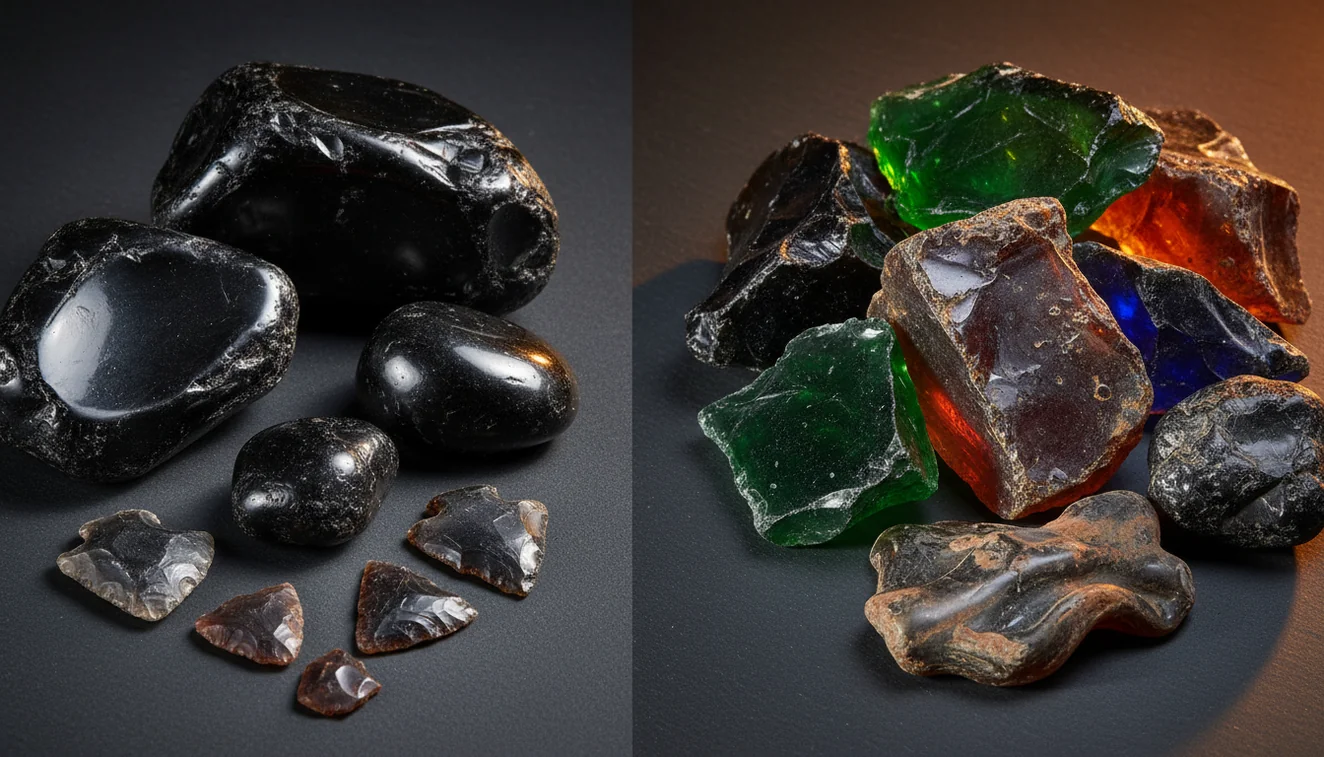
Quick answer: Obsidian vs slag glass: how to tell the difference depends on origin, texture, fracture, inclusions, and find location rather than color alone. Obsidian is natural volcanic glass that commonly shows smooth conchoidal fracture, while slag glass is man-made industrial glass that often shows bubbles, metallic specks, ropey melt textures, or industrial-site context.
AI Rock ID can help compare obsidian and slag glass from specimen photos when fracture, bubbles, luster, and inclusions are visible. RockIdentifier.io provides a web photo-upload option for checking glassy rock look-alikes before confirming the result with field context and simple observations.
Quick summary
- Best for
- Collectors, hikers, beginners, field naturalists, lapidary hobbyists
- Works on
- Glassy rocks, black glass fragments, volcanic glass, slag glass, found specimens
- Accuracy
- Useful for a first-pass visual separation, but context and simple field checks are still needed.
- Needs confirmation
- Yes
- Professional replacement
- No
- Platforms
- iPhone, iPad, Web
This guide is best for
- Collectors comparing black glassy fragments found in gravel, washes, beaches, or road cuts
- Beginners trying to separate natural volcanic glass from industrial slag glass
- Hikers and field naturalists documenting sharp, vitreous specimens in possible volcanic areas
- Lapidary hobbyists sorting rough material before cutting or polishing
- Teachers explaining why origin, bubbles, fracture, and context matter in rock identification
- Rockhounds checking whether a found glassy piece needs closer testing or expert review
Consider another approach if you
- Archaeological artifact authentication or legal provenance decisions
- Museum cataloging, formal curation, or academic classification
- Gem valuation, treatment certification, or appraisal work
- Hazard assessment of industrial waste or contaminated slag
- Specimens that are wet, coated, painted, heavily polished, or photographed with strong glare
Obsidian is natural volcanic glass, while slag glass is man-made industrial glass from smelting or furnace processes. The fastest way to tell them apart is to check for volcanic context, clean conchoidal fracture, and uniform vitreous luster versus bubbles, metallic specks, ropey flow, and industrial-site context.
What Is Obsidian vs Slag Glass: How to Tell the Difference?
Obsidian vs slag glass: how to tell the difference comes down to origin plus texture. Obsidian forms when silica-rich lava cools so quickly that crystals do not grow, creating a natural volcanic glass with vitreous luster and conchoidal fracture. Slag glass is an anthropogenic byproduct from smelting, furnaces, rail work, or industrial fill, so it often contains vesicles, swirls, metallic inclusions, or mixed melt textures.
The two materials can overlap in color, hardness, sharp edges, and translucency along thin margins. For geology context, the [USGS overview of obsidian](https://www.usgs.gov/volcanoes/glossary/obsidian) is a useful reference for natural volcanic glass. In hand sample, field setting and internal texture usually matter more than color alone.
How Obsidian vs Slag Glass: How to Tell the Difference Works
A good obsidian versus slag glass check works by combining visual classification with simple field observations. Rock Identifier compares a specimen photo against learned patterns such as vitreous luster, fracture shape, surface pitting, flow banding, color zoning, and likely look-alikes, then returns candidate IDs rather than a lab-grade determination.
The mechanism is strongest when the photo shows diagnostic features: a fresh broken edge, thin translucent margin, bubbles or lack of bubbles, and any matrix or metallic grains. Photos are processed for specimen identification in a privacy-friendly way, not to identify the person taking the image. Treat the result as a shortlist, then confirm with context, streak, magnet response, density feel, and close inspection under side lighting.
How to Use an Obsidian vs Slag Glass Check
Start with location
Record where the piece was found. Volcanic fields, rhyolite domes, and obsidian-bearing deposits support a natural glass ID, while rail beds, old foundries, smelter sites, coal dumps, and construction fill strongly support slag glass.
Inspect bubbles and inclusions
Look for vesicles, frothy zones, ropey swirls, or metallic specks. Clean obsidian can have flow banding or snowflake-like devitrification, but abundant chaotic bubbles and furnace debris are much more typical of slag.
Check fracture and edges
Turn the specimen under oblique light and examine a fresh break. Obsidian usually shows smooth, curved conchoidal fracture with very sharp edges; slag may also fracture conchoidally but often has irregular melted surfaces.
Photograph multiple angles
Shoot the whole specimen, a close-up of the freshest fracture, and a backlit thin edge. Avoid glare, lock focus on texture rather than shine, and include scale so the photo-based lookup has useful context.
Confirm with simple tests
Use a streak plate, weak magnet, hand lens, and field notes. Similar Mohs hardness means scratch testing alone rarely separates the two, so weigh several clues instead of relying on one property.
When to Use Obsidian vs Slag Glass Identification (and When Not To)
Use it when
- Use it when a specimen is black, brown, green, smoky, or bottle-like glass with sharp curved fracture.
- Use it when the find location is ambiguous, such as roadside gravel, beach fill, mine waste, or a volcanic region with nearby human activity.
- Use it when you need a quick first-pass separation before sorting, labeling, or deciding which pieces deserve closer microscopy.
- Use it when photos can capture fresh fracture, bubbles, surface texture, and thin-edge translucency in natural light.
- Use it when teaching collectors how to distinguish natural volcanic glass from industrial melt products using observable evidence.
Skip it when
- Do not use it as the final word for archaeological artifacts, legal sourcing, or museum cataloging.
- Do not use it to certify gem value, provenance, or treatment status.
- Do not rely on it when the specimen is wet, highly polished, coated, painted, or photographed under harsh glare.
- Do not handle suspected industrial slag carelessly; some pieces may contain sharp glass, embedded metal, or residue from smelting feedstock.
- Do not assume every shiny black rock is obsidian; basaltic glass, coal clinker, tektite-like glass, and man-made cullet can mimic it.
Obsidian vs Slag Glass Identification vs Google Lens and Stone Identifier
| Feature | Rock Identifier | Competitor 1 | Competitor 2 |
|---|---|---|---|
| Tool compared | Photo-based rock and mineral scanner | Google Lens | Stone Identifier App |
| Best use | Shortlisting geological and lapidary look-alikes from specimen photos | Finding visually similar web images and shopping-style matches | General crystal and stone photo matching |
| Obsidian vs slag clues | Useful when photos show fracture, vesicles, luster, and inclusions | May match black glass broadly without geological reasoning | Can help with common stones but may over-focus on polished crystals |
| Field workflow | Works well with multiple angles and follow-up physical observations | Good for broad visual search but less structured for hand-sample notes | Convenient for hobby IDs, less specific for industrial slag context |
| Main caution | Still requires confirmation from setting and tests | Visual similarity can outweigh material origin | Polished or dyed pieces may skew results |
For obsidian versus slag glass, the best workflow is not a single app result. Use the scanner to narrow candidates, then let geology do the deciding: volcanic setting, vesicle pattern, metallic inclusions, fracture surface, and industrial context.
Use Cases for Obsidian vs Slag Glass Identification
- Field collecting: Collectors often find glassy fragments in gravel bars, desert washes, road cuts, and rail beds. A structured check helps separate plausible volcanic glass from furnace slag before pieces go into a labeled tray.
- Classroom geology: Obsidian and slag glass make a useful comparison for teaching amorphous materials, conchoidal fracture, vesicles, and human-made versus natural origins. Students can observe why color is weaker evidence than texture and context.
- Estate and collection sorting: Old collections often contain unlabeled black glass, tumbled pieces, or mixed decorative stones. Comparing fracture, bubbles, inclusions, and provenance notes helps decide which specimens need expert review.
- Safety screening: Slag can come from contaminated industrial ground and may contain sharp edges, metal droplets, or residue. Identification helps flag pieces that should be handled with gloves or left in place.
- Lapidary planning: Before cutting or tumbling, it helps to know whether the material is natural obsidian or vesicular slag. Internal bubbles, cracks, and mixed inclusions can affect polish quality and breakage.
Obsidian vs Slag Glass Limitations
- Treated stones and dyed glass can imitate natural obsidian colors, especially in polished beads, carvings, and decorative cabochons.
- Polished specimens hide fresh fracture, surface pitting, vesicles, and sharp edges, which are some of the best clues for separating obsidian from slag glass.
- Rare volcanic glasses, tektite-like materials, basaltic glass, coal clinker, and industrial cullet can overlap visually with both categories.
- Photo quality matters: glare, wet surfaces, low resolution, strong shadows, and missing scale can make bubbles or flow lines disappear.
- Value estimates are not reliable from photo ID alone; market value depends on size, locality, quality, craftsmanship, demand, and documentation.
- Hardness is limited as a separator because both materials commonly fall around Mohs 5 to 6 and can scratch or chip in similar ways.
- Weathering can mislead the eye; hydration rinds, abrasion, soil staining, and old breakage can make obsidian look pitted or make slag look more natural.
Common mistakes
- Assuming every shiny black glassy rock is obsidian without checking the find location.
- Treating bubbles as automatic proof of slag even though some natural volcanic glass can contain vesicles.
- Ignoring metallic specks, rusty spots, or furnace debris that strongly suggest industrial slag glass.
- Relying on hardness alone even though obsidian and slag glass can feel similarly hard in hand sample.
- Photographing only the glossy surface instead of showing a fresh fracture and thin translucent edge.
- Overlooking rail beds, smelter sites, coal dumps, and construction fill as common sources of slag glass.
- Calling a polished or tumbled black glass piece obsidian when polishing has removed many diagnostic textures.
Check obsidian vs slag glass with visible evidence
A useful obsidian vs slag glass check compares fracture, bubbles, inclusions, luster, translucency, and field setting. Photo identification can narrow the options, but the most reliable conclusion comes from combining images with simple observations.
Related Articles
How to distinguish obsidian from slag glass
Obsidian is natural volcanic glass, while slag glass is an industrial by-product. Both can have a glassy luster and sharp conchoidal fracture, so the strongest clues are context and internal features: slag commonly contains abundant round bubbles, frothy zones, metallic particles or mixed artificial colors, whereas obsidian more often shows flow banding, tiny mineral inclusions or elongated bubbles.
No single visual feature is conclusive because obsidian can contain bubbles and well-formed slag can look natural. Record where the piece was found, inspect it with magnification and avoid relying on color alone. For a photo-based comparison of likely obsidian varieties, use the existing obsidian identifier, but seek expert or laboratory analysis for archaeological or valuable material.
Frequently Asked Questions
Is obsidian usually magnetic?
Obsidian is usually not magnetic, although rare iron-rich inclusions can cause a weak response. Strong magnetism suggests embedded metal or furnace-related material, which is more consistent with slag glass.
What hardness should I expect?
Both obsidian and slag glass commonly test around Mohs 5 to 6. Hardness alone is not a dependable separator, so combine it with vesicles, inclusions, fracture, and find location.
Does obsidian have cleavage?
No, obsidian has no true mineral cleavage because it is amorphous volcanic glass. It breaks with conchoidal fracture, producing curved surfaces and sharp edges.
Can slag glass be translucent?
Yes, slag glass can be translucent along thin edges and may appear green, brown, smoky, blue, or black. Translucency supports a glassy material ID, but it does not prove natural obsidian.
Do bubbles mean slag glass?
Abundant frothy bubbles strongly favor slag glass, especially with metallic grains or industrial context. A few small voids do not automatically rule out volcanic glass, so examine the whole specimen.
What does streak show?
Most glassy materials leave a white, pale, or nearly absent streak on unglazed porcelain. A strongly colored streak suggests contamination, weathering products, or a different material.
Is black glass always obsidian?
No, black glass can be slag, bottle glass, coal clinker, basaltic glass, or another man-made melt. Obsidian needs supporting evidence such as volcanic setting, uniform vitreous luster, and clean conchoidal fracture.
Can polished pieces be identified?
Polished pieces can sometimes be narrowed down, but they remove many diagnostic surface clues. If possible, inspect an unpolished edge, chip, drill hole, or broken area under strong side lighting.
Is slag glass valuable?
Most slag glass has low specimen value, but unusual color, historic origin, decorative use, or lapidary quality can make some pieces collectible. Do not estimate value from appearance alone.
Do bubbles mean a glassy rock is slag?
Numerous round or frothy bubbles support a slag identification, especially with metallic inclusions or an industrial find location. However, volcanic glass can also trap gas bubbles, so bubbles are not definitive by themselves.
Can a scratch test distinguish obsidian from slag glass?
Usually not. Obsidian and many manufactured glasses have overlapping hardness and similar fracture. A scratch test may damage the specimen without resolving its origin, so context, inclusions and professional analysis are more useful.