Jasper vs Agate: How to Tell Them Apart
Jasper and agate are both chalcedony, but agate is usually banded and partly translucent while jasper is typically opaque and more irregularly patterned. Use edge translucency, true growth bands, and simple quartz-family tests to make the call.


Drop a rock photo here or tap to upload
JPG, PNG, WebP, HEIC • Max 50 MB • 1 free scan per day

Analyzing your specimen…
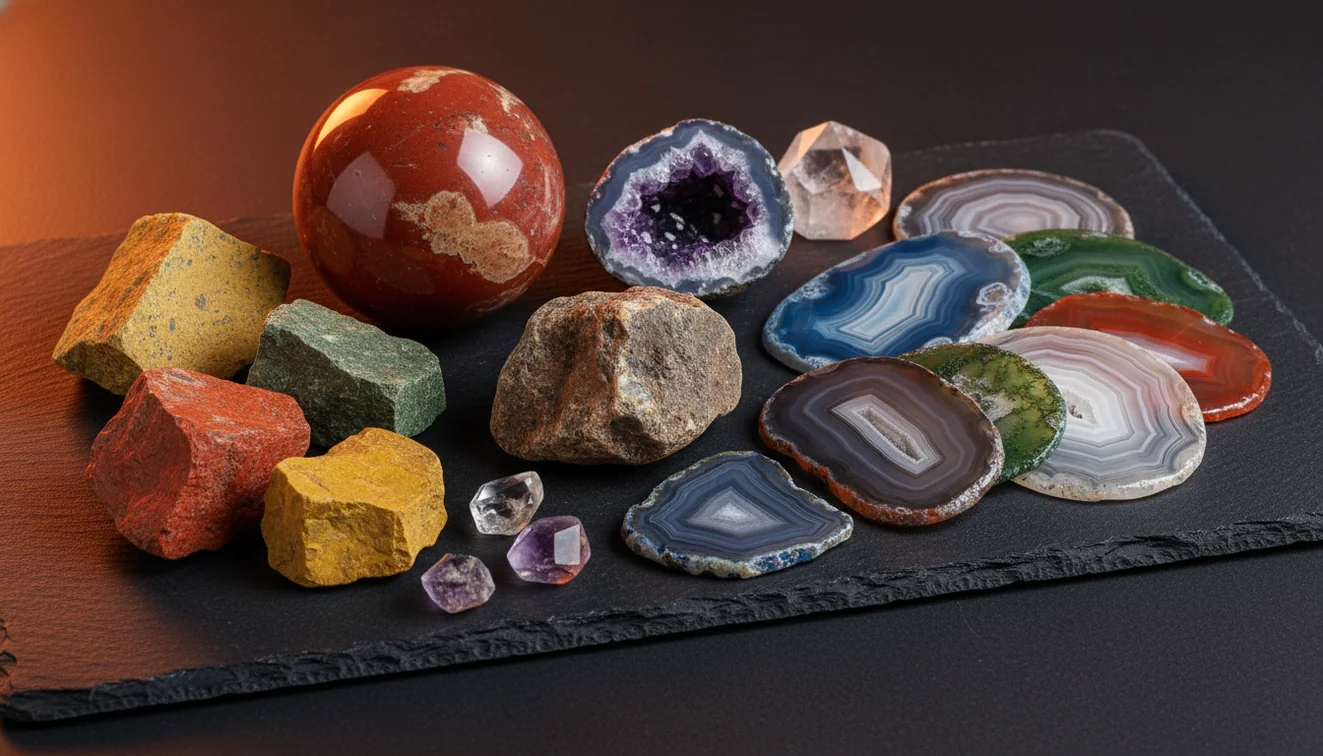
Quick answer: Jasper vs agate: how to tell them apart usually depends on translucency and banding, not hardness or basic chemistry. Agate is typically partly translucent at thin edges and often shows curved, parallel growth bands, while jasper is usually opaque with mottled, brecciated, scenic, or iron-rich patterns.
AI Rock ID can help compare jasper and agate photos by looking for visible banding, edge translucency, fracture texture, and other chalcedony clues. RockIdentifier.io provides a web photo upload workflow for getting a jasper-versus-agate shortlist that should still be checked with simple field tests.
Quick summary
- Best for
- Collectors, rockhounds, lapidary hobbyists, beginners, beach and river gravel finders
- Works on
- Chalcedony, jasper, agate, tumbled stones, polished slabs, rough nodules
- Accuracy
- Good for a visual shortlist when edge translucency, true banding, and quartz-family tests are visible
- Needs confirmation
- Yes
- Professional replacement
- No
- Platforms
- iPhone, iPad, Web
This guide is best for
- Beginners comparing opaque jasper-like stones with translucent agate-like stones
- Rockhounds sorting mixed chalcedony from river gravel, beaches, or field collections
- Collectors checking whether bands are true agate growth bands or only color zoning
- Lapidary hobbyists evaluating rough, slabs, cabochons, or tumbled material before labeling
- Readers who can inspect a thin edge, wet the surface, and run simple quartz-family checks
- People using photos as a starting point before confirming with hardness, streak, and fracture
Consider another approach if you
- Sellers who need a final gemstone grade, price, or legally reliable trade description
- Users trying to identify heavily dyed, coated, resin-filled, or artificially enhanced material from photos alone
- Researchers making rare locality claims or museum-level identifications
- Anyone with only a polished face photo and no visible edge, fracture, or matrix
- People expecting a strict binary answer for transitional chalcedony with both opaque and banded zones
Jasper vs agate: how to tell them apart comes down to banding and translucency. Agate commonly shows curved, parallel growth bands and some light transmission at thin edges, while jasper is generally opaque with mottled, brecciated, scenic, or iron-rich patterns. Both are microcrystalline quartz, so hardness and streak help confirm the chalcedony family but usually do not separate the two by themselves.
What Is Jasper vs Agate: How to Tell Them Apart?
Jasper vs agate: how to tell them apart is a chalcedony identification problem, not a basic chemistry problem. Both are microcrystalline quartz, usually near Mohs 6.5–7, with waxy to vitreous luster, white streak, and conchoidal to uneven fracture. The practical difference is texture: agate is classically banded and often translucent at thin edges, while jasper is usually opaque and colored by iron oxides, clay, or other inclusions.
A good first pass is to wet the surface, backlight a thin edge, and look for rhythmic silica bands. If the specimen glows at the rim and shows curved, parallel bands, call agate first. If it stays opaque and shows spots, breccia fragments, earthy reds, yellows, browns, or picture-like scenes, jasper is more likely. For mineral background, Mindat’s chalcedony entry is a useful authority: https://www.mindat.org/min-960.html.
For a field photo workflow, the Rock Identifier iOS app can provide a free photo ID starting point when you show both the polished face and an edge close-up. Then confirm the result with hardness, streak, fracture, and whether the pattern is true growth banding or just color zoning.
How Jasper vs Agate: How to Tell Them Apart Works
Jasper vs agate identification works by separating visual structure from shared quartz-family properties. The scanner first evaluates visible cues in the photo: band geometry, color zoning, translucency at edges, fracture texture, surface polish, and whether the specimen appears massive, nodular, or cavity-filled. Agate forms from rhythmic silica deposition in openings, so its bands often curve with the cavity wall. Jasper is commonly silica-rich material packed with opaque impurities, so its patterns tend to be mottled, brecciated, orbicular, or scenic rather than evenly layered.
Because both materials have similar hardness and streak, the mechanism is comparative rather than single-test identification. A dry face photo may hide bands, so a wet-surface photo and a backlit edge usually improve confidence. Photos are processed for ID in a privacy-friendly way, and the result should be treated as a shortlist to verify with simple hand tests.
How to Tell Jasper vs Agate Apart
Backlight a thin edge
Hold the specimen against a bright window or phone light. Agate often transmits light at thin rims, while jasper usually remains opaque even where the edge is narrow.
Wet the surface
Wipe the stone with clean water to reduce dust and reveal color boundaries. Wetting often makes agate bands sharper and exposes whether a jasper pattern is actually mottling, brecciation, or iron staining.
Inspect the banding
Look for curved, parallel, repeated growth bands. Regular bands that wrap around a cavity or nodule favor agate; chaotic patches, plume-like scenes, or angular fragments favor jasper.
Check quartz-family basics
Test a discreet fresh edge if appropriate. Both jasper and agate should resist a steel nail, commonly scratch glass, show a white streak, and break with conchoidal to uneven fracture.
Photograph two views
Take one face-on photo and one edge or fracture close-up on a plain background. A photo-based lookup performs best when it can see bands, translucency, fracture texture, and any host matrix.
When to Use Jasper vs Agate: How to Tell Them Apart (and When Not To)
Use it when
- Use it when sorting mixed chalcedony from river gravel, beach finds, old collections, or lapidary rough.
- Use it when the specimen is polished but still has a visible edge, fracture, saw cut, or unpolished patch.
- Use it when you need a fast agate-or-jasper shortlist before doing Mohs hardness, streak, or loupe work.
- Use it when the main question is visual classification: true agate banding versus opaque jasper patterning.
- Use it when comparing dry and wet photos, since water often clarifies bands, zoning, and fracture texture.
Skip it when
- Do not use it as the only method for pricing, grading, or declaring a gemstone variety for sale.
- Do not rely on it when the stone is heavily dyed, resin-filled, coated, or photographed under colored light.
- Do not use it alone for rare locality claims, named jasper varieties, or museum-level documentation.
- Do not trust a polished face only if the edge, fracture, and matrix are hidden.
- Do not force a binary label when a specimen is transitional chalcedony with both opaque zones and agate-like bands.
Jasper vs Agate: How to Tell Them Apart vs Google Lens and Crystal Apps
| Feature | Rock Identifier | Google Lens | Rock & Crystal Identifier |
|---|---|---|---|
| Best use | Photo-based mineral shortlist with prompts for banding, translucency, streak, hardness, and fracture checks. | Broad visual web search that may match similar-looking jewelry, decor, or stock photos. | General crystal and gemstone lookup, often useful for common tumbled stones and collection labels. |
| Jasper vs agate focus | Stronger when you provide edge close-ups, wet surfaces, and chalcedony-specific visual details. | Can find lookalike images but may confuse trade names, dyed material, and decorative objects. | Usually helpful for common agate or jasper names, but may emphasize metaphysical or retail categories. |
| Geology prompts | Encourages confirmation with Mohs hardness near 7, white streak, no cleavage, and conchoidal fracture. | Does not consistently ask for mineral tests or formation context. | Varies by app; some provide mineral facts, while others focus on crystal catalog browsing. |
| Photo requirements | Works best with a plain background, natural light, one face view, and one thin-edge or fracture view. | Works from almost any image but may prioritize visually similar internet matches over mineral criteria. | Typically performs best with centered, clean photos of common specimens. |
| Main limitation | Still cannot measure specific gravity, confirm dye treatment, or prove locality from a photo alone. | Not built specifically for mineral identification and may return jewelry or decor results. | May over-label trade varieties when a simple chalcedony, jasper, or agate label is safer. |
Use the app or another mineral-focused scanner for geology-guided sorting, and use Google Lens when you mainly want broad visual matches or retail context. For jasper versus agate, the winning workflow is not one photo; it is a face view, an edge view, and a quick check for true bands and translucency.
Jasper vs Agate Use Cases
- Sorting tumbled stones: Tumbled chalcedony can hide fracture and matrix, so separate likely agates by visible banding and edge glow. Put opaque, picture-like, red, yellow, brown, or brecciated pieces in a jasper review pile.
- Checking rough nodules: Rough nodules often show weathered rinds that conceal internal structure. A fresh chip, saw cut, or wet surface can reveal whether the interior has agate bands or massive opaque jasper texture.
- Reviewing inherited collections: Old labels may use trade names loosely. Recheck each specimen by banding, translucency, hardness, white streak, and fracture before preserving or replacing labels.
- Screening dyed material: Dyed agate may look like bright jasper, especially in tumbled stones. Look for unnatural color saturation, dye concentrated in cracks, or color pooling around drill holes and fractures.
- Preparing lapidary cuts: Before cutting, inspect the rough for band orientation and opacity. Agate bands can guide cabochon layout, while jasper patterns often reward cuts that center scenes, breccia, or color contrast.
Jasper vs Agate: How to Tell Them Apart Limitations
- Treated stones can mislead visual identification. Dyed agate, stabilized jasper, resin-filled fractures, and heat-enhanced colors may not show natural color relationships.
- Polished specimens hide useful evidence. A glossy face can obscure micro-banding, fracture texture, matrix contact, and natural rind features that help separate jasper from agate.
- Rare minerals and lookalikes require more than photos. Some silicified rocks, chert, rhyolite, petrified wood, and chalcedony mixtures can resemble jasper or agate in a single image.
- Photo quality changes the result. Glare, low light, colored bulbs, shallow focus, dusty surfaces, and busy backgrounds can hide banding or make opaque material appear translucent.
- Value estimates should not come from identification alone. Price depends on size, cutting quality, pattern, locality, treatment, market demand, and whether the material is natural or altered.
- Transitional specimens may not fit cleanly. Some chalcedony contains both opaque jasper-like zones and translucent agate bands, so a combined label may be more accurate.
- Hardness and streak confirm the quartz family but rarely separate the two. Both commonly have white streak, no cleavage, and hardness near 7.
Common mistakes
- Assuming every banded-looking stone is agate, even when the lines are only staining, cracks, or color zoning.
- Calling a stone jasper only because it is red, brown, or yellow, even though many agates contain iron-rich colors.
- Ignoring edge translucency, which is often one of the fastest ways to separate agate from opaque jasper.
- Using hardness alone to decide between jasper and agate, even though both are microcrystalline quartz and usually test similarly.
- Mistaking chaotic breccia fragments, plume patterns, or scenic inclusions for true parallel agate growth bands.
- Photographing only the polished face and hiding the edge, fracture, or saw cut that could show translucency and structure.
- Forgetting that one chalcedony specimen can contain both opaque jasper-like zones and translucent agate-like bands.
Check Jasper vs Agate with Photos and Simple Field Clues
A clear face photo plus a backlit edge photo can help narrow a jasper vs agate identification. Confirm the photo result by checking translucency, true banding, white streak, quartz-like hardness, and fracture texture.
Related Articles
Frequently Asked Questions
Are jasper and agate the same mineral?
They are both varieties of chalcedony, which is microcrystalline quartz. The difference is mainly structure and appearance: agate is banded and often translucent, while jasper is usually opaque and impurity-rich.
Can jasper have bands too?
Yes, jasper can show layers, flow lines, or color zoning. Classic agate bands are usually more regular, curved, parallel, and tied to rhythmic silica growth in cavities.
Does agate always look translucent?
No. Some agate is only translucent at thin edges, and iron staining or dark color can make it look nearly opaque. Backlighting an edge is more useful than judging the main face.
What is the fastest field test?
Check edge translucency first, then look for true curved bands. If the stone stays opaque and the pattern is mottled, brecciated, or scenic rather than regularly banded, jasper is more likely.
Do both scratch glass?
Usually, yes. Jasper and agate are both near Mohs 6.5–7, so a fresh edge commonly scratches glass and resists a steel nail, though weathered surfaces can test softer.
What streak should I expect?
Both typically leave a white streak on unglazed porcelain. A red, yellow, green, or dark streak suggests heavy contamination, a coating, or a different material.
How do I spot dyed agate?
Look for unnaturally bright color, color concentrated in fractures, and strong color boundaries that do not follow natural bands. Drill holes, cracks, and porous zones often reveal dye pooling.
Is picture jasper an agate?
Picture jasper is generally opaque chalcedony or silicified material with scenic iron-rich patterns. If it lacks translucent edges and true rhythmic bands, it is usually treated as jasper rather than agate.
Can one stone be both?
Yes, mixed chalcedony can contain jasper-like opaque zones and agate-like translucent bands. In that case, a descriptive label such as jasper-agate or chalcedony with agate banding may be more honest.