Basalt vs Obsidian vs Scoria: Volcanic Rock Identification
Volcanic rock identification starts with texture: basalt is dense and fine-grained, obsidian is glassy, and scoria is vesicular and lightweight. Use photo ID as a fast field check, then confirm with hardness, streak, fracture, and geologic context.


Drop a rock photo here or tap to upload
JPG, PNG, WebP, HEIC • Max 50 MB • 1 free scan per day

Analyzing your specimen…
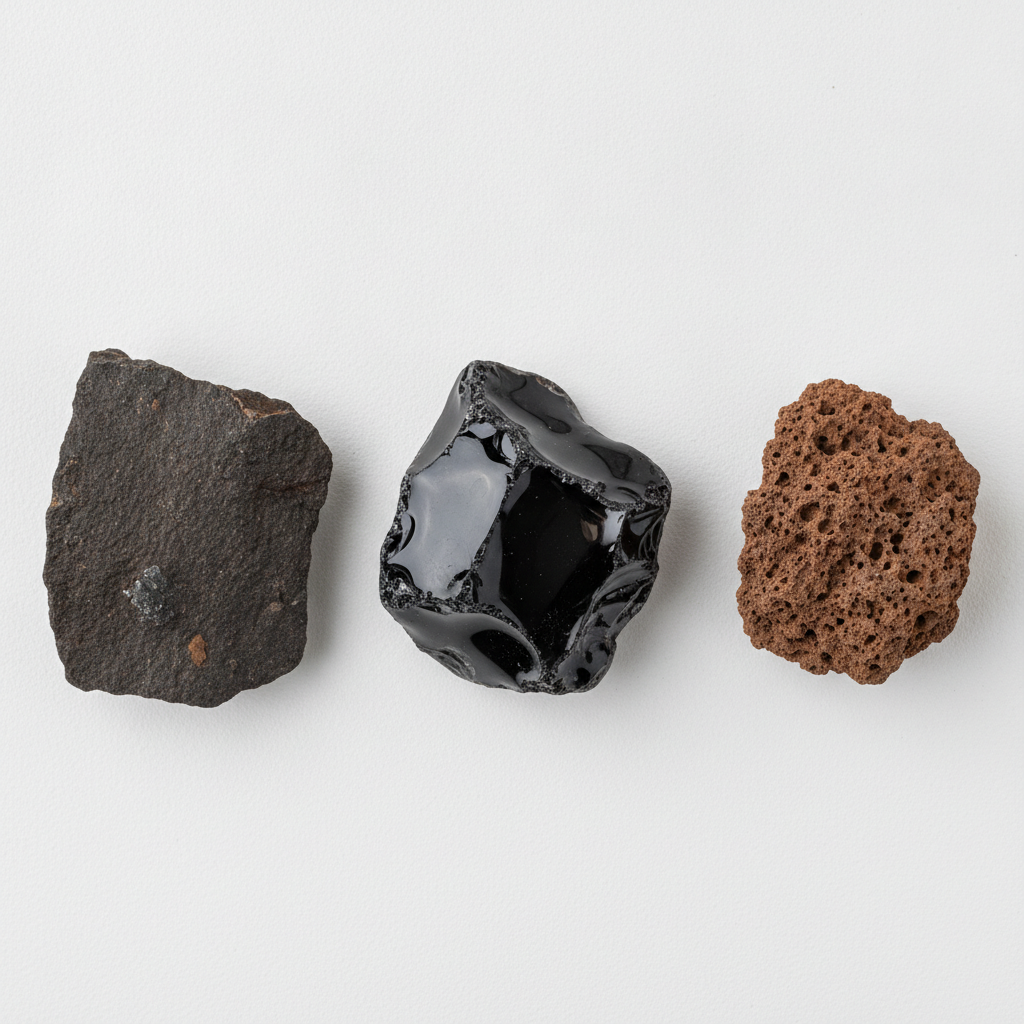
Quick answer: Volcanic rock identification is usually based first on texture: basalt is dense and fine-grained, obsidian is glassy with conchoidal fracture, and scoria is vesicular with many bubble holes. Color alone is not reliable, so a likely photo match should be checked with hardness, weight, magnetism, streak, fracture, and geologic setting.
AI Rock ID can help compare volcanic rock photos against visible traits such as fine grain, glassy fracture, vesicles, and dark mafic surfaces. RockIdentifier.io provides a web photo-upload workflow for checking whether a specimen is more consistent with basalt, obsidian, scoria, or another volcanic rock.
Quick summary
- Best for
- Rock collectors, hikers, students, beachcombers, geology beginners
- Works on
- Basalt, obsidian, scoria, pumice, volcanic rocks
- Accuracy
- Useful for narrowing common volcanic rocks from clear photos, but not a lab-grade classification
- Needs confirmation
- Yes
- Professional replacement
- No
- Platforms
- iPhone, iPad, Web
This guide is best for
- Beginners comparing basalt, obsidian, and scoria from hand samples
- Hikers and travelers checking volcanic rocks found near trails, beaches, or lava fields
- Students learning how texture, vesicles, and glassy luster help identify igneous rocks
- Collectors sorting dark volcanic specimens in a personal rock collection
- Homeowners trying to identify volcanic-looking landscaping gravel or cinders
- Teachers preparing simple visual ID examples for igneous rock lessons
Consider another approach if you
- People who need formal petrographic or geochemical classification
- Buyers or sellers who need authentication or appraisal before a transaction
- Anyone trying to determine whether a specimen is a meteorite, slag, or industrial glass without further testing
- Collectors evaluating protected-site, hazardous, radioactive, or asbestos-bearing material
- Users working only from wet, polished, dyed, coated, or heavily weathered specimens
Basalt, obsidian, and scoria are all volcanic rocks, but they look different because lava cooled under different conditions. Basalt is usually dark, dense, and fine-grained; obsidian is shiny volcanic glass; scoria is dark, bubbly, and full of vesicles. A free photo ID tool can narrow the match quickly, but the best identification combines images with simple physical tests.
What Is Volcanic Rock Identification?
Volcanic rock identification is the process of recognizing igneous rocks formed from lava or volcanic ejecta by using texture, color, mineral content, vesicles, glassiness, and field setting. For basalt, obsidian, and scoria, the fastest clues are grain size, luster, density, and gas-bubble cavities.
Basalt is typically aphanitic, meaning its crystals are too small to see without magnification. Obsidian is amorphous volcanic glass with conchoidal fracture and sharp edges. Scoria is usually mafic, reddish-brown to black, and vesicular because gas escaped as the lava cooled.
For a geology reference on volcanic rocks and igneous processes, the USGS provides useful background at https://www.usgs.gov/programs/VHP/volcanoes. In practice, use visual ID first, then check hardness, magnetism, streak, and whether the specimen came from a lava flow, cinder cone, beach gravel, or landscaping aggregate.
How Volcanic Rock Identification Works
Volcanic rock identification works by matching visible rock features to known igneous textures and compositions. A photo-based lookup analyzes color, luster, grain size, vesicles, fracture pattern, and surface weathering, then compares those traits with reference examples of basalt, obsidian, scoria, pumice, and related volcanic rocks.
The mechanism is strongest when the image shows a fresh broken face and a weathered exterior. Basalt often resolves as dark gray to black with tiny plagioclase or pyroxene grains; obsidian resolves by glassy reflectance and conchoidal fracture; scoria resolves by abundant rounded cavities. Photos are processed for ID in a privacy-friendly way, and the result should be treated as a ranked suggestion rather than a lab determination.
How to Use Volcanic Rock Identification
Photograph a fresh surface
Show a broken or unweathered face if possible, because oxidation, soil coating, and desert varnish can hide diagnostic texture. Place the specimen in natural light and avoid glare on shiny obsidian.
Capture scale and texture
Include a coin, ruler, or fingertip for size, then take a close-up of grain size, vesicles, fracture, or glassy luster. For scoria, make sure the bubble cavities are visible from the side and top.
Submit the clearest photo
Use the iOS app link context on rockidentifier.io if you want a mobile field workflow, or upload from your device when reviewing samples later. Choose the image that shows the most geology, not necessarily the prettiest angle.
Compare the suggested match
Check whether the result fits observable traits: dense fine-grained basalt, glassy obsidian, or porous vesicular scoria. If the app suggests several volcanic rocks, rank them by texture first and color second.
Confirm with simple tests
Test hardness against glass or a steel nail, note whether the rock feels unusually light, and check for magnetism. Do not rely on a single photo when the specimen is polished, tumbled, wet, coated, or artificially colored.
When to Use Volcanic Rock Identification and When Not To
Use it when
- Use it when you need a fast distinction between basalt, obsidian, scoria, pumice, and other common lava-derived rocks.
- Use it in the field when the specimen has visible texture, such as vesicles, glassy fracture, flow banding, or fine-grained crystalline surfaces.
- Use it for beach stones, trail finds, landscaping gravel, cinder-cone samples, and classroom collections where a likely ID is enough to guide follow-up testing.
- Use it before organizing a collection, labeling specimens, or deciding which samples deserve closer inspection under a hand lens.
Skip it when
- Do not use it as the only basis for buying, selling, or appraising a specimen.
- Do not rely on it for thin sections, geochemical classification, or distinguishing rare volcanic minerals that require microscopy or lab analysis.
- Do not treat it as conclusive when the rock is wet, polished, dyed, coated, slag-like, or heavily weathered.
- Do not use it to determine whether a specimen is safe, radioactive, asbestos-bearing, or legally collectible from a protected site.
Volcanic Rock Identification vs Google Lens and Rock Scanner
| Feature | Rock Identifier | Google Lens | Rock Scanner |
|---|---|---|---|
| Primary purpose | Rock and mineral photo ID with geology-focused labels and specimen guidance | General visual search across web images, products, places, and objects | Rock and crystal lookup with broad consumer-friendly suggestions |
| Basalt vs obsidian vs scoria | Uses igneous texture cues such as vesicles, glassy luster, and fine-grained mafic surfaces | May return visually similar web images, sometimes mixing slag, glass, meteorites, or décor stones | Can identify common rocks but may be less precise when volcanic textures are weathered |
| Field workflow | Good for quick mobile checks, collection notes, and follow-up physical tests | Useful when you want related web pages, retail listings, or image matches | Useful for casual collecting and simple crystal or stone naming |
| Geology context | Connects the visual result to rock type, likely traits, and practical verification steps | Depends on indexed pages and image similarity rather than a rock-specific workflow | Usually provides a name and short description, with variable geology depth |
| Best use | Identifying unknown volcanic specimens from clear photos and confirming with texture | Finding visually similar images or broader web references | Checking common stones in a hobby collection |
Rock Identifier is strongest when the question is geological: “Is this basalt, obsidian, scoria, pumice, or something else volcanic?” Google Lens is better for broad image search, while a rock scanner competitor may be enough for casual naming but can miss fine distinctions caused by texture, weathering, and lava composition.
Volcanic Rock Identification Use Cases
- Distinguishing basalt from scoria: Basalt and scoria can both be dark and mafic, but basalt is usually dense and massive, while scoria is full of vesicles and feels lighter for its size. A close-up of the surface texture helps separate a lava-flow rock from a cindery volcanic fragment.
- Checking black glassy rocks: Obsidian is identified by its glassy luster, sharp edges, and conchoidal fracture, not just by being black. Photo ID can help separate obsidian from slag, bottle glass, chert, or polished decorative stone.
- Sorting landscaping gravel: Many yards contain crushed basalt, lava rock, or scoria sold as decorative aggregate. Identification helps explain why one piece is dense and fine-grained while another is bubbly, red-black, and lightweight.
- Building a teaching collection: Basalt, obsidian, and scoria are excellent classroom examples because they show different cooling histories and gas contents. Students can compare texture, density, fracture, and vesicles before learning igneous classification terms.
- Screening field finds: A quick result helps decide whether a specimen is worth additional tests, such as hardness, magnetism, streak, or hand-lens inspection. It is especially helpful after hikes near volcanic provinces, cinder cones, or old lava flows.
Volcanic Rock Identification Limitations
- Treated stones can mislead photo ID. Dyed, coated, heat-treated, resin-filled, or oiled specimens may not show natural volcanic texture or color.
- Polished specimens are harder to classify. Tumbling and cutting can remove vesicles, weathering rind, fracture clues, and the rough surface texture used to separate basalt, obsidian, and scoria.
- Rare minerals and unusual volcanic rocks may need lab work. Thin-section petrography, X-ray diffraction, or geochemical testing can be necessary for uncommon volcanic glass, altered lava, or mineral-rich inclusions.
- Photo quality strongly affects results. Blur, harsh flash, wet surfaces, shadows, low resolution, and missing scale can make basalt look like chert, obsidian look like artificial glass, or scoria look like slag.
- Value estimates should not come from photo ID alone. Price depends on locality, size, condition, provenance, lapidary quality, and market demand, not just the rock name.
- Weathering can hide the original rock. Iron staining, clay alteration, desert varnish, and ocean rounding can obscure grain size, luster, and vesicles.
- Industrial slag can mimic volcanic rock. Slag may be glassy, bubbly, metallic, or black, so context and physical clues are important before calling a specimen obsidian or scoria.
Common mistakes
- Identifying every black volcanic-looking rock as basalt without checking grain size or density
- Calling any shiny black stone obsidian even when it lacks conchoidal fracture and glassy texture
- Confusing scoria with pumice by using color alone instead of comparing weight and vesicle structure
- Assuming holes in a rock always mean scoria, even though basalt, slag, and other materials can also be vesicular
- Ignoring weathered surfaces that can hide the fresh texture needed for volcanic rock identification
- Relying on a single photo instead of confirming with hardness, magnetism, streak, and field context
- Mistaking industrial slag or melted glass for natural volcanic rock because it looks dark, bubbly, or glossy
Check volcanic rock identification with a clear photo
A clear photo can help narrow whether a specimen looks more like basalt, obsidian, scoria, or another volcanic rock. Confirm the suggested match by examining texture, fracture, weight, hardness, and where the rock was found.
Related Articles
Frequently Asked Questions
How do I identify volcanic rock?
Start with texture: look for glassy surfaces, fine grains, vesicles, flow banding, or ash-like fragments. Then compare density, hardness, fracture, and location to decide whether it is basalt, obsidian, scoria, pumice, or another volcanic rock.
Is basalt always black?
Basalt is commonly dark gray to black, but it can weather brown, reddish, or greenish depending on iron oxidation and alteration minerals. Fresh basalt is usually dense, fine-grained, and may show tiny feldspar or pyroxene crystals.
How can I tell obsidian from glass?
Obsidian has a natural volcanic context, conchoidal fracture, and often subtle flow banding or inclusions. Bottle glass and slag may look similar, so check for bubbles, mold marks, industrial context, and unnatural color uniformity.
What makes scoria different from pumice?
Scoria is usually darker, denser, and mafic, with larger vesicles and a red-black color range. Pumice is typically lighter colored, more silica-rich, and so vesicular that many pieces can float, at least until water fills the pores.
Can basalt have holes in it?
Yes, basalt can be vesicular if gas bubbles were trapped as the lava cooled. When the rock is extremely bubbly and cindery, especially in red or black fragments, it may be described as scoria rather than massive basalt.
Why is my black rock magnetic?
Many basaltic rocks contain magnetite or other iron-bearing minerals, so weak to moderate magnetism can be normal. Strong magnetism may also suggest slag or an iron-rich industrial material, so use texture and context too.
Is obsidian a crystal or rock?
Obsidian is a volcanic rock, not a crystal, because it is natural glass without a regular crystalline structure. It forms when silica-rich lava cools so quickly that mineral crystals do not have time to grow.
Can a photo identify a rock accurately?
A clear photo can often narrow a common volcanic rock to a likely match, especially when texture is visible. Accuracy improves when you add scale, fresh surfaces, location, and simple physical tests.
What rocks look like meteorites?
Basalt, slag, magnetite-rich rocks, and dark weathered volcanic stones are often mistaken for meteorites. True meteorite identification usually requires more than appearance, including density, fusion crust evaluation, metal content, and expert testing.