Citrine vs Heat-Treated Amethyst: How to Tell the Difference
Real citrine vs fake citrine is usually a treatment question, not a simple “real or glass” question. Natural citrine and heat-treated amethyst are both quartz, but their color pattern, crystal habit, and specimen context often give useful clues.


Drop a rock photo here or tap to upload
JPG, PNG, WebP, HEIC • Max 50 MB • 1 free scan per day

Analyzing your specimen…
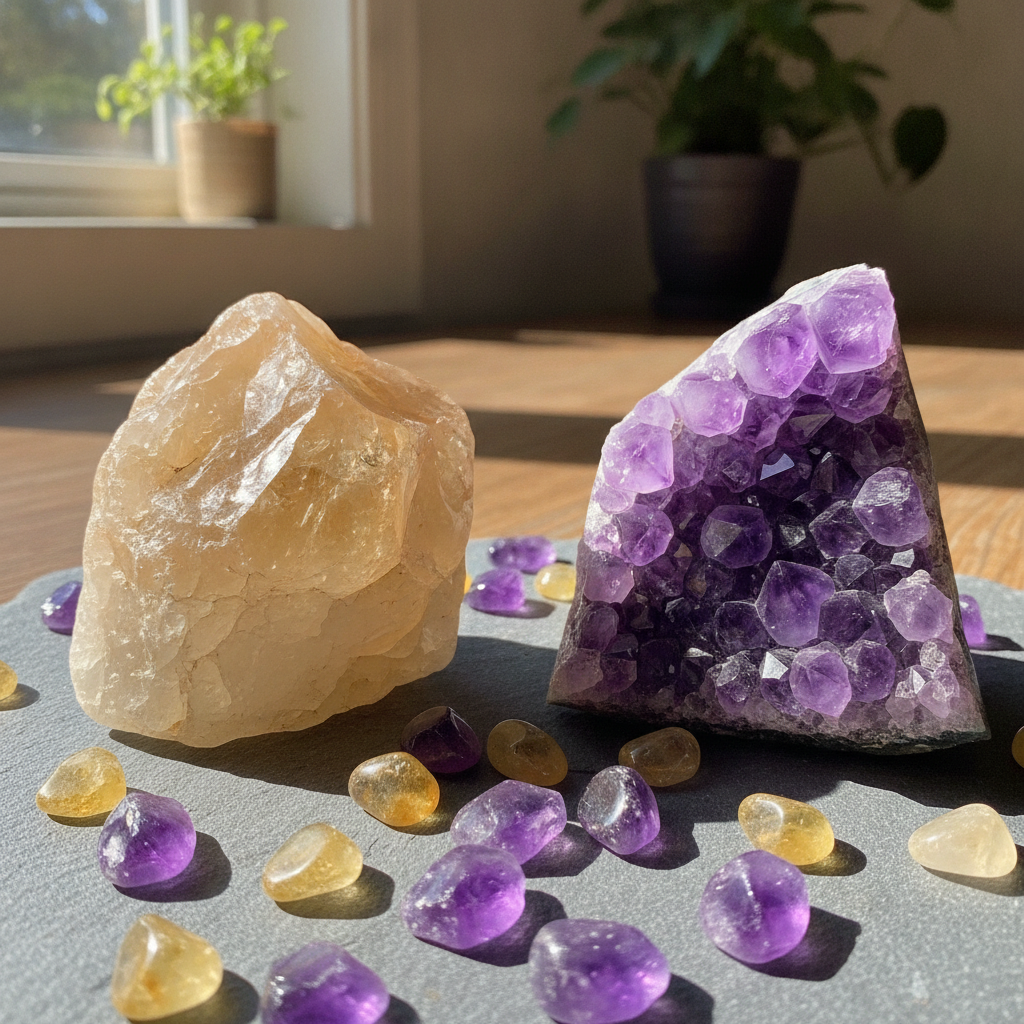
Quick answer: Real citrine vs fake citrine is usually a question of natural quartz versus heat-treated quartz, not necessarily quartz versus glass. Natural citrine is commonly pale yellow, smoky yellow, or honey colored, while heat-treated amethyst often looks vivid orange to reddish brown with a white base or geode-cluster habit.
AI Rock ID can help readers compare citrine photos for visual clues such as hue, crystal habit, color zoning, and possible heat-treated amethyst features. RockIdentifier.io provides a web photo upload option for checking citrine-labeled quartz specimens before deciding whether lab confirmation or seller documentation is needed.
Quick summary
- Best for
- Collectors, crystal buyers, beginners, shop staff, educators
- Works on
- Quartz crystals, citrine, amethyst clusters, tumbled stones, cut stones
- Accuracy
- Useful for visual screening, but not definitive for treatment history
- Needs confirmation
- Yes
- Professional replacement
- No
- Platforms
- iPhone, iPad, Web
This guide is best for
- Collectors comparing natural citrine with heat-treated amethyst specimens
- Crystal buyers checking bright orange quartz before purchase
- Beginners learning color, habit, and zoning clues in quartz
- Shop staff sorting citrine-labeled inventory for disclosure questions
- Teachers or students explaining why treatment is different from imitation
- Field-note users documenting quartz specimens with photos and observations
Consider another approach if you
- Appraisals, insurance reports, or resale claims that require formal proof
- High-value faceted citrine that needs gemological testing
- Legal disputes over seller disclosure or treatment history
- Specimens photographed under strong reflections, colored lighting, or filters
- Anyone needing a laboratory-level conclusion from a single image
Natural citrine is usually pale yellow, smoky yellow, or honey-toned quartz with relatively even color. Heat-treated amethyst often shows strong orange to reddish-brown color, a white base, and geode-cluster growth. A photo can flag likely treatment clues, but lab testing or reliable provenance is needed for a confident trade-grade conclusion.
What Is Real Citrine vs Fake Citrine?
Real citrine vs fake citrine compares natural yellow quartz with stones sold as citrine because of treatment, imitation, or mislabeling. Natural citrine is quartz colored by trace elements and irradiation over geologic time; it is typically light yellow, smoky yellow, or brownish yellow rather than neon orange.
Most “fake citrine” in shops is not always fake mineral material. It is often heat-treated amethyst or smoky quartz, which is still quartz but has been altered to create a stronger yellow-orange color. Glass, dyed material, and composite beads are separate imitation issues.
The practical question is disclosure. A treated quartz point may be attractive and durable, but it should not be represented as rare natural citrine. For gemology background on quartz varieties and treatments, see the Gemological Institute of America at https://www.gia.edu/quartz-description.
How Real Citrine vs Fake Citrine Identification Works
Real citrine vs fake citrine identification works by combining visual pattern recognition with quartz-specific geology clues. The scanner evaluates hue, saturation, color zoning, crystal habit, luster, fracture texture, matrix, and whether the specimen resembles a natural single crystal, a geode cluster, a bead, or a cut stone.
Heat-treated amethyst commonly appears as bright orange, burnt amber, or reddish brown, often darkest at the crystal tips with a chalky white base. Natural citrine more often shows softer yellow to smoky tones and fewer abrupt orange-white transitions. Photos are processed for identification and used to return an ID result, not to publish a public listing by default.
Image analysis cannot prove treatment history by itself. It works best as a first-pass decision aid before you confirm with provenance, magnification, spectroscopy, or a qualified gemologist.
How to Tell Real Citrine vs Fake Citrine
Photograph the specimen in neutral light
Use indirect daylight or a daylight-balanced lamp, not warm display lighting. Take one full-specimen photo, one close-up of crystal tips, and one view of the base or matrix so color zoning and growth habit are visible.
Check the color range
Look for soft yellow, smoky yellow, champagne, or honey tones in likely natural citrine. Treat vivid orange, burnt brown, reddish tips, or unusually saturated “pumpkin” color as possible heat-treated amethyst clues.
Inspect the crystal habit
Natural citrine is often seen as individual quartz crystals or cut stones, while heat-treated amethyst is very commonly sold as small geode clusters. A white base with orange crystal points is one of the strongest visual warning signs.
Scan with a photo-based lookup
Upload the best image and compare the suggested ID with the visual evidence. If you are checking from a phone, use the iOS app link on the site to keep specimen notes, photos, and likely identifications together.
Confirm before pricing or resale
Do not rely on color alone for value. Ask for seller disclosure, locality, treatment history, and testing when the specimen is expensive, faceted, unusually clean, or represented as rare natural citrine.
When to Use Real Citrine vs Fake Citrine Checks (and When Not To)
Use it when
- Use it when a crystal cluster is bright orange or reddish brown and you want to know if it is likely heat-treated amethyst.
- Use it when a seller labels a specimen “natural citrine” but gives no locality, treatment statement, or gemological paperwork.
- Use it when sorting quartz specimens for a collection, classroom tray, metaphysical shop inventory, or field notebook.
- Use it when you need a fast visual screen before deciding whether paid gem testing is worth it.
- Use it when comparing multiple stones under the same lighting so differences in hue, zoning, and crystal habit are easier to judge.
Skip it when
- Do not use it as the only proof for insurance, appraisal, resale, or legal dispute documentation.
- Do not use it to separate all natural citrine from all treated citrine when the stone is faceted, very clean, or photographed through reflections.
- Do not use it as a replacement for spectroscopy, microscopy, refractive index testing, specific gravity, or a gem lab report.
- Do not assume every dark yellow quartz is treated; some smoky citrine and iron-stained quartz can be visually confusing.
- Do not make value claims from a single photo because origin, clarity, cutting, size, and disclosure strongly affect market price.
Real Citrine vs Fake Citrine vs Google Lens and Crystal Identifier
| Feature | Rock Identifier | Google Lens | Crystal Identifier |
|---|---|---|---|
| Primary goal | Rock, mineral, crystal, and gemstone identification from specimen photos | General visual search across the web | Crystal name lookup and basic metaphysical or collecting information |
| Citrine treatment clues | Highlights color, habit, geode-cluster form, and quartz look-alikes | May find similar product photos but often misses treatment context | May identify citrine, but treatment detail varies by app and database |
| Best photo type | Close, sharp specimen images with neutral light and visible base or matrix | Product-like images or objects with recognizable web matches | Single crystals, tumbled stones, or common collection specimens |
| Geology context | Uses mineral terms such as quartz, amethyst, smoky quartz, luster, and crystal habit | Search-result context depends on indexed pages | Usually simplified for hobby use |
| Limit for citrine | Cannot prove heat treatment without supporting evidence | Can confuse sales listings with identification evidence | May not distinguish natural color from heat-treated quartz |
Rock Identifier is strongest when you need a mineral-focused first pass, not just a visually similar shopping result. Google Lens is useful for finding matching images, while a crystal app competitor may be convenient for common names but less consistent on citrine treatment disclosure.
Real Citrine vs Fake Citrine Use Cases
- Checking a crystal shop purchase: A common use case is evaluating a bright orange cluster sold as natural citrine. The app can flag the combination of saturated orange tips and pale base that often points to heat-treated amethyst, helping you ask better seller questions before buying.
- Sorting a quartz collection: Collectors often inherit mixed quartz trays containing amethyst, smoky quartz, iron-stained quartz, and citrine-labeled pieces. A structured photo check helps separate likely natural citrine candidates from obvious treated clusters or mislabeled yellow quartz.
- Teaching mineral identification: In classrooms or clubs, citrine is a useful lesson in mineral species versus variety versus treatment. Students can compare Mohs hardness, quartz crystal habit, color centers, and commercial labeling using real specimens and photo results.
- Screening online listings: Before ordering from a listing, save seller photos and look for visual red flags: uniform orange geode points, over-saturated color, vague origin, and no treatment disclosure. The result is not proof, but it helps decide whether the listing deserves more scrutiny.
Real Citrine vs Fake Citrine Limitations
- Heat-treated amethyst and natural citrine are both quartz, so hardness, basic luster, and many surface features can overlap.
- Polished specimens, beads, cabochons, and faceted stones may hide crystal habit, zoning, matrix, and base color clues.
- Rare natural citrine localities and smoky-yellow quartz can look different from common textbook examples.
- Photo quality matters: warm lighting, filters, reflections, blur, and overexposure can make pale yellow quartz look orange.
- Treated stones are not automatically worthless, but treatment must be disclosed for accurate collecting, resale, and appraisal.
- Value estimates cannot be made reliably from a photo because size, clarity, cut, origin, condition, and documentation all matter.
- Irradiated quartz, dyed stones, glass, and iron-stained quartz may require tests beyond visual identification.
- A single image cannot replace lab methods such as spectroscopy, microscopy, refractive index measurement, or expert examination.
Common mistakes
- Assuming every orange crystal sold as citrine is natural citrine.
- Calling heat-treated amethyst glass or fake mineral material when it is still quartz.
- Ignoring a white base with orange points, which is a common visual clue for treated amethyst clusters.
- Judging citrine only by color without considering crystal habit, zoning, and specimen context.
- Photographing citrine under warm store lighting and mistaking the lighting effect for natural color.
- Assuming tumbled or polished citrine can be verified from appearance as easily as a natural crystal point.
- Treating a photo-based ID as proof of treatment history for pricing, appraisal, or resale.
Check real citrine vs fake citrine clues before you buy
A neutral-light photo can help flag color, habit, and geode-cluster clues that separate likely natural citrine from possible heat-treated amethyst. Use photo identification as a screening step, then confirm important specimens with disclosure, provenance, or gemological testing.
Related Articles
Frequently Asked Questions
Is heat-treated amethyst fake citrine?
Heat-treated amethyst is real quartz, but it is not natural-color citrine. It should be sold as treated quartz or heat-treated amethyst rather than undisclosed natural citrine.
What color is natural citrine?
Natural citrine is usually pale yellow, smoky yellow, honey yellow, or brownish yellow. Very vivid orange or reddish-brown color, especially on geode clusters, is more suspicious for heat treatment.
How can I spot treated citrine?
Look for bright orange tips, a white or pale base, and small clustered geode crystals. That combination is commonly associated with heat-treated amethyst sold as citrine.
Is orange citrine always fake?
No, orange color alone does not prove a stone is fake. However, strong orange saturation with abrupt zoning is a reason to ask for treatment disclosure or lab confirmation.
Can a photo identify real citrine?
A photo can identify likely quartz and show clues that suggest natural citrine or treated amethyst. It cannot prove geologic color origin with the same confidence as gemological testing.
Does real citrine form in clusters?
Natural citrine can occur in crystal groups, but the common retail “citrine cluster” with orange points and a white base is often heat-treated amethyst. Habit and color pattern should be judged together.
Is tumbled citrine usually treated?
Many tumbled stones sold as citrine are treated quartz, but not all are. Because tumbling removes matrix and crystal habit, seller disclosure and testing become more important.
Is treated citrine worth buying?
Treated citrine can be worth buying if you like the appearance and the price reflects the treatment. The problem is not treatment itself; the problem is undisclosed treatment sold as rare natural material.
What tests confirm natural citrine?
A gemologist may use microscopy, spectroscopy, refractive index, specific gravity, and origin documentation. For higher-value stones, a reputable lab report is the safest confirmation.