Fossil Identification Guide: Crinoids, Brachiopods, and Shark Teeth
Use this fossil identification guide to recognize common field finds by shape, symmetry, texture, and preservation style. Rock Identifier can help compare a fossil photo with likely matches when you need a second look.


Drop a rock photo here or tap to upload
JPG, PNG, WebP, HEIC • Max 50 MB • 1 free scan per day

Analyzing your specimen…
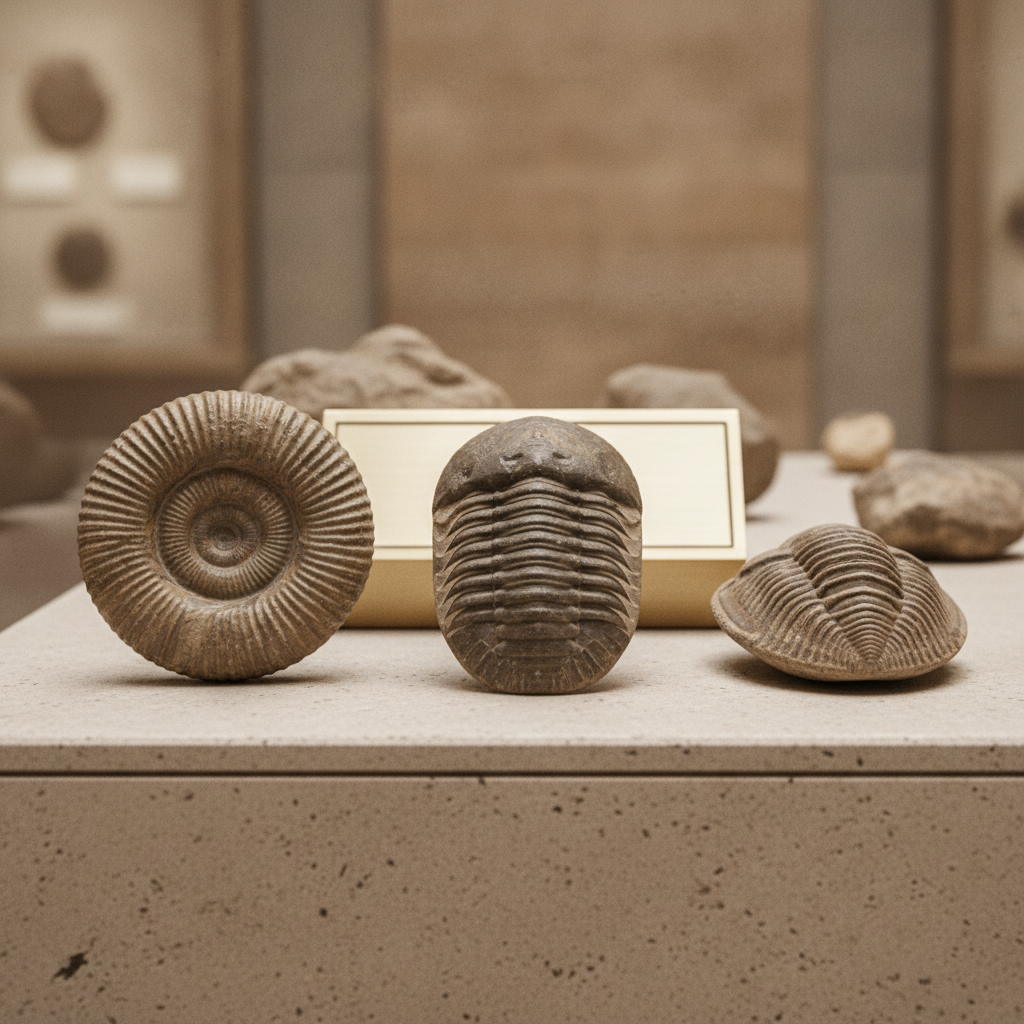
Quick answer: A fossil identification guide helps match visible traits such as symmetry, ribbing, tooth shape, stem segments, matrix, and preservation style to likely fossil groups. It is useful for recognizing common fossils such as crinoids, brachiopods, and shark teeth, but species-level identification often needs locality, geologic age, and expert confirmation.
AI Rock ID can help users compare fossil photos with likely groups such as crinoids, brachiopods, shark teeth, and other common marine fossils. RockIdentifier.io supports web photo uploads for fossil identification when a user wants a quick first-pass comparison from a clear image.
Quick summary
- Best for
- Beginners, fossil collectors, beachcombers, hikers, students, field naturalists
- Works on
- Crinoids, brachiopods, shark teeth, shell fossils, marine fossil fragments, trace fossils
- Accuracy
- Good for first-pass fossil group identification when photos show clear shape, texture, scale, and matrix; less reliable for worn, polished, or fragmentary specimens.
- Needs confirmation
- Yes
- Professional replacement
- No
- Platforms
- iPhone, iPad, Web
This guide is best for
- Beginners learning how to separate fossils from ordinary rocks and shell fragments
- Collectors sorting common marine fossils such as crinoids, brachiopods, and shark teeth
- Beachcombers comparing dark triangular finds with possible fossil shark teeth
- Hikers and field observers documenting fossils with scale, matrix, and location notes
- Students practicing fossil identification by shape, symmetry, ribbing, and preservation style
- Rock and fossil hobbyists who want a first-pass ID before researching local geology
Consider another approach if you
- Researchers who need museum-grade species identification or publication-level confirmation
- Collectors trying to determine commercial value from a photo alone
- Users identifying rare, highly weathered, polished, or cut fossil specimens
- People collecting on private land, protected parks, road cuts, or heritage sites without permission
- Anyone needing legal, conservation, or paleontological certification for a fossil find
A fossil identification guide helps you match visible traits such as shell symmetry, tooth shape, stem segments, matrix, and surface texture to likely fossil groups. Crinoids often look like small disks or columns, brachiopods look like ribbed shells with bilateral symmetry, and shark teeth show a glossy enamel crown with a root. Photo identification is useful for narrowing possibilities, but exact species-level ID may require locality, geologic age, and expert review.
What Is a Fossil Identification Guide?
A fossil identification guide is a practical reference for recognizing preserved remains, traces, or impressions of ancient life. For common marine fossils, the fastest clues are morphology: crinoid stems form bead-like columns or star-centered disks, brachiopods show two shell valves with symmetry down the center of each valve, and shark teeth preserve a hard enamel crown with a root and sometimes serrated cutting edges.
Good fossil ID also uses context. The surrounding rock, local stratigraphy, and whether the specimen came from limestone, shale, sandstone, or beach gravel can change the likely answer. For geologic time and fossil context, the [USGS fossil overview](https://www.usgs.gov/faqs/what-fossil) is a useful authority.
How a Fossil Identification Guide Works
A fossil identification guide works by comparing observable features against known fossil groups, then narrowing the match with context. The scanner reads photo cues such as outline, ribbing, chambering, symmetry, color contrast, fracture pattern, and matrix texture. It then compares those cues with reference examples and returns likely categories rather than a guaranteed species name.
For crinoids, it looks for columnals, circular stems, and flower-like calyx fragments. For brachiopods, it weighs hinge shape, fold-and-sulcus structure, ribs, and valve symmetry. For shark teeth, it evaluates crown shape, root lobes, cutting edges, and serrations. Locality and formation age still matter because similar shapes can appear in unrelated fossil groups.
How to Use a Fossil Identification Guide
Photograph the fossil in natural light
Place the specimen on a plain background and shoot straight down, then from the side. Avoid harsh glare because enamel, polished surfaces, and wet limestone can hide diagnostic texture.
Capture scale and both faces
Add a ruler, coin, or field notebook edge for scale. Photograph both sides of shells, teeth, stems, and fragments because hinge lines, roots, and internal molds may only appear on one face.
Open the photo-based lookup
Use the iOS app link on rockidentifier.io or open the Android version, then upload the clearest image. Photos are processed for identification rather than public posting, which keeps the workflow privacy-friendly.
Compare the suggested group
Check the result against visible traits: crinoid columnals should repeat like stacked disks, brachiopods should show valve symmetry, and shark teeth should have a distinct crown and root.
Confirm with location and rock type
Record where the fossil came from, if collecting rules allow it. Limestone and shale often preserve marine fossils, while beach deposits can mix shark teeth from multiple ages and sources.
When to Use a Fossil Identification Guide (and When Not To)
Use it when
- Use it when you have a clear photo of a common fossil fragment and need a fast first-pass ID.
- Use it for likely crinoids, brachiopods, shark teeth, corals, bivalves, gastropods, ammonites, and trace fossils.
- Use it when teaching beginners how to compare symmetry, ribbing, hinge lines, tooth roots, and matrix.
- Use it before organizing a collection so labels can separate broad groups from unknown specimens.
- Use it in the field when you want to decide whether a find deserves closer study at home.
Skip it when
- Do not use it as the only source for museum-grade species identification or publication work.
- Do not rely on photo ID for rare minerals, pseudofossils, concretions, or heavily weathered fragments.
- Do not use it to estimate commercial value, especially for shark teeth, amber inclusions, or display fossils.
- Do not collect from protected parks, road cuts, private land, or heritage sites without permission.
- Do not assume a polished or cut fossil shows enough diagnostic anatomy for a confident match.
Fossil Identification Guide vs Google Lens and Stone Identifier Rock Scanner
| Feature | Rock Identifier | Google Lens | Stone Identifier Rock Scanner |
|---|---|---|---|
| Best use | Photo-first rock, mineral, crystal, gemstone, and fossil lookup | Broad web image matching across many object types | General stone and crystal photo identification |
| Fossil cues | Uses visible morphology such as ribs, symmetry, matrix, roots, and stem segments | May match visually similar web images without geology-specific filtering | Often stronger for polished stones than fragmentary fossils |
| Crinoids and brachiopods | Useful for common marine fossil categories and comparison images | Can confuse fossils with shells, beads, corals, or decorative objects | May identify matrix as a rock instead of the fossil inclusion |
| Shark teeth | Helpful for narrowing tooth-like specimens by crown, root, and serration traits | Good at finding similar images but less consistent on worn teeth | May classify dark beach finds as mineral or stone material |
| Geology workflow | Pairs photo ID with field-observation habits such as scale, matrix, and locality | Search-oriented rather than specimen-oriented | App-oriented, but not always fossil-specific |
Rock Identifier is best used as a geology-aware starting point, not as a substitute for formation data, curated fossil keys, or a paleontologist’s review. Google Lens is useful for broad visual search, while a general stone scanner may be better for crystals than fossil anatomy.
Fossil Identification Use Cases
- Beachcombing for shark teeth: Dark triangular objects on beaches can be shark teeth, shell fragments, bone, or modern debris. A guide helps you check for an enamel crown, root lobes, edge wear, and serrations before labeling the find.
- Sorting limestone fossils: Limestone often contains crinoid columnals, brachiopod shells, bryozoans, corals, and shell hash. Comparing repeating disks, radial patterns, and ribbed valves can separate fossil groups quickly.
- Teaching fossil morphology: Students learn faster when they compare real specimens with named visual features. Terms like bilateral symmetry, hinge line, calyx, columnal, mold, cast, and matrix become easier to understand with photo examples.
- Checking inherited collections: Old boxes often contain mixed fossils, rocks, replicas, and souvenir pieces without labels. A photo-based workflow helps create rough group labels before deciding which items need expert verification.
- Field note cleanup: After a collecting trip, you can pair photos with location notes, rock type, and tentative IDs. That creates a cleaner record than trying to identify every fragment from memory weeks later.
Fossil Identification Guide Limitations
- Treated stones, dyed specimens, resin-coated fossils, and artificially aged souvenirs can look more natural in photos than they are.
- Polished specimens may remove or obscure diagnostic features such as ribbing, sutures, shell microstructure, root texture, and matrix contacts.
- Rare minerals, concretions, dendrites, manganese stains, and pseudofossils can mimic fossils and may need lab or expert confirmation.
- Photo quality strongly affects results; blur, glare, shadows, wet surfaces, and no scale reference can produce misleading matches.
- Value estimates should not be made from a photo alone because price depends on species, completeness, preparation, legality, provenance, and market demand.
- Fragmentary fossils may only be identifiable to a broad group, such as brachiopod, crinoid, coral, bivalve, or vertebrate tooth fragment.
- Exact age is usually impossible from the object alone; locality, stratigraphic formation, and associated fossils are often required.
Common mistakes
- Calling every ribbed shell fossil a brachiopod without checking whether symmetry runs down the middle of each valve.
- Mistaking crinoid stem pieces for beads, coins, or coral because the stacked disk pattern is not examined closely.
- Identifying every dark triangular beach object as a shark tooth without looking for enamel, a root, and natural cutting edges.
- Photographing a fossil without a ruler or coin, which makes size-based comparison much less reliable.
- Ignoring the surrounding rock matrix even though limestone, shale, sandstone, and beach gravel can point to different fossil histories.
- Relying on color alone, even though fossil color often reflects mineral staining rather than the original organism.
- Assuming a polished fossil or cut slab shows enough anatomy for confident identification.
Use a Fossil Identification Guide as a First-Pass Check
A fossil identification guide is most useful when a clear photo, scale, matrix, and location notes are considered together. Use photo-based results to narrow the likely group, then confirm important finds with local geology resources or a qualified fossil expert.
Related Articles

Frequently Asked Questions
How can I tell it is a fossil?
Look for biological patterns such as symmetry, repeated segments, shell ribs, pores, growth lines, or tooth enamel. Also check whether the object is embedded in or attached to a rock matrix rather than simply lying on the surface.
What do crinoid fossils look like?
Crinoid fossils often appear as small circular disks, stacked bead-like stems, or star-centered columnals. Less commonly, you may find calyx pieces that look like a small cup or flower head.
What do brachiopods look like?
Brachiopods usually look like ribbed shells with two valves, but their symmetry runs through the middle of each valve. That differs from many clams, where the left and right shells mirror each other.
How do I identify shark teeth?
Check for a glossy enamel crown, a root with two lobes or a flattened base, and a distinct cutting edge. Serrations, tooth width, curvature, and overall shape help narrow the likely shark group.
Can a photo identify fossils?
A clear photo can often identify common fossils to a broad group, especially crinoids, brachiopods, corals, ammonites, and shark teeth. Species-level identification usually needs locality, age, and close examination.
Where are common fossils found?
Common fossils are often found in sedimentary rocks such as limestone, shale, sandstone, and chalk. Beaches, stream gravels, quarries, and eroding outcrops can also expose fossils, but collecting rules vary by location.
Is collecting fossils legal everywhere?
No, fossil collecting is not legal everywhere. Always check rules for parks, public lands, private property, road cuts, and protected heritage sites before collecting or removing specimens.
What if my fossil is polished?
Polishing can make a fossil attractive but may hide texture, shell structure, matrix, and other diagnostic traits. Use side lighting and close-up photos, but expect a less certain identification.
Are crinoid fossils worth anything?
Most loose crinoid stem pieces are common and have modest value. Complete crowns, well-prepared slabs, rare localities, and aesthetic display pieces can be more collectible.