Is My Rock a Meteorite? Slag vs Meteorite Identification Guide
If you are asking “is my rock a meteorite,” start with texture, density, magnetism, and signs of industrial slag. This guide explains the practical field clues before you spend money on lab testing.


Drop a rock photo here or tap to upload
JPG, PNG, WebP, HEIC • Max 50 MB • 1 free scan per day

Analyzing your specimen…
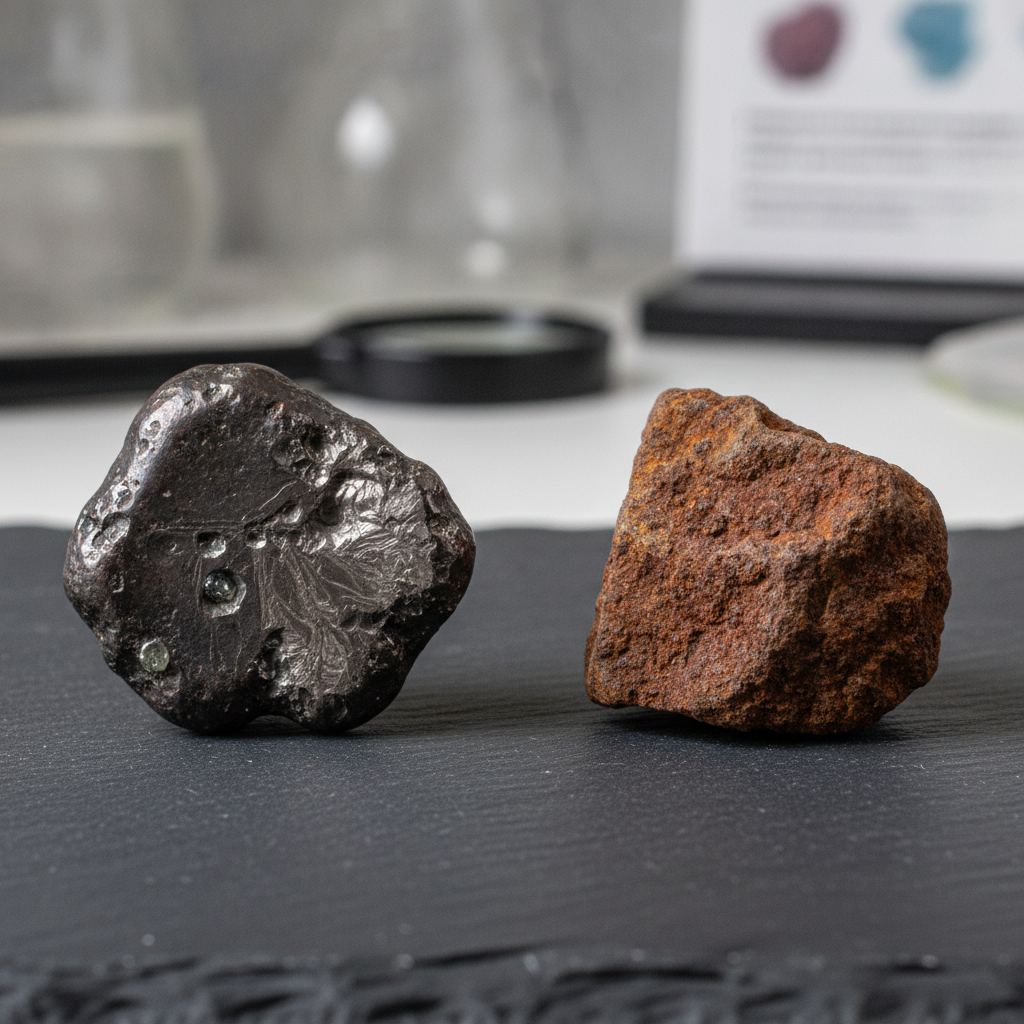
Quick answer: An is my rock a meteorite check looks for a combination of clues such as density, magnetism, fusion crust, metal flecks, and the absence of bubbly or glassy slag texture. Most suspected meteorites are terrestrial rocks or industrial slag, so photo screening can narrow the possibilities but cannot confirm a meteorite classification by itself.
AI Rock ID can help users compare a suspected meteorite with common meteor-wrongs such as slag, magnetite, hematite, and basalt from field photos. RockIdentifier.io provides a web photo upload option for an initial is my rock a meteorite screening before a user considers professional testing.
Quick summary
- Best for
- Collectors, hikers, beginners, teachers, field observers
- Works on
- Suspected meteorites, slag, magnetite, hematite, basalt, iron-rich rocks
- Accuracy
- Useful for first-pass screening when paired with clear photos and simple field observations
- Needs confirmation
- Yes
- Professional replacement
- No
- Platforms
- iPhone, iPad, Web
This guide is best for
- People asking whether a dark, heavy rock could be a meteorite
- Collectors comparing slag vs meteorite features before paying for testing
- Hikers or landowners who found an unusual magnetic stone
- Teachers explaining meteor-wrongs and basic field identification
- Beginners learning how magnetism, streak, density, and texture work together
- Field users documenting a possible fresh fall before altering the specimen
Consider another approach if you
- Anyone needing an official meteorite classification for sale or publication
- People seeking legal, ownership, export, or insurance decisions
- Specimens that have been cut, polished, coated, or heavily altered
- Finds that require laboratory chemistry, microscopy, or isotope testing
- Users who only have one blurry photo and no field observations
Most suspected meteorites are not meteorites; they are commonly slag, hematite, magnetite, basalt, or other terrestrial rocks. A real meteorite is usually dense, magnetic, dark from fusion crust, and does not show bubbly glassy texture like furnace slag. A photo-based check can narrow the possibilities, but laboratory confirmation is needed for a definitive meteorite classification.
What Is an Is My Rock a Meteorite Check?
An “is my rock a meteorite” check is a structured way to separate meteorites from common meteor-wrongs such as slag, magnetite, hematite, basalt, and iron concretions. The goal is not to prove extraterrestrial origin from one clue, but to stack evidence: fusion crust, density, weak to strong magnetism, regmaglypts, chondrules, and a fresh interior without vesicles.
Slag is the most frequent lookalike because it can be dark, heavy, metallic, and magnetic. The giveaway is often texture: slag commonly has bubbles, glassy flow surfaces, rusty pockets, or lightweight vesicular areas, while meteorites tend to be compact and stony or metallic. For background terminology, see the USGS meteorite overview: https://www.usgs.gov/faqs/i-think-i-found-meteorite-how-can-i-tell-for-sure
How “Is My Rock a Meteorite” Works
Meteorite identification works by comparing visible and testable traits against known meteorite classes and common terrestrial mimics. The scanner looks for surface features such as a thin dark fusion crust, thumbprint-like regmaglypts, metallic flecks, chondrule-like rounded grains, rust patterns, and the absence of gas bubbles. It also weighs your observations: whether a magnet attracts the specimen, whether a streak test leaves red-brown powder, and whether the rock feels unusually dense for its size.
Photos are processed for identification in a privacy-friendly way and are used to return likely matches, not to publish your specimen publicly by default. The result is a probability-based shortlist, not a laboratory certificate.
How to Use an Is My Rock a Meteorite Check
Photograph the whole specimen
Take sharp photos in natural light from several angles. Include the exterior crust, any broken edge, and a scale object such as a coin or ruler so shape and grain size are easier to evaluate.
Test for magnetism
Use a small magnet and note whether attraction is strong, weak, or absent. Many meteorites attract a magnet, but so do magnetite, slag with iron, and some industrial byproducts, so treat this as one clue rather than proof.
Check for bubbles and glass
Look closely for round holes, frothy texture, shiny glass, or melted-looking flow lines. Those traits usually point toward slag or volcanic scoria rather than a compact meteorite.
Inspect a fresh interior
If the stone is already broken, photograph the fresh surface. Chondrules, tiny metal flecks, and a dense fine-grained matrix are useful clues, while red-brown streaks or earthy interiors often suggest hematite or ironstone.
Compare the result before lab testing
Use the photo-based lookup to narrow the candidate list, then decide whether the specimen justifies professional testing. For iPhone users, the iOS app link is the fastest route to run a field photo check.
When to Use Is My Rock a Meteorite Identification (and When Not To)
Use it when
- Use it when a dark, dense, magnetic rock has a smooth outer rind and no obvious bubbles.
- Use it after a bright fireball, fresh fall report, or unusual find in a desert, dry lake, field, or gravel bar.
- Use it when you need to distinguish slag vs meteorite before paying for laboratory classification.
- Use it when you can provide multiple clear photos plus notes on magnetism, streak, weight, and location.
- Use it as a first-pass screening tool for teaching, collecting, or field triage.
Skip it when
- Do not use it as the final proof for selling a specimen as a meteorite.
- Do not rely on photos alone when the rock is heavily weathered, coated, polished, or altered.
- Do not assume strong magnetism means meteorite; magnetite and iron slag can be strongly magnetic.
- Do not cut, acid-test, or grind a potentially important fresh fall before documenting it.
- Do not use it for legal ownership, export, insurance, or scientific naming decisions without expert confirmation.
Is My Rock a Meteorite vs Google Lens and Rock Scanner
| Feature | Rock Identifier | Google Lens | Rock Scanner |
|---|---|---|---|
| Best purpose | Rock, mineral, crystal, and meteor-wrong screening from specimen photos | Broad visual web search across similar-looking images | General rock and crystal lookup |
| Slag vs meteorite focus | Uses geology-specific cues such as vesicles, fusion crust, magnetism notes, and metallic flecks | May match dark rocks visually but often misses diagnostic geology context | Can help with common rock names but may be less specific about industrial slag |
| Field observations | Works best with user notes on streak, magnet pull, density, and fresh interior | Mostly image similarity, with limited structured specimen testing | Usually photo-centered with some basic descriptions |
| Meteorite confidence | Useful for first-pass probability and next-step guidance, not final classification | Useful for finding similar web images, not confirmation | Useful for casual comparison, not laboratory proof |
| Best user | Collectors, hikers, teachers, and anyone sorting meteorites from meteor-wrongs | Users who want fast image search across the open web | Casual crystal or rock hobbyists |
Rock Identifier is strongest when you combine clear photos with simple field tests. Google Lens is useful for visual leads, but meteorite identification needs geology-specific evidence that image search alone often cannot weigh.
Is My Rock a Meteorite Use Cases
- Slag found near roads or rail beds: Dark, rusty, magnetic pieces near old industrial areas are often furnace slag, rail ballast, or smelter waste. A structured check helps identify bubbles, glassy surfaces, and iron-rich inclusions before the find is mistaken for a meteorite.
- Dense black stone after a fireball: A fresh fall candidate deserves careful documentation. Photograph the stone in place if possible, record GPS location, avoid cleaning it, and compare fusion crust, interior texture, and magnetism before seeking expert testing.
- Beach or river ironstone: Rounded black rocks from beaches and streams can be magnetite, basalt, ironstone, or man-made material. Water-worn surfaces remove many diagnostic features, so interior texture and streak color become especially important.
- Classroom and museum screening: Students can learn why one clue is not enough. Comparing slag, basalt, hematite, and real meteorite photos builds practical recognition of vesicles, crust, density, and mineral grains.
- Collector purchase review: Before buying a supposed meteorite, use photos and seller-provided data to check for red flags. A genuine seller should be able to provide weight, provenance, classification details, and clear interior and exterior images.
Is My Rock a Meteorite Limitations
- Treated stones, coated specimens, painted rocks, or heat-altered material can hide the true surface and make photo identification unreliable.
- Polished specimens lose diagnostic exterior traits such as fusion crust, regmaglypts, oxidation patterns, and natural fracture texture.
- Rare meteorite types, unusual achondrites, and highly weathered finds may not look like common stony or iron meteorites in photographs.
- Photo quality matters: blur, glare, wet surfaces, poor lighting, and no scale object can shift a likely match toward the wrong material.
- Value estimates should not be based on app results; meteorite price depends on classification, mass, condition, provenance, and documentation.
- Magnetism is not definitive because magnetite, hematite mixtures, slag, and some industrial alloys can also attract a magnet.
- A streak test can help identify hematite or magnetite, but it may damage a specimen and should be avoided on a suspected fresh fall.
- Final meteorite confirmation requires expert examination, petrography, magnetic susceptibility, geochemistry, or classification by a qualified laboratory.
Common mistakes
- Assuming a rock is a meteorite only because it attracts a magnet
- Mistaking bubbly furnace slag for a meteorite fusion crust
- Ignoring a red-brown streak that points toward hematite or ironstone
- Calling every dark melted-looking surface a fusion crust
- Cutting or grinding a possible fresh fall before photographing and documenting it
- Overlooking the find location, such as old rail beds, roads, or industrial sites
- Expecting a single photo to prove extraterrestrial origin
Check Is My Rock a Meteorite Clues Before Lab Testing
A careful is my rock a meteorite check can help separate likely meteor-wrongs from specimens worth further attention. Use clear photos, magnetism notes, streak observations, and texture details before seeking professional confirmation.
Related Articles
Frequently Asked Questions
Is my rock a meteorite?
It might be, but most suspected meteorites are terrestrial rocks or slag. Check for density, magnetism, a thin dark fusion crust, no bubbles, and a fresh interior with possible metal flecks or chondrules.
How do I identify slag?
Slag often has bubbles, glassy patches, irregular melted surfaces, and rusty metallic pockets. It may be magnetic and heavy, which is why it is commonly mistaken for a meteorite.
Are meteorites always magnetic?
Many meteorites are magnetic because they contain iron-nickel metal, but not all are strongly magnetic. Magnetism alone is not proof because magnetite, slag, and iron-rich industrial waste can also attract a magnet.
Do meteorites have holes?
Meteorites usually do not have round gas bubbles or frothy holes. Small surface pits called regmaglypts can occur, but bubbly texture is more typical of slag or volcanic scoria.
What color is meteorite streak?
Many meteorites leave little or no strong colored streak on unglazed ceramic. A red-brown streak often suggests hematite, while a dark gray to black streak can suggest magnetite.
Can a meteorite be shiny?
A fresh meteorite can have a dark, slightly shiny fusion crust, but it usually is not glassy and bubbly like slag. Iron meteorites may show metallic areas if cut or abraded.
Should I cut my rock open?
Do not cut a possible fresh meteorite before documenting it with photos, weight, and location. If the rock is already broken, photograph the interior; otherwise, consider expert advice before altering it.
How much is a meteorite worth?
Value depends on confirmed classification, weight, condition, rarity, and provenance. A photo-based result cannot provide a reliable market value or replace laboratory documentation.
Where should I test a meteorite?
For a serious candidate, contact a university geology department, museum, meteoritics lab, or recognized meteorite expert. Provide clear photos, weight, magnetism notes, streak observations, and the find location if appropriate.